
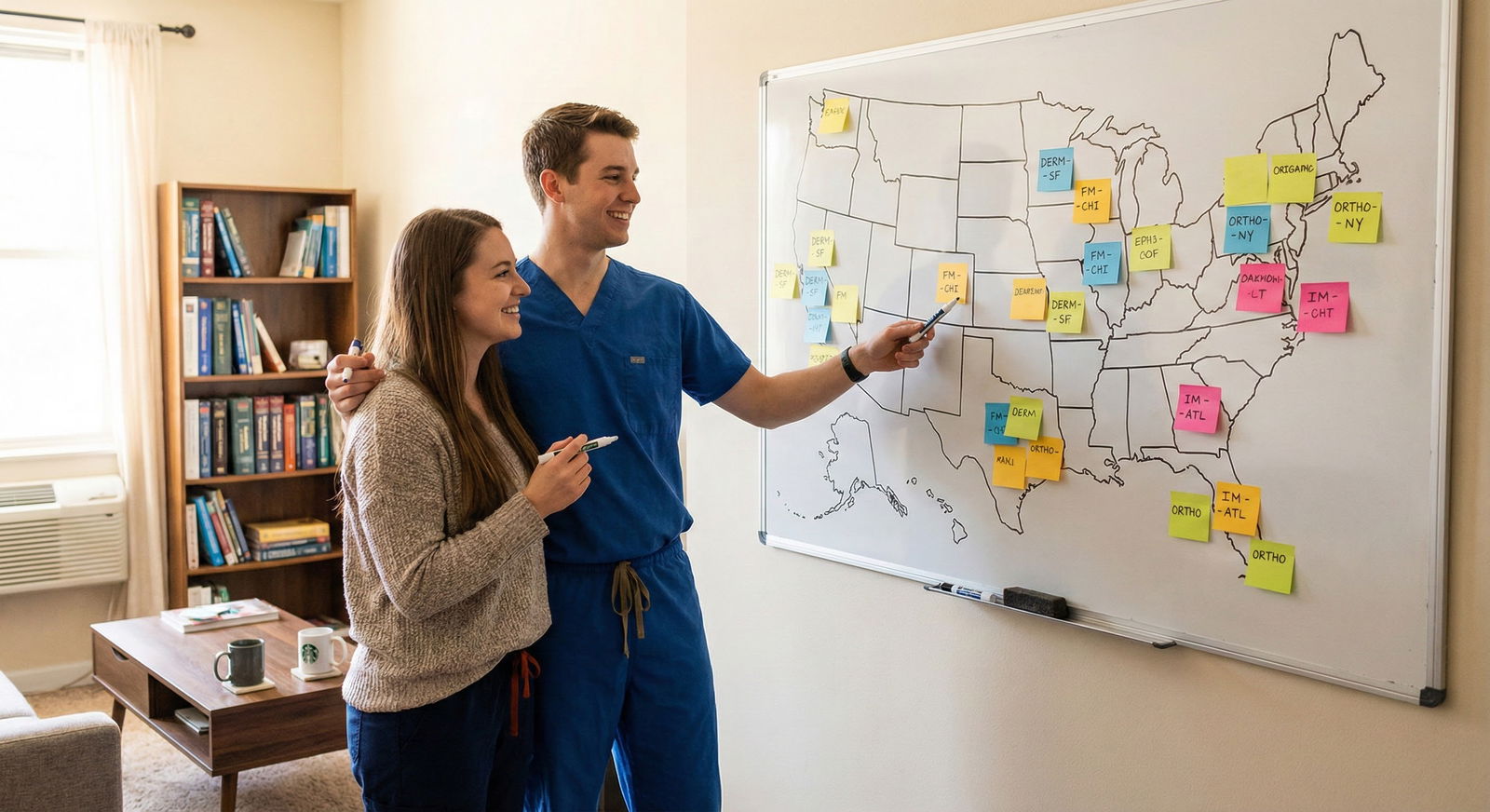
The rule is simple: you cannot do an official NRMP Couples Match if only one of you is applying this year.
If one person is in the Match and the other is not registered as an applicant in that same Match cycle, the system literally has no way to “pair” you. That’s the blunt truth.
But that’s not the end of the story. You do have options. And some of them work surprisingly well if you plan with your eyes open.
Let me walk you through what actually works, what’s fantasy, and how real couples handle this.
1. The Core Question: Can We Still Couples Match?
Here’s the direct answer:
- To enter the NRMP Couples Match, both of you must be active applicants in the same Match cycle (same year, same NRMP Match).
- You both must:
- Register individually with the NRMP
- Pay the couples fee
- Designate each other as partners
- Build a paired rank order list
If one of you is not applying this year (maybe still an MS3, taking a research year, doing an MPH, reapplying later, or already matched from a prior year and just working), you cannot:
- Use the “Couples Match” function in NRMP
- Link rank lists
- Force the algorithm to treat your outcomes as tied
So if the question is:
“Can we officially couples match if only one of us is applying this year?”
The answer is no. Not in the NRMP sense of “Couples Match.”
But that leads naturally to the real question:
“If only one of us is applying this year, how do we still maximize our chances of ending up in the same city?”
That one has a lot more room to maneuver.
2. What Scenario Are You Actually In?
Different situations, different strategies. Figure out which bucket you’re in:
| Scenario | Can You Officially Couples Match? |
|---|---|
| MS4 + MS3 (only MS4 applying) | No |
| One reapplying; other already in residency | No |
| One in fellowship; other applying to residency | No |
| One in prelim/TY year; other applying to advanced | Possibly (if both in same Match) |
| Both applying, but different pathways (e.g., SOAP vs Main Match) | No for SOAP pairs |
The only edge-case where “sort of” couples matching may still be possible is when:
- One partner is doing a prelim/TY this year
- The same partner is applying for advanced positions in the same Match cycle
- The other partner is also applying for something that same cycle
In that case, you actually are both applicants in the same NRMP Match and can use Couples Match. But that’s a niche situation.
For everyone else: one active applicant = no couples function.
3. If Only One of You Is Applying: What Actually Works
When only one partner is in the Match, you’re basically trying to simulate a couples match manually.
Here’s what’s realistic.
A. Anchor Around the Non‑Applicant’s Location (If Fixed)
If the non-applying partner is essentially “fixed” somewhere for at least 1–3 years (already in residency, locked into a specific city for school, visa, family, etc.), then your best play is obvious:
- Treat that city (or its commutable radius) as home base
- Apply as if you’re geographically limited
That means:
- Over-apply regionally. If they’re in Boston, you apply to every reasonable program in Boston, Providence, Worcester, maybe even NH.
- Be honest with mentors: “My partner is locked in [city]; I need to maximize my chances there.”
- Tell programs (strategically) about your partner location in:
- Personal statement (briefly)
- Regionally targeted emails
- Interviews when they ask “Why here?”
What you’re really doing: trying to recreate the effect of a couples match by making yourself extremely geographically focused.
Is it a disadvantage? Yes and no. You lose national flexibility, but programs often like people with strong ties to the area. I’ve seen applicants with middling scores match at solid programs because their “my partner is here, we’re committed to this city” story was believable and consistent.
B. If the Non‑Applicant Is Flexible
If the non-applicant can move (e.g., MS3 who’ll apply next year, partner who can job hunt anywhere, someone on a gap/research year), then the smart move shifts: you maximize the first applicant’s match strength, then the second person targets that city later.
In practice:
Applicant this year:
- Applies broadly to fit + realistic programs, but may slightly weight regions where:
- Partner is likely to apply next year
- There are many programs (so later flexibility is higher)
- Applies broadly to fit + realistic programs, but may slightly weight regions where:
Partner next year:
- Treats that city or region as “primary target”
- Couples matches (officially, next year) with the location reality already known
If your partner is an MS3 right now and you’re an MS4:
You are not couples matching this year. You are pre-positioning for a couples match dynamic next year when they apply.
4. Talking to Programs About a Partner Who Isn’t in the Match
This part is where people either help themselves or shoot themselves in the foot.
Programs generally respond well when:
- You sound stable
- Your story is consistent
- You don’t sound like you’re threatening to leave if your partner cannot come
Decent ways to bring it up:
- On a regional pre-interview email:
- “I have a long-term partner currently in [city/program] and we’re planning to stay long-term in this region.”
- On interview day if they ask “Why here?”:
- “My partner is in [X] here, and we’ve built our support system in this city. So this isn’t just a training location for me; it’s home.”
Things that make programs nervous:
- “I’m only ranking places where my partner might get a job.” (Sounds unstable)
- “If we don’t end up together, I’ll probably try to transfer.” (Immediate red flag)
- Long emotional monologues about your relationship
You want “committed, grounded adult” energy, not “my whole existence hinges on this relationship.”
5. Planning for Next Year’s Match (for the Other Partner)
If you’re the one not applying this year, you cannot use NRMP couples functionality right now. But you can start preparing for when you do apply.
This is the high-yield way to think about it:
- Assume your partner’s match city this year will become your “hub” next year.
- Build your application story pointing toward that hub:
- Do rotations there if you can
- Get letters from attendings tied to that region
- Mention regional/family ties if genuine
- When you apply next year:
- You can couples match with someone in a different application pathway (e.g., one in categorical IM, one in EM), as long as both are active applicants that year
- You rank multiple geographic combinations that keep you reasonably close
Does that feel like you missed your chance this year? Maybe. But the truth is, a ton of couples are slightly “out of sync” and still end up in the same city after one extra cycle of planning.
6. Common Misconceptions (And Why They’re Wrong)
Let me clear up some myths I’ve heard way too often:
“Can we fake a couples match if one of us just registers and doesn’t apply anywhere?”
No. To couples match:
- Both of you must certify a rank list
- The NRMP algorithm must see both lists and pair them
- A non-applying partner with no rank list cannot be linked to anything
So that workaround doesn’t exist.
“Can we somehow couples match between Main Match and SOAP?”
No. SOAP is for unmatched applicants only, runs on a compressed timeline, and does not support couples pairing.
You cannot couples match:
- Main Match applicant + SOAP applicant
- SOAP applicant + person not in SOAP
The couples option is strictly a Main Match feature with both people in the same cycle.
“If we tell programs we’re basically couples matching, they’ll treat us like a pair, right?”
Some might try to help informally. But they have no official mechanism to rank you as a unit. Different specialties, different leadership, different rank committees. They cannot truly “bind” your outcomes together.
At best, you get a bit of advocacy: “Her partner is strong; let’s look favorably on his application” or “They have a compelling reason to be here together.” That helps. But it’s not a guarantee.
7. Practical Strategy: How to Build Your Rank List in This Situation
If only one of you is in the Match this year, here’s how I’d tell you to rank:
First, build your pure list:
- Rank programs in the exact order of where you’d want to train if you were totally single and career-focused.
Then layer in reality:
- Adjust positions for:
- Partner’s location (if fixed)
- Likelihood they can move later
- Strength of program vs relationship logistics
- Adjust positions for:
Watch for traps:
- Don’t rank one local but miserable program over an excellent slightly-farther program just out of fear. Long-distance for a few years is survivable. A toxic training environment is much harder to undo.
You are not couples matching, but you are making a couples-aware rank list. That’s different. More flexible. And you maintain control instead of locking into some rigid “must-be-same-city-at-all-costs” rule.
8. Quick Visual: When Can We Actually Be a Couples Match?
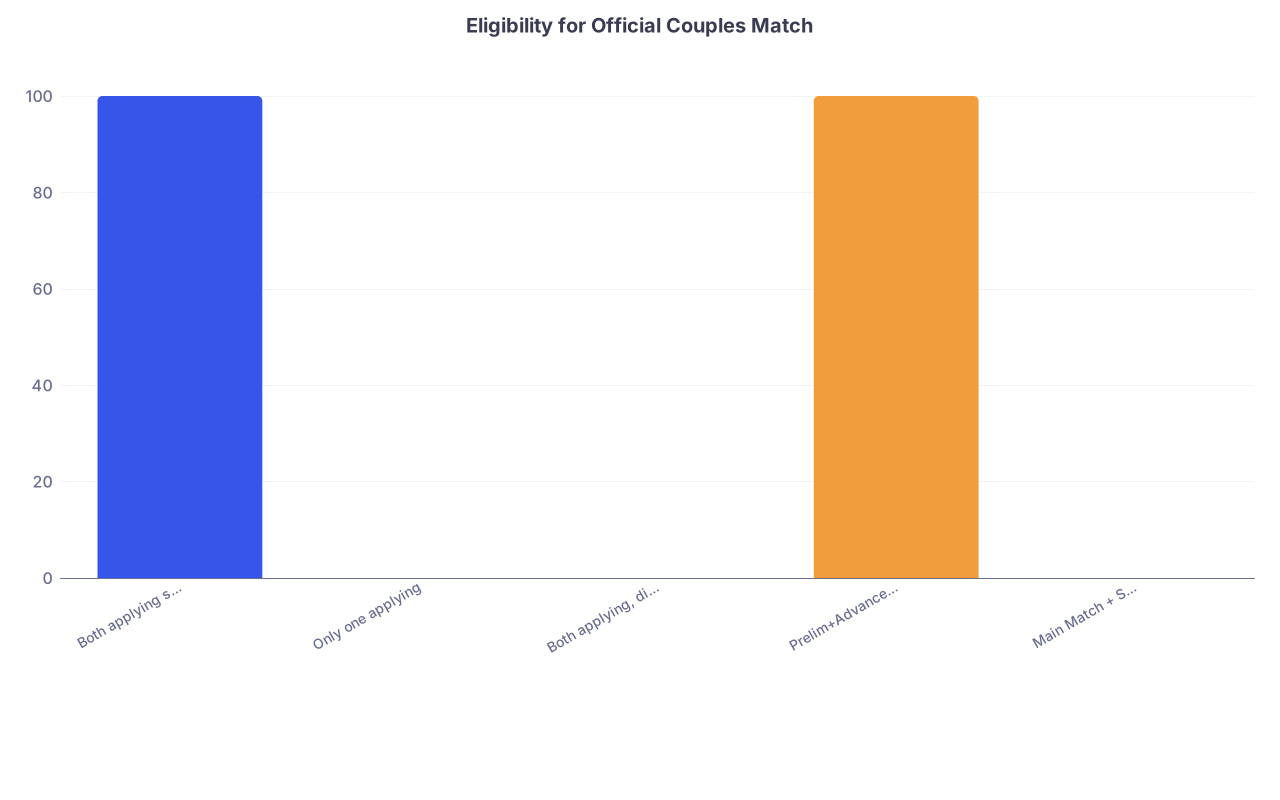
| Category | Value |
|---|---|
| Both applying same year | 100 |
| Only one applying | 0 |
| Both applying, different cycles | 0 |
| Prelim+Advanced in same year | 100 |
| Main Match + SOAP | 0 |
Interpretation is simple:
- 100 = “Yes, you can couples match”
- 0 = “No, you cannot”
Only two situations hit 100:
- Both of you applying in the same NRMP Match year
- A specific prelim/advanced combo where one person is effectively in the Match twice that year and the other is also an applicant (edge case)
Everything else? No couples function.
9. What You Should Actually Do This Week
Here’s a concrete, low-drama way to move forward if you’re in this situation right now:

| Step | Description |
|---|---|
| Step 1 | Identify who is applying this year |
| Step 2 | Define primary region around that city |
| Step 3 | Prioritize best-fit programs nationally |
| Step 4 | Over-apply within region |
| Step 5 | Apply broadly with mild regional preference |
| Step 6 | Discuss story with mentors |
| Step 7 | Decide how/when to mention partner to programs |
| Step 8 | Is other partner fixed in a city? |
Do that honestly, and you’ll be ahead of most couples who are still stuck on “but can’t they just make an exception for us?”
They can’t. But you can still make smart moves.
FAQ (Exactly 7 Questions)
1. Can we register as a couple in NRMP if only one of us is actually applying to programs?
No. Both partners must be active applicants with their own rank lists in that Match cycle to register as a couple. A person who isn’t applying and doesn’t submit a rank list cannot be part of a couples pair in the system.
2. My partner is an MS3 and I’m an MS4 applying this year. Are we missing our only chance to couples match?
You’re not missing your “only” chance; you just can’t couples match this year. You apply solo now. Next year, when your partner is an MS4 and you’re a resident, they can target your city and potentially couples match with another applicant or just strategically apply around your program’s region. Plenty of couples end up together with staggered timelines.
3. My partner already matched last year and is in PGY-1. Can we do anything similar to couples matching now?
Not formally. What you can do is heavily prioritize programs in your partner’s city or nearby, openly state your geographic ties and partner situation in applications and interviews, and ask mentors to advocate regionally. It’s an unofficial geographic strategy, not a true couples match.
4. Should I tell programs in my personal statement that my partner is in a certain city or not applying this year?
You can, but keep it short and tactical. One or two lines about having a committed partner in the region and planning to build your life there is enough. Do not turn your personal statement into a relationship essay. Expand more in interviews or emails if it strengthens your regional story.
5. If we cannot use couples match, is it ever smart to rank a weaker local program over a much stronger one elsewhere for the relationship?
Sometimes, yes—but only after an honest conversation. If the local program is solid (not malignant) and the relationship and support system are huge priorities for you, ranking local higher can be rational. But never sacrifice your safety, mental health, or a dramatically better training environment purely out of fear of distance. Long-distance can be temporary; a bad residency experience sticks.
6. Can we couples match if one of us is reapplying after an unmatched year and the other isn’t applying now?
No for this year. The unmatched partner can enter the Match again; the other, already matched or not applying, cannot be paired unless they are also actively participating with their own rank list in the same cycle. If both re-enter the Match the same year, then couples match becomes an option.
7. What’s the single best move we can make right now if only one of us is in this year’s Match?
Sit down tonight and define your non-negotiables as a couple: is the priority a specific city, a radius around family, or the best possible program regardless of distance? Once you’re clear, the applicant builds a rank list that respects those priorities while still putting career-quality first wherever possible. Then email one trusted mentor, explain the situation in two paragraphs, and ask for concrete regional or program-specific advice.


