

The biggest mistake mixed-career couples make in the Couples Match is pretending it is only about the physician. It is not. It is a two-person career decision under extreme time pressure, and if you do not systematize it, the process will chew you up.
You need a toolkit. Not vibes. Not “we’ll figure it out.” A concrete planning system that lets a physician and a non-MD partner treat this as a joint negotiation with the Match algorithm, not a lottery ticket.
This is that system.
1. Get Ruthlessly Clear on Both Careers (Not Just the MD One)
Most couples start here: “We want to be together in City X.” That is sentimental. The Match is not sentimental. You must translate feelings into constraints.
Step 1: Map the MD constraints
The resident’s side is easier because there are rules and data. Put this on paper:
Specialty and competitiveness
- Are we talking FM vs Derm? IM vs Ortho? Big difference.
- Look at:
- Step scores / COMLEX
- Class rank, AΩA, research
- How many programs realistically? 30 vs 80+?
Geographic tolerance
- Rank each broad region 1–5:
- NE, Mid-Atlantic, South, Midwest, Mountain West, West Coast
- Note red lines:
- “I will not go to rural programs.”
- “I must be within 1 hr of a major airport.”
- “I must be near family due to childcare.”
- Rank each broad region 1–5:
Program type preferences
- Community vs university vs county.
- Mission-driven (safety-net) vs prestige-driven (name-brand).
- Shift-heavy vs clinic-heavy.
- These matter because they control how many cities even have plausible options.
Write all of this down in one page. No more “it depends” conversations.
Step 2: Map the non-MD partner’s real career constraints
This is where people usually mess up. The non-MD partner says, “I can work anywhere.” Then March hits, they land in a city with a thin job market, and resentment starts.
Be objective. Use this checklist:
Industry realities
- Tech / software / data → clustered in big metros or fully remote.
- Education / K–12 → possible almost anywhere, but public vs private matters.
- Academia → narrow geographic options.
- Finance / consulting / media → major urban centers.
- Trades / healthcare-adjacent / union roles → often better in mid-size metros.
Remote vs hybrid vs on-site
- What percentage of roles in your field are:
- Fully remote?
- Hybrid and anchored to certain cities?
- Strictly on-site?
- Pull 15–20 recent job postings on LinkedIn/Indeed. Do not guess. Count.
- What percentage of roles in your field are:
Career stage
- Early career: more flexible, can pivot roles or industries.
- Mid-career: specialized, higher salary, less flexible.
- Re-training or grad school: location may be constrained by programs.
Income and financial buffer
- How much income do you need from the non-MD partner to:
- Cover loans?
- Offset resident salary?
- Maintain sanity (childcare, visits to family, etc.)?
- How much income do you need from the non-MD partner to:
Do this together. Out loud. If you feel tension, that means you are finally being honest.
2. Build a Joint Geography Strategy (Not Wishful Thinking)
Now you take both sets of constraints and convert them into an actual map. This is non-negotiable.
Step 1: Define your “zones”
You will not treat every city the same. That is naive. Create three zones:
Zone A – Target cities
Strong MD options + strong non-MD options + strong personal fit.
Cities where both careers are actually viable.Zone B – Acceptable cities
Solid MD options, non-MD partner can make something work (maybe lateral move, lower pay, or temporary shift). Not ideal, but livable.Zone C – Emergency-only
Primarily for the MD to avoid not matching. Non-MD career likely takes a hit. Use sparingly and intentionally.
Make a rough table. For example:
| City/Region | Zone | MD Program Density | Non-MD Job Market | Notes |
|---|---|---|---|---|
| Boston | A | High | High | Great for both careers |
| Minneapolis | A | High | Medium-High | Good tech + strong hospitals |
| Raleigh-Durham | B | Medium | High | Growing market, some tradeoffs |
| St. Louis | B | High | Medium | Acceptable but not preferred |
| Smaller Midwest | C | Medium | Low | Safety for MD only |
Do this for your actual reality, not what looks good on an Instagram map.
Step 2: Check your fantasy against job data
You might “love” Portland. Or Austin. Or Denver. That does not mean your careers will.
Use this quick protocol:
- Pick 10–15 cities you are considering.
- For each:
- Residency programs: Search FREIDA/ERAS for your specialty in that city/state. Count programs.
- Non-MD jobs:
- Search LinkedIn / Indeed for your field with that city filter.
- Count how many new jobs posted in the last 30 days that are realistic fits.
- Score each city 1–5 for:
- MD program availability
- Non-MD job volume
- Personal preference (family, climate, culture)
Then assign zones A/B/C with actual numbers behind them, not vibes.
3. Use the NRMP Couples Algorithm Like a Strategy Game
The Couples Match algorithm is rigid, but it is predictable. If you treat it like a black box, you lose power. You are allowed up to 300 paired ranks. That is leverage.
Quick reality check on how the algorithm treats you
- You submit a joint rank list of pairs of programs.
- Each pair is: (MD program, “program” for non-MD partner).
- The algorithm is trying to match you to your highest-ranked pair where:
- The MD gets a spot in that program.
- The non-MD partner gets… something corresponding in the NRMP.
But the non-MD partner is not actually in a program. So you use stand-ins (more on that below).
Step 1: Decide your structural strategy
You have three core structural decisions:
How much “safety” are you building in for the MD?
- Are you willing to drop to Zone C cities to avoid MD non-match at all costs?
- Or are you willing to risk the SOAP or a gap year to avoid terrible locations?
How tightly bound is the couples match?
- Hard bind: You two must end up in the same metro.
- Soft bind: You accept nearby cities with commutable distance (e.g., Philly–NYC, Providence–Boston).
- Flexible bind: MD may match somewhere while non-MD adjusts later (remote work, delayed move).
What is your “deal-breaker floor”?
- City types or program types you absolutely will not accept even if technically possible.
This is where most couples should have one short, decisive conversation about what happens if the MD risks not matching versus both ending up somewhere unlivable.
4. Turn the Non-MD Partner into a Structured Variable, Not an Afterthought
Here is the core challenge: the algorithm only “understands” residency and fellowship programs. Your partner’s job is invisible to it.
So you simulate your partner’s options inside the system.
Option A: Use a “dummy” specialty for the non-MD partner
If the non-MD partner is not actually matching, some couples:
- Register the partner with NRMP.
- Choose a super-low-stakes specialty with abundant prelim or transitional year programs they have zero intention of joining.
- Use these “dummy programs” as placeholders to encode geography in the couples rank list.
Then your pairs look like:
- (MD: Mass General IM) + (Non-MD: Dummy program in Boston)
- (MD: Brigham IM) + (Non-MD: Dummy program in Boston)
- (MD: Beth Israel IM) + (Non-MD: Dummy program in Boston)
- (MD: Yale IM) + (Non-MD: Dummy program in New Haven)
- etc.
You are not actually planning for the non-MD to attend residency. The partner just withdraws before ranking for real, or does not sign any contract. These “dummy” ranks are simply how you force the algorithm to keep you geographically paired.
This is somewhat hacky. Yes. But it is how couples have forced geographic coupling between one real and one symbolic partner.
Warning:
Talk to your dean’s office or GME advisor before you do this. Do not sleepwalk into a contractual mess. But understand that this is how you can “teach” the algorithm where your partner is.
Option B: Use proximity logic instead of strict co-location
Some couples accept being within a defined radius rather than identical city.
You can mimic this by:
- Treating “Boston metro” as: Boston, Providence, Worcester.
- Treating “NYC metro” as: Manhattan, Brooklyn, Queens, northern NJ, maybe New Haven.
Then you create pairs where:
- MD program in City A + Dummy program in City B
if A and B are within your defined distance limit.
You are encoding “acceptable commute distance” directly into your ranked pairs.
Option C: Skip dummy accounts and plan for serial relocation
If you decide not to play the dummy account game at all:
- You do a normal individual Match for the MD.
- You act like a “pseudo-couples” pair by:
- Controlling MD application geography heavily.
- Pre-planning remote or flexible options for the non-MD partner.
- Having a tight post-Match job search protocol for the non-MD partner.
This is simpler administratively, but gives you less structural control over geography.
5. Build Your Paired Rank List With a System, Not Emotion
The biggest trap is building the list in one sitting and calling it done. Do not do that. You want a process.
Step 1: Create a master spreadsheet
Include columns like:
- MD Program Name
- City / Metro Area
- Program Tier (1–3)
- Workload / Schedule (1–3)
- Fit (1–3)
- Non-MD Job Market Score (1–5)
- Zone (A/B/C)
- Commute radius label (if using flexibility)
- Notes (family, schools, cost of living, etc.)
This sheet is the backbone of rational ranking.
Step 2: Decide your ranking principle
Pick one primary ranking rule and stick to it. For example:
- Rule: “Within Zone A cities, we rank by MD program quality. Within Zone B, we rank by joint score (MD tier + job market). Zone C only appears at the bottom as “last-ditch safety.”
Or:
- Rule: “We always prefer Zone A programs over higher-tier MD-only options in Zone B or C.”
You can have debate before this point. After you decide the rule, the list is mostly mechanical.
Step 3: Construct the actual coupled pairs
This is tedious. Do it in order:
- Filter your spreadsheet to Zone A cities only.
- For each city:
- List all MD programs where the applicant interviewed.
- For each, assign the corresponding “partner location” (dummy or metro label or just city name).
- Order all Zone A cities properly.
- Then do the same for Zone B.
- Finally, if you are going to use them at all, add Zone C.
This is where couples fight. Expect it. That is normal. Just keep coming back to the rule you defined earlier.
6. Parallel-Track the Non-MD Job Search (Before Match Day, Not After)
If the non-MD partner waits until Mid-March to start looking, you have already lost six weeks. Do not do that.
Step 1: Build a “geo-flexible” resume and LinkedIn profile
The non-MD partner should:
- Remove or soften location anchors.
E.g. change “Boston, MA” to “Open to relocation: Northeast / Midwest” or similar. - Highlight remote-adjacent skills:
- Independent work
- Digital collaboration
- Client communication
- Prepare multiple versions of their resume tailored to:
- Tech / remote-friendly roles
- Local on-site roles
- Transitional or “bridge” jobs (contract, temp, part-time)
Step 2: Start market-testing cities before you rank
Pick your top 5–7 likely cities. For each:
- Set up job alerts now.
- Apply to a small number (3–5) of roles just to:
- See response rates.
- Gauge how your background is received in that market.
- Track:
- Recruiter replies.
- Interview requests.
- Signal content: “We do not sponsor visas here,” “We need you onsite 5 days,” etc.
This tells you if your Zone A/B assignments are sane. If your partner gets zero bites in a supposedly “great” city, that city might not be Zone A for you.
Step 3: Design a post-Match 90-day execution plan
You do not want to invent a job-search system in crisis mode. Draft it now:
Week 1–2 post-Match:
- Update location on LinkedIn to the matched city.
- Change all job board filters to that region.
- Blast out “relocation” announcement to your network.
Week 3–6:
- 10–20 targeted applications per week.
- 3–5 informational interviews with people in that city/industry.
- Join local online groups (Slack, Meetup, industry associations).
Week 7–12:
- Aggressive follow-up.
- Start considering temporary or contract roles if needed.
- Reassess: stay strict in field vs temporary pivot for income.
Write this plan down now. Put calendar reminders. When Match hits, you will not be thinking clearly. You will be emotional. You want the system ready.
7. Manage Stress and Power Dynamics So They Do Not Wreck You
I have watched couples implode over this process. Not because they could not match together, but because they let the system pit their careers against each other.
Here is how you do not become that story.
Step 1: Name the power imbalance explicitly
Residency feels “non-negotiable” and urgent. The other career feels “flexible.” That easily turns into:
- Physician: “My career is on rails. This is the one shot.”
- Non-MD: “So I just burn my career for yours?”
Say that out loud. Then reject it as your operating assumption.
You are not sacrificing one person for the other. You are solving a hard joint optimization problem with constraints. That mindset change matters.
Step 2: Use structured check-ins, not endless rehashing
Create a brief, recurring agenda. Example:
- Weekly 30–45 min couples match meeting
- 5 min: MD update (interviews, impressions)
- 5 min: Non-MD update (job market research)
- 10 min: Revisit or confirm top 10 cities
- 10–20 min: Tackle one specific decision (e.g., “Do we include City X as Zone B or drop it?”)
Outside those meetings, you agree not to re-argue decisions unless new data appears. Saves you from death by a thousand tiny arguments.
Step 3: Pre-agree on “if everything goes wrong” scenarios
You need a written plan for:
- If the MD does not match anywhere.
- If you match in a city where the non-MD partner truly cannot find work within 6–9 months.
- If the non-MD partner gets a dream offer in City A and the MD is in City B.
Actually write your contingencies down:
- SOAP vs reapply vs research year.
- Temporary long-distance.
- Moving again after PGY-1.
- Non-MD partner going back to school or shifting fields.
Painful? Yes. But better than improvising your relationship terms in crisis.
8. Example: How a Real Mixed-Career Couple Could Structure This
Let me walk you through a realistic scenario.
- MD partner: Applying IM. Step 1 pass, Step 2 = 239. Strong letters, medium research.
- Non-MD partner: 4 years experience in digital marketing. Some remote options, but most jobs are hybrid in mid/large cities.
- Both value: Being near an airport, diverse city, reasonable cost of living.
Their zones might look like:
- Zone A: Boston, Chicago, Minneapolis, Seattle, Raleigh-Durham.
- Zone B: St. Louis, Milwaukee, Pittsburgh, Richmond.
- Zone C: Smaller Midwest cities with IM programs but weak marketing job markets.
They:
- Pull job data for “Digital Marketing Manager” in each city.
- Count programs for IM in each metro.
- Discover that:
- Seattle has few IM programs but excellent marketing jobs.
- St. Louis has many IM programs, okay marketing jobs.
- Smaller Midwest city has multiple IM programs and almost no relevant jobs.
They decide:
- Zone A = cities where there are ≥3 IM programs + ≥30 marketing jobs posted in 30 days.
- Zone B = cities with 1–2 IM programs + ≥15 marketing jobs.
- Zone C = all others where only MD thrives.
Then:
- MD applies to 50 IM programs, heavily loaded toward Zone A.
- Non-MD starts networking now in those cities.
- They rank:
- Top IM programs in Zone A.
- Mid-tier IM in Zone A.
- Top IM in Zone B.
- Finally, a handful of Zone C as absolute safety, after deciding together they would accept those only to avoid MD non-match.
No illusions. No “wherever you go, I go” without checking if “wherever” has jobs.
9. Use Data Visuals to Stay Rational
Visuals keep you from lying to yourselves. Do not just talk. Track.
Application spread vs job strength
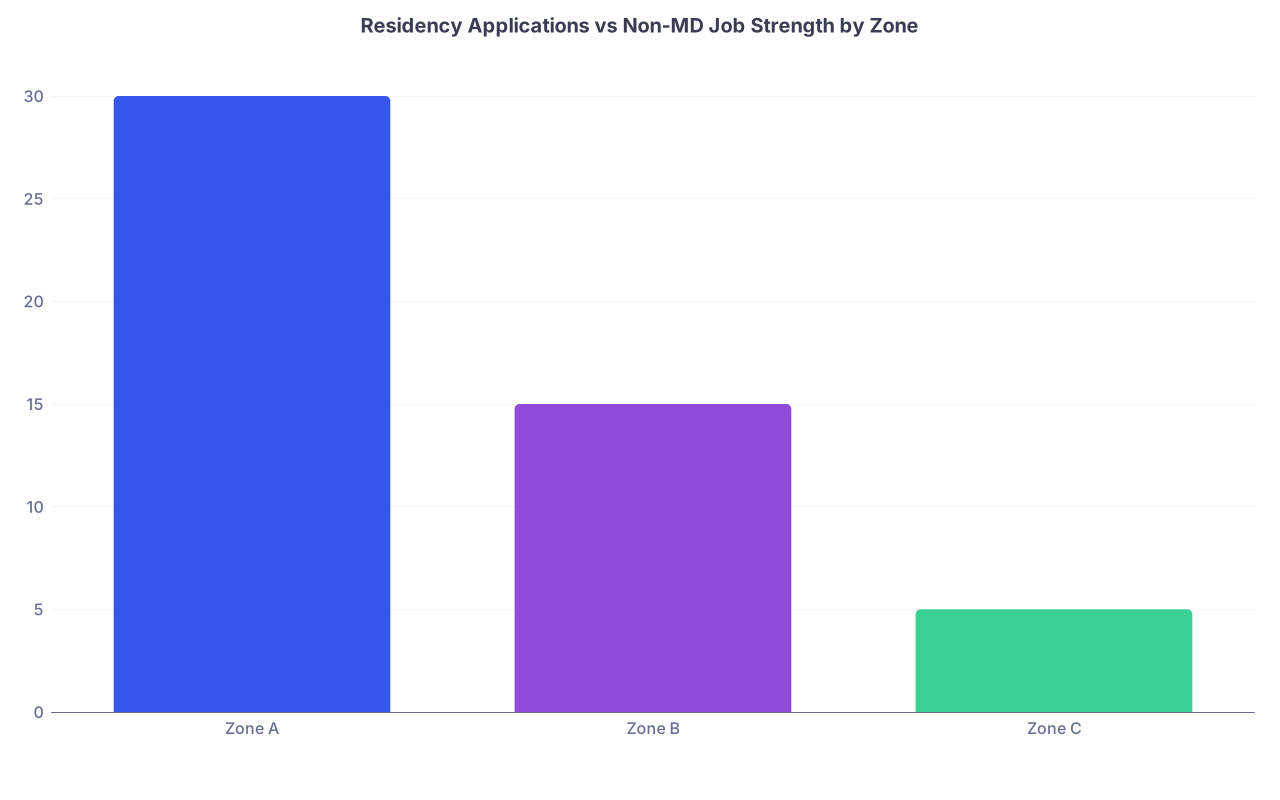
| Category | Value |
|---|---|
| Zone A | 30 |
| Zone B | 15 |
| Zone C | 5 |
You want most of your applications where both of you can actually live and work.
Timeline: when to do what
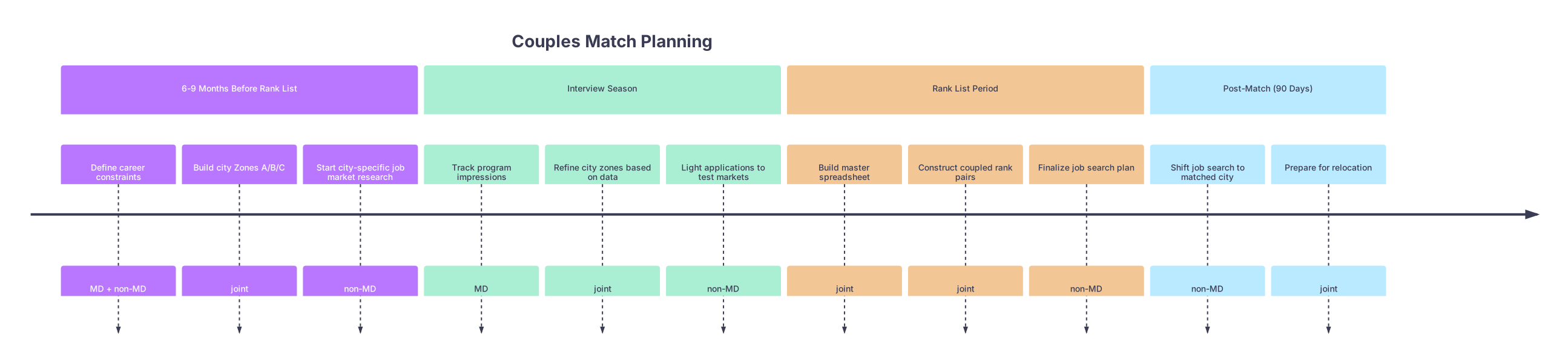
| Period | Event |
|---|---|
| 6-9 Months Before Rank List - Define career constraints | MD + non-MD |
| 6-9 Months Before Rank List - Build city Zones A/B/C | joint |
| 6-9 Months Before Rank List - Start city-specific job market research | non-MD |
| Interview Season - Track program impressions | MD |
| Interview Season - Refine city zones based on data | joint |
| Interview Season - Light applications to test markets | non-MD |
| Rank List Period - Build master spreadsheet | joint |
| Rank List Period - Construct coupled rank pairs | joint |
| Rank List Period - Finalize job search plan | non-MD |
| Post-Match (90 Days) - Shift job search to matched city | non-MD |
| Post-Match (90 Days) - Prepare for relocation | joint |
Location vs career alignment
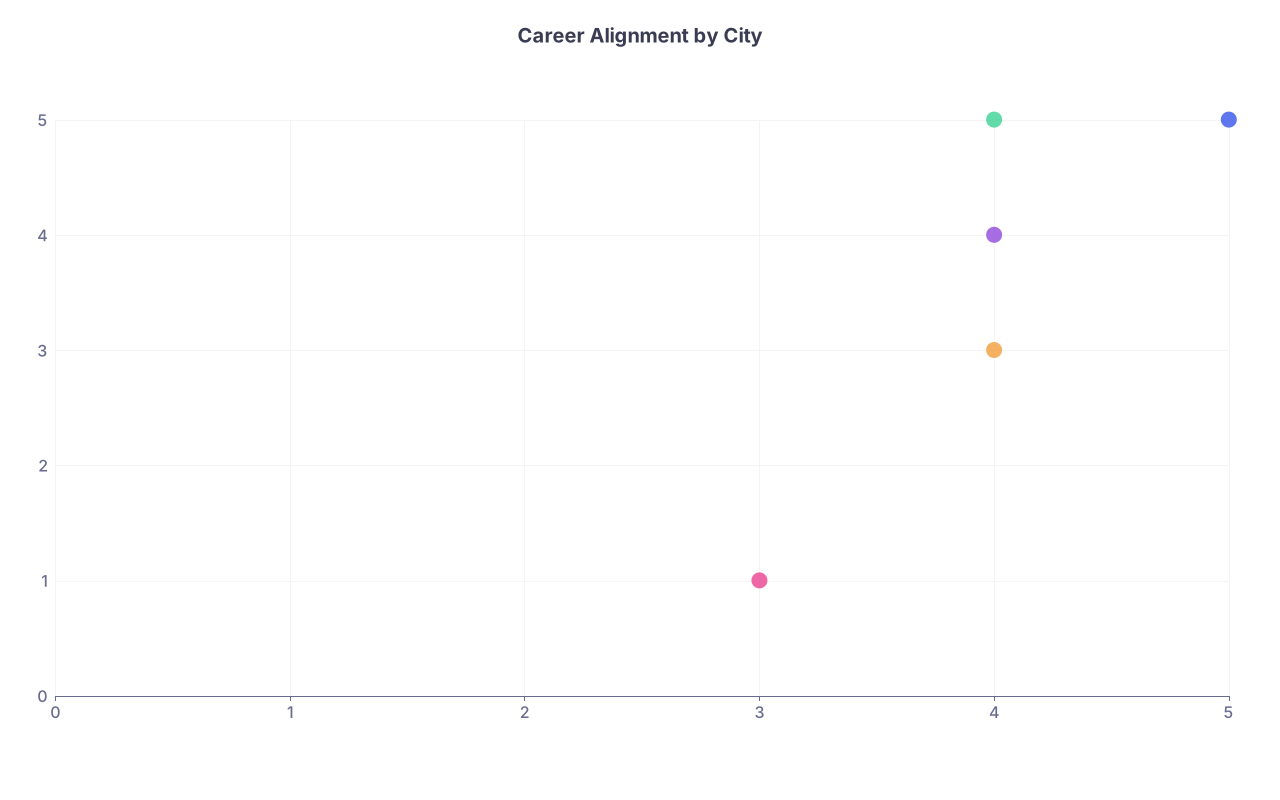
| Category | Value |
|---|---|
| Boston | 5,5 |
| Chicago | 4,4 |
| Raleigh | 4,5 |
| St. Louis | 4,3 |
| Small Midwest City | 3,1 |
X-axis (implicit): MD program strength (1–5)
Y-axis: Non-MD job market strength (1–5).
You want most of your realistic ranks clustered top-right.
10. Common Failure Patterns (And How to Fix Them Fast)
Let me be blunt about what goes wrong most often—and exactly how to counter it.
Failure Pattern 1: “We’ll figure out the non-MD job after we match.”
Fix:
- Non-MD partner must start:
- Industry research.
- Resume upgrades.
- City-specific testing.
- Before you finalize your rank list, you should know which 3–5 cities are most likely to yield a job quickly.
Failure Pattern 2: Letting guilt or martyrdom run the ranking
Signs:
- Non-MD silently agrees to every decision.
- MD partner says, “I feel bad you are compromising, so let’s just rank the most competitive academic programs in impossible cities and hope.”
Fix:
- Write down both of your non-negotiables and minimum acceptable conditions.
- Use clear zones and numeric criteria to constrain the list.
- Get a neutral third party (mentor, advisor) to sanity-check your proposed rankings.
Failure Pattern 3: Overweighting prestige, underweighting life
Residents overestimate the career impact of “name” and underestimate the impact of burnout, resentment, and isolation on both people.
Fix:
- Force each program/city to answer three questions:
- Will I get solid training here? (not “Is this famous?”)
- Can my partner build or maintain a real career here?
- Could we stand to live here for 3–7 years?
Anything that fails #2 and #3 should be very low on the list, no matter how shiny the logo.
Your Next Step Today
Do one concrete thing right now:
Open a blank document and create three headings: “My Career Constraints,” “My Partner’s Career Constraints,” and “Zones A/B/C.”
Spend 30 minutes filling those in together. No scrolling. No side conversations. Just the two of you facing the real constraints on both careers.
Once you have that, everything else—applications, interviews, rank lists, job searches—stops feeling like chaos and starts looking like a strategy you can actually execute.


