

Most couples walking into Match season have a fantasy plan and no real backup. That is how you end up in a panic on SOAP Monday, refreshing ERAS and fighting with your partner over geography at 2:00 p.m.
If you are couples matching and there is any realistic chance you might land in SOAP, you need a tiered backup plan. Planned. Written. Agreed upon before rank lists lock.
This is that plan.
1. Accept the Hard Truth Early: Couples Are Higher Risk
If you match as a couple with no issues, great. You never needed this article. But if you are reading this, I am going to assume:
- One or both of you are in a competitive specialty or
- One or both of you have red flags (low scores, attempts, LOA, limited interviews, visa needs) or
- You have a tight geographic restriction (family, childcare, visa, finances)
Any of those make SOAP more likely. As a couple? The risk is multiplied.
Why couples are more vulnerable to SOAP
I have watched this play out too many times:
- One partner has 14 interviews in Internal Medicine, the other has 5 in EM.
- They couples match their rank list tightly.
- EM partner strikes out; IM partner has several unpaired ranks that could have matched solo.
- Result: both end up unmatched and in SOAP, even though one of them “should” have matched easily.
The logic is simple and brutal:
- Couples matching forces pairing of positions.
- Fewer pairs exist than single positions.
- Every preference constraint (same city, same hospital, same region) reduces match probability.
If you do not respect that math now, you will pay for it later.
Your job: design a set of backup layers that protect:
- Matching at all (for one or both of you)
- Limiting separation if one matches and the other does not
- A rational, pre-agreed SOAP strategy
2. Build a Tiered Plan: Three Levels, Not One
Do not think “backup” as one blob. Think in three distinct tiers that you design in advance.
| Tier | Timeframe | Goal |
|---|---|---|
| Tier 1 | Before ROL lock | Prevent both from going unmatched |
| Tier 2 | Match Week (if only one matches) | Minimize separation and career damage |
| Tier 3 | SOAP (if both unmatched or one unmatched) | Secure *any* acceptable PGY-1 spot |
You need written answers for all three.
3. Tier 1: Pre–Rank List Damage Control
Tier 1 is about preventing disaster before it happens. This is the part couples skip because it is uncomfortable. Do not skip it.
Step 1: Do a cold, data-driven risk assessment
No sugarcoating. Pull out a spreadsheet and list:
- Specialty for each of you
- Step 2 / COMLEX 2 scores - Number of interviews per specialty
- AOA / class rank / any serious red flags
- Visa needs
- Number of programs in overlapping cities you both interviewed at
Then compare that to realistic match expectations.
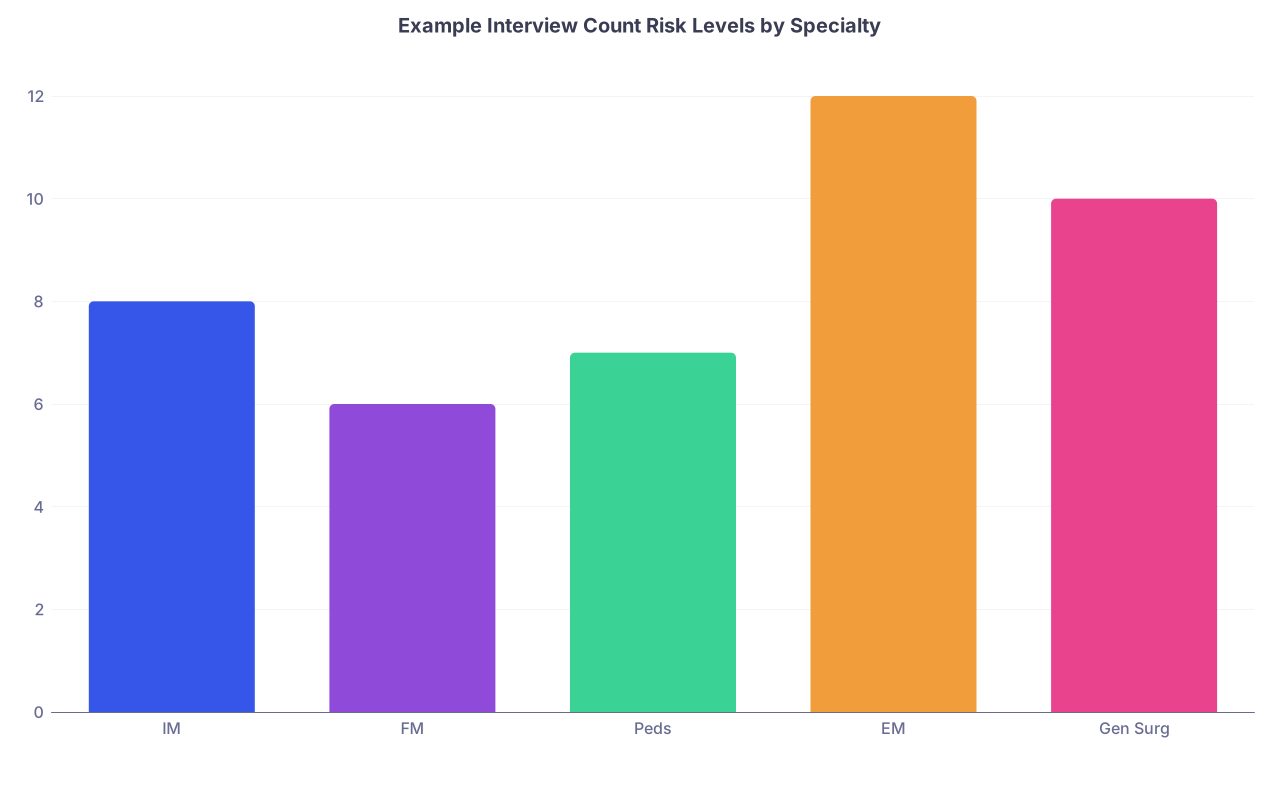
| Category | Value |
|---|---|
| IM | 8 |
| FM | 6 |
| Peds | 7 |
| EM | 12 |
| Gen Surg | 10 |
Interpretation example (this is not gospel, but it is grounded in experience):
- Internal Medicine categorical:
- 12+ interviews: low risk
- 8–11: moderate
- <8: high
- Family Med / Psych / Peds:
- 10+ low, 7–9 moderate, <7 high
- EM, General Surgery, OB/GYN:
- 12+ low, 8–11 moderate, <8 high
- Super-competitive (Derm, Ortho, ENT, etc.): if not in the top of the pack with strong research and letters, assume high risk regardless of interview count.
If both of you are high risk, you must be aggressive with backup planning. If one is high, one is low/moderate, your strategy will focus on preserving the stronger partner’s match while building off-ramps for the higher-risk partner.
Step 2: Decide your “we will not go unmatched together” rule
You need a clear rule before rank lists lock. Example:
“We will not submit a couples rank list that gives either of us less than an 80–90% chance of matching somewhere.”
Translation: You will not couples-rank your way into oblivion for the dream of living across the street from Trader Joe’s.
Practical options:
Option A: Couples match with a long tail
- Top 5–10 ranks: tightly coupled in your dream cities.
- Middle ranks: same city, different hospitals; broaden geography.
- Lower ranks: one of you at a strong program, the other at any acceptable program even if in a nearby city or slightly worse reputation.
Option B: Dual list – couples list + individual list
Some couples quietly accept: “If stacking our list too tightly makes us both unmatched, it is better one of us matches than zero.”
You use the couples functionality, but also:- The stronger partner creates an individual rank list that the other partner accepts as a last-ditch outcome.
- This is emotionally hard, but career-saving.
Step 3: Identify a pre-SOAP backup specialty for the weaker partner
If one partner is in a competitive field with a shaky application (say EM with 6 interviews, or Gen Surg with 5), they need a Plan B specialty aligned before rank day. Examples:
- EM → IM, FM, or Transitional Year
- Gen Surg → Preliminary Surgery or IM categorical
- Ortho/Neuro/ENT → Prelim Surgery or Transitional Year
- Derm/Optho → Transitional Year or Prelim Medicine
You are not applying there yet. You are:
- Identifying which specialties you would realistically enter via SOAP.
- Making a list of programs that:
- Historically have unfilled spots in that backup specialty.
- Exist in regions you would tolerate living (loosely).
- Reviewing what those programs actually are like (manual review now saves chaos later).
Step 4: Have the hard geographic conversation
You need a pre-agreed hierarchy:
- Same hospital, same program
- Same city, different hospitals
- Same region (e.g., 1–3 hours drive)
- Anywhere in the country, as long as both match
- One matches, the other SOAPs anywhere
- One matches, the other takes a research year / prelim / non-clinical job and reapplies
Write this down. Literally. Because Match Week you will both be sleep-deprived and emotional.
4. Tier 2: If Only One of You Matches on Monday
Scenario: Match Monday email arrives.
- One of you: “You have matched.”
- Other: “You did not match.”
This is a rough moment. You need a script ahead of time so you do not damage either career or your relationship.
Step 1: Follow the pre-agreed priority list
Here is a structure that works for most couples:
The person who matched keeps their position.
Do not throw away a confirmed PGY-1 spot in some fantasy that SOAP will hand both of you the perfect paired programs. That is not how this works.The unmatched partner executes the SOAP plan focused on:
- Same institution if possible.
- Same city/region next.
- Best possible program even if far away if local options do not exist.
If SOAP fails:
- Predefined fallback: research year, prelim, non-clinical work, or reapplicant plan.
You discuss this now. Not on Monday at 11:05 a.m. when the ERAS portal opens.
Step 2: Understand what the matched partner can and cannot do
Non-negotiables:
- The matched partner cannot enter SOAP. Full stop.
- They cannot “hold” a matched position while trying to coax something “better” for the couple.
- They can:
- Help screen programs for the unmatched partner.
- Call PDs where they matched and ask about unfilled spots in other departments.
- Provide emotional and logistical support.
Step 3: Pre-plan emotional boundaries
You are not robots. This will hurt. Decide ahead:
- No guilt-tripping (“I should give up my spot,” “You are holding me back,” etc.).
- No major life decisions (breakups, engagements, marriages, pregnancies) made during Match Week.
Sounds obvious, but I have seen people do exactly this. It always ends badly.
5. Tier 3: Concrete SOAP Playbook for Couples
SOAP is chaos if you walk in cold. It is just work if you have a plan.
Here is the structure I recommend and have used with multiple couples:

| Step | Description |
|---|---|
| Step 1 | Match Week: Unmatched Partner |
| Step 2 | Activate Joint SOAP Plan |
| Step 3 | Activate Solo SOAP Plan |
| Step 4 | Prioritize same city/region programs |
| Step 5 | Prioritize programs near matched partner |
| Step 6 | Apply broadly within backup specialties |
| Step 7 | Interview offers and ranking |
| Step 8 | Accept best available option |
| Step 9 | Both Unmatched? |
Step 1: Before Match Week – build your SOAP targets list
You do not know exactly which programs will be in SOAP, but you can pre-identify categories:
- Backup specialties you are willing to enter.
- Regions you are okay with as a couple:
- “We will live anywhere” vs
- “We truly cannot live in rural areas / certain states / >3 hours from family.”
- Institutions with multiple residencies where pairing is more likely (large academic centers, big community systems).
Create a shared spreadsheet with:
- Column A: Program name
- Column B: Specialty
- Column C: City/State
- Column D: “Good for both / only for partner A / only for partner B”
- Column E: Notes (visa friendly, prior communication, etc.)
You are not guessing blindly on SOAP Monday; you are cross-referencing your spreadsheet.
Step 2: Know how SOAP differs for couples vs singles
SOAP is individual, not couples-based. NRMP couples functionality does not apply. You each (if unmatched) get your own:
- SOAP-eligible list of programs
- Application cap (up to the NRMP limit per round)
- Interview offers and decisions
However, as a couple you are coordinating:
- Which programs you both apply to in overlapping geographies.
- Who applies where if a program has limited spots.
- Whether you prioritize geography or program quality.
If both of you are unmatched, the playbook is:
- Rank overlap locations highest in your own minds but still apply widely individually.
- If only one partner gets interviews in a desirable city and the other does not:
- That partner still pursues those interviews. You do not sabotage one career because geography is imperfect.
- If one gets a solid categorical spot far away and the other is only getting weak or no options nearby:
- You accept the solid spot. The other partner plans gap year / future reapplication in that region if possible.
Step 3: Special case – preliminary and transitional spots
Prelim and TY positions are SOAP-heavy. For couples, these can be used strategically:
- For the weaker partner:
- A prelim surgery or medicine role in the same hospital / city as the stronger partner’s categorical spot is a huge win.
- They build local connections to reapply into a categorical position next year.
- For both unmatched partners:
- Two prelims or a TY + prelim in the same region is far better than:
- One categorical in Alaska and one prelim in New York.
- Two prelims or a TY + prelim in the same region is far better than:
But be honest about the tradeoff:
- Prelim surgeries can be brutal, with no guarantee of a categorical slot later.
- TYs can be comfortable but may not impress more competitive specialties.
You decide now how much pain and risk you are each willing to take for the chance to be together versus the chance of a stronger long-term specialty fit.
6. Specific Scenarios and How to Handle Them
Let me walk through a few common real-world configurations and the exact tiered plan I advise.
Scenario A: IM (strong) + EM (borderline)
- Partner A: Internal Medicine, 12 interviews, solid Step 2, no red flags.
- Partner B: EM, 6 interviews, Step 2 barely above cutoffs.
Tier 1 Plan:
Couples rank list:
- Top: paired IM–EM in cities where they both interviewed.
- Middle: A: IM at multiple programs in a city; B: EM where possible, but also willingness for B to be unmatched.
- Tail: A’s IM programs alone (agree that one match is better than none).
Pre-SOAP:
- Partner B identifies IM/FM as backup SOAP specialty.
- Spreadsheet of IM/FM programs in cities where Partner A interviewed.
Tier 2 Plan (if only B unmatched):
- A keeps IM spot.
- B uses SOAP to:
- First target IM/FM in A’s city/region.
- Then widen region mildly if nothing available.
- If still nothing categorical, consider prelim IM in A’s city.
Tier 3 Plan (if both unmatched):
- Both aggressively target IM/FM (and EM if spots exist) in overlapping regions.
- If one gets a strong categorical spot and the other only prelim / weaker option near that spot, they still accept.
Scenario B: Two competitive specialties, both borderline
- Partner A: Gen Surg, 8 interviews.
- Partner B: OB/GYN, 7 interviews.
- Both at or slightly below average stats.
Tier 1 Plan:
- Brutally honest conversation: very real risk both miss.
- Couples list:
- Still rank dream pairs first, but create a large tail where:
- A ranks categorical/ prelim Surgery widely.
- B ranks OB/GYN and if needed, prelim/TY in same regions.
- Still rank dream pairs first, but create a large tail where:
- Each agrees to individual lists as last resort if couples matching obliterates odds.
Tier 2 / Tier 3:
- Both pre-identify backup specialties:
- A: Prelim Surgery, Prelim IM
- B: Prelim/TY, then maybe IM/Peds
- SOAP targets focus on big hospitals with both Surgery and OB/Peds departments.
- Accept that:
- One may land categorical in something not first-choice (IM, Peds).
- The other may do prelim with reapplication.
Scenario C: One strong, one very weak / reapplicant
- Partner A: Psych, 15 interviews, strong application.
- Partner B: Categorical Surgery reapplicant, 3 interviews.
Tier 1:
- A maintains a broad, robust Psych rank list.
- B ranks their 3 Surgery interviews but also:
- Has a clear pre-agreed pivot: “If Surgery fails again, I will SOAP into Prelim Surgery or IM and pivot my long-term plan.”
- Couples list is loose. They prioritize that A should not sacrifice a stable Psych spot.
Tier 2 / 3:
- If A matches, B targets prelim / IM in same region via SOAP.
- If B fails SOAP entirely:
- Pre-planned: research year near A’s program or remote research + living together wherever A matched.
7. Logistics: What You Should Prepare Before Match Week
Here is where most couples get sloppy. They “talk about things” but do not actually prepare tools. Fix that.
1. Shared spreadsheet (non-negotiable)
Minimum tabs:
- Tab 1 – Programs applied to (by each of you)
- Helps understand where overlapping institutional ties already exist.
- Tab 2 – Potential SOAP-friendly programs
- List by region, institutions with multiple residencies.
- Tab 3 – Backup specialties and preferences
2. Document your non-negotiables and preferences
Each of you answers in writing:
- My top three specialty priorities (including acceptable backups).
- My geographic red lines (places I truly will not go).
- How much separation I am willing to tolerate for 1 year if needed.
Then you compare. If those lists are incompatible, better to know now than on SOAP day.
3. Draft template emails
During SOAP you do not have time to write from scratch. Pre-draft:
- A short email your unmatched partner could send to PDs at institutions where the other partner matched or interviewed. For example:
Subject: SOAP Interest – [Your Name], [Specialty] Applicant
Dear Dr. [Name],
I am an unmatched applicant in [specialty/backup specialty] and wanted to express strong interest in any potential unfilled positions at [Institution]. My partner has matched / interviewed in [Program], and we are committed to the [City] region for personal and professional reasons.
I would be grateful for any consideration during SOAP and would be happy to provide any additional information.
Sincerely,
[Name], AAMC ID [ID]
You customize day-of, not create from zero.
8. How to Discuss All This Without Blowing Up Your Relationship
The planning itself can be more stressful than Match Week if you handle it poorly. Be deliberate.
- Set a dedicated time: “Sunday 3–5 p.m., we are mapping backup and SOAP.”
- Use an agenda:
- Risk assessment.
- Geographical priorities.
- Backup specialties.
- What happens if only one matches.
- Use a whiteboard or shared doc, so it feels like you are solving a problem together, not attacking each other’s dreams.
- Ban absolute statements during planning:
- No “I would rather not match than leave [city].” That is emotional, not strategic.
- Rephrase to: “Leaving [city] would be very hard for me. Can we prioritize staying within X distance, but still accept that we may have to leave if no options exist?”
You are not choosing between “dream couple life” and “career.” You are optimizing under constraints. Both matter. Neither gets to be 100%.
9. The Real Goal: Future Flexibility, Not a Perfect PGY-1
One last mindset fix.
Residency Match feels permanent. It is not. The goal of this tiered backup structure is:
- Get at least one of you into a stable, accredited program.
- Get the other into:
- A categorical spot if possible, or
- A prelim/TY/ research year that keeps them competitive.
From there:
- People transfer.
- People change specialties.
- People reapply with stronger applications and local mentors.
- Couples re-align geographically after 1–2 years.
I have seen couples start PGY-1 in different states and end up at the same institution PGY-3 because they were willing to optimize for options, not instant perfection.
You protect your long-term careers by refusing to gamble everything on a single city or program in your first year.
Your Next Step Today
Do not just “think about” this. Open a shared document with your partner right now and create three headings: Tier 1 (Pre-ROL), Tier 2 (One Matches), Tier 3 (SOAP). Under each, write one concrete decision you both agree on.
If you cannot fill those three lines together, you are not ready to hit “Certify” on your rank lists.


