

The worst couples match disasters do not come from low scores. They come from last‑minute specialty changes with no plan.
If one of you changed specialties late and you are already in the couples match pipeline, you are not “a bit behind.” You are in an unstable situation that can absolutely wreck both careers if you try to pretend it is fine.
The good news: there is a way to salvage this. But it requires brutal clarity, fast decisions, and a structured emergency plan.
This is that plan.
Step 1: Stabilize the Situation in 48 Hours
You cannot fix everything in a week. You can stop the bleeding in 48 hours.
1. Lock in your shared non‑negotiables
Sit down, phones away, laptops closed for the first 10 minutes.
You each write on separate sheets:
- Top 3 personal non‑negotiables (examples):
- Must match this year vs willing to SOAP or take a research year
- Must be within X miles of aging parents/children
- Must be in a program with fellowship opportunities
- Absolutely cannot do preliminary only vs okay with a prelim + reapply
Then share and rank them together:
- Joint priority #1
- Joint priority #2
- Joint priority #3
Everything else is “nice to have,” not a requirement.
If one partner has changed to a much more competitive specialty late (for example: switching from internal medicine to dermatology, from family medicine to orthopedic surgery), often the real joint priority becomes: “Both match into something in the same general region.” Not “both match dream specialty in the same city.”
Be honest. If you lie to yourselves here, the rest of the plan collapses.
2. Define which scenario you are actually in
Do not treat all “late changes” the same. Identify your exact category:
| Scenario | Description |
|---|---|
| A | Switched to a *less* competitive specialty (e.g., surgery → IM) |
| B | Switched to a *more* competitive specialty (e.g., IM → derm) |
| C | Switched within same competitiveness tier (e.g., peds → IM) |
| D | Switched plus weak application (low scores, red flags) |
- If you are Scenario A or C: You probably can stabilize with aggressive program list adjustments.
- If you are Scenario B or D: You need a true backup specialty and a different couples strategy. Immediately.
Write your scenario at the top of a shared Google Doc. This doc becomes command central.
3. Map the calendar pressure
Where are you in the cycle?
- Before ERAS submission
- After submission, before most interview invites
- In the middle of interview season
- Post‑interviews, pre‑rank list
- Post‑rank list (then this article is mostly for the post‑mortem and SOAP planning)
Draw a simple timeline. I like something like this:
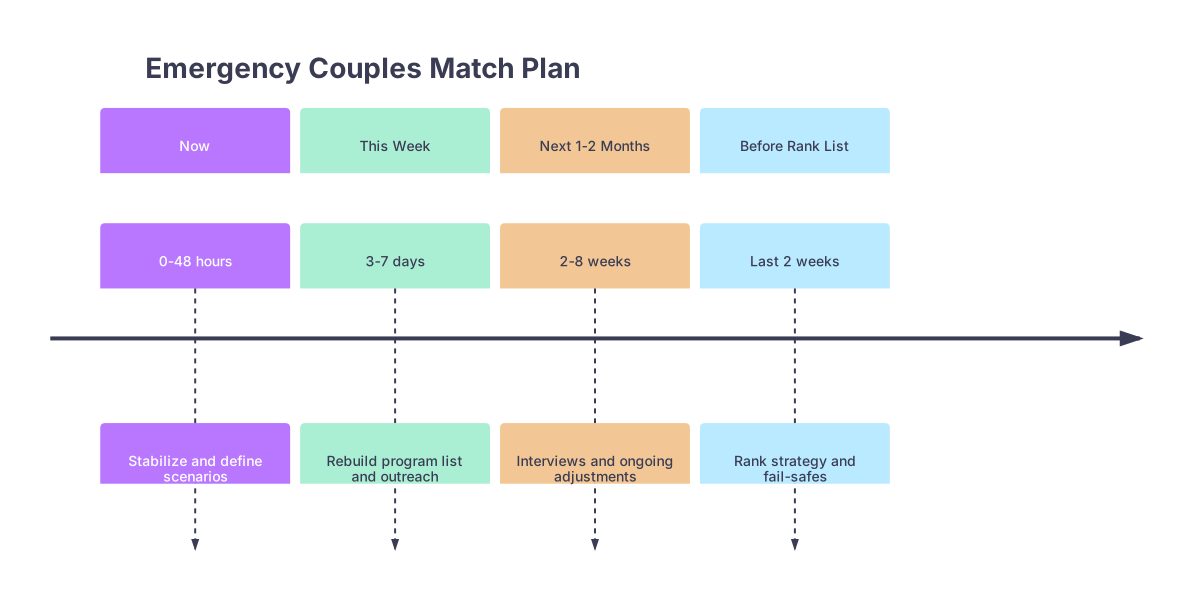
| Period | Event |
|---|---|
| Now - 0-48 hours | Stabilize and define scenarios |
| This Week - 3-7 days | Rebuild program list and outreach |
| Next 1-2 Months - 2-8 weeks | Interviews and ongoing adjustments |
| Before Rank List - Last 2 weeks | Rank strategy and fail-safes |
This keeps you honest about what is truly still changeable.
Step 2: Rebuild the Program Strategy from Scratch
The biggest mistake couples make after a late change: they keep the same general target list and just “tack on a few more programs.” That is lazy and dangerous.
You are no longer normal applicants. You are a couple with:
- Asymmetric competitiveness
- Mismatched specialty geography
- Time constraints
You need a redesigned map.
1. Classify each partner’s competitiveness realistically
No fluff. No “my advisor said I’m strong.” Use actual data.
For each of you, list:
- USMLE/COMLEX scores (or pass/fail + Step 2 CK)
- Number of programs already applied to
- Number of interview invites received so far (if applicable)
- Research output in the new specialty (if any)
- Clinical grades, AOA, class rank
- Red flags (failures, LOA, professionalism issues)
Then label each of you as:
- High: Top quartile for that specialty
- Middle: Solid, typical matched profile
- Vulnerable: Below-average or late switcher without solid specialty‑specific support
If the late‑switch partner is not “High,” and you are in a competitive specialty (ortho, derm, plastics, ENT, neurosurg, etc.), you must assume at least a 40–60% chance they do not match this cycle in that field.
That assumption drives your couple plan.
2. Resegment your program list by “couple feasibility”
Dump your current program spreadsheet. Make a new one with these columns:
- Program name (Partner A)
- City / region
- Program name (Partner B)
- Same institution? (Y/N)
- Same city but different institution? (Y/N)
- Distance between hospitals (miles / minutes)
- Program competitiveness tier (for each)
- Has taken couples in last 3 years? (if known)
Your true target now is not “great programs.” It is “geographically overlapping ecosystems where both careers are viable.”
Use this to build three tiers:
Tier 1 – Same institution pairings
- Example: IM and psych at University Hospital X
- These go at the very top of your list later.
Tier 2 – Same city but different institutions
- Example: Ortho at City Academic Center, FM at County Hospital across town
Tier 3 – Same region (within 60–90 minutes)
- Example: One at a city program, the other at a community program in a nearby town
Real talk: If one of you just switched to a hyper‑competitive field, Tier 3 may be where your realistic overlap actually lives.
3. Expand aggressively where needed
You probably need to over‑apply now. I have seen late‑switch couples stabilize only after adding 30–60 new, appropriate programs.
Use something like this:
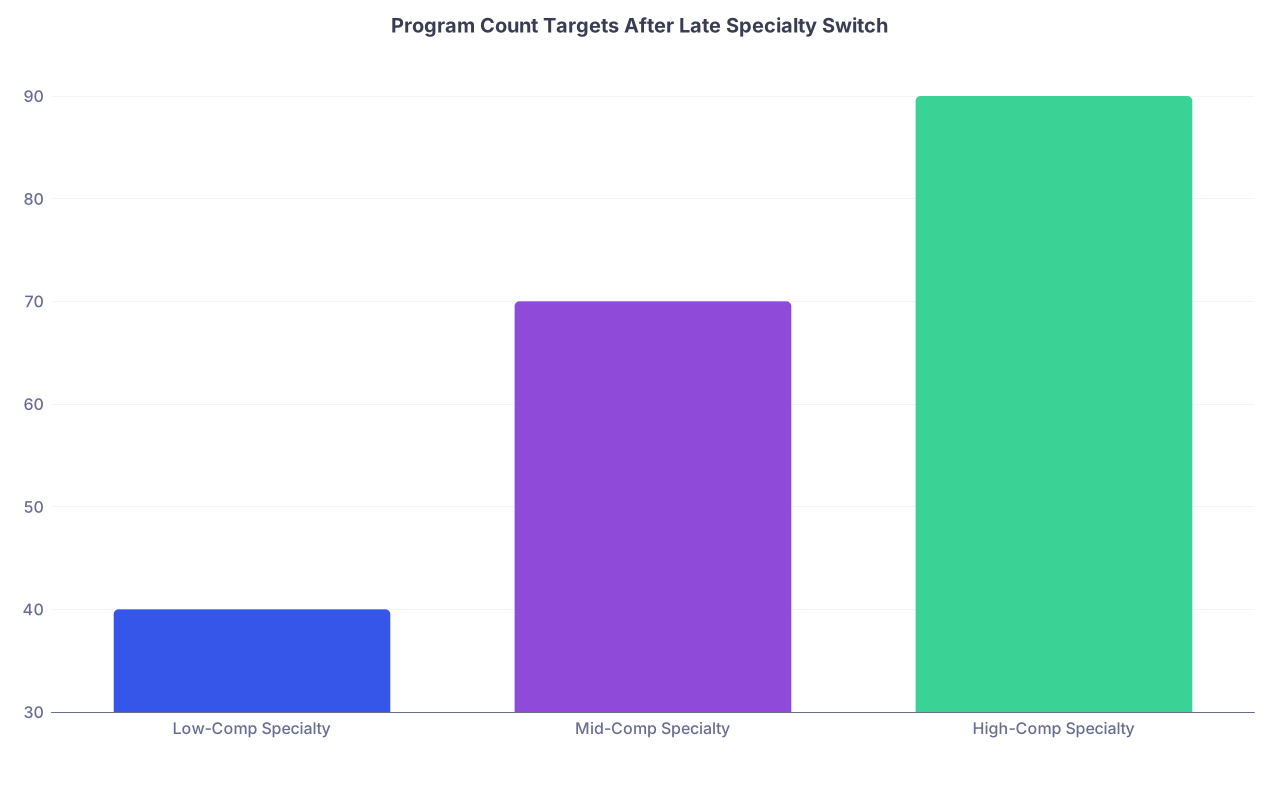
| Category | Value |
|---|---|
| Low-Comp Specialty | 40 |
| Mid-Comp Specialty | 70 |
| High-Comp Specialty | 90 |
Rough guidance for the late‑switch partner:
- Low‑competitiveness field (FM, psych, peds in many regions):
- Aim: 35–50 programs total
- Middle (IM, OB‑GYN, anesthesia, EM in many regions):
- Aim: 60–80 programs total
- High (ortho, derm, plastics, neurosurg, ENT, rad onc):
- Aim: 80–100+ plus a backup specialty
Yes, it is expensive. You know what is more expensive? Not matching.
Step 3: Decide Your Backup Strategy Now, Not in February
If one partner changed late into a competitive specialty and is not an elite applicant, forcing a “ride or die” couples match with no backup may drag both of you into SOAP or a second application cycle.
You need a pre‑agreed backup plan. Before interviews. Before rank lists.
1. Choose your backup specialty
For the late‑switch partner, identify:
- 1 realistic backup specialty they would be willing to do long‑term
or - 1 preliminary year they would accept (IM prelim, surgery prelim) with a realistic re‑application plan
Common examples:
- Ortho → backup: general surgery, prelim surgery
- Derm → backup: IM or transitional year + research
- ENT → backup: general surgery or prelim surgery
- Radiology → backup: prelim medicine or transitional year
This is not theoretical. You decide:
- Will we apply to the backup this cycle in parallel?
- Will we only use backup if SOAP is needed?
If you are already late in the season and invites are poor, parallel backup applications are usually safer.
2. Decide your couples “unlink” thresholds
You must answer this explicitly:
- Under what conditions are we willing to uncouple our rank lists?
Concrete triggers help. Examples:
- If competitive‑specialty partner has 0–2 interviews by date X → they apply to backup and we consider rank list uncoupling.
- If one of us has >10 interviews and the other has ≤3 by late January → we strongly consider uncoupling to prevent dual non‑match.
You do not have to like these numbers. You do have to define them.
Write them down in your shared doc. Bold them.
Step 4: Fix the Application Narrative for the Late Switch
A late specialty change looks like a red flag unless you control the story.
I have read these personal statements. Program directors think:
- “They are indecisive.”
- “They panicked after a bad rotation.”
- “They will leave our program.”
You must proactively disarm that.
1. Rewrite the personal statement with a clean arc
For the late‑switch partner, the personal statement must:
- Acknowledge the change without drama
- Show a clear through‑line of interests that makes sense
- Demonstrate concrete actions taken to commit to the new field
A simple skeleton that works:
- Paragraph 1: Snapshot clinical moment in the new specialty that crystallized the choice.
- Paragraph 2: Brief backstory of prior trajectory, then the turning point (not three pages of your childhood).
- Paragraph 3: Specific steps taken since the switch (electives, research, mentors, QI projects).
- Paragraph 4: What you bring to this specialty specifically.
- Paragraph 5: What you are looking for in a program and how you see your future.
Avoid the classic errors:
- “I always loved surgery but also always loved dermatology.” That sounds unserious.
- Over‑explaining or sounding apologetic.
- Blaming another specialty or rotation.
You are not confessing. You are explaining a thoughtful pivot.
2. Fix your letters of recommendation
This is where many late switches get crushed.
You need:
- At least 2 strong letters from faculty in the new specialty
- Ideally at least 1 letter that directly acknowledges the switch and endorses it
If timelines are tight:
- Email potential letter writers with a clear, concise packet:
- CV
- Personal statement draft
- 1–2 paragraph summary: why you switched, what you have done to commit
- Any specific experiences with them you hope they might mention
Yes, you can ask them directly:
“Given my late switch, if you feel comfortable, a brief comment on my commitment to [specialty] and your view of my fit for the field would be tremendously helpful, especially as program directors may see my change as a risk.”
Do not assume they will infer this. Spell it out.
Step 5: Coordinate Outreach as a Couple (Without Being Annoying)
After a late switch, smart, respectful outreach suddenly matters more. Done right, it can turn a “maybe” into an interview.
1. Who should email whom?
- The late‑switch partner emails:
- Programs in the new specialty where the other partner has already applied or has ties
- The “stable” partner emails:
- Their programs explaining the couples status and the partner’s late switch in a focused, non‑needy way
But keep it tight. No one has time for a saga.
A template for the late‑switch partner:
Subject: Couples Match Applicant – [Your Name], [Specialty]
Dear Dr. [PD Last Name],
I am a [MS4/IMG] applying to your [Specialty] residency and am participating in the couples match with my partner, [Partner Name], who has applied to [their specialty] at [same institution/nearby hospital].I transitioned to [new specialty] after [brief explanation: key clinical experiences] and have since [1–2 concrete actions: completed electives, engaged in research, sought mentorship]. Your program is especially appealing because [1 program-specific reason].
I recognize my switch is later than typical, but my commitment to [specialty] is strong and I would be grateful for consideration for an interview. I have attached my CV for your reference.
Sincerely,
[Name, AAMC ID, contact info]
Keep it under 200 words. No life story.
2. When to email
- Before rank lists open, obviously
- Ideal windows:
- 1–2 weeks after ERAS release
- After you see where interview patterns are forming and where gaps exist
Do not send weekly follow‑ups. One initial email + maybe one follow‑up about 3–4 weeks later if no response.
Step 6: Ruthless Rank List Strategy That Protects Both Careers
This is where most couples destroy themselves: rank lists that look romantic but are mathematically suicidal.
1. Understand your real options
You have four basic strategic positions:
Ride‑or‑die strict coupling
- You only rank combinations where you are in the same institution or city.
- High risk of one or both not matching if one partner is weak.
Flexible geographic coupling
- You rank same‑institution pairs at the top, same‑city second, nearby‑region third.
- You do not go below X quality threshold for either partner.
Conditional uncoupling
- You keep lists coupled to a point, then uncouple below an agreed rank line.
- Example: Top 10 ranks are coupled, below that each has a solo list.
Full uncoupling this cycle
- You essentially run independent matches but remain emotionally coupled.
- Sometimes the only rational choice when one partner’s match odds are extremely low.
For most late‑switch couples where one partner is in a risky field, Option 2 or 3 is safest.
2. Build the list with a fail‑safe floor
Here is a simple rule I push hard:
“Neither partner ranks a program below the line where they would rather not match at all.”
That means:
- No ranking programs you would hate just to be in the same city
- No sacrificing your entire career for a one‑year fantasy of cohabitation
Work from the top down:
- Rank all same‑institution acceptable pairs.
- Then same‑city different‑institution pairs that still meet minimum standards.
- Then nearby‑region pairs where commutes or occasional distance is realistic.
- Below that, decide: do we uncouple or stop?
This is not romantic. It is adult.
3. Run “what if” scenarios
Sit with a whiteboard and ask:
- If late‑switch partner does not match, what happens to the other?
- If one partner matches far away, will the other reapply there next year?
- Are we actually willing to do long‑distance, or is that just something we say to feel better?
Force yourselves to answer out loud.
Step 7: Emotional and Logistical Damage Control
A late specialty change in couples match is not just logistical. It can poison the relationship if you are not proactive.
1. Stop the blame game early
I have watched this conversation more times than I can count:
- Partner A: “Why did you switch now of all times?”
- Partner B: “So I’m supposed to be miserable for the rest of my career so we live in the same zip code?”
Nobody wins that fight.
Redirect energy toward: “Given that the switch has happened, what is the best plan from here?” You cannot re‑run last year.
2. Split tasks like a project, not a soap opera
Divide roles:
Logistics lead
- Maintains the spreadsheet
- Tracks interview invites and dates
- Monitors program communication
Narrative lead
- Coordinates personal statements
- Manages email templates
- Schedules advisor / mentor meetings
If the late‑switch partner is emotionally flooded (they often are), let the other handle more of the boring logistics for a few weeks.
3. Set a weekly “business meeting” for match stuff
Once a week, 45–60 minutes, strictly for:
- Updating the program spreadsheet
- Reviewing new invites or rejections
- Adjusting plan based on new information
No crying, no venting, no “you always…I never…” in this block. You can do that at another time. This is business.
Step 8: Special Cases and Hard Truths
There are a few patterns I see repeatedly that deserve direct answers.
1. IMG or DO late‑switch to competitive specialty
If the late‑switch partner is IMG/DO and switched late into derm, ortho, neurosurg, ENT, plastics with no prior track record:
- You must assume non‑match is the default outcome this cycle.
- Couples match linkage makes it worse.
In this case, a parallel backup specialty is not optional. It is required. And realistically, you should favor flexible geographic coupling or conditional uncoupling.
2. One partner already has strong interviews, the other has none
Once one of you passes 8–10 solid interviews and the other sits at 0–2, you are in dangerous fantasy territory if you insist on strict coupling.
Here the rational sequence often is:
- Intensify outreach for the weak partner.
- Add more backup programs for them.
- If still <3–4 interviews by late January, strongly consider uncoupling to protect the stronger partner’s match.
You can still plan to reunite later (transfer, fellowship, reapplication). But dual unemployment helps no one.
3. SOAP reality check
If it goes wrong and you land in SOAP:
- Competitive late‑switch specialty is basically off the table.
- You pivot hard to:
- Prelim IM or surgery
- FM, psych, peds, IM categorical in less desirable locations
Your couples plan for SOAP should already be sketched. Do not build it at 10 p.m. on Monday of SOAP week.
One Concrete Example
To ground this, here is a real‑world type scenario I have seen (details changed, but pattern realistic).
- Partner A: US MD, Step 1 pass, Step 2 245, strong IM application, 8 IM interview invites by December.
- Partner B: US MD, Step 2 240, had planned IM, but in September decided they “must” do neurosurgery. One neurosurg away rotation, no neurosurg research, one lukewarm neurosurg letter, 2 neurosurg interview invites.
What we did:
48‑hour stabilization:
- Ranked joint priorities: both must match this year; geographical proximity preferred but not at cost of career suicide.
Program strategy:
- Partner B applied to 25 additional neurosurg programs and 40 prelim surgery + IM prelim programs.
- Partner A applied to more IM programs in cities with neurosurg or prelim spots.
Backup decision:
- They agreed: if B had ≤3 neurosurg interviews by January 15, they would treat neurosurg as exploratory and prioritize prelim + future reapply.
- They pre‑planned SOAP focus on prelims + IM categorical for B.
Rank list:
- Top: 5–6 same‑institution IM + neurosurg combos.
- Next: IM for A + prelim surgery in same city for B.
- Below that: A’s strong IM programs alone and B’s prelim programs alone (uncoupled).
Outcome:
- B did not match neurosurg. Matched a surgery prelim in the same city where A matched IM categorical.
- A year later, B reapplied to neurosurg with research and better letters from that prelim year. Different story.
Not perfect. But not the dual catastrophe it could have been.
The One Thing You Should Do Today
Open a shared document right now and write, in bold at the top:
“If one of us must compromise to protect both our long‑term careers, we agree to choose the plan that keeps both of us employed physicians.”
Then:
- Identify your exact scenario (A–D above).
- List your joint top 3 non‑negotiables.
- Sketch a first draft of your backup and uncoupling thresholds.
You can refine the details later with advisors and mentors. But if you and your partner are not aligned on the fundamentals, no amount of clever EMR spreadsheets or reworded personal statements will save this couples match.
Get aligned first. Then execute the plan.


