

The way most couples use away rotations is wrong. They treat them like “bonus auditions” instead of the primary tool to control geography and program options in the Couples Match.
If you are matching as a couple, away rotations are not optional. They are your leverage. Used well, they massively increase the number of realistic pairings. Used badly, they waste 4–8 of your most valuable weeks and lock you into a terrible map of programs.
Let me walk you through how to use away rotations strategically as a couple, not emotionally, not reactively.
Step 1: Get Ruthlessly Clear on Your Couple Priorities
Before you touch VSLO, calendars, or emails, you and your partner need a shared playbook. Not vibes. Not “we’ll see.” A written, ranked list.
Sit down, no phones, and answer these questions separately first, then compare:
Geography:
- Top 3 metro areas or regions you would actually be happy living in.
- Any absolute no-go locations.
- Will one of you commute up to 60–90 minutes if needed?
Competitiveness gap:
- Who is in the more competitive specialty? (Derm, Ortho, ENT, Plastics, Urology, IR, etc.)
- Who has the stronger overall application on paper (scores, AOA, research, letters)?
Career non-negotiables:
- Any must-have features? (Major academic center, specific fellowship pipeline, visa needs, etc.)
- Any deal-breakers? (No unopposed community program, no middle of nowhere, etc.)
Relationship risk tolerance:
- Are you truly willing to do distance for 1 year (prelim + couples match later)?
- Or is “same city or bust” the actual rule?
Write it down. Rank each item. Then decide:
- Whose specialty is the “anchor” (i.e., the one that’s harder to place)?
- What are your Tier 1 cities (must-target with away rotations) vs Tier 2 (nice-to-have)?
That anchor specialty will drive where away rotations matter most.
Step 2: Decide What Each Partner’s Away Rotations Must Accomplish
You have limited away slots. Most schools allow:
- 0–2 aways for less competitive fields (FM, IM, Peds, Psych)
- 2–4 aways for competitive fields (Ortho, Derm, ENT, etc.)
You cannot “try everything everywhere.” You must assign each rotation a job.
Here is the basic division:
If one of you is in a highly competitive specialty
Examples: Dermatology, Orthopedic Surgery, ENT, Neurosurgery, Plastics, Urology.
For that partner, away rotations should:
- Demonstrate you can perform at top programs in realistic cities.
- Create geographic anchors that the other partner can apply around.
- Secure at least 2–3 strong letters from recognized faculty.
If the other partner is in a less competitive specialty
Examples: Internal Medicine, Pediatrics, Family Medicine, Psychiatry, Neurology, EM (borderline).
For that partner, away rotations should:
- Target the same cities/regions the competitive partner is anchoring.
- Show flexibility: ability to thrive in both academic and solid community settings.
- Broaden your program list in those anchor cities (more interview options = more couples pairs).
Put simply:
- Competitive partner: “Open the door to target cities.”
- Less competitive partner: “Fill the door frame with lots of options.”
Step 3: Build a City-First, Not Program-First, Away Rotation Map
Couples who screw this up usually do this:
- Person A picks aways at “famous” places.
- Person B picks aways wherever they happened to get accepted.
- Result: zero geographic synergy.
You are not just collecting lines on a CV. You are building a geography net.
Do this instead
List 3–5 metro areas you both can accept. For example:
- Boston
- Chicago
- Dallas
- Pacific Northwest (Seattle / Portland)
- Mid-Atlantic (Philly / Baltimore / DC)
For each city/region, list:
- All residency programs in Partner A’s specialty
- All residency programs in Partner B’s specialty
Mark which combos are actually plausible:
- Same hospital (ideal)
- Same city, different hospitals (good)
- Neighboring cities with realistic commute (acceptable)
- Too far or mismatched (ignore)
Now, assign away rotations to maximize the number of plausible pairs in as few cities as possible.
Concrete example:
- You: Orthopedic Surgery (competitive)
- Partner: Internal Medicine (less competitive)
You both like: Chicago, Dallas, and Boston.
Your plan might look like:
You (Ortho):
- Away 1: Ortho at major academic center in Chicago
- Away 2: Ortho at strong mid-tier program in Dallas
- Home rotation: Ortho at your home program (maybe Boston-ish region)
Partner (IM):
- Away 1: IM at Chicago program that overlaps / cooperates with your Chicago hospital
- Away 2: IM at Dallas system with multiple hospitals + another local IM program
- Elective / Acting Internship: IM at home institution (Boston-style)
Now you have:
- Chicago: 1–2 Ortho programs + 2–4 IM programs
- Dallas: 1–2 Ortho programs + 2–4 IM programs
- Boston/home region: 1 Ortho + 2–3 IM
That is real geographic alignment. The couples match algorithm finally has something it can work with.
Step 4: Use Aways to Fix Your Weak Spots—Not Just To Show Off
There are four classic reasons to do away rotations. As a couple, you must consciously pick which you are using.
| Purpose | When to Use It |
|---|---|
| Geographic anchor | Couples Match priority |
| Prestige / name brand | Very strong applicants |
| Back-up safety network | If risk of not matching |
| Home program booster | If home is top choice |
You and your partner should assign each of your aways a main purpose. Do not try to make one rotation do everything.
Some concrete strategies:
1. Geographic anchor rotations (high priority for couples)
- Rotate in your Tier 1 city even if the program is not “#1 name brand.”
- The objective:
- Get local letters.
- Signal interest in that city.
- Learn the local ecosystem so you can target other programs there smartly.
2. Prestige rotations (only when it makes sense)
- If you are a top-tier applicant, one away at a big-name place in a preferred city can boost reach.
- But if that city has only 1 other program for your partner, it is a bad couples strategy.
3. Safety rotations (underused but powerful)
- For the less competitive partner: pick a city where your partner has multiple options and you can be “the strong applicant” at a slightly less competitive program.
- You want at least one rotation where a PD tells you: “If you rank us highly, we will almost certainly rank you too.”
This can become your geographic safety net as a couple.
Step 5: Align Your Timelines and Application Signals
Away rotations are not just clinical experiences. They are timed interactions with programs that influence interviews and rank lists.
You and your partner should:
Stagger key aways so you are peaking when applications go out.
- For early specialties (Derm, Ortho, ENT, etc.), July–September aways are high-value.
- For later-review specialties, August–October can still work well.
Coordinate signals:
- Both of you explicitly mention the same city in your personal statements or secondary responses for those programs.
- You can both say some version of: “My partner is applying in X specialty; we are participating in the Couples Match and strongly hope to train in [City].”
Ask attendings explicitly to address your couples situation in letters (when safe).
Something like:
“She is an outstanding candidate in orthopaedic surgery and would be an asset to any program. She and her partner are couples matching and have a strong interest in remaining in the Chicago area.”
That anchors the geography in the minds of PDs.
Step 6: Decide When You Rotate Together vs Separately
This part is tricky and people rarely think about it strategically.
There are 3 main configurations:
- Same institution, same time
- Same city, different institutions, same time
- Different cities, different times
Each has pros and cons.
1. Same institution, same time
Pros:
- Programs see you as a package deal early.
- Some PDs love it when both members are strong.
- Easier for logistics / housing / support.
Cons:
- If one of you is clearly weaker, it can anchor the other down.
- One weak performance can hurt both reputations.
- Some programs are quietly wary of couples because of scheduling and retention issues.
Use this when:
- Both of you are clearly strong applicants.
- The program has both specialties and is a major target.
- You want to send a loud signal: “We want to be here together.”
2. Same city, different institutions
Pros:
- Doubles your network in that city.
- Reduces the “we come as a package, take us or leave us” effect.
- Each of you is evaluated independently but can still cross-mention interest in the city.
Cons:
- Less obvious as a couple to PDs.
- Requires explicit communication later about couples matching.
This is usually the safest and most effective setup for most couples.
3. Different cities, different times
Pros:
- Each of you maximizes your own individual strategy without compromise.
- Good when one specialty has very limited spots in your target city.
Cons:
- Weakens geographic overlap.
- Programs do not feel your combined presence in any one area.
- Harder to coordinate interviews and rank lists later.
Use this only when your specialties rarely coexist in the same hospitals or regions, or when one partner must chase a very narrow set of programs for career reasons.
Step 7: Communicate With Programs Like Adults, Not Teenagers Hiding a Relationship
You are not the first couple they have seen. Some PDs actively like couples. Some are neutral. A few are annoyed by the logistics. But almost all appreciate clear communication.
Here is how to do it without being needy:
Before or during the away rotation
Mention in person to the PD or APD:
- “My partner is applying in [specialty] and we will be couples matching. We are both very interested in [City/Institution], so we are being thoughtful about our rotations here.”
If your partner is also in that hospital:
- Ask whether there are any joint opportunities (resident retreats, Grand Rounds, etc.) where both of you can be visible.
In your ERAS application
- Use the “Couples Match” indicator clearly.
- If appropriate, one line in your personal statement:
- “My partner and I are couples matching, with the strong hope of training together in [Region].”
After the away, before rank lists
- If you both like the place:
- Each of you sends a concise, separate update email:
- Thank you for the opportunity.
- Reiterate fit.
- Brief mention that as a couples match pair you are ranking them highly.
- Each of you sends a concise, separate update email:
Avoid drama. Avoid ultimatums. Just be explicit and calm.
Step 8: Structure Your Program Lists to Reflect Your Away Strategy
Once interviews start rolling, the number of possible pairs explodes. You must stay disciplined.
Here is how away rotations should translate into your rank strategy as a couple:
Tier your programs by geography and strength:
- Tier A: Programs in cities where both of you rotated and liked it.
- Tier B: Programs in your anchor cities where at least one of you rotated.
- Tier C: Programs with no away exposure, but interview impressions were good.
- Tier D: Desperation / last-resort geographies.
Use aways to create tight ordering in top-tier cities.
Within Chicago, for example:
- If you did Ortho away at Hospital X and IM away at Hospital Y, and both went well, those X/Y pairings should cluster high in your couples list.
- Do not over-rank singletons in random cities just because they are prestigious.
If you loved a big-name Boston program but your partner has only one fragile option there, that pair should not outrank cities where each of you has 3–4 realistic options.
Remember: the couples algorithm rewards density of options in a given geography much more than prestige points for one of you.
Step 9: Common Patterns by Specialty Pair
Let me give you a few concrete archetypes so you can recognize your situation.
Competitive + Less Competitive (e.g., Derm + IM, Ortho + Peds)
Strategy:
Competitive partner:
- 2–3 aways in 2–3 Tier 1 cities you both like.
- Focus on places that actually have multiple programs in partner’s specialty.
Less competitive partner:
- 1–2 aways in the exact same cities, ideally at programs slightly below the very top to maximize acceptance odds.
- Maximize total number of interviews in those anchor cities.
Big mistake to avoid:
Competitive partner picks ultra-elite, narrow-ecosystem programs (tiny town or single hospital city) where the other partner has little to no options.
Two Moderately Competitive Specialties (e.g., EM + Anesthesiology, Neurology + OB/GYN)
Strategy:
- Each of you does 1–2 aways in the same two cities, but not always at the same hospital.
- You aim to create 3–5 reasonable program combos per city.
- You may want a third city as a mutual “safety region” where both of you would be okay even if the names are less fancy.
Big mistake to avoid:
One partner over-invests in an away at a glamorous city where the other has only one mediocre or risky option.
Two Very Competitive Specialties (e.g., Ortho + ENT, Derm + Plastics)
Hard mode. Here the playbook changes.
Strategy:
- Each of you may need 2–3 aways primarily for personal match chances, not couples optimization.
- You must deliberately overlap at least one city with reasonable programs for both, even if they are mid-tier.
Accept up front:
- You may need to rank “strong but less elite” combined options higher than “dream solo program + terrible partner options” cities.
Step 10: Financial and Logistical Reality Check
Away rotations for couples can get expensive fast.
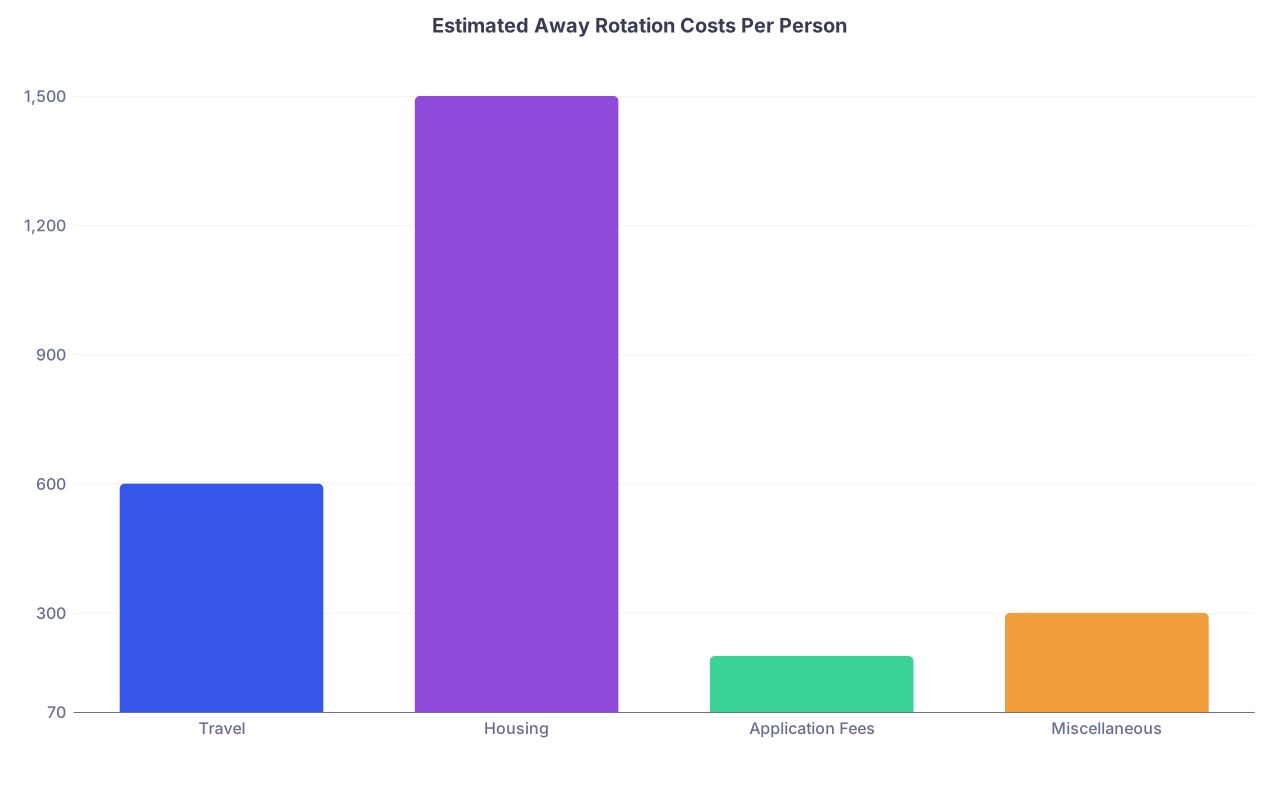
| Category | Value |
|---|---|
| Travel | 600 |
| Housing | 1500 |
| Application Fees | 200 |
| Miscellaneous | 300 |
Now double that for two people and multiple away blocks.
You must:
- Consolidate cities. Doing two separate aways in the same city allows shared housing, transportation, and local knowledge.
- Use sublets strategically. One 8-week lease is cheaper than two 4-week leases in different cities.
- Apply early. The prime rotations in prime cities disappear quickly; couples with complex needs cannot afford to be late.
If money is tight:
- Prioritize one joint anchor city where you both rotate (to justify the housing cost), then:
- One partner can do a cheaper nearby rotation or use home elective time strategically.
- Look for programs that offer housing or stipends for visiting students. Not common, but they exist, especially in less popular locations.
Step 11: What If Your Aways Go Badly?
It happens. One of you gets a lukewarm evaluation. Or you both hate the city.
Do not panic. Use it rationally.
Bad clinical eval / weak impression
- Do NOT rank that program highly as a couple unless you must.
- Shift that city down and re-elevate other cities where you had better receptions.
- You can still use local knowledge of the area to guide applications to other programs there.
You hated the city
Good. That is data.
- Drop that city out of Tier 1.
- Double down on cities where you actually liked the daily living reality.
- Do not sacrifice 3–7 years of your lives for a big-name program in a city you cannot stand.
Step 12: A Simple Planning Framework You Can Copy
Use this to structure your planning session together.

| Step | Description |
|---|---|
| Step 1 | Define Couple Priorities |
| Step 2 | Choose 3-5 Target Cities |
| Step 3 | Map Programs for Both Specialties |
| Step 4 | Assign Anchor Cities |
| Step 5 | Plan Aways for Competitive Partner |
| Step 6 | Plan Aways for Other Partner in Same Cities |
| Step 7 | Decide Same vs Different Hospitals |
| Step 8 | Apply Early and Secure Housing |
| Step 9 | Use Aways to Communicate Couples Intent |
| Step 10 | Adjust Rank Strategy Based on Away Outcomes |
Print that flow out. Work through each step.
The One Thing Most Couples Never Do (And You Should)
Most couples never bother to quantify their geographic overlap. They make a vague list of programs, then pray the algorithm is kind.
Do this instead, on a whiteboard or spreadsheet:
- Down the left: list your programs.
- Across the top: list your partner’s programs.
- Highlight cells where:
- Same city
- Acceptable commute
- Both of you would actually go there
That grid shows you where away rotations should concentrate. Your job with aways is to make that grid as dense as possible in your top 2–3 cities.
To visualize how interviews should ideally stack in your target regions:
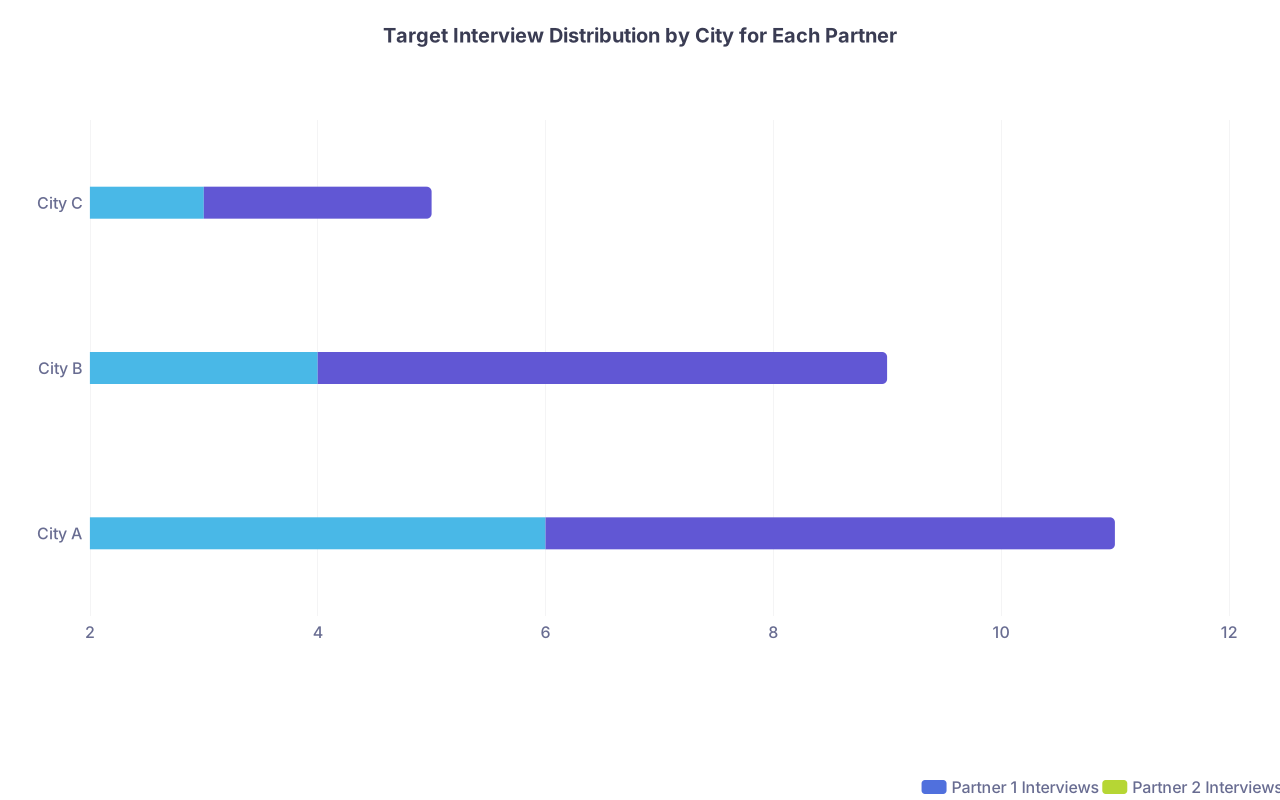
| Category | Partner 1 Interviews | Partner 2 Interviews |
|---|---|---|
| City A | 6 | 5 |
| City B | 4 | 5 |
| City C | 3 | 2 |
Your away rotations should be chosen with that kind of distribution in mind.
A Final Tactical Tip Most People Miss
After your aways, especially if you did them in the same city but different hospitals, quietly ask residents and chiefs:
- “Where do your partners mostly match if they couples match?”
- “Which programs in this city tend to be open to couples?”
- “Any programs we should be cautious about as a couple?”
You will hear real stories:
- “Our PD loves couples, half our class is coupled.”
- “That other program in town avoids couples, they have been burned before.”
- “The OB and Peds PDs coordinate here all the time for couples.”
That information is gold. It tells you which rank pairs are realistic and which are fantasy.
Your Next Step Today
Open a blank document and do three things right now:
- Write down your top 3 cities as a couple and mark them Tier 1.
- Under each city, list every program for both of your specialties.
- Put a star next to any city where you could both reasonably schedule an away rotation.
That is your starting map. Once you see it on paper, you will know exactly where your away rotations must go—and which “fun ideas” you need to kill before they quietly kill your Couples Match.
Then, and only then, should you open VSLO.


