

Most couples blow the “which cities do we rank?” question and only realize it after Match Day.
You do not need to be those people.
If you and your partner are couples matching on different coasts—or even just open to very different regions—the problem is not “it is impossible.” The problem is usually that your process is sloppy. Vague priorities. No hard numbers. Emotional arguments masquerading as strategy.
Let us fix that.
This is a step‑by‑step system for consolidating cities as a couples pair so you end up with a coherent, safe, and sane rank list—whether one of you wants Boston and the other swears they will only be happy in California.
Step 1: Define the Real Problem (It Is Not Just “East vs West”)
The headline tension—“she wants the East Coast, I want the West Coast”—is almost never the real problem.
The real issues are usually:
- Different tolerance for risk
- Different willingness to be far from family
- Different value placed on program prestige vs lifestyle
- Different debt loads and financial pressure
- Different specialty competitiveness
Before touching cities, you need to know what you are actually optimizing.
Sit down together. No laptops. Just paper.
Each person answers, separately, then you compare:
How risk‑tolerant are you about matching apart?
- 1 = “We must match in the same city”
- 5 = “We would rather each get a great fit, even if that means different cities”
How strongly do you care about:
- Being near family? (1–5)
- Cost of living? (1–5)
- Prestige / fellowship potential? (1–5)
- Climate / geography? (1–5)
- Program culture / wellness? (1–5)
Non‑negotiables (max 2 each)
Examples:- “Not more than 6 hours drive from my parents”
- “No cities with COL like NYC or SF on our current budget”
- “Must be at a program with an established cardiology fellowship”
Now compare answers. This is where fights usually start. Let them. Better now than in February at 2 a.m. over the NRMP portal.
You are trying to answer one question:
“Are we optimizing for being together above everything else, or for program quality + relationship, in that order?”
Write down the shared conclusion in one clear sentence. That sentence is what you will come back to whenever you get stuck.
Step 2: Build a Joint “City Universe” Before You Touch Programs
Most couples go straight to program spreadsheets. Wrong order.
You need a city universe first. Cities where you are both at least open to living.
Create three buckets:
- Green cities – Both of you would be genuinely happy
- Yellow cities – One person is lukewarm but open; the other is happy
- Red cities – Off the table for one or both
Use a simple rule:
If either person puts a city in red, it is red for the couple. Non‑negotiables are non‑negotiable.
Now you are going to deliberately shrink your universe. This feels uncomfortable. Good. You are doing it right.
Target: 8–14 cities total across all buckets for most couples.
More than 15 and your rank list usually becomes dilute and risky. Fewer than 6 and you are asking to match in different ZIP codes.
To keep this disciplined, use a quick scoring system.
| City | Family Proximity (1–5) | Cost of Living (1–5) | Prestige Potential (1–5) | Lifestyle Fit (1–5) | Total (max 20) |
|---|---|---|---|---|---|
| Boston | 5 | 2 | 5 | 3 | 15 |
| NYC | 4 | 1 | 5 | 3 | 13 |
| Seattle | 2 | 3 | 4 | 5 | 14 |
| SF Bay | 1 | 1 | 5 | 4 | 11 |
| Denver | 2 | 4 | 3 | 4 | 13 |
Anything under a certain threshold (say ≤ 10) you agree to drop unless it fills a strategic need (for example, a less competitive safety city).
You should now have a manageable, realistic set of cities—on multiple coasts—that you will build the rest of your plan around.
Step 3: Map Your Specialties to Those Cities (Reality Check Time)
Here is where many couples discover the real constraint. Not coasts. Not weather.
Program density and competitiveness.
If one of you is applying to something like dermatology, plastics, or ENT, and the other is in internal medicine or pediatrics, the bottleneck is obvious.
You need to know, for each city in your universe:
- How many programs exist for Person A’s specialty?
- How many programs exist for Person B’s specialty?
- Are they mostly competitive, mid, or safety for each of you based on your stats?
Make a quick table for each city pair. It can look as rough as this in your notebook:
Boston
- Person A (IM): 5 academic programs, 3 community
- Person B (Derm): 2 programs, both highly competitive
- Bottom line: Great for A, brutal for B. Needs backup cities.
Seattle
- Person A (IM): 1 large academic, 1 community
- Person B (Derm): 1 program
- Bottom line: Both bottlenecked; do not rely on just this.
Do that for every city. Then categorize each city for you as a couple:
- Double‑dense (several options for both)
- Asymmetric (many options for one, very few for the other)
- Sparse (1–2 total options combined)
You want at least 2–3 double‑dense cities on your list if possible. Those are your safest anchors.
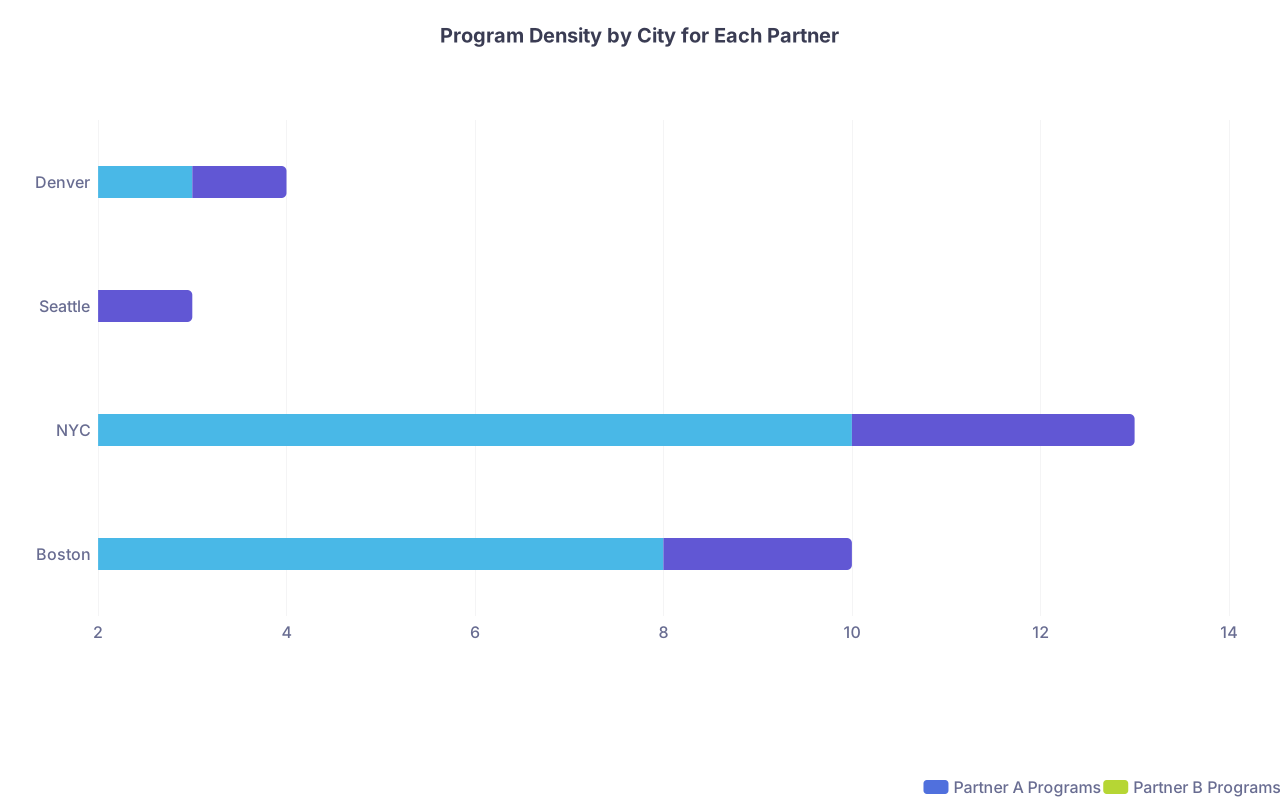
| Category | Partner A Programs | Partner B Programs |
|---|---|---|
| Boston | 8 | 2 |
| NYC | 10 | 3 |
| Seattle | 2 | 1 |
| Denver | 3 | 1 |
If you discover that most of your preferred cities are asymmetric or sparse, you have three options:
- Add some less sexy but denser cities (think: Midwest academic hubs, state capital cities).
- Increase the total number of cities you apply to.
- Accept higher risk of separating.
But do not pretend it is “fine” if the math is ugly. Name it and consciously choose your level of risk.
Step 4: Decide on a Strategy: Anchor City vs Parallel Coasts
Once you understand program density, you need an overall couples strategy. There are two main approaches when you are pulling toward different coasts.
Strategy A: Anchor City + Flanking Coasts
You pick 1–3 anchor cities where you maximize overlap, even if one of you compromises on coast, and then you flank those with each person’s preferred coast cities in parallel.
Example:
- Anchor cities: Chicago, Denver
- East Coast cities: Boston, NYC, Philly
- West Coast cities: Seattle, SF Bay, LA
You then build your rank list to prioritize anchors, with parallel city pairs after.
When to use this:
- You strongly prefer to end up together.
- Your specialties have at least a few solid anchor cities.
- Both of you can tolerate living in the anchor region.
Strategy B: Parallel Coasts With High‑Probability Overlap
You accept that your ideal programs may cluster on opposite coasts, so you:
- Each apply broadly on your preferred coast, plus
- Identify 3–5 cross‑coast overlap cities where you both apply heavily
This is riskier but sometimes rational, especially if:
- Both of you are competitive applicants with strong interviews
- Your relationship can tolerate a worst‑case scenario of 1–2 years apart
- One or both specialties are extremely location‑limited
For most couples, Strategy A is safer. Strategy B is for couples who value individual career optimization almost as highly as co‑location.
Be explicit: write at the top of your shared spreadsheet:
“We are using Strategy A: Anchor City + Flanking Coasts.”
This keeps you from shifting the goalposts every week when emotions swing.
Step 5: Build a Joint Spreadsheet That Actually Works
Time to get tactical. You need a shared, living spreadsheet that drives your decision‑making.
Here is what I recommend (Google Sheets so you both can edit):
Columns (minimum):
- City
- Program Name
- Partner A Specialty
- Partner B Specialty
- Program Type (Academic / Community / Hybrid)
- A’s Competitiveness vs Program (Reach / Target / Safety)
- B’s Competitiveness vs Program (Reach / Target / Safety)
- Interview Received? (Y/N)
- Interview Date
- A’s Interest Score (1–5)
- B’s Interest Score (1–5)
- Combined Priority (High / Medium / Low)
- Notes (vibes, red flags, people you met)
You are going to color‑code rows by city so you can visually see clusters.
Then filter by city and check the balance:
- Do you have a mix of reach / target / safety for each of you?
- Are there cities where it is all reach for one partner? Those are fantasy cities unless balanced elsewhere.
- Are you unconsciously overweighting one person’s dream cities?
You want a portfolio of cities and programs that, taken together, give you a high chance of:
- Both matching.
- Matching in the same metropolitan area.
- Having at least a couple of “we would be thrilled” outcomes.
If the portfolio looks lopsided, fix it now:
- Add more safety programs for the weaker partner in double‑dense cities.
- Consider dropping vanity reaches that add no real couples‑match value.
- Add a few new cities that favor the weaker partner if the other person can tolerate them.
Step 6: Use Interview Season to Prune and Consolidate
Interviews are not just about impressing programs. They are your field research on cities.
You should use interview season to test and refine your city universe.
Here is the mistake couples make: they treat every interview as equally meaningful on the rank list. That is lazy.
Instead, after each interview trip:
Do a 10‑minute debrief together (in person or over FaceTime):
- Rate the city (1–5) separately from the program.
- Name one “hell no” and one “surprising positive” about that city.
Update your spreadsheet within 24 hours:
- Adjust A’s and B’s interest scores.
- Flag any city that felt completely wrong in person.
Once a month, re‑run your city buckets:
- Promote some yellow cities to green if they exceeded expectations.
- Demote green cities to yellow or red if reality was worse than your fantasy.
By January, your “we could live here” list should be smaller and sharper than when you started. That is the whole point.

Step 7: Construct the Couples Rank List Logically (Not Emotionally)
Now the thing everyone dreads: actually building the couples rank list in NRMP.
You have two goals that fight each other:
- Maximize the number of joint, same‑city combinations
- Preserve as much individual program preference as possible
The only way to keep your sanity is to do this in layers.
Layer 1: City‑First, Not Program‑First
Start with your city priority order as a couple, not individual program rank.
Example shared city order:
- Boston
- Seattle
- Denver
- NYC
- Chicago
Within each city, then order combinations of programs based on:
- Both partners’ interest scores
- Safety mix (you probably want at least one “strong safety for each” combination in every high‑priority city)
Layer 2: Within‑City Program Pairing
For each city, list realistic program pairs:
- (A: MGH IM, B: BIDMC Anesthesia)
- (A: BIDMC IM, B: MGH Anesthesia)
- (A: Tufts IM, B: BIDMC Anesthesia)
- …etc.
This gets overwhelming if you try to do it all at once. Stay systematic:
- For the city, sort Partner A’s programs from most to least preferred.
- For the same city, sort Partner B’s programs from most to least preferred.
- Start pairing in a grid, top‑left first, and march down and across.
Ask for each pair: “Would we be happy enough with this combination to put it above any combination in the next city on the list?”
If yes, it goes higher. If no, it drops below.
You are not aiming for philosophical perfection. You are trying to prevent scenarios where you accidentally rank:
- A “meh” combination in your favorite city below
- A “great for one, terrible for the other” combination in your third city.
Layer 3: Add a Deliberate Safety Tail
The couples match punishes reckless idealism. I have seen very capable couples end up apart because they simply refused to rank enough boring but solid combinations.
Your safety tail usually includes:
- Less desirable cities that are still acceptable
- Lower‑tier or community programs where both of you would almost certainly match if you got interviews
- Asymmetric combinations you would hate but will accept over going unmatched
You do not need 200+ combinations if your interview slate is modest. But you do want a tail that acknowledges:
“If we fall to this part of the list, things have already gone badly. What is the least bad outcome we will still accept?”
You define that ahead of time, not at 1 a.m. before the deadline.

| Step | Description |
|---|---|
| Step 1 | List Cities in Joint Priority Order |
| Step 2 | Within Each City, Rank Programs Individually |
| Step 3 | Create Program Pairs for Each City |
| Step 4 | Order Pairs by Happy Enough Test |
| Step 5 | Move to Next City and Repeat |
| Step 6 | Add Safety Tail Across All Cities |
| Step 7 | Convert Final Order into NRMP Couples List |
Step 8: Protect the Relationship While You Argue About All This
Technical strategy is the easy part. Keeping your relationship intact while you are tired, broke, and terrified is harder.
Here are a few rules I give couples who actually want to still like each other on Match Day:
No “you always / you never” fights about cities.
Keep it to: “When we prioritize X, I feel like my Y is not being weighed.”Schedule decision blocks.
You do rank list work on, for example, Saturday mornings 9–11. Not every night in bed.Use the data as a referee.
Instead of “You just want to be near your parents,” say:
“Look at the spreadsheet—5 of our top 6 cities are within 2 hours of your parents. That feels unbalanced. How do we fix that?”Re‑read your shared priority sentence monthly.
The one from Step 1.
“We are prioritizing co‑location above all else.”
Or
“We are prioritizing each person’s best career fit, accepting that we may end up apart.”
If your behavior does not match that sentence, one of you is cheating on the agreement.

Step 9: Specific Scenarios and How to Handle Them
Let me hit a few common patterns I keep seeing.
Scenario 1: One Partner Has a Much Stronger Application
Stronger partner is competitive for top‑tier coastal programs; weaker partner is fighting for mid‑tier in the same specialties or for a very saturated specialty (e.g., Psych in certain cities).
What to do:
- Use the stronger partner to “pull” the couple into cities that have lots of mid‑tier options for the weaker partner.
- The stronger partner should be willing to dip down in program prestige if it materially increases joint match probability.
- Add extra safety programs for the weaker partner in anchor cities, even if they are not glamorous.
Translation: the stronger partner carries more program compromise so the couple can preserve geographic flexibility.
Scenario 2: One Person Is Dead‑Set on One Coast
“I will be miserable anywhere but the West Coast.”
Fine. But you need to see the cost.
- Put real numbers on it: how many programs per specialty in those West Coast cities?
- How many interviews did you actually get there?
If the list is thin, you must either:
- Add non‑West‑Coast anchor cities.
- Or accept the risk of either going unmatched or living apart.
Do not run the fantasy that “things will just work out” in a hyper‑limited geography. Couples match does not reward magical thinking.
Scenario 3: Different Contract Lengths (Prelim / TY Year Involved)
One of you has a prelim or TY year, the other is categorical.
For city consolidation, that means:
- Rank combinations where both of you are in the same metro area for year 1 as a high priority.
- Then consider cities where at least the prelim person is in a place that has strong options for PGY‑2+ applications.
Think:
“Can we use this city as a launching pad for the second match cycle if we need to?”
| Category | Value |
|---|---|
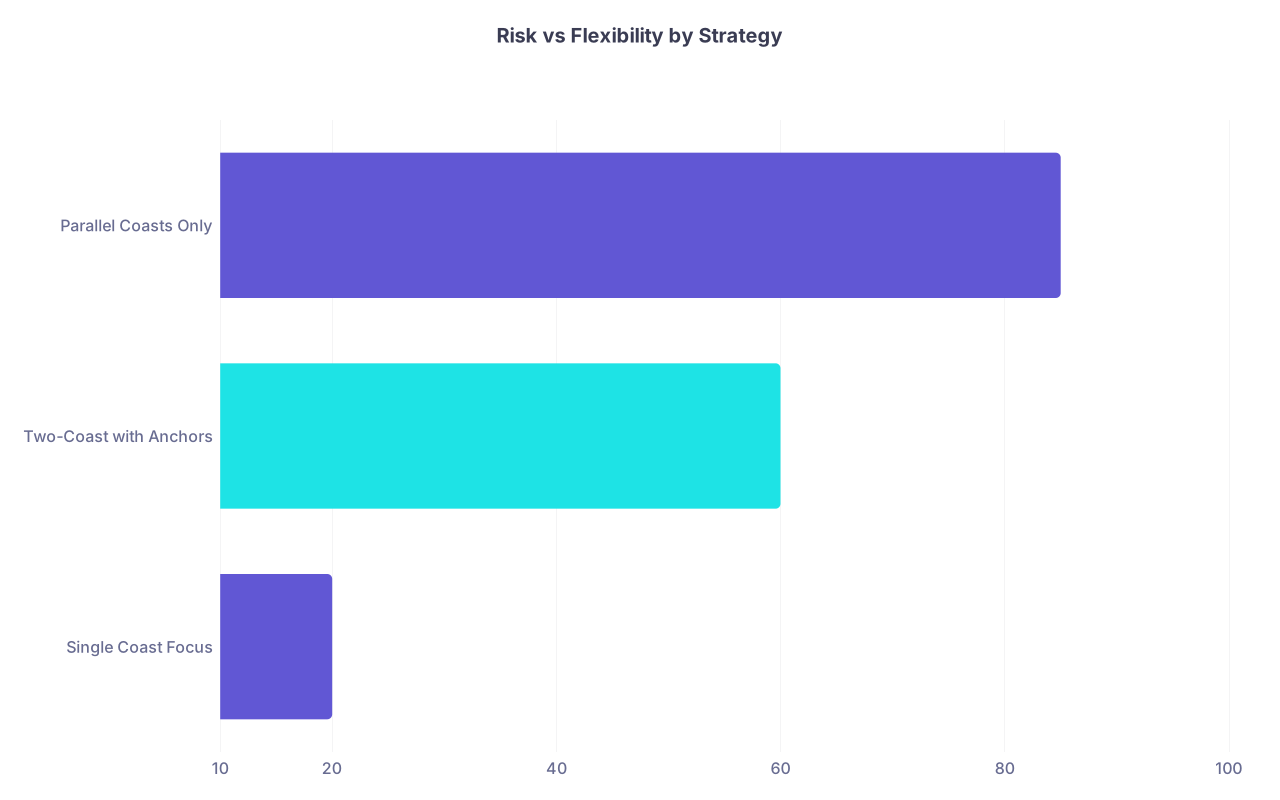
| Single Coast Focus | 20 |
| Two-Coast with Anchors | 60 |
| Parallel Coasts Only | 85 |
(Scale 0–100: higher = more risk of separation or going unmatched.)
Step 10: Match Week Reality Check
Once your list is in and you wait, stop tinkering. But you can still prepare mentally using the work you did.
Walk through three outcomes as a couple:
Best cluster outcomes – top 5–10 combinations
- What does life look like?
- What is the plan for housing, finances, family?
Middle of the list outcomes
- “We got a city that is fine but not thrilling.”
- What is the upside? How will you make it work?
Tail outcomes
- Maybe you ended up in your “we will accept this but hate it” combination.
- Agree ahead of time: We will not blame each other. We made this list together, eyes open.
You did the work. You used data. You made adult trade‑offs. That is all you can control.

FAQ (Exactly 4 Questions)
1. How many cities should couples realistically target in the couples match?
For most couples, 8–14 cities is the functional range. Fewer than 6 and your risk of ending up apart climbs quickly unless you are both very strong and overlapping in dense cities. More than 15 and the list becomes noisy, with a lot of low‑yield combinations that do not add much safety but do add confusion. Focus on a small set of double‑dense anchor cities and a few asymmetric cities to round out your portfolio.
2. What if one of us did not get many interviews in our shared top cities?
You treat that as a constraint, not an annoyance. The partner with fewer interviews in those cities is the limiting reagent. You have three levers:
- Move some of your shared emphasis to cities where that partner did get more interviews.
- Aggressively add safe combinations in any shared city where they have any interview.
- Decide consciously whether you are comfortable increasing the chance of a split match to preserve more of the other partner’s preferences. Do not keep your original dream city order if the interview data clearly undermines it.
3. Should we rank combinations where one of us is in a city we really dislike if it keeps us together?
Only if you have explicitly agreed that co‑location outweighs personal city preference. Many couples say that out loud but do not rank accordingly. A good rule: if you would be bitter and resentful for years in that city, it is safer to either rank it very low or not at all. You are allowed to decide that some cities are worse for your relationship than a year or two of long‑distance, especially if there are future fellowship or transfer options.
4. Is it ever smart for couples to not couples match and just apply independently?
Yes. If your specialties are wildly mismatched in geography or competitiveness (for example, one in neurosurgery, the other in a very constrained subspecialty) and you both care more about individual program fit than immediate co‑location, applying independently can make sense. But you must be honest: that trades near‑term togetherness for long‑term career positioning. If you do this, still coordinate city lists and program choices informally so you maximize the chance of ending up in the same region even without a formal couples link.
Key points, no fluff:
- You are not fighting about coasts. You are fighting about risk, priorities, and non‑negotiables. Name those first, then pick cities.
- Build around anchor cities where both specialties have options, then use your rank list to prioritize city‑first, not ego‑first.
- Let the data—program density, interview numbers, safety mix—do most of the arguing. Your relationship should not have to.


