

The couples match can wreck your plans in the final month if you let interview imbalance spiral out of control.
You are a couple. One of you is swimming in interviews. The other is staring at a half-empty calendar and a rising sense of dread. And the clock is ticking.
Let me be blunt: if you do not actively rebalance and redistribute your applications and interviews as a couple, the algorithm will not “figure it out” for you. You will just match where the weaker application can pull you. Or you will not match at all.
This is fixable. But you have to treat it like a logistics and strategy problem, not an emotional one.
Below is a step‑by‑step system I use with couples who come to me in late interview season with exactly this issue.
Step 1: Get the Situation Out of Your Heads and Onto Paper
You cannot fix what you have not mapped.
Sit down together. No phones. Laptops open. 60–90 minutes.
You need three things in front of you:
Complete interview list for each partner
- Program name
- Specialty
- City
- Interview date
- Whether the program knows you are a couple
Programs applied to but no interview for each partner
- Highlight:
- Where Partner A has an interview but Partner B does not
- Where both applied but neither has an interview
- Highlight:
Your joint geographic priorities
- Rank regions:
- Tier 1 (must-try-to-match regions)
- Tier 2 (acceptable)
- Tier 3 (only if we have no better options)
- Rank regions:
Do not skip this step. “I think I have around 10” is garbage data. Get the exact numbers.
To make it concrete, build a simple table like this:
| Program | City | Specialty A | A: Interview? | Specialty B | B: Interview? |
|---|---|---|---|---|---|
| Univ Gen Hosp | City X | IM | Yes | Peds | No |
| County Med Ctr | City X | IM | Yes | Peds | Yes |
| Metro Health | City Y | FM | No | FM | Yes |
You want this for every program that matters.
Step 2: Quantify the Imbalance (Stop Hand‑Waving It)
Once everything is in front of you, you are looking for three numbers:
- Total interviews each partner has
- Number of overlapping cities
- Number of overlapping programs that actually take couples in both specialties
Now categorize by region and overlap.
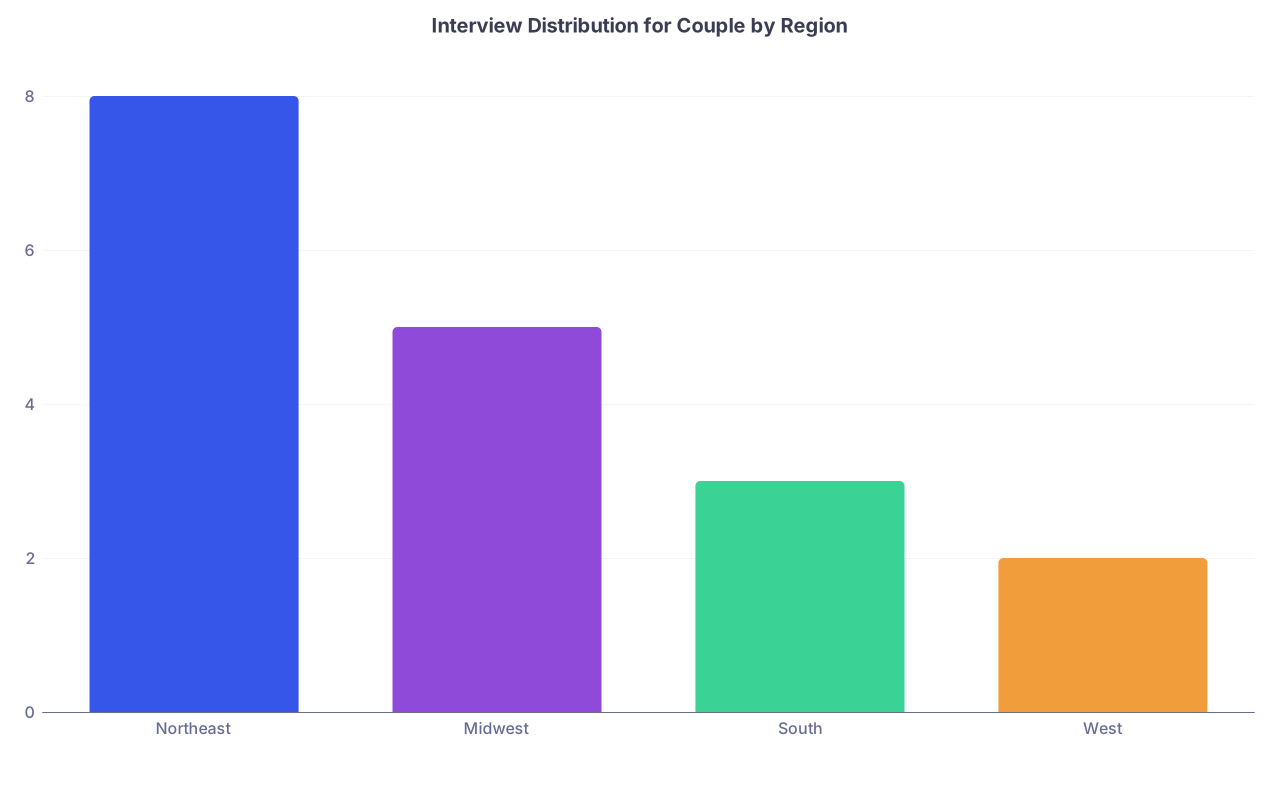
| Category | Value |
|---|---|
| Northeast | 8 |
| Midwest | 5 |
| South | 3 |
| West | 2 |
Then ask:
- Does one partner have > 1.5x the number of interviews of the other?
- Are most of your overlaps in a region you actually want?
- Is one partner’s interview set heavily scattered while the other’s is regionally clustered?
Patterns I see all the time:
- Partner A (competitive specialty) has 18 scattered interviews.
- Partner B (less competitive specialty or geographic restriction) has 7, but 5 of those are in one region.
- Overlaps: 3 total. All in Tier 2 cities, not Tier 1.
If that looks familiar, you have an interview imbalance plus geographic misalignment. That is what we are going to fix.
Step 3: Decide Your Real Priority: Specialty vs Location
Most couples never say this out loud, so the whole season is chaos.
You must pick your hierarchy:
- Option 1: Specialty first, location second
- “We would rather both match in our chosen fields even if we end up in a random city.”
- Option 2: Location first, specialty second
- “We would rather be together in the same region, even if one of us has to match at a community program or prelim/transitional year.”
- Option 3: One partner specialty‑priority, the other location‑flexible
- “Partner A must match in Derm/Ortho/ENT. Partner B is flexible on program tier or even specialty, as long as we are in the same city/region.”
Stop pretending all three are equally important. They are not.
Say it clearly:
- “Our hierarchy is: (1) both match somewhere, (2) same region, (3) preserve Partner A’s specialty, (4) preserve Partner B’s specialty, (5) prestige.”
Once you commit to that, the rest of the decisions get easier and less emotional.
Step 4: Aggressively Label Programs by Role
Every program on both your lists needs a role label:
- Anchor – Strong chance both can match here; good fit; in a preferred region.
- Upside – Reach program/prestige, may not take many couples, or mismatch with one partner’s competitiveness.
- Safety – Not ideal location or prestige, but reality-based place to both match.
- Solo‑only – One partner has a shot; the other has essentially no pathway (wrong specialty, too few positions, historically no couples).
Now overlay that on the imbalance:
- Where Partner A has an interview and Partner B has none:
- Can Partner B reasonably still get an interview here?
- Does the program even have slots in Partner B’s specialty?
- Do they take couples or dual‑specialty couples?
If the honest answer is “no realistic path for Partner B,” that interview becomes Solo‑only by default. Which means that if your priority is staying together, that interview is disposable under pressure.
That is the part people do not like hearing. But it is the only way to protect the couple match.
Step 5: Redistribute Using Three Levers
Now you get tactical. You have three main levers:
- Communication to programs
- Adding or dropping applications/interviews
- Rank list strategy
Let us walk through them.
Lever 1: Email Programs to “Pull Up” the Weaker Side
This is the part almost no one uses well. They either do nothing, or they send vague, needy emails that get ignored.
You are going to send targeted, high‑yield emails in two directions:
A. Programs where one of you has an interview, the other does not
These are your best opportunities.
Template (adapt and make it sound like you):
Subject: Couples Match – Interest in [Program Name], [Specialty]
Dear Dr. [PD Last Name],
My partner and I are participating in the NRMP Couples Match. I am interviewing with your [Specialty A] program on [date]. My partner, [Partner Name], applied to your [Specialty B] program but has not yet received an interview invitation.
We are both very interested in training at [Program Name] and in building our lives together in [City]. [Partner Name] is particularly drawn to your program because of [specific reason – curriculum track, patient population, research, etc.].
I understand how competitive this season has been. If there is any possibility for [Partner Name] to be considered for an interview, we would be extremely grateful. We believe we would both be a strong fit for [Program Name] and would rank your programs highly on our couples list.
Thank you for your time and consideration.
Sincerely,
[Your Name], [Medical School]
AAMC ID: [ID]
Key points:
- One concise email, not a novel.
- Specific reason, not “great reputation.”
- Clear couples match mention.
- Subtle but explicit: “We will rank you highly.”
B. Regions where you have partial traction
Example:
- Partner A has 4 Midwest interviews.
- Partner B has 1 Midwest interview + 3 South interviews.
You want to cluster around that Midwest cluster.
Email other Midwest programs where Partner B applied but never heard back. Use a similar email, but reference both partners’ interest in the region, specific ties, or reasons.
You will not get a 100% hit rate. You do not need that. If you pull in even 2–3 extra interviews for the weaker partner in the right region, that can completely change your match outcome.
Lever 2: Strategic Adds and Late Applications
Yes, late applications are annoying and expensive. Sometimes they are the smartest move you can make as a couple.
Here is when I tell couples to strongly consider late additions:
- One partner has >12 interviews already; the other has <7.
- Your overlaps are fewer than 4–5 programs.
- You have not yet meaningfully targeted community programs or less competitive regions.
Use a focused approach:
Identify:
- Cities where one of you already has an interview.
- Nearby programs within 1–2 hours of that city in the other partner’s specialty.
Add programs that:
- Historically take more IMG/DO/average‑stat residents.
- Are community‑based or university‑affiliated community programs.
- Are in Tier 2 or Tier 3 regions but within a drive of anchor cities.
In your application:
- Use your personal statement or an additional paragraph to mention your partner and couples match.
- Follow up with a short email to the PD and coordinator flagging your application and couples status.
You are not trying to magically get into the “top 5” program with a late app. You are building safety and proximity.
Lever 3: Ruthless Interview Dropping and Consolidation
Now the part that actually redistributes: some of those shiny interviews one partner has are doing nothing for you as a couple.
Examples of interviews that should be on the chopping block:
- Partner A has a single interview in City Z (no family ties, no partner traction nearby), 2,000 miles from everywhere else.
- The program does not have Partner B’s specialty.
- Or Partner B’s specialty at that institution has never taken couples, or is hyper‑competitive.
Unless you are willing to risk a solo match there, this interview is expensive fantasy.
You drop that interview, and you repurpose:
- Time → for better interview prep at programs that matter jointly.
- Money → for additional applications for the weaker partner or travel to cluster interviews.
- Emotional bandwidth → less scattered, more focused.
To decide what to drop, use two questions:
- “Is there a realistic path for both of us to match in or near this city?”
- “Does this interview meaningfully change our floor (safety) or ceiling (prestige) as a couple, given our priorities?”
If the answer is no to both, it is a vanity interview. Let it go.
Step 6: Build a Couples‑Smart Rank List (Not Just Merge Two Solo Lists)
Most couples screw this up. They basically:
- Make their own solo rank lists.
- Try to “line them up” and call it a couples list.
That is not a strategy. That is laziness disguised as compromise.
You are going to build your list from the couple’s perspective first, then adjust individually.
Here is the process I use:
List all program pairs that are realistically possible
- Same institution, both specialties.
- Same city, different institutions.
- Nearby cities (commutable or realistic for a 1–2 year distance plan, if you have chosen that).
Categorize each pair:
- Tier A: We would be thrilled here.
- Tier B: This is solid and realistic.
- Tier C: This is our “we both match” list, even if not ideal.
Sequence by couple priority, not solo prestige
- A mid‑tier program pair where you are together usually outranks a top‑tier solo for one partner and no spot for the other.
Only after the couple list is built do you add solos at the bottom
- Solo tracks for:
- “Partner A matches, Partner B SOAPs or reapplies.”
- Or vice versa.
- Solo tracks for:
This is where it helps to actually sketch the logic.

| Step | Description |
|---|---|
| Step 1 | Start |
| Step 2 | Rank joint program pair |
| Step 3 | Rank solo + unmatched partner |
| Step 4 | Do not rank |
| Step 5 | Next combination |
| Step 6 | Finalize list |
| Step 7 | Both together? |
| Step 8 | Geographically acceptable solo? |
You are building a ladder from best‑case together → worst‑case together → solo safety scenarios. That is how you prevent “we both go unmatched because we only ranked impossible pairs.”
Step 7: Specific Playbooks for Common Couple Scenarios
Let me run through some real‑world patterns and what I tell people to do.
Scenario 1: One very competitive specialty + one moderately competitive
Example:
- Partner A: Dermatology, 14 interviews.
- Partner B: Internal Medicine, 6 interviews.
Risk: Partner A matches somewhere great. Partner B is shut out or far away.
Fix:
Partner A:
- Drop 2–3 geographically isolated derm interviews with no IM opportunities nearby.
- Email PDs at derm programs in cities where Partner B has IM interviews to express strong interest, couples status, and willingness to rank highly.
Partner B:
- Add community IM programs in every city where Partner A has a derm interview.
- Email IM PDs explicitly about the couples match and willingness to rank them highly if granted an interview.
Both:
- Prioritize derm+IM pairs in the same city first on the rank list.
- Use solo derm or solo IM only near the bottom as true “we would rather one of us match than both go unmatched” options.
Scenario 2: Same specialty, big spread in competitiveness
Example:
- Both EM.
- Partner A: 16 EM interviews (mix of academic + community).
- Partner B: 5 EM interviews (all community).
This is easier than you think.
Fix:
Partner A:
- Shift focus from top‑tier academic programs that have shown no interest in Partner B.
- Email PDs at Partner B’s community programs where A has not been invited, explicitly asking for consideration (“I would be very excited to rank your program highly with my partner”).
Add:
- A few extra lower‑tier or geographically flexible EM programs that are “friendlier” to applicants like Partner B.
- If still thin, consider prelim medicine or transitional years in the same cities as A’s strongest EM programs.
-
- EM/EM together first.
- EM/prelim or EM/TY combos in the same city next.
- Only then EM/No match options if you both decide that is acceptable.
Scenario 3: One partner has very few or zero interviews
This is the nightmare scenario. I have seen couples here in late January who thought “something will come eventually.” It did not.
You need a harsh plan.
Fix:
Accept reality fast:
- If one partner has 0–2 interviews after the main invite waves, their match probability is low.
Reframe goals:
- Goal 1: Make sure somebody in the couple matches.
- Goal 2: Set up the weaker partner for a stronger reapplication year in a specific region.
Stronger partner:
- Stop dropping any interview that could become an anchor city for the couple next year.
- Prioritize cities where weaker partner could reasonably:
- Get a research year
- Do an MPH/MSc
- Work as a research assistant or hospital staff
Weaker partner:
- Identify and apply to research or non‑ACGME roles in those likely match cities right now.
- Start establishing connections this cycle (email faculty, volunteer, etc.).
Rank list:
- You will mostly be ranking solo outcomes for the stronger partner plus “unmatched” for the other.
- Painful, but better than both going unmatched.
I have seen couples recover from this and match together the following year because they handled this year strategically instead of emotionally.
Step 8: Communication Rules Between the Two of You
The tactical stuff will not work if you are busy fighting each other.
Set some ground rules:
No guilt for having more interviews.
- The market is irrational. Stop making this a referendum on self‑worth.
Every drop is a joint decision.
- If Partner A is giving up a dream‑program interview, Partner B acknowledges that cost. Explicitly.
No solo “Hail Mary” moves without discussion.
- No secret emails asking for independent positions far away “just in case.”
- That is how couples end up half‑breaking up on Match Day.
Weekly 30‑minute sync until rank list certification.
- What changed?
- Any new interviews?
- Any programs moved tiers?
- Any new information (program reputation, call schedules, city impressions)?
Treat it like a joint project, not two parallel solo runs.
Quick Timeline If You Are Late in the Season
If you are reading this in December–January, here is how to triage.
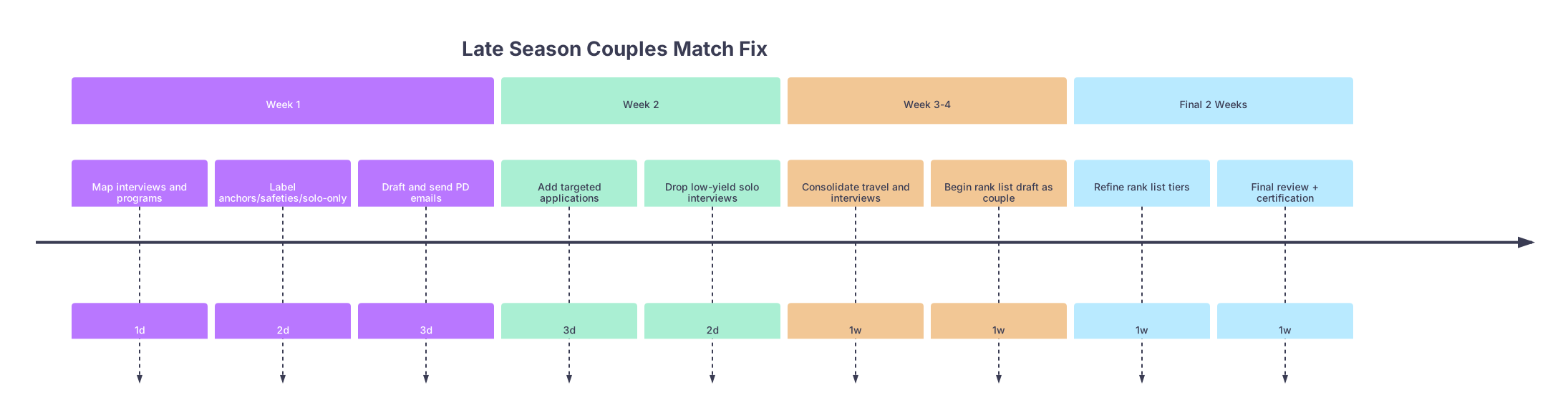
| Period | Event |
|---|---|
| Week 1 - Map interviews and programs | 1d |
| Week 1 - Label anchors/safeties/solo-only | 2d |
| Week 1 - Draft and send PD emails | 3d |
| Week 2 - Add targeted applications | 3d |
| Week 2 - Drop low-yield solo interviews | 2d |
| Week 3-4 - Consolidate travel and interviews | 1w |
| Week 3-4 - Begin rank list draft as couple | 1w |
| Final 2 Weeks - Refine rank list tiers | 1w |
| Final 2 Weeks - Final review + certification | 1w |
Do not wait until the night before the rank list is due. You will just panic and preserve the imbalance.
Example: Before-and-After Rebalance
Here is what this can look like in practice.
Before:
- Partner A: 17 interviews, 9 cities.
- Partner B: 6 interviews, 4 cities.
- Overlapping cities: 2.
- Overlapping programs: 1.
Actions taken:
- Emails to 8 programs where A had interviews and B did not.
- B added 7 new community programs in A’s existing cities.
- Dropped 4 of A’s isolated interviews.
- Weekly 30‑minute check‑ins.
- Built couple‑first rank list.
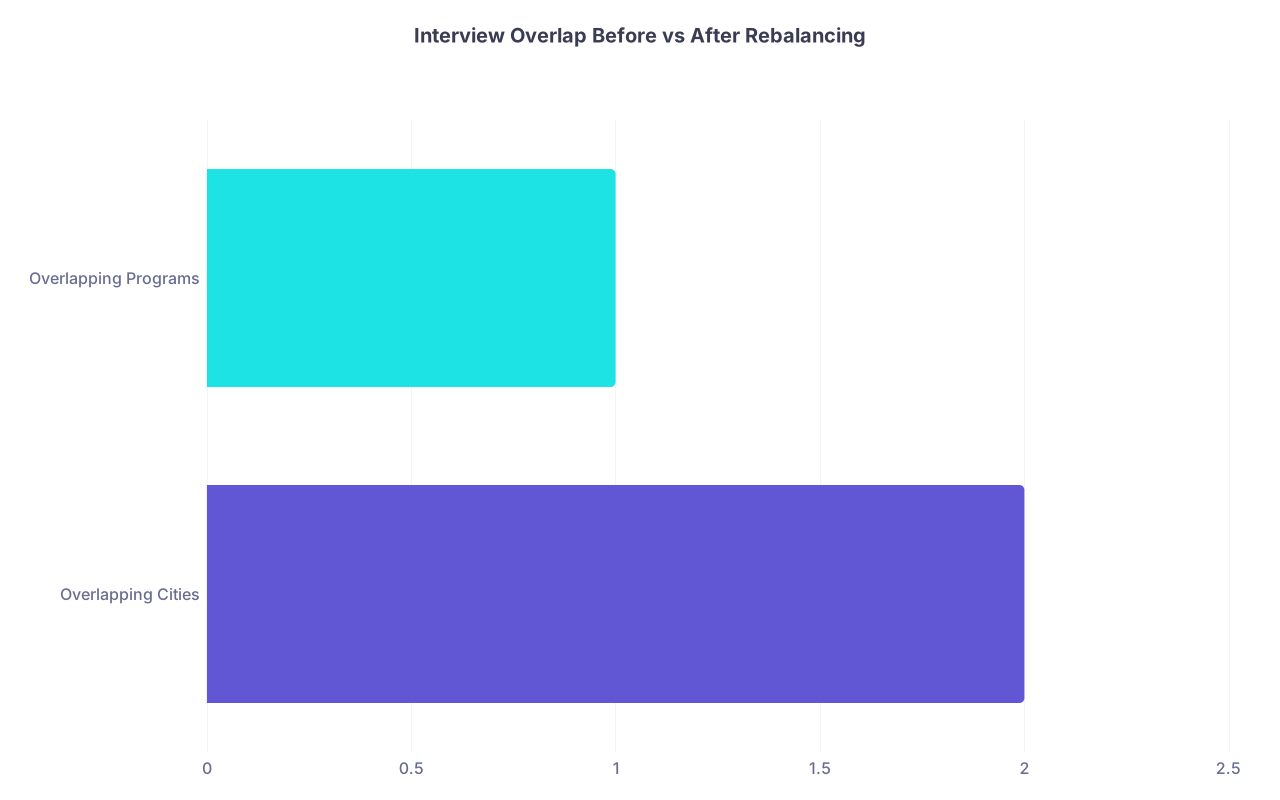
| Category | Value |
|---|---|
| Overlapping Cities | 2 |
| Overlapping Programs | 1 |
After rebalancing:
- Partner A: 13 interviews (all in cities where B has at least 1 program).
- Partner B: 10 interviews.
- Overlapping cities: 5.
- Overlapping programs: 4.
- Rank list: ~35 realistic together‑options before any solo scenarios.
That couple matched in a Tier 2 city, both in categorical positions. Neither in their original “dream” program. Both very happy two months later.
A Simple Mental Model: Anchors, Arcs, and Airballs
If you want a shortcut to sanity, classify each interview and program as one of three:
- Anchor – A realistic, solid place for both of you to land.
- Arc – A reach that could lift you to a great outcome if it works.
- Airball – Looks cool, feels flattering, but has almost no path to a joint match.
Your job in this late stage is:
- Increase the number of anchors.
- Have a few arcs.
- Ruthlessly cut airballs.
And then build your rank list around that logic.
FAQ (Exactly 4 Questions)
1. Is it actually safe to tell programs we are couples matching, or will it hurt us?
In practice, for residency, being a couples match usually helps more than it hurts, especially for mid‑tier and community programs. You are signaling higher probability of staying in the area, building a life there, and being committed. Most PDs like stability. The only time I advise caution is if one partner’s application is dramatically weaker and you are contacting a hyper‑competitive academic program that already interviewed the strong partner; occasionally a PD will quietly worry about being pressured to take both. Even then, the bigger risk is saying nothing and having no path for the second partner.
2. How many interviews does each partner need to feel reasonably safe as a couple?
For most core specialties (IM, Peds, FM, Psych, etc.), I start to sleep better when each partner has at least 10–12 interviews, with at least 5–6 overlapping cities and several overlapping programs. Very competitive specialties are their own beast; there, even 8–10 interviews can be “enough” for that partner, but you must build a bigger base of options for the other partner in the same regions. The critical metric is not the raw number of interviews; it is how many realistic city or program pairs you can rank together.
3. Should we ever rank solo options high, or does that defeat the purpose of couples matching?
That depends on your hierarchy. Some couples explicitly decide, “We would rather both go unmatched than be apart,” and they rank almost no solo options. Others say, “One of us matching is better than neither,” especially if one partner is in a time‑limited visa situation or a narrow specialty. My default recommendation: build a long, serious list of together‑options first, then add solo outcomes only near the bottom as true worst‑case safety nets. But you have to align on this explicitly as a couple, not discover on Match Day that you had different assumptions.
4. Is it too late to fix an interview imbalance if it is already January or early February?
Not necessarily. You will not magically turn 3 interviews into 15, but you can still materially improve your odds as a couple. Late‑season emails can pull in an extra 1–3 interviews for the weaker partner, particularly at community and less saturated programs. Strategic dropping of low‑yield solo interviews can tighten your geography and give you more realistic pairs to rank. And even if the numbers do not change much, a couples‑first rank list can prevent you from wasting your limited overlap on unrealistic pairings. The worst thing you can do late is to freeze and just “hope the algorithm is kind.” It will not be. You need to move.
Key takeaways:
- Treat interview imbalance as a logistics problem: map everything, categorize programs, use targeted emails and late applications to pull up the weaker partner and build anchors.
- Drop low‑yield solo interviews that do nothing for you as a couple, and build your rank list from the couple’s priorities first, with solo outcomes only as explicit safety nets.


