

62% of couples who use the NRMP Couples Match end up in the same hospital or even the exact same program.
That is the opposite of what you hear on the wards.
Ask a random attending or PGY-2 and you’ll hear some version of: “Couples rarely end up together; be ready for long-distance.” It gets repeated so often that people treat it like a law of physics. It is not. It is a half-remembered anecdote dressed up as wisdom.
Let’s cut through the folklore and look at what the numbers actually say.
What the NRMP Data Really Shows About Couples Matching
The NRMP publishes Couples Match data every year. Hard numbers. Not vibes, not “this one couple I knew back in 2012.”
Here’s the punchline: couples don’t just “sometimes” end up together. A majority do.
From recent NRMP reports (pattern is consistent year after year):
- About 1,300–1,500 couples participate in the Couples Match each year (so ~2,600–3,000 applicants).
- Roughly 95% of couples match to two positions.
- Among those, around two-thirds land either:
- in the same program, or
- in different programs at the same institution.
Let me show you the structure of what we’re talking about:
| Outcome Type | Approximate Share of Matched Couples |
|---|---|
| Same program | 25–30% |
| Different programs, same hospital | 30–35% |
| Different hospitals, same city | 20–25% |
| Different cities (2-position match) | 10–15% |
Are those exact numbers for every single year? No. Are they directionally accurate and consistent across recent reports? Yes.
The idea that “couples almost never match together” is simply false. The rarer outcome is the one people love to dramatize: both partners matching to solid programs but in totally different cities.
And the reason that story gets told so often is simple: it’s painful, memorable, and everyone loves to tell a horror story.
Why Everyone Thinks Couples Rarely Match Together
This is the classic med school informational bias problem.
You remember the one couple who matched 1,000 miles apart and cried in the hallway. You do not remember the four couples who quietly matched into the same hospital and just went on with their lives.
I’ve heard all of these, sometimes from faculty who should know better:
- “If you couples match, you’re basically agreeing to sacrifice your careers.”
- “Programs hate couples.”
- “You’ll have to go to some random middle-of-nowhere place if you want to stay together.”
Combine that with the baked-in pessimism of clinical training, and you get a myth that sounds plausible even while the data torpedoes it.
Here’s the reality:
Programs don’t hate couples. Programs hate risk and uncertainty. Once they understand who you are as a pair and how your rank list works, many of them actually like the idea of securing two stable residents at once.
How the Couples Match Algorithm Actually Works (Without the Fairy Dust)
The Couples Match is not a separate algorithm. It’s the standard NRMP algorithm with one twist: it evaluates ranked pairs of programs instead of single programs.
You and your partner create a joint rank list. Each line is a pair:
- (Your Program A – Their Program A)
- (Your Program A – Their Program B)
- (Your Program B – Their Program A)
- (Your Program C – Their Program C)
- (Your Program D – Unmatched)
- (Unmatched – Their Program D)
And so on.
The algorithm then tries to place you in the highest possible pair that works for both of you simultaneously.
Here’s the part people misunderstand:
It is not “both in top choice or you’re destroyed.” The algorithm will happily place you in a slightly lower preference where you’re together rather than a higher preference where only one of you fits.
To make that clearer:

| Step | Description |
|---|---|
| Step 1 | Start with top ranked pair |
| Step 2 | Match to that pair |
| Step 3 | Move to next pair |
| Step 4 | Unmatched or partial outcomes |
| Step 5 | Can both fit? |
| Step 6 | Reached end of list? |
So if you rank thoughtfully and build enough pairs in the same hospital or city, the math is not working against you. It’s working with you.
Same Hospital vs Same City: What You’re Actually Aiming For
“Same hospital or bust” is one of the more self-sabotaging takes I see.
Yes, there are couples who land in the exact same institution. But an awful lot of rational couples use a tiered approach:
- Same program
- Same hospital
- Different hospitals, same city
- Neighboring cities with commutable distance
- Only then, true long-distance
If you structure your list this way – instead of “same program or nothing” heroics – your chances of being in the same city are very good.
Here’s roughly how the probability drops as you expand your geographic flexibility:
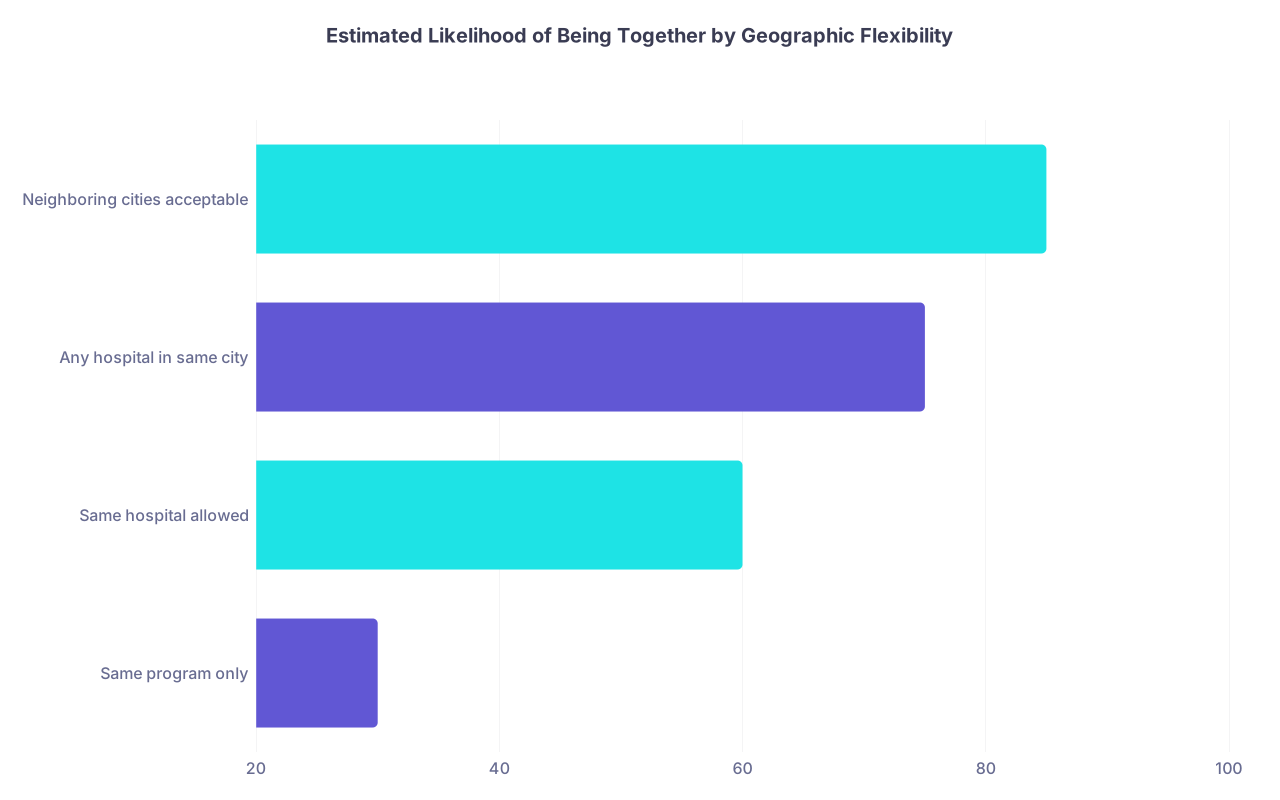
| Category | Value |
|---|---|
| Same program only | 30 |
| Same hospital allowed | 60 |
| Any hospital in same city | 75 |
| Neighboring cities acceptable | 85 |
These aren’t official NRMP numbers; they’re consistent with what you see when you combine the NRMP data with the way couples usually rank. The pattern holds: if you accept “same city” instead of insisting on “same hallway,” you dramatically cut your risk of separation.
The Real Trade-Off: Location Snobbery vs Being Together
You cannot talk about the Couples Match honestly without stepping on some toes. So let’s do that.
The couples who get burned the worst are very often the ones who:
- Apply to 15–20 programs each in ultra-competitive specialties
- Only rank 1–2 cities as acceptable
- Refuse to consider mid-tier or community programs
- Then act shocked when the algorithm does exactly what they told it to do
If both of you want MGH, UCSF, or Penn, and neither of you will tolerate the idea of a strong but less-branded program, you’re not in a “Couples Match problem.” You’re in an expectations problem.
By contrast, the couples who quietly succeed do a few unglamorous but effective things:
- They over-apply in less competitive regions.
- They talk openly with each other about what’s truly non-negotiable.
- They accept that one of them might go to the slightly “less shiny” program so they can be together.
I’ve watched:
- A derm + psych couple both land at the same big academic center, but the derm partner was willing to take a lower-tier program there instead of chasing a prestige name across the country.
- An EM + FM couple who matched at two different hospitals in the same city because they ranked the city as the priority, not the institution.
Did either couple get their absolute dream AOA fantasy? No. Did they get to live together and train at solid programs in good cities? Yes.
That’s the actual bargain you’re making as a couple: you trade a bit of individual geographic and prestige optimization for a high probability of ending up together.
If you pretend that trade-off doesn’t exist, the Match will teach it to you the hard way.
Specialty Choice: Are Some Couples Just Doomed?
Some combinations are harder than others. No way around that.
If both of you are:
- Gunning for ultra-competitive fields (derm, plastics, ortho, ENT, neurosurgery), and
- Only willing to live in major coastal cities,
your risk of separation goes up. Quite a bit.
On the other hand:
- IM + peds
- IM + psych
- FM + almost anything
- Or one competitive + one less competitive specialty
Those pairs have a lot of institutional overlap. Plenty of hospitals train those specialties side by side. That’s why NRMP data consistently shows couples in primary-care-ish combinations doing very well at staying together geographically.
But again, even competitive–competitive couples are not doomed. They just have to be more strategic and less precious.
A not-uncommon pattern I’ve seen: the more competitive partner applies very widely and treats a slightly “down a tier but same city” option as a win, not a disaster. When they do that, same-hospital or same-city outcomes become quite realistic.
The Big Hidden Benefit: Couples Actually Match More Often
Here’s the quiet fact almost nobody talks about:
Couples who enter the Match as a couple have a higher overall match rate than individual applicants.
Why? Two reasons:
- They tend to apply more broadly because they’re scared. Ironically, the fear pushes them into safer behavior.
- The algorithm gives them more ways to succeed. A pair that might not independently land at their #2 or #3 programs can still end up with a favorable combined outcome (e.g., #4/3 pair) that keeps them together at good institutions.
The myth is “the Couples Match is a huge risk.”
The data says couples, on average, are slightly more protected.
Is there still risk? Obviously. But it’s not some Russian roulette variant. It’s a structured system that gives you a lot of control—if you use it intelligently.
How to Stack the Odds in Your Favor (Without Gaming the System)
You cannot hack the algorithm. You can, however, stop sabotaging yourself.
A few principles I’ve seen pay off repeatedly:
- Decide as a couple what matters more: together vs prestige vs city. Rank accordingly. Do not lie to yourselves about this.
- Build a deep, realistic rank list of same-hospital and same-city pairs before you start adding far-flung “reach” combos.
- Be very clear with programs (when appropriate) that you’re in the Couples Match, what your partner is applying in, and where they’ve applied. Some PDs absolutely do coordinate informally.
- Be willing for one partner to “take the slightly less shiny role” if it keeps you together. The second-best academic IM program in a city is still an academic IM program.
And maybe the most important: stop asking your bitter PGY-3 friend who “knows a couple that got split” to model your risk. Read the actual NRMP data.
So, Do Couples Rarely Match in the Same Hospital?
No. That line is flat-out wrong.
Most couples who participate in the NRMP Couples Match:
- Match to two positions, and
- Land in the same hospital or at least the same city, especially if they’re remotely flexible and rational about geography and prestige.
The real danger is not the algorithm. It’s magical thinking, rigid expectations, and listening to loud anecdotes instead of quiet statistics.
If you care more about being together than chasing the perfect logo, the system is surprisingly friendly to you.
Key points:
- A majority of couples end up in the same program or same hospital; separation is the exception, not the rule.
- Your flexibility on city and prestige matters more than the fact you’re in the Couples Match.
- The algorithm actually protects couples more than it hurts them—if you build a thoughtful, realistic joint rank list.


