

The belief that “couples match always lowers your chances” is wrong. The data we actually have tells a much less dramatic story—and in many cases, the penalty is far smaller than people scare each other into thinking.
You’re not playing on “hard mode” just because you couples match. You’re playing a different game with different constraints. And some of you are sabotaging yourselves more with bad strategy than with the couples algorithm itself.
Let’s sort myth from reality.
What the Data Actually Shows About Couples Match Outcomes
First, numbers. Not vibes. Not that one horror story you heard from an upperclassman at 2 a.m. in the call room.
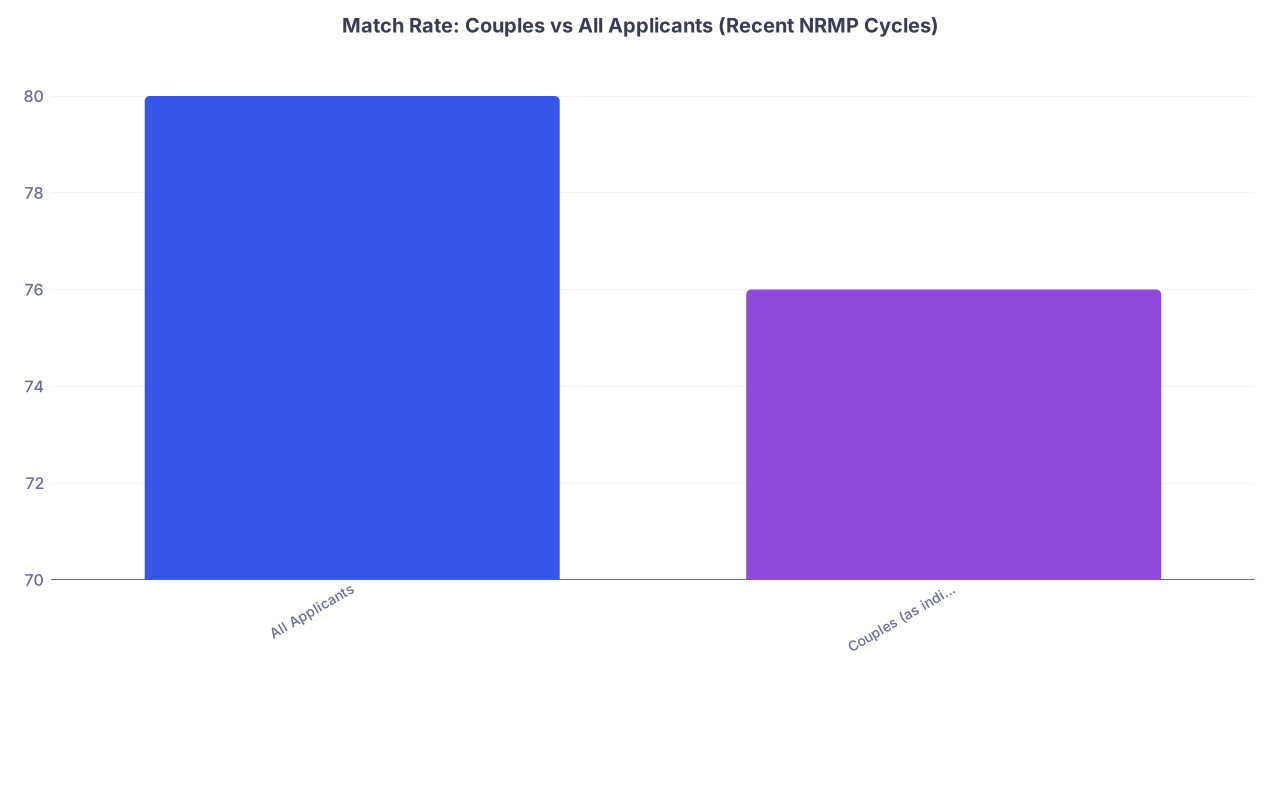
NRMP directly publishes couples match data. Here’s what jumps out when you actually read it instead of repeating folklore.
| Category | Value |
|---|---|
| All Applicants | 80 |
| Couples (as individuals) | 76 |
Across recent Main Residency Matches:
- Overall PGY-1 match rate for all applicants tends to hover around 80–83%.
- Match rate for applicants participating as couples tends to be only a few percentage points lower—usually mid-70s as individuals.
Not 40%. Not “you’re doomed.” A small drop.
The important part: that’s the individual match rate. But couples match isn’t graded on individuals. What you care about is:
Do we both match, and do we end up in the same region or city?
For that, NRMP also gives us something more useful: the percentage of couples who match to both positions in their rank list (i.e., each partner gets a position from their couples-linked list). That figure is typically high—well over 90% of couples match at least one position each, and the majority match to one of their paired ranks.
So the reality:
- Being in the couples match slightly lowers your individual odds.
- It does not turn the match into a lottery from hell.
- Most couples end up matching together somewhere.
Is there some trade-off? Of course. But the horror-story version is inflated.
What Actually Lowers Your Chances (Hint: It’s Usually Not “Couples”)
Here’s the piece people ignore because it’s less fun than blaming “the couples algorithm.”
Most couples do worse not because they couple. They do worse because they:
- Apply like a non-couple in terms of number and spread of programs.
- Over-anchor on a single city or a few “dream” programs.
- Build a completely unrealistic rank list structure.
Let me be blunt. I’ve watched couples:
- Both apply to 20–25 programs in ultra-competitive specialties.
- Only overlap at 8–10 programs in the same city.
- Refuse to consider nearby-but-not-identical locations (e.g., Philly vs NYC vs New Haven vs Boston).
- Then act shocked on Match Day.
That’s not a couples-match problem. That’s a strategy problem.
Here’s what the algorithm actually does: it tries to place you as a unit at the best possible pair of positions consistent with both your joint rank list and program rank lists. When you give it 12 realistic, geographically flexible options, it does pretty well. When you give it 3 fantasy pairings in one city and nothing else, it shrugs and moves on.
The couples algorithm does exactly what you ask it to do. A lot of couples are just asking badly.
How the Couples Algorithm Really Works (And Why the “Always Lower” Claim Is Oversimplified)
You do not need to be a computer scientist to understand this well enough to actually use it.
In the regular match, the algorithm looks at your rank list, tries your first choice, then your second, and so on, while balancing what the programs want.
In the couples match, you and your partner submit pairs of choices.
Think of each line of your rank list as:
- (Your Program #1, Partner Program #1)
- (Your Program #2, Partner Program #2)
- (Your Program #3, Partner Program #3)
- …
You can also pair a real program with “No Match” on one side. For example:
- (Your Awesome IM Program, Partner – No Match)
- (You – No Match, Partner Awesome Peds Program)
The algorithm then tries each pair in order. It asks: “Is there a way to assign both partners to these programs, given everyone else’s ranks and program caps?” If yes, you both tentatively land there. If not, it moves to the next pair.
The key myth: “Because it has to find two spots, you always get bumped down dramatically compared to if you matched alone.”
Reality is more nuanced:
- In dense program markets (large metro areas, lots of hospitals, multiple residencies), it’s surprisingly easy for the algorithm to find paired spots—especially for bread-and-butter specialties like IM, peds, prelim medicine, FM.
- The penalty becomes noticeable when:
- You’re both in competitive specialties with low spot numbers, or
- You insist on a ultra-narrow geographic target with very few programs.
But again, that’s not “the couples algorithm hates you.” That’s simple math: two highly constrained searches intersecting.
What couples match does add is correlation: your outcomes are linked. You’re no longer two independent applicants. That means:
- Less variance: much less chance that one of you matches top-tier and the other SOAPs into a random prelim.
- More constraint: somewhat lower probability of each of you independently maximizing your personal dream scenario.
Most couples prefer that trade. They want the correlation. They just underestimate how much flexibility they still need to build in.
Where Couples Match Does Clearly Hurt Your Chances
Let’s not sugarcoat the parts that actually are worse.
There are a few situations where I’ve consistently seen couples match become a real handicap, not just a small penalty.
1. Two Competitive Specialties, Same City, Minimal Backups
Classic bad setup:
- Partner A: ENT or Derm or Ortho
- Partner B: Ortho, Derm, Rad Onc, or even EM in some markets
- Both only applying heavily to, say, one or two urban hubs (Boston, SF Bay, NYC)
- Both with rank lists that basically say: “These 5 shiny brand names or nothing.”
You’ve turned an already-competitive process into a constrained optimization problem with almost no solutions.
Could both match individually? Possibly.
Could both match together in those exact spots? Much less likely.
If you’re both reaching, you need to be aggressively compensating with:
- Long rank lists
- Willingness to separate “by a drive” (e.g., 60–90 minutes apart)
- One or both of you adding a safety-rich specialty (primary care, prelim + advanced backup) if you truly cannot move.
If all three of those are “no,” then yes—the couples match is amplifying your risk.
2. Tiny Regions With Few Programs
If you want “same city, same hospital system” in a place with:
- One academic center
- Maybe one community program
You’re playing on hard mode. A single program director’s preferences can drastically change your odds. This is where couples match stops being a mild penalty and becomes a real constraint.
Look at the actual program numbers. If your joint geography has:
- Only 1–2 IM programs
- 0–1 of your partner’s specialty
- No prelims or transitional years
Your flexibility is basically zero. The couples algorithm can’t place you in positions that don’t exist.
3. Strong Applicant + Weak Applicant, But No Realistic Compromise
Here’s a quiet pattern I’ve seen:
- One partner is objectively much stronger on paper (higher Step 2, better school, stronger letters, more research).
- That partner could reach significantly more competitive programs or coastal academic centers.
- The other partner can’t realistically stretch that high without a miracle.
If the stronger partner refuses to build a two-tier list—“shared realistic options” plus “individually stronger options paired with No Match / weaker city slots for the partner”—then both sink to the level of the weaker application.
That’s not inevitable. That’s a planning failure and an ego problem.
You can design a list that prioritizes shared realistic matches up top, then lets the stronger partner reach independently further down with paired (Program, No Match) or (Program, Backup City) options. But couples often skip that nuance.
Where Couples Match Hurts Far Less Than People Think
On the flip side, there are many scenarios where the couples penalty is often negligible—if you don’t sabotage yourself.
Scenario: One Competitive, One Less Competitive, Big Metro Area
This is incredibly common:
- Partner A: IM, peds, FM, psych, prelim medicine, anesthesia at mid-range.
- Partner B: More competitive, but not insane (e.g., EM in a normal market, anesthesia, rads, categorical surgery but not Plastics or Ortho).
And they’re open to:
- Any large metro or cluster of cities within 60–90 minutes.
- Academic + community.
- Name vs no-name.
What happens? Usually:
- Partner A has no problem finding a spot in most cities that can absorb Partner B.
- Partner B’s competitiveness becomes the rate-limiting factor.
- Because there are usually multiple programs in large metro areas, the algorithm can often find some pairing—maybe not at the top of their individual lists, but well within their joint realistic range.
Here, couples matching shifts things a little downward, but not dramatically. You might move from a “top 3 solo” outcome to a “top 5 joint” outcome. That’s not torpedoing your chances. That’s a trade for being in the same place.
And no, that’s not a tragedy.
The Part Nobody Tells You: Great Strategy Beats “Going Solo”
Let me be very direct: I’ve seen couples match better than they likely would have individually because the process forced them to be more realistic, more organized, and more intentional.
Solo applicants often:
- Apply to too few programs.
- Fixate on dream cities.
- Underestimate how strong the competition is.
Couples, when they do this intelligently, often:
- Apply to a broader set of regions.
- Seriously discuss tiered options: “dream,” “solid,” “floor.”
- Build longer joint rank lists with real backup structures.
Result: their effective odds of both landing in a decent spot can actually feel less random and more stable than two chaotic solo applications.
To make the couples algorithm work for you rather than against you, you need three things:
Brutal realism about competitiveness
Not the fantasy where “my advisor said I have a shot anywhere.” Look at your Step 2, school, red flags, and actual interview counts. If one of you is clearly weaker, build the list around the joint realistic level, then create individual reach tiers further down.Geographic flexibility in regions, not just single cities
Think: “Mid-Atlantic corridor,” “Upper Midwest cluster,” “Texas triangle.”
If you insist on exactly one metro and nothing else, you’re manufacturing your own disadvantage.Thoughtful rank list engineering
Use:- (Program A City X, Program B City X)
- (Program A City X, Program B City Y — 60 min away)
- (Program A City Y, Program B City Y)
- (Program A City Y, No Match)
etc.
Don’t write three ideal pairs and quit because it’s annoying to build more.
Reality Check: Emotional Risk vs Statistical Risk
Part of why couples match feels so dangerous is not statistics. It is emotional exposure.
If you match solo and your partner doesn’t, you’re sad, but you can rationalize: “We’ll figure something out next year.” If you couples match and both of you fall lower than your expectations—or one of you SOAPs into a less desired specialty/location—it’s easy to blame the decision to couples match.
But emotionally charged regret is not the same as statistical disadvantage.
If the data says:
- You’d have an 80% individual chance going solo.
- You have a 75–77% individual chance going couples.
- And a high chance of both matching somewhere together.
You’re not taking some catastrophic gamble. You’re accepting a small statistical penalty to avoid the very real relational and logistical nightmare of being states apart for 3–7 years.
That’s a reasonable trade for most people.
A Quick Comparison: Solo vs Couples Reality
Let’s put this side-by-side.
| Factor | Solo Match | Couples Match |
|---|---|---|
| Individual match rate | Slightly higher | Slightly lower (few % points) |
| Chance both end up same city | Pure luck | Algorithm actively optimizes for this |
| Geographic flexibility needed | Moderate | Higher, unless extremely strong applicants |
| Emotional risk | Asymmetric (one can be far better off) | Linked (you rise and fall together) |
| Strategy required | Can be sloppy and still succeed | Poor strategy gets punished more |
In other words: couples match doesn’t destroy your chances. It punishes magical thinking more harshly.
So, Is Couples Match “Bad Strategy”? No—Bad Planning Is.
Here’s the answer you probably do not want but need:
- If both of you are reasonably competitive for your specialties.
- If you’re willing to apply broadly and be honest about program tiers.
- If you treat the rank list like a serious design problem, not a formality.
Then couples matching does not “always lower your chances” in any meaningful, life-ruining way. The penalty is modest, usually a few percentage points, and often well worth the trade of staying together.
The real threats are:
- Unrealistic geographic rigidity.
- Overly competitive specialty pairs with no backups.
- Tiny rank lists built around prestige fantasies.
If you avoid those traps, the couples match is not your enemy. It is a blunt, somewhat unforgiving tool that does exactly what you tell it to do.
Use it well, and your odds are far better than the horror stories imply.
Key Takeaways
- Couples match does not catastrophically lower your chances; the data shows only a modest drop in individual match rates compared with solo applicants.
- Most of the real risk comes from bad strategy: narrow geography, competitive specialty pairings without backups, and short or unrealistic rank lists.
- If you’re realistic, flexible by region, and meticulous with your joint rank list, couples matching is a reasonable—and often smart—way to protect your relationship without dramatically sacrificing your residency prospects.


