

Couples who only rank identical programs are usually sabotaging their match, not protecting it.
That goes against what you hear in a lot of med school hallways: “We’re couples matching, so we just ranked the same places in the same order.” I’ve watched that exact strategy blow up rank lists and turn strong applicants into unnecessary non-matches or bottom-of-the-barrel outcomes.
Let me be blunt: the NRMP Couples Match does not require you to rank only matching programs, and using it that way is like driving a Tesla only in first gear because you’re scared of the autopilot button.
You are leaving an enormous amount of optionality, and often happiness, on the table.
This article is about tearing down the myth and replacing it with how the algorithm actually works—and how smart couples really build their lists.
Where the Myth Comes From (And Why It Sounds So Convincing)
The myth:
“If we’re couples matching, we should only rank the exact same programs in the exact same order so we don’t get split up.”
I’ve heard versions of this:
- “Our dean told us to keep it simple: same programs, same order.”
- “Our friends last year just made one shared rank list and copied it.”
- “We were told the safest is only paired options—no solo ranks.”
It feels intuitive: you want to end up together, so you only give the algorithm choices where you’re together. Right?
Not really.
Here’s the problem. That “simple” strategy:
- Treats you as if you’re the same applicant (you aren’t)
- Ignores geographic flexibility (where one of you might be OK taking a slightly different program)
- Destroys your backup options (especially if one partner is more competitive)
- Misunderstands how the Couples Match algorithm actually evaluates pairs
The myth survives because people confuse simple to understand with optimal. The match algorithm does not reward you for simplicity.
How the Couples Match Actually Works (In Plain Language)
You do not submit two independent lists that NRMP then tries to glue together.
As a couple, you submit a single, paired list of combinations. Each “row” is one possible joint outcome.
Row 1 might be:
- Partner A: Program A1
- Partner B: Program B1
Row 2 might be:
- Partner A: Program A1
- Partner B: Program B2
And so on.
The algorithm then walks down these rows in order, trying to place you in the highest joint outcome that both programs can accept you into, considering everyone else in the match.
Key truths most people don’t internalize:
- You can pair different cities.
- You can pair different institutions in the same city.
- You can even rank “Program X / No Match” as a deliberate asymmetric backup.
The system doesn’t care whether the programs “match” neatly. It only cares that every row is a real combination that you are willing to accept.
So when a couple decides “we’re only ranking the same programs in the same order,” what they’re really doing is refusing to use most of the power of the couples algorithm.
They turn a 3D tool into a 1D list.
Why Only-Ranking-the-Same-Programs Is Usually a Bad Strategy
Let’s go through the main reasons this idea is flawed. And not in a small, “could be a bit better” way. In a “this can absolutely tank your outcome” way.
1. You erase one partner’s competitiveness advantage
Imagine this (which I’ve actually seen, almost number-for-number):
- Partner A (Internal Medicine): 252 Step 2, AOA, strong research, 18 interviews, including big names (Mayo, UCSF, Penn).
- Partner B (Pediatrics): 230 Step 2, solid but not elite, 10 interviews, skewed toward community and mid-tier academic.
If you only rank programs where both have interviews and then only the ones that overlap, you’ve automatically thrown away:
- A’s higher-tier academic options that did not interview B.
- B’s perfectly good programs where A didn’t bother interviewing because “they’re below my level.”
Result: your shared rank list becomes the intersection of two very different opportunity sets. That’s the smallest and often weakest overlap.
Smart couples do something different. They exploit the fact that one partner’s strong application can often still get them a solid program in a market where the other partner is weaker. That might mean:
- A at a higher-tier academic IM program
- B at a mid-tier or community peds program in the same city or nearby metro
Not identical programs. But a better joint outcome than “we both settle way lower than necessary in some random city just because both of us got interviews there.”
2. You annihilate your backup layers
The only-same-programs strategy usually creates a wafer-thin list. Something like:
- Both at Dream Academic X
- Both at Solid Academic Y
- Both at Decent Community Z
- Both at Safety Program Q
Then it stops. Because that’s where the exact overlaps stop.
You know what happens when that wafer-thin list collides with a competitive specialty or a lopsided interview season? You can drop all the way from “pretty strong applicants” to “scramble/SOAP”.
What you should be doing is building layers:
- High-end “together” options
- Same-city, different-program options
- Same-region, commutable options
- Last-ditch “one matches, one doesn’t (on purpose)” if your priority is not double-SOAPing
You cannot build that if you religiously insist on identical programs only.
Evidence and Data: What Actually Happens to Couples
The NRMP publishes data on couples every year. People rarely read beyond the one-line stat that “couples have a slightly lower match rate than individuals.”
The more useful reality:
- Most couples do match together.
- The couples who get burned are usually:
- Overly rigid in geography, and
- Overly conservative in list construction.
In the NRMP’s “Charting Outcomes in the Match” and Couples Match reports, two patterns are constant:
- Longer rank lists correlate with better match outcomes for couples.
- Couples disproportionately end up in slightly less competitive programs than their single-applicant equivalents.
That second point is often self-inflicted. When a couple decides they can only be at the same exact program, they naturally migrate to the largest, less selective institutions (lots of positions, easier to double-place). They never fully explore combinations where, say, one lands at a slightly stronger program across town while the other is at a more accessible one.
Let me make this visual.
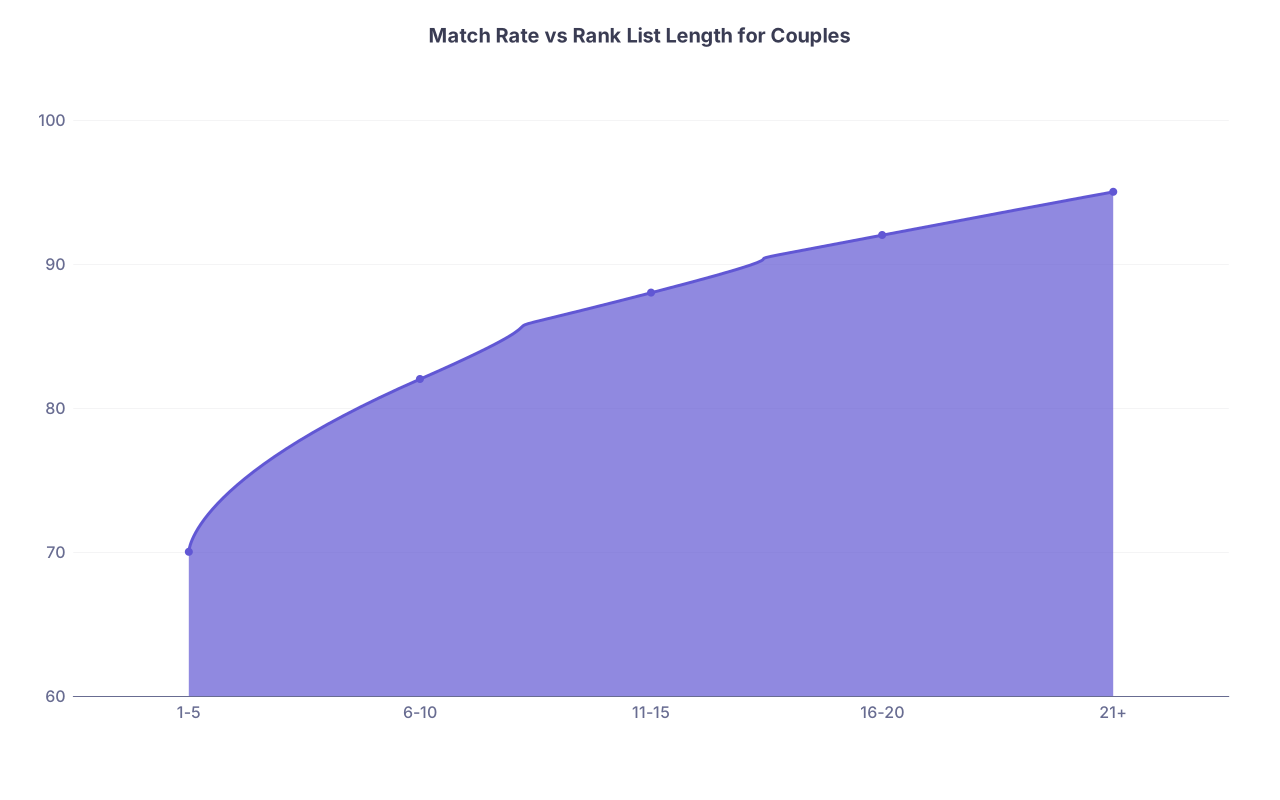
| Category | Value |
|---|---|
| 1-5 | 70 |
| 6-10 | 82 |
| 11-15 | 88 |
| 16-20 | 92 |
| 21+ | 95 |
That’s not an official NRMP graph, but it’s representative of the trend you see: more combinations → better chances. Fixating on only overlapping identical programs is the fastest way to cap your list at the low end of that spectrum.
How Smart Couples Actually Build Rank Lists
Let’s replace dogma with a practical, evidence-based structure.
Step 1: Map your joint geography, not your program clones
Start by drawing circles on a map, not listing identical institutions.
Ask:
- Which metro areas are acceptable?
- How far are you willing to commute (in real traffic, not Google Maps at 2 a.m.)?
- Are there satellite hospitals or affiliates in the same system?
Many couples do much better when they think in “commuting zones” instead of “same hospital or bust.”
Example: Boston area. You could reasonably pair (depending on commute tolerance):
- Partner A: MGH, Partner B: Boston Medical Center
- Partner A: Beth Israel, Partner B: Tufts
- Partner A: Lahey, Partner B: UMass (if you accept a longer drive or maybe a carpool-style lifestyle)
None of those are the same program. All are viable real-life setups.
Step 2: Use tiers of combinations
Instead of a flat list of “same program only,” build concentric circles of preference:
Top-tier “together at same program” options
Absolutely rank them. If they’re realistically in reach, lead with them.Same city, different programs (same tier)
“We’d rather both be in City X at solid programs than one at Dream, one at bottom-of-the-barrel in a city we hate.”Same metro, different tiers
One partner at slightly stronger academic program, the other at mid-tier or community. This is how you protect the more competitive partner from being dragged too far down just to chase overlap.Same region, commutable with sacrifice
The “we can survive a year of rough commuting if needed” tier.Asymmetric backups (one match, one ‘No Match’)
Nuclear options for couples where one partner’s risk of not matching at all is truly catastrophic (e.g., visa issues, super-competitive specialty with limited spots).
You’re using the algorithm the way it was meant to be used: reflecting your real preferences, not a cartoonish “same badge or nothing” rule.
Concrete Example: What This Looks Like In Practice
Let’s say:
- Partner A: EM applicant, 13 interviews, spectrum from strong academic to solid community.
- Partner B: FM applicant, 15 interviews, widely distributed including places A didn’t consider.
Bad list (same-programs-only mindset):
- A: Big Academic 1 / B: Big Academic 1
- A: Solid Academic 2 / B: Solid Academic 2
- A: Mid Community 3 / B: Mid Community 3
- A: Safety 4 / B: Safety 4
Four lines. That’s it. If those four combos don’t work because any given program prefers another random applicant or decided they’ve filled their EM slots before the algorithm gets to you, you’re dead.
Smarter list (collapsed version):
1–5. Both at the same top-tier shared programs (in your exact true preference order). 6–20. Same-city different-program combos (A at City X EM Program 1, B at City X FM Program A; then A at Program 1, B at Program B, etc.). 21–35. Same-region but different city, commutable if needed. 36–40. Asymmetric “one matches, one No Match” rows where that genuinely beats double-SOAP for both of you.
That second list is what couples who actually understand the system build. It’s longer. It reflects nuanced preference. And it doesn’t pretend that your interview portfolios are identical.
Let me compare “same-programs-only” vs “flexible” in a quick table.
| Aspect | Same-Program-Only | Flexible Paired List |
|---|---|---|
| List length | Short, often <10 rows | Long, often 20–40+ rows |
| Use of geography | Single hospital focus | City, metro, and region considered |
| Competitive partner | Often dragged down | Can still capitalize on strength |
| Backup options | Thin to nonexistent | Multiple tiers of realistic fallbacks |
| Risk of both not match | Higher | Lower |
The “We Don’t Want to Be Split” Objection
This is where couples dig in:
“We’d rather go unmatched than be in different programs or different cities.”
Fine. Your preferences are your preferences. But then be honest about what you’re choosing.
Two critical points:
You can still reflect that preference without artificially restricting yourself to identical programs.
You simply rank any “split” or “different program” scenario below every “together at same program” scenario. The algorithm honors that order.“Split” doesn’t have to mean “opposite coasts.” It might mean:
- Different hospitals in the same city
- An hour commute apart
- Short-term sacrifice to avoid long-term career damage
If you still decide that any non-identical pairing is unacceptable, then sure, build only-same-program rows. But now that’s an informed, eyes-wide-open trade-off, not some fake “this is how the couples match works” rule you picked up from a classmate.
How to Actually Enter Complex Lists Without Losing Your Mind
People avoid more complex lists because they’re scared of messing them up. Fair concern. But not a reason to dumb down your strategy.
Use structure:
- Start by grouping rows by city/region.
- Within each group, order combinations purely by joint happiness, not fairness, not ego, not “but I deserve X.”
- Double-check your “No Match” rows last. Ask yourself: “If we get this row, will we regret not ordering something else higher?”
If you’re especially anxious, sketch it out visually.

| Step | Description |
|---|---|
| Step 1 | List all interview cities |
| Step 2 | Mark acceptable cities for both |
| Step 3 | Create same program pairs first |
| Step 4 | Add same city, different program pairs |
| Step 5 | Add same region, commutable pairs |
| Step 6 | Optionally add one match / one no match |
| Step 7 | Order all rows by true joint preference |
| Step 8 | Review for errors and finalize submission |
You do not need to be perfect. You just need to stop pretending that a four-line list of identical programs is “safe.”
A Quick Reality Check on “Game Theory”
Every year someone tries to “game” the couples algorithm by under-ranking some programs, or avoiding combinations where one partner looks weak, or only ranking “where they really love us.”
This is superstition with math cosplay.
The match algorithm is applicant-optimal. That means: your best play is to rank programs in your true order of preference, and as deeply as you can tolerate. That applies to couples, too.
So no:
- Do not cut out combinations just because you think “they probably won’t take both of us.”
- Do not reorder to “seem more committed.”
- Do not self-reject based on imagined institutional psychology.
You are not smarter than the algorithm. Use it correctly; don’t try to finesse it.
Key Takeaways
Couples do not need to rank only the same programs; doing so usually weakens your match, shortens your list, and wastes the flexibility the couples algorithm gives you.
Strong couples lists use tiers: same-program options first, then same-city/different-program, then same-region, and, if needed, asymmetric backups—ordered strictly by your true joint preferences.
The safer couples strategy is not a “simple” identical-program list; it is a thoughtful, long, and flexible list that reflects where you can realistically build a life together, not just share an employer logo.


