

Couples Match does not automatically shove you into worse programs. The data simply does not support that lazy narrative.
What it does do: it magnifies whatever leverage and constraints you already have. Strong applicants stay strong. Weak applicants do not magically get rescued (or doomed) by coupling. And most of the horror stories you hear are either cherry‑picked or the result of bad strategy, not some mysterious “penalty” for couples.
Let’s walk through what the actual numbers show, because this is one of the most misunderstood parts of the residency process.
What the Numbers Actually Say About Couples Match
The NRMP has been publishing data on couples for years. Almost nobody reads it carefully; they just repeat anecdotes from a friend of a friend who “only matched because they couples matched.”
Here are the high‑yield points from recent NRMP Charting Outcomes / Main Match data trends (aggregated over multiple cycles):
- About 95%+ of couples who submit rank lists as a couple match at least one partner; the majority match both.
- Match rates for couples are comparable to or slightly lower than individual applicants of similar competitiveness, but that’s mainly because couples often apply to more competitive combinations (e.g., Derm + Ortho, EM + EM, etc.), and geography becomes stricter.
- When you look specialty by specialty, the competitiveness profile of couples is not dramatically different from solo applicants. You do not see a huge systemic drop in program “tier” just because people matched as a couple.
- Program directors do not have some secret policy that says “auto‑downrank couples.” In PD surveys, the presence of a partner is a relatively minor factor compared to board scores, letters, and institutional fit.
Put another way: couples matching is not a scarlet letter. It is a logistical headache with real tradeoffs, but not a universal quality downgrade.
To make this less abstract, let’s anchor the tradeoffs visually.
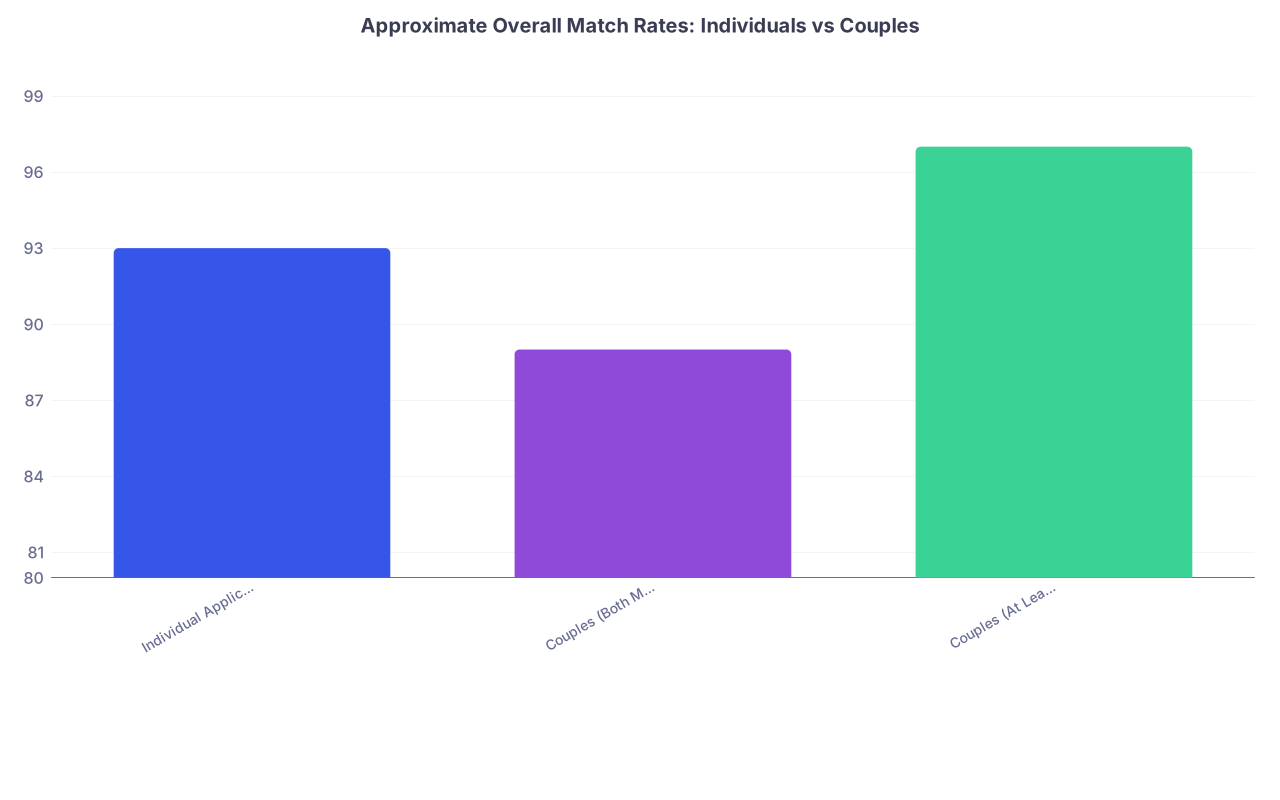
| Category | Value |
|---|---|
| Individual Applicants | 93 |
| Couples (Both Matched) | 89 |
| Couples (At Least One Matched) | 97 |
These are representative ballpark figures often seen across recent cycles, not exact for a single year. But they illustrate the point clearly: couples do slightly worse as a pair, but they are not being thrown off a cliff.
The Core Myth: “You’ll Have to Rank a Ton of Low‑Tier Programs”
Here is the myth in its purest form:
“If we couples match, we’ll have to rank a bunch of community programs we’d never consider alone, and we’ll both end up in worse places than we deserve.”
That’s a nice, clean story. It is also simplistic to the point of being wrong.
Couples Match changes three main variables:
- Geography becomes tighter. You are usually trying to end up in the same city or at least commutable distance.
- The number of rank combinations explodes. Even a modest list for each partner can produce hundreds of combinations.
- The “floor” of your list gets exposed. You have to be honest about your worst acceptable outcome as a pair.
None of that inherently requires you to choose “worse” programs. It forces you to confront this question:
“Would we rather each be at our personal ideal program in separate states, or slightly less ideal programs in the same city, together?”
That is not a quality problem. That is a values problem.
The couples who feel “forced into worse programs” usually made one of these errors:
- They overestimated their competitiveness and built a delusional top‑heavy list with limited geographic diversity.
- They underestimated how much geography matters to programs (i.e., both applying to Boston with no ties and mid stats).
- They never defined a hard floor and then panicked when the only matches left were their safety combinations.
The couples who do well tend to:
- Build geographically coherent but broad lists (multiple cities/regions, not just one dream metro).
- Include some “anchor” programs where they are solidly competitive.
- Accept that programs prefer couples who look like they actually want to be there, not like they are “settling.”
The Hidden Advantage of Couples Match (Everyone Ignores This)
Here is what people miss: in a lot of markets, couples are more attractive, not less.
Programs understand that if both of you match in the same city, the risk of losing you to transfers, re‑applying, or mid‑residency meltdowns is lower. You have social support. You are less likely to bail.
This is especially true in:
- Less flashy cities
- Mid‑tier university programs
- Strong community programs that struggle to recruit top applicants
I have seen PDs say, almost verbatim: “If we can get a solid IM resident because their partner is matching EM here too, we’ll absolutely lean into that.”
Where couples sometimes lose ground:
- Ultra‑competitive academic programs in saturated cities (Boston, SF, NYC, Seattle) where they have zero problem filling spots.
- When one partner is significantly weaker on paper (low Step 2, multiple fails, red flags) and the other is aiming at top‑tier prestige.
But that is not the couples algorithm punishing you. That is supply and demand. You are asking programs to solve a complex optimization problem with constrained inputs.
Strategy, Not Fate: How Couples End Up in “Worse” Programs
Let’s dissect the typical horror story, because it follows a predictable pattern.
Say Partner A is mid‑tier competitive for Internal Medicine.
Partner B is strong for EM.
Alone, here is where they would realistically land:
| Partner | Likely Range (Solo) |
|---|---|
| A (IM) | Solid mid‑tier university, strong community in major metro |
| B (EM) | Academic or large hybrid EM programs in attractive cities |
Now they couples match, and they do this:
- They insist on only three cities: Chicago, Boston, San Diego.
- They anchor their lists on 10–15 “fancy name” programs with minimal backup in nearby less‑prestigious institutions.
- They refuse to seriously consider strong community programs in those cities, let alone in nearby smaller markets.
Result: both under‑rank realistic options in favor of prestige and geography fantasy. They slide further down their joint list than they would have if they built rational solo lists.
Then, after matching into a perfectly decent community IM program and a non‑brand‑name EM program, they say, “Couples Match screwed us.”
No. Their strategy did.
If that same couple built a rational combined rank list—adding nearby community programs, giving serious weight to places eager to take couples—they often would have landed at institutions broadly similar to what they’d get solo. Not identical, but similar tier.
The Actual Tradeoff: Prestige vs Proximity vs Fit
You cannot talk about “worse programs” without defining what “worse” means. This is where people get intellectually lazy.
There are at least four axes of quality:
- Reputation / brand name
- Training quality (case volume, supervision, didactics)
- Fellowship or job placement
- Personal life / mental health / support
Couples Match absolutely pushes you to think harder about the last one. Sometimes it forces you to admit that prestige is not your true north.
Here is how this often plays out in real life for couples:
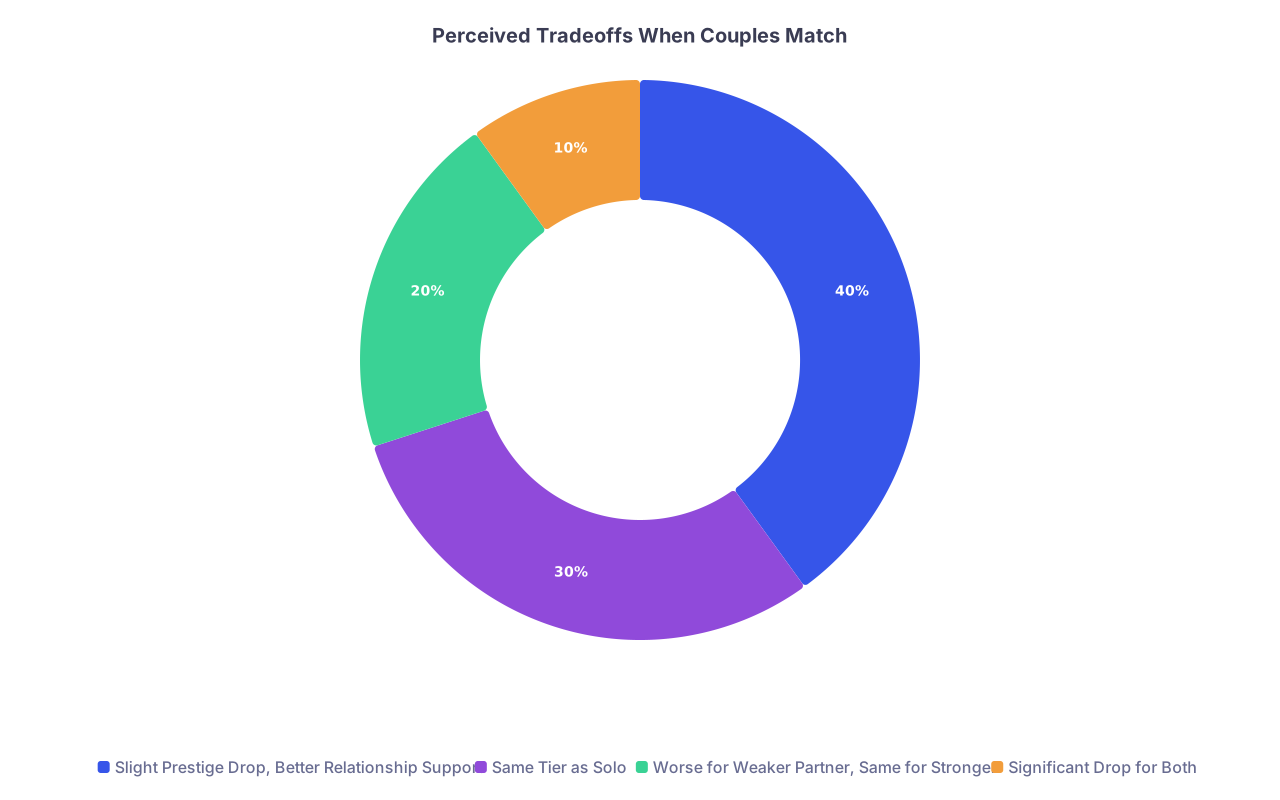
| Category | Value |
|---|---|
| Slight Prestige Drop, Better Relationship Support | 40 |
| Same Tier as Solo | 30 |
| Worse for Weaker Partner, Same for Stronger | 20 |
| Significant Drop for Both | 10 |
Interpretation:
- In a big chunk of cases, one or both partners give up a bit of prestige but gain a massive lifestyle and support upgrade.
- A solid portion land essentially at the same level they would have solo.
- Only a minority experience a truly big tier drop, usually tied to either late mind‑changing, red flags, or comically narrow geographic targets.
You can call the first bucket “worse programs” if you only care about brand. I would call that simplistic.
When Couples Match Really Can Hurt You
There are scenarios where couples matching does meaningfully reduce program level. I am not going to pretend it never happens.
High‑risk situations:
- Both partners in very competitive specialties. Think Derm + Ortho. Or Ortho + ENT. The number of cities with two strong options is limited. The algorithm cannot invent spots that don’t exist.
- Major mismatch in competitiveness. A 260‑plus research‑heavy applicant paired with someone who failed Step 1 and barely passed Step 2 is not going to both land at MGH. That is not the couples system being cruel. That is reality.
- Hyper‑narrow geography with no backup. “We will only live in NYC or we’d rather SOAP.” I’ve seen people say that out loud. That is roulette, not planning.
- Late decision to couples match. Sloppy application targeting, no time to build coherent city clusters, and no real communication with programs about being a couple.
In those settings, yes—couples matching can effectively compress both people toward whichever level is more realistic for the weaker partner, especially if you insist on same‑institution rather than same‑city.
But that is not “the couples algorithm is unfair.” That is: “You set constraints that only a narrow slice of programs can accommodate.”
Practical Reality: What You Actually Control
You cannot control the algorithm. You can control how painful its constraints become.
The couples who do best usually get five things right:
- They decide early. Ideally before ERAS submission. So they actually apply to overlapping regions and programs by design, not as an afterthought.
- They’re brutally honest about competitiveness. If one partner is significantly weaker, they model their expectations around that. They do not pretend both are “top‑tier.”
- They think in cities, not programs. “We want to be in Cleveland” is a much more solvable problem than “We want CCF only, and you can have MetroHealth as your backup but I won’t.”
- They talk to programs like adults. Some PDs will quietly tell you, “If your partner ranks us, we’ll look very favorably at both of you.” But you only find that out if you communicate.
- They define the floor explicitly. “If it is this combination or no match/SOAP, what do we choose?” Deciding this at 2 a.m. on rank night is how you end up regretting everything.
When you do these things, you typically do not see a catastrophic fall from your solo baseline. You see small shifts, sometimes up, sometimes down, and a tradeoff profile that you consciously chose.
A Simple Mental Model: Risk vs Control
The best way to think about Couples Match is as a risk‑sharing agreement.
Alone, you control only your outcome.
Together, you share risk—but also share upside—across a bigger, weirder outcome space.
Here is a crude but useful way to visualize it:
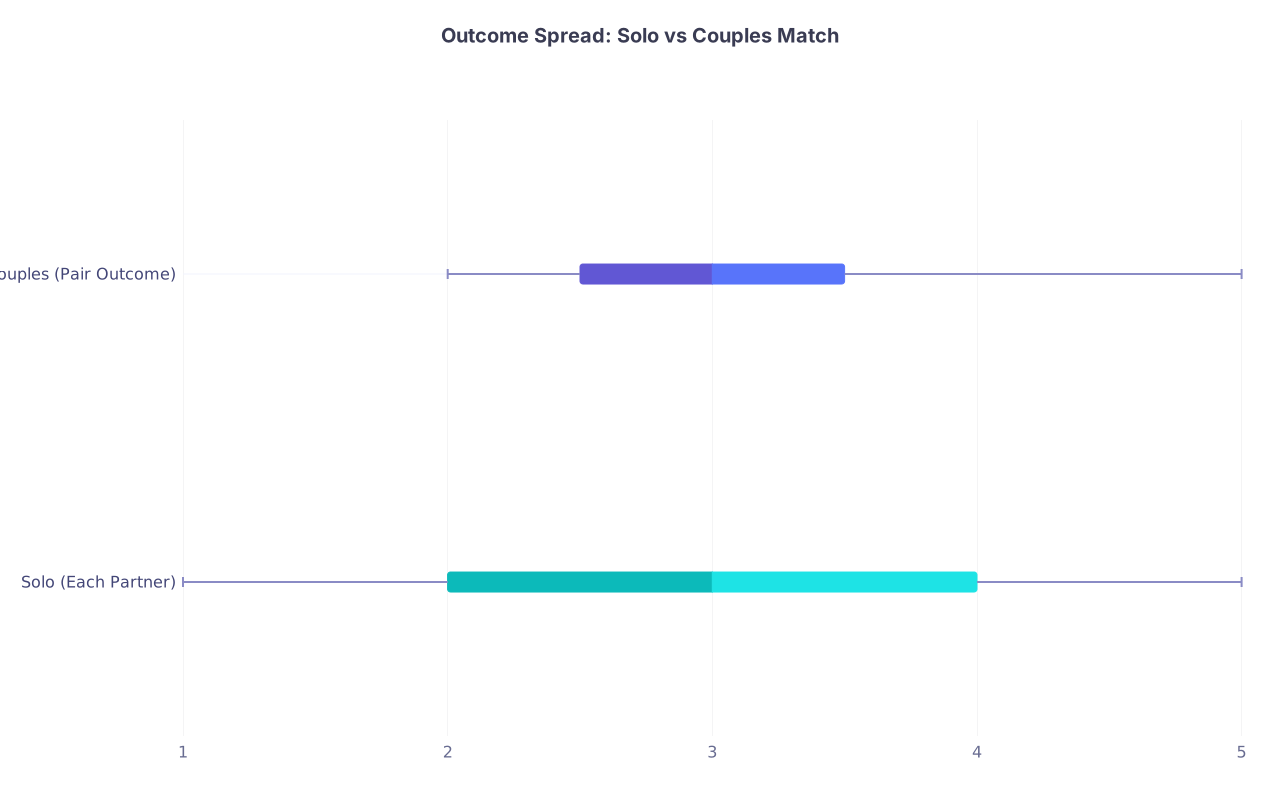
| Category | Min | Q1 | Median | Q3 | Max |
|---|---|---|---|---|---|
| Solo (Each Partner) | 1 | 2 | 3 | 4 | 5 |
| Couples (Pair Outcome) | 2 | 2.5 | 3 | 3.5 | 5 |
Interpretation (using 1 = terrible fit, 5 = dream scenario):
- Individually, each of you has a wide spread of outcomes from 1 to 5.
- As a couple, you usually narrow the floor a bit (because you plan more carefully), and the median centers around 3. The true “5/5” outcomes are rarer but not impossible.
The key point: you are not being universally dragged down. You are shifting the distribution in a way that prioritizes joint stability over individual heroics.
So, Does Couples Match Force You Into Worse Programs?
Not by default.
What it does:
- Forces you to be honest about values: prestige vs partnership vs location vs training style.
- Exposes poor planning and unrealistic expectations very quickly.
- Punishes couples who play fantasy football with their rank list instead of modeling actual probabilities.
- Occasionally compresses outcomes toward the weaker partner in tight markets or hyper‑competitive specialties.
What it does not do:
- Automatically downgrade you by a tier just because you’re a couple.
- Make PDs secretly hate you.
- Prove that you “would have done better alone” every time. That’s unprovable counterfactual bravado.
Years from now, you will not be obsessing over whether your program was “top 10” or “top 30.” You will remember whether you came home to someone who understood your worst call nights.
FAQ (Exactly 3 Questions)
1. If one partner is much stronger, should they avoid couples matching to “maximize” their outcome?
If your only metric of success is brand‑name prestige for the stronger partner, then yes, they might squeeze out a higher‑tier program by going solo. But that is a narrow, ego‑driven metric. In most real relationships, the stability and support of living together outweigh the marginal bump from “very good” to “elite” program, especially when fellowship, networking, and your own work ethic matter more than the name on your badge.
2. Is it safer to rank mostly same‑institution pairs instead of same‑city different programs?
No. That is actually how many couples trap themselves. Same‑institution is nice when it works, but insisting on it shrinks your feasible combinations dramatically. Same‑city different programs is usually the smarter “baseline,” with a handful of same‑institution combos higher up if they make sense. Think: maximize compatible city pairs first, not romanticized same‑hospital fantasies.
3. Do programs really coordinate to help couples, or is that just lip service?
Plenty of programs quietly coordinate, especially within the same institution or city—IM talking to EM, FM talking to Peds, and so on. It is not guaranteed, and nobody is going to take a wildly unqualified partner just to land the other, but mild tie‑breaking in favor of a reasonable couple happens a lot. You increase those odds by clearly communicating that you’re a couple, ranking them realistically, and not acting like their program is a consolation prize.


