

The way coordinators actually pair schedules for couples in residency is far more improvised, political, and human than anyone tells you on interview day.
You’re picturing some sophisticated algorithm or “system.” That’s not what’s happening. What’s really happening is a tired coordinator, a messy Excel file (or a clunky scheduling program), and a handful of whispered rules from the PD about which lines are sacred and which ones can be bent for the couple who might rank them #1.
Let me walk you through how it really works behind closed doors.
How Couples Match Actually Plays Out After Match Day
Here’s the first thing you need to understand: once the NRMP spits out “you two matched here,” the computer is done caring about your relationship. From that moment on, your fate rests with:
- Your program director
- Your co-residents’ goodwill (or lack of it)
- One or two coordinators who control the schedule more than anyone else in the building
Every institution runs things a little differently, but I’ve seen the same basic pattern at large academics (think Mayo, Michigan, Stanford), big county hospitals, and mid-size community programs.
The sequence is usually some version of this:
- GME sends the matched list to each program.
- Coordinators and PDs meet, glance at who’s a couples match, and quietly label them in the spreadsheet or scheduling software.
- Blocks and rotations get assigned. This is the critical part. If you think there’s some standardized “couple protocol,” there isn’t. There are only priorities. And they vary.
Some programs are extremely intentional. They pre-label couples in the scheduling software (AMiON, QGenda, some homegrown Excel monster), set rules like “always on the same night float block,” and then build around that.
Others barely acknowledge it. They’ll match you at the same hospital and say, “Well, you’re in the same city — that should be enough.”
You need to know which kind of place you’re dealing with before you rank them.
What Coordinators Actually Look At When Pairing Schedules
Let’s talk about the coordinator’s brain when they’re staring at the master schedule.
They are not thinking, “How do I maximize couple happiness?” They are thinking, “How do I keep this schedule legal, cover the service, and avoid a revolt from the chiefs?”
The couple is one variable in a mess of constraints:
- ACGME rules (duty hours, continuity clinic, ICU caps, etc.)
- Service coverage (you can’t have 3 interns on wards and 0 in the ICU)
- Vacation rules
- Senior–junior pairings
- Fairness between residents (yes, they pay attention to this)
Your relationship adds another constraint: “Try to keep these two lined up as much as possible… within reason.”
Key phrase: within reason.
That’s where things get interesting.
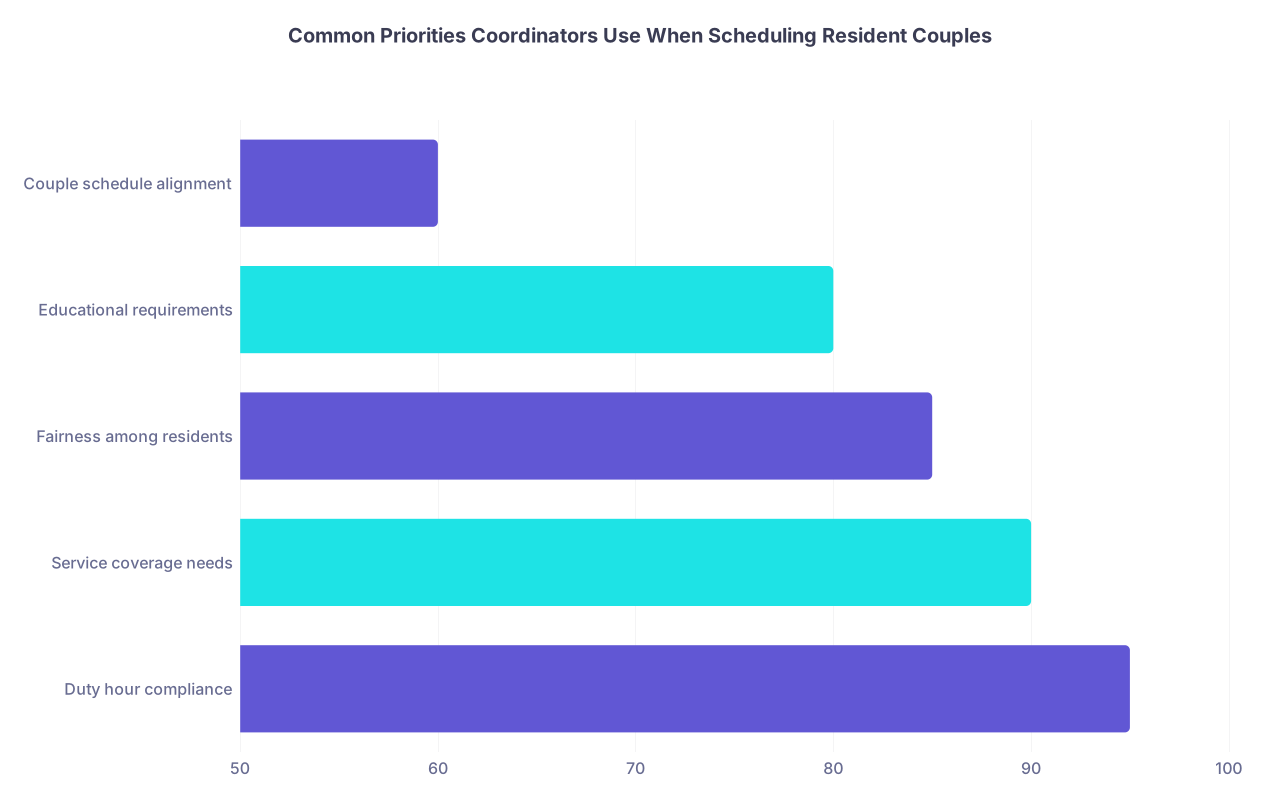
| Category | Value |
|---|---|
| Duty hour compliance | 95 |
| Service coverage needs | 90 |
| Fairness among residents | 85 |
| Educational requirements | 80 |
| Couple schedule alignment | 60 |
What I’ve heard coordinators say behind closed doors:
- “I can give them the same off-service months, but I’m not blowing up ICU coverage for a couple.”
- “They’re on nights together two blocks; that’s already better than most couples here get.”
- “If they wanted perfect alignment, they shouldn’t have matched IM + Surgery.”
Yes, that last line has been said almost verbatim.
You’re asking them to solve a logistics puzzle with hundreds of moving parts and then overlay your relationship on top. Some will go to bat for you. Some will do the minimum.
The Three Main Models of “Couples Scheduling” You’ll See
There are three broad patterns programs fall into when dealing with couples. No one will spell this out on interview day, but you can pick up clues by how people talk.
| Approach Type | Typical Behavior |
|---|---|
| High-support | Actively coordinates same rotations/shifts |
| Medium-support | Attempts overlap on key blocks only |
| Minimal-support | Only guarantees same institution/campus |
1. The High‑Support Programs
These are rare, but they exist. Usually larger academic centers with enough residents and rotation sites to have flexibility.
What they do:
- Tag couples in the system right away
- Actively pair night float, ICU, and ward months
- Try to line up golden weekends and vacations
- Sometimes even coordinate across two different specialties if both PDs are cooperative
A place like this will have a coordinator who can tell you off the top of her head, “Oh yes, we have 3 couples this year and they’re generally on the same schedule at least 60–70% of the time.”
The hidden truth:
High-support programs usually got burned years ago by losing a great couple or seeing a relationship implode because of brutal, misaligned schedules. That institutional memory lingers. The older PDs remember the fallout and quietly decree, “We’re going to do better with couples.”
Watch for that in the way they answer questions.
2. The Medium‑Support Programs
This is the most common category.
They’ll try to help you. But the help is episodic, and it depends heavily on:
- How vocal (but not annoying) you are
- How much the chiefs care
- How much trust your PD has in the coordinators
Typical pattern:
- Same weekend off occasionally
- Same block for at least some heavy rotations (e.g., both on nights for one month of the year)
- Shared vacations maybe once or twice in PGY-1
The attitude is: “We’ll be reasonable, but you’re adults. You chose this.”
You can have a good life as a couple in these programs if you approach them strategically and early. If you sit back and assume “they’ve got this,” you’ll end up on opposite schedules just often enough to be miserable.
3. The Minimal‑Support Programs
These programs are honest internally: “We match couples, but we don’t schedule around them.”
They won’t tell you that in those exact words.
What they do:
- Acknowledge you’re a couple
- Make zero formal scheduling commitments
- Fix egregious issues only when you complain (and even then, maybe once)
Common at:
- Small community programs with skeleton coverage
- Highly malignant or service-heavy programs where the hospital dictates the schedule more than the PD
- Programs where the coordinator is drowning and can barely keep the call schedule legal
If a resident from one of these places says, “We see each other maybe one weekend a month,” believe them. That isn’t an exaggeration.
The Real Mechanics: How Schedules Actually Get Paired (or Don’t)
Forget theories. Let’s talk about what literally happens on the coordinator’s computer.
Most schedulers are working with block schedules: 4-week or 13-week blocks, depending on the institution.
Here’s how a typical first pass looks for a couples pair in, say, IM + EM:
Block alignment first
Coordinator for IM says, “I’ll put them on wards in blocks 2 and 7, ICU in 4, and clinic heavy in 5 and 9.”
EM coordinator says, “Ok, I’ll line up EM nights in blocks 2 and 4 and try to put their elective blocks together around 5 and 9.”Shift-level alignment (if possible)
On the EM side, nights vs days can often be moved around within the month. IM night float sometimes can’t.
So you get: both on nights for one block, completely mismatched the next.Back-and-forth trades
Chiefs might step in: “Can we slide Resident A’s ICU block to 3 so they can be together on 4? We’ll move Resident B to wards in 3.”
If the chiefs care about morale, they’ll make this happen. If they’re burned out and cynical, they won’t.Hard stops
There are rotations the coordinators will not touch for you:- Required specialty months tied to specific attendings
- Away rotations or VA coverage with strict staffing rules
- Clinic templates that can’t be easily rescheduled
Once those immovable pieces are set, your relationship gets squeezed into the remaining gaps.

| Step | Description |
|---|---|
| Step 1 | Match List Released |
| Step 2 | Identify Couples in Each Program |
| Step 3 | PDs and Coordinators Meet |
| Step 4 | Assign Core Rotations and Required Blocks |
| Step 5 | Align Night Float/ICU/Electives for Couple |
| Step 6 | Minimal Alignment, Focus on Coverage |
| Step 7 | Chiefs Adjust Individual Schedules |
| Step 8 | Finalize Call and Shift Details |
| Step 9 | Residents Request Tweaks or Trades |
| Step 10 | Is There Flexibility? |
The underrated lever here: chief residents.
They’re often the ones massaging the final call schedule. I’ve seen chiefs quietly swap calls for couples after the “final” schedule was sent out, then email the coordinator: “Hey, we traded Post-Call A for B, just updating you.”
If you have reasonable chiefs, you’ll survive even in a medium-support program.
What Coordinators Will Do For You… If You Ask the Right Way
Here’s the part students never get taught: you can influence this. Not completely. Not magically. But more than zero.
And it starts early.
Timing: When to Speak Up
The first mistake couples make is waiting until orientation week to say anything.
By then, the skeleton of the schedule is done. Changing it means tearing out studs, not just moving furniture.
The right time:
- After you match
- Before the chiefs and coordinators finalize the block assignments
Usually late March to May.
You send a short, polite, specific email. Not a sob story. Not, “We want to be together as much as possible.” Everyone wants that.
Something like:
“We’re very grateful to have matched here. Since we’re a couples match (IM + Peds), if there’s any flexibility, we’d be especially grateful for help aligning:
– Night float blocks
– ICU months
– At least one shared vacation weekWe understand there are coverage and educational needs; we’re just hoping for rough alignment where possible.”
You’ve just done three things coordinators appreciate:
- You’re early
- You’re concrete
- You’re realistic
That goes a long way.
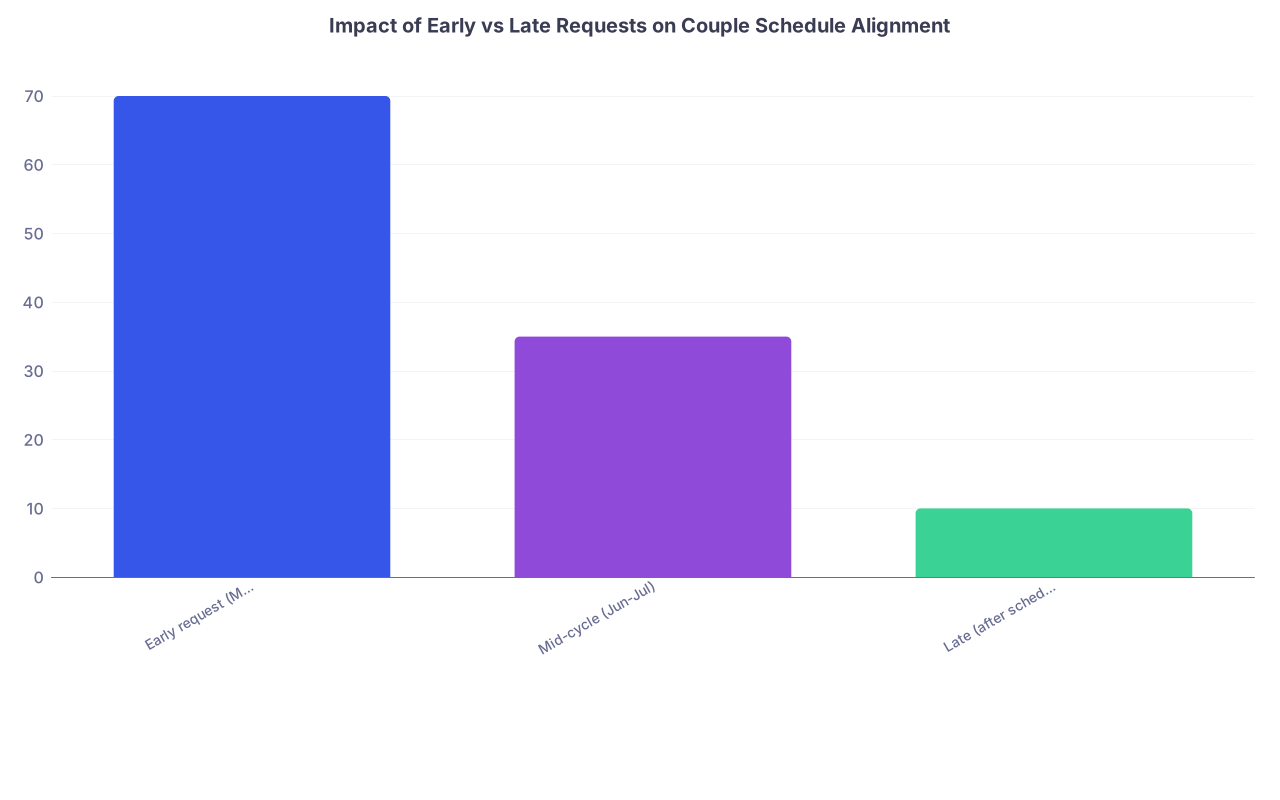
| Category | Value |
|---|---|
| Early request (Mar-Apr) | 70 |
| Mid-cycle (Jun-Jul) | 35 |
| Late (after schedules released) | 10 |
Yes, those percentages are roughly what I’ve seen: early couples get about double the alignment.
What They’ll Commonly Try To Give You
From years of seeing this behind the scenes, the “standard couple package” at a halfway decent program looks like:
- 1–2 shared night blocks per year
- 1 shared vacation (sometimes 2 if you’re lucky or persistent)
- Partial overlap on a big rotation like ICU or wards
That’s it. Anything beyond that is bonus.
If you’re both in the same specialty and same program? They can do more, because your template is similar. If you’re in totally different departments, your realistic ceiling is lower.
The Politics: When Other Residents Start Complaining
Here’s the dark side that no one wants to say out loud:
If the coordinator is too nice to you, other residents will notice and they will complain.
I’ve literally heard:
- “So because they’re married, I get stuck with Christmas and they don’t?”
- “Why do they have three golden weekends when I barely have one?”
- “I didn’t realize you had to come as a package deal to get a humane schedule.”
That puts coordinators and PDs on the defensive. And once that happens, your requests suddenly become “less feasible.”
The better coordinators manage this by:
- Spreading the “good” across the class
- Quietly helping couples but not advertising it
- Making sure your benefits don’t look too lopsided
You can help them by not bragging about your aligned vacation weeks or perfect golden weekends. The more invisible your perks, the easier it is for them to keep helping you.
Hard Truth: Some Pairings Are Logistically Brutal
Not all couples are created equal in the eyes of the schedule. Some pairings are relatively easy. Others are an ACGME-compliance nightmare.
Easier to coordinate:
- IM + Peds (similar block structure, similar inpatient months)
- IM + Neurology or Psych (especially at integrated or categorical programs)
- Two residents in the same large department
Painful to coordinate:
- Emergency Medicine + any traditional ward-heavy specialty
- Surgical field + non-surgical (e.g., Ortho + FM, Gen Surg + IM)
- Two small programs with rigid, service-heavy templates
If you’re EM + Ortho at a place with thin staffing, coordinators simply don’t have the slack to give you perfect alignment. They can help on the edges — a vacation here, a shared elective there — but you will have many months with totally opposite schedules.
This is why I tell MS4s: the time to care about this is before you hit “Certify” on your rank list. Not after.

The Quiet Tricks Coordinators Use (When They Actually Want to Help You)
This is the part no one tells you, but you see once you sit in enough scheduling meetings.
When coordinators do want to support a couple, they pull a few specific levers.
Shadow pairing
They won’t always put you on the exact same service, but they’ll put you on similar intensity at the same time.
Example: you on wards, your partner on ED days. Different services, but similar “life intensity” blocks.Stacked pain, stacked relief
They’ll intentionally align hard months together (ICU + Nights) so your easy months line up too. Your year ends up more bimodal — 2 months are hell, 2 months feel almost like vacation — but for both of you at once.Micro-adjustments to shifts
On services with flexible shifts (EM, some hospitalist-style rotations), they’ll sneak your start times closer together. You’re both off at 7 pm instead of one at 7 pm and one at 11 pm. Tiny change, big quality of life gain.Holiday engineering
Coordinators will sometimes do this quietly: one of you works Christmas Eve, the other Christmas Day, but you both get New Year’s together. Or vice versa. They’re trading misery so you at least share some real time off.
You’ll never see these tricks listed in a handbook. But they’re there in the background when a coordinator genuinely cares about resident wellness.

How You Can Stack the Deck In Your Favor
No, you cannot control everything. But you’re not powerless either.
Here’s what actually moves the needle in real life:
Rank programs based on behavior, not slogans
Don’t trust, “We support couples.” Ask current resident couples:- “How often do you get the same nights?”
- “How many vacations did you actually share this year?”
- “When you’ve had conflicts, how responsive were the chiefs/coordinator?”
Be early, specific, and sane in your requests
This is the trifecta coordinators respect. Long, emotional emails loaded with demands do not play well.Build a relationship with your coordinator
The residents who walk into the office, are kind, fix their own minor issues, and say thank you? They get more help. It’s human nature.Use your chiefs strategically, not constantly
Save your “big ask” for something meaningful — a shared vacation for a wedding, an aligned night block, or a honeymoon week. Don’t nickel-and-dime them for every random weekend.Know when you’re asking for the impossible
If you’re both in brutal, rigid specialties at under-staffed programs, you will not get dreamy, synchronized schedules no matter how eloquent your email is. Stay realistic and focus on the highest-impact changes.

| Step | Description |
|---|---|
| Step 1 | Match as a Couple |
| Step 2 | Ask Current Residents About Real Support |
| Step 3 | Rank Programs With Realistic Insight |
| Step 4 | After Match: Email Coordinators Early |
| Step 5 | Request Specific Alignments |
| Step 6 | Build Goodwill With Coordinator and Chiefs |
| Step 7 | Request Occasional High-Value Adjustments |
| Step 8 | Reassess and Adapt Each Year |
FAQs
1. How much schedule alignment can a typical resident couple realistically expect?
If you’re in the same specialty and same program at a reasonably supportive institution, you can often expect:
- 1–2 shared night or ICU blocks
- At least one fully shared vacation week
- Partial overlap on several other rotations
If you’re in different specialties or programs, you should scale that expectation down. Shared vacations become the most realistic ask; full alignment of nights and weekends is much harder.
2. Is it OK to ask about couples scheduling during the interview season?
Yes — but do it smart. Don’t ask the PD in a big group session, “How much can you guarantee for couples?” Instead, in smaller settings or with residents, ask, “For current resident couples, how often do they realistically get nights or vacations aligned?” Listen to answers, but pay more attention to how specific they are. Vague reassurance usually means minimal real support.
3. What if our schedules end up terrible despite asking early and respectfully?
Then you pivot from “build” to “salvage.” Talk to your chiefs about targeted fixes: one shared vacation, one aligned night month, or a swap for a major life event. Coordinate vacation bids together. Use trades with co-residents (and be willing to take an occasional worse call in exchange). And quietly reassess for PGY-2 and beyond; many programs have significantly more flexibility after intern year.
Bottom line:
Programs don’t have magical couples-match machinery. They have humans, constraints, and priorities.
Couples who do best are the ones who:
- rank based on real resident experiences, not glossy promises,
- approach coordinators early with specific, realistic asks, and
- understand they’re one variable in a much bigger puzzle — and act accordingly.


