

The couples match does not ruin relationships. Unrealistic geography does.
If couples crash and burn in the Match, it is almost never “because NRMP is unfair” or “because programs hate couples.” It is because they built a fantasy map instead of an honest one. They treated geography like an afterthought. They trusted vibes instead of mileage, call schedules, and airline routes.
You are about to make more location decisions in 3 months than most people make in a decade. If you get the geography wrong, everything else—specialty fit, prestige, research—becomes background noise behind a constant grind of distance, expense, and resentment.
Let me walk you through the mistakes I see every year. The ones people regret quietly. Sometimes loudly.
1. Treating “Same City” As Automatically “Same Life”
Being “in the same city” can still feel like long distance if you ignore three things: commute, call schedules, and time of day.
Couples love telling me, “We matched in the same city, we’re fine.” Then I hear the details.
- One is at a suburban community program.
- The other is downtown at a big academic center.
- One lives 8 minutes from the hospital.
- The other is 55 minutes away… with no traffic. Which never exists.
Suddenly:
- Nights: opposite sides of the metro area.
- Post-call: one is driving an hour on no sleep.
- Rent: either double rent or one person sacrifices badly on commute.
- Social circle: both end up embedded in totally different hospital ecosystems.
That “same city” quickly becomes:
- Two separate lives.
- One exhausted driver.
- One person always compromising.
The mistake: assuming “same city = good enough” without mapping your actual daily reality.
You avoid this by forcing yourselves to answer three very specific questions for every “same-city” pair of programs:
- Where will we actually live?
- Not in theory. Pick a neighborhood on a map. Midpoint? Closer to one hospital? Why?
- What will the commute look like during:
- Rush hour
- Night float
- Winter storms (for northern programs)
- What is our worst-case day?
Example:- Person A: 24-hour call, stuck late to 30h, 50-minute commute home.
- Person B: starts at 5:30 a.m. next day, 35-minute commute. How often will that happen? Once a year or twice a month?
If you are not doing that level of detail, you are lying to yourselves about what “same city” really means.
2. Ignoring That One Partner’s Family Is a Geographic Anchor
“I do not need to be near my family” is one of the most dangerous lies I hear from MS4s in couples match. They say it with conviction. They actually believe it. Until:
- Their parent gets sick.
- Their sibling has a crisis.
- They have a baby.
- Or they just hit month 7 of intern year, burnt out and alone in a new city.
Here is the pattern:
- Partner A: “Family anywhere is fine.”
- Partner B: quietly very attached to a region but “does not want to hold us back.”
- They rank a bunch of attractive coastal cities and one or two home-region anchors.
- March comes, they end up far from everyone they know.
- Stress rises. Partner B starts resenting that they are “stuck” away from support.
The relationship takes the hit. Not the rank list.
You cannot afford fuzzy thinking about families in couples match. You must decide:
- Which families are actual support systems vs. holiday-only.
- Whether anyone has:
- Chronic illness
- High support needs
- Single-parent situations
- Cultural/community ties that are not easily replicated elsewhere
Because residency is not college. You do not get long breaks. You cannot just fly home whenever something happens.
Be explicit:
- Is there a family region we absolutely need in our top 3–5 clusters?
- Are we willing to do worse programs on paper to be near real support?
- If not near family, what backup support structure will we actually have? Not fantasy friends. Real people who live there now.
If the answer is “we will just make friends,” that is not a plan. That is a hope.
3. Romanticizing Long-Distance To Protect Rank List Options
Every couples match season I hear the same dangerous sentence:
“We can handle long distance for a few years if we have to.”
Can you? Maybe. But most people who say this have never:
- Done 80-hour weeks
- Been on q4 call
- Tried coordinating call schedules across time zones
- Flown standby after a 24-hour shift just to see someone for 32 hours
They imagine some version of long-distance college dating—FaceTime, weekend trips, cute airport reunions. They do not picture:
- Missed anniversaries because of last-minute schedule switches
- Flights cancelled, Sunday night delayed to Monday noon, and now you are post-call on the plane
- One person starting nights exactly when the other finally gets a free weekend
- Fighting about money because flights are $450 each time, not $150
Let me be blunt:
Choosing long distance when you had viable same-city or same-region options higher on your list is a mistake most couples regret.
There are two scenarios:
Forced long distance:
- You tried to cluster.
- You built realistic geographic priorities.
- The algorithm split you because options were limited.
This hurts but is survivable because you did not willingly walk into it ignoring reality.
Self-inflicted long distance:
- You prioritized prestige or “dream city” over proximity.
- You split your list across coasts “just in case we both get something great.”
This is where resentment festers. Because someone feels chosen second behind a program name.
Use long distance as a true last resort, not a casual “we’ll be fine” backup.
4. Ranking Prestige Over Proximity Without Owning the Trade-off
Somebody always says it: “We cannot throw away the chance at [Top Program X].”
Fine. You want the shiny name. Say it out loud. Own it. But do not pretend you are not trading something very concrete to chase it.
Here is where couples screw this up: they list a prestigious distant program so high that if only one of them gets in, they split across states… even though there were solid, same-city options they pushed down.
They tell themselves:
- “We will just commute by plane.”
- “We can survive 3–4 years long distance.”
- “This will boost our careers so much it will be worth it.”
Then reality:
- Airfare + time = brutal
- Money drain: $400–$600 per trip, multiple times per year
- You are too tired to enjoy the fancy city anyway
- The “career boost” feels abstract compared to being alone on a Sunday after call
If you choose a big prestige gap across distance, do it with your eyes open. Ask:
- Are we okay if only one of us gets the dream program and the other ends up far away at a mid-tier place?
- Will we be able to say, later, “Yes, this distance was worth what we gained professionally”?
If your honest answer is “I have no idea,” you probably should not rank that combination above a strong same-city pair.
5. Assuming Airlines, Highways, and Weather Will Be Kind
Couples routinely underestimate logistical friction. It is not the miles that kill you. It is the connections, missed flights, and 2-lane highways in winter.
I have seen all of these:
- “It is only a 5-hour drive” that becomes 7–8 hours after night call and a snowstorm.
- “There are tons of cheap flights” out of a small regional airport that only actually flies to one major hub, with terrible schedules.
- “We can meet halfway” at a random town that is just chain hotels and gas stations, not a real chance to recharge.
Here is an uncomfortable truth: once you are post-call, any drive over 2 hours is borderline unsafe. You will do it anyway. Residents do. But it is risky.
Before you rank any pair of locations where you are not in the same metro area, you need hard logistics, not vibes:
- Direct flight or always a connection?
- How many flights per day between those cities?
- How often do winter storms shut down travel there?
- Is there train or bus backup?
- Are those tickets realistically affordable on a resident salary?
Do not just say “we’ll figure it out.” No, you will not. You will be too tired.
6. Overestimating How Much Time You Will Have To Travel
Early in MS4 year, people still have third-year brains. They sort of remember being busy. They do not really grasp how residency compresses time.
This leads to fantasy-level assumptions like:
- “We will see each other at least twice a month.”
- “We can rotate weekends.”
- “We will always visit on post-call days.”
Reality for most programs:
- 1–2 weekends off per month. Sometimes none.
- Random days off in the middle of the week.
- Night float blocks where you are basically unavailable.
- Golden weekends that do not align between two departments or hospitals.
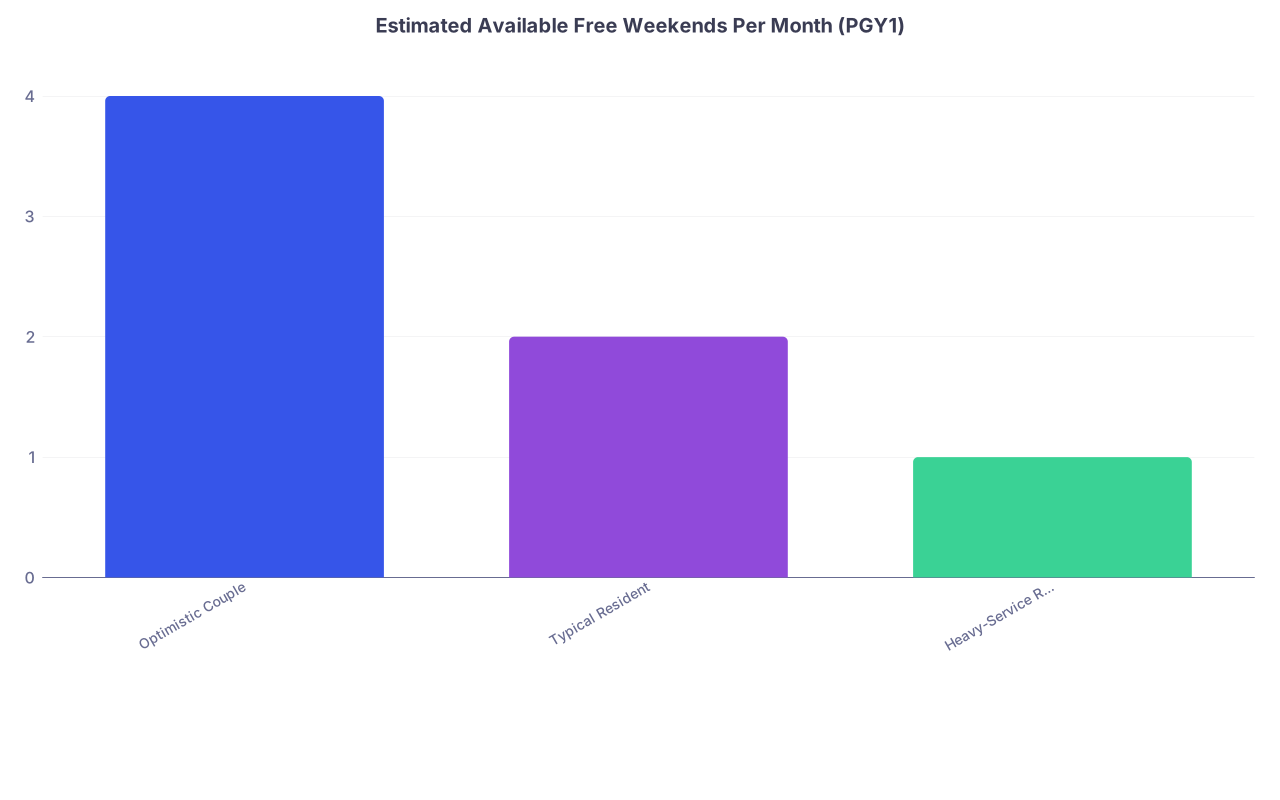
| Category | Value |
|---|---|
| Optimistic Couple | 4 |
| Typical Resident | 2 |
| Heavy-Service Resident | 1 |
If you have not looked at sample schedules from programs, you are guessing. Guessing is a bad strategy here.
What to check (actually check, not assume):
- Call frequency on ward months for both specialties.
- Night float systems (one long block vs scattered).
- Weekend clinic expectations.
- Average vacation distribution (can you sync weeks off?).
Then ask: How many physically realistic visits can we expect per year?
If you are serious, you will sit down with a calendar and:
- Mock out a sample year.
- Block call-heavy rotations.
- See what is left.
If the number of realistic visits is less than 6–8 per year, you are not just “long distance.” You are “we barely see each other.”
7. Forgetting That Cities Have Cultures, Not Just ZIP Codes
Here is a mistake I see especially in high-achieving couples: they evaluate geography like a spreadsheet.
- Cost of living
- Rent
- Flight times
- Food scene
All useful. But they skip an ugly question: Can both of you actually stand living here?
I have watched couples do this:
- One person absolutely hates small towns. Other person grew up rural and does not care.
- They match to a city of 60k people with one bar and two coffee shops.
- Two months into intern year, the city-leaning partner is quietly miserable.
- But they cannot say anything because “we chose this for us.”
Or the reverse:
- One partner is deeply tied to a specific cultural or religious community.
- They move to a town where they are the only one of their background on the ward team.
- Isolation hits hard. Especially on days off when they have nobody outside the hospital.
You are not just matching to hospitals. You are matching to a life context.
Ask yourselves:
- Does one of us need a big city vibe to stay sane?
- Does one of us need a specific cultural community to feel at home?
- Are we both actually okay with winters here? Or summers here?
If the honest answer for one person is “I will just tolerate it,” watch that. Tolerable in month 2 can become unbearable in year 3 when you are exhausted and burned out.

8. Not Ranking In Geographic Clusters
The single most common structural mistake in couples match rank lists: chaos.
- Row 1: Person A in Boston / Person B in Chicago
- Row 2: A in NYC / B in LA
- Row 3: A in Seattle / B in Seattle
- Row 4: A in Chicago / B in Chicago
- Row 5: A in LA / B in San Diego
A mess. No clear geographic strategy. Just throwing combinations at the algorithm.
You should be thinking in clusters, not individual programs.
Your list should look more like:
- Rows 1–12: All combinations that keep you both in or very near City/Region 1
- Rows 13–25: All combinations that keep you both in or very near City/Region 2
- Rows 26–35: All combinations that keep you both in or very near City/Region 3
- Only after that: Inter-regional combinations where you are truly okay with distance

| Step | Description |
|---|---|
| Step 1 | Start Rank List |
| Step 2 | Rank all combinations in Region 1 |
| Step 3 | Rank all combinations in Region 2 |
| Step 4 | Rank all combinations in Region 3 |
| Step 5 | Add long-distance pairs at bottom |
| Step 6 | Stop - do not add distant pairs |
| Step 7 | Primary Region Cluster? |
| Step 8 | Secondary Region Cluster? |
| Step 9 | Tertiary Region Cluster? |
| Step 10 | Willing to accept distance? |
Why this matters:
- The algorithm tries to find your highest joint place on the list.
- Clustering your geography tells it clearly: these areas matter to us.
- Random interleaving of distant cities tells it: geography is optional, prestige is king.
If you end up split across regions after building strong local clusters, fine. You did what you could. But if you get split while half your rank list was chaotic, you did that to yourselves.
9. Ignoring Specialty-Specific Geography Constraints
Some specialties are everywhere. Some are not. Couples who ignore this fact end up forcing distance because they pretended they had options they never actually had.
Example:
- Partner A: Dermatology
- Partner B: Family Medicine
Derm is heavily concentrated in:
- Academic centers
- Larger cities
- Specific regions with more programs
Family med is everywhere.
If you pretend you can “both end up anywhere” you are setting yourself up to fail. Realistically, the derm applicant’s map defines your tightest cluster options. The family med applicant will have much more flexibility inside those regions.
Flip example:
- Partner A: Neurosurgery
- Partner B: Psychiatry
Same problem. Limited neurosurgery programs. Lots of psych programs. That asymmetry should control how you think about geography from the beginning.
Do this early:
- Identify which specialty is the limiting geography specialty (fewer programs, more competitive, more academic focus).
- Build your primary clusters around that specialty’s viable programs.
- Within each cluster, list every possible program for the more flexible specialty.
This is not romantic. It is reality. One person’s specialty will anchor your map more. Ignoring that is how couples accidentally end up 800 miles apart.

10. Failing To Declare Non-Negotiable Boundaries Up Front
The most heartbreaking stories I have seen did not come from bad luck. They came from couples who never made their lines clear. They tried to be “flexible” until it was too late.
Examples I have actually heard after the Match:
- “I did not realize living near my siblings mattered this much to me.”
- “I said I was okay with long distance, but I am not.”
- “I thought I could handle winters here. I cannot.”
- “I feel like I chose their career over my entire support system.”
Those are not post hoc complaints. They are the fallout from unspoken boundaries.
You need to decide, before you certify your list:
- Maximum distance you are willing to tolerate if not in the same metro:
- Same city only?
- Same state?
- Same region with realistic monthly visits?
- Weather limits:
- Are you actually okay with 6 months of snow?
- Or 110°F summers?
- Family limits:
- Are there specific relatives you must be within X hours of?
- Cultural/community access:
- Do you need a minimum level of community (religious, ethnic, LGBTQ+, etc.) nearby?
Put these on paper. Literally. Write:
- We will not rank combinations that put us farther than X driving hours apart.
- We will not rank programs where one of us is miserable in the city environment.
- We will accept slightly worse programs if they keep us close.
Then check your rank list against that document. If your list violates your own rules, fix the list. Do not rewrite your boundaries to fit the shiny programs.
| Boundary Type | Example Limit |
|---|---|
| Max driving distance | 3 hours each way |
| Climate limit | No cities with >80 in Jan snow index |
| Family proximity | Within 4 hours of at least one set of parents |
| City size need | Population > 200,000 |
| Community need | Active [X] cultural/religious community present |
11. Underestimating Housing And Cost-Of-Living Strain
Housing is where geography hits your bank account and your stress level simultaneously.
Geographic mistakes I see here:
- Ranking only high-cost coastal cities without a realistic budget.
- Assuming you can always live midway between two hospitals in a big metro and keep rent reasonable.
- Ignoring the cost of second car, parking, and tolls when you live far from one site.
Here is how this plays out:
- You end up in a major city with:
- $2,200–$2,800 rent for a basic 1-bedroom.
- Parking $150–$300 per month.
- Commute 30–60 minutes by car or transit.
- Add flights to see family or to see each other if split across cities. Annual cost: thousands.
You are now:
- Exhausted from commuting.
- Financially stressed.
- Less able to afford visits to each other or to family.
- Fighting more over money.
That is not “just finances.” That is the erosion of mental health and relationship stability.
Before ranking, you should:
- Price realistic rents in your intended neighborhoods, not fantasy ones.
- Check parking costs if you will commute by car.
- Estimate annual travel costs if not co-located.
If the answer makes you queasy, it is not magically going to feel better on a resident salary.
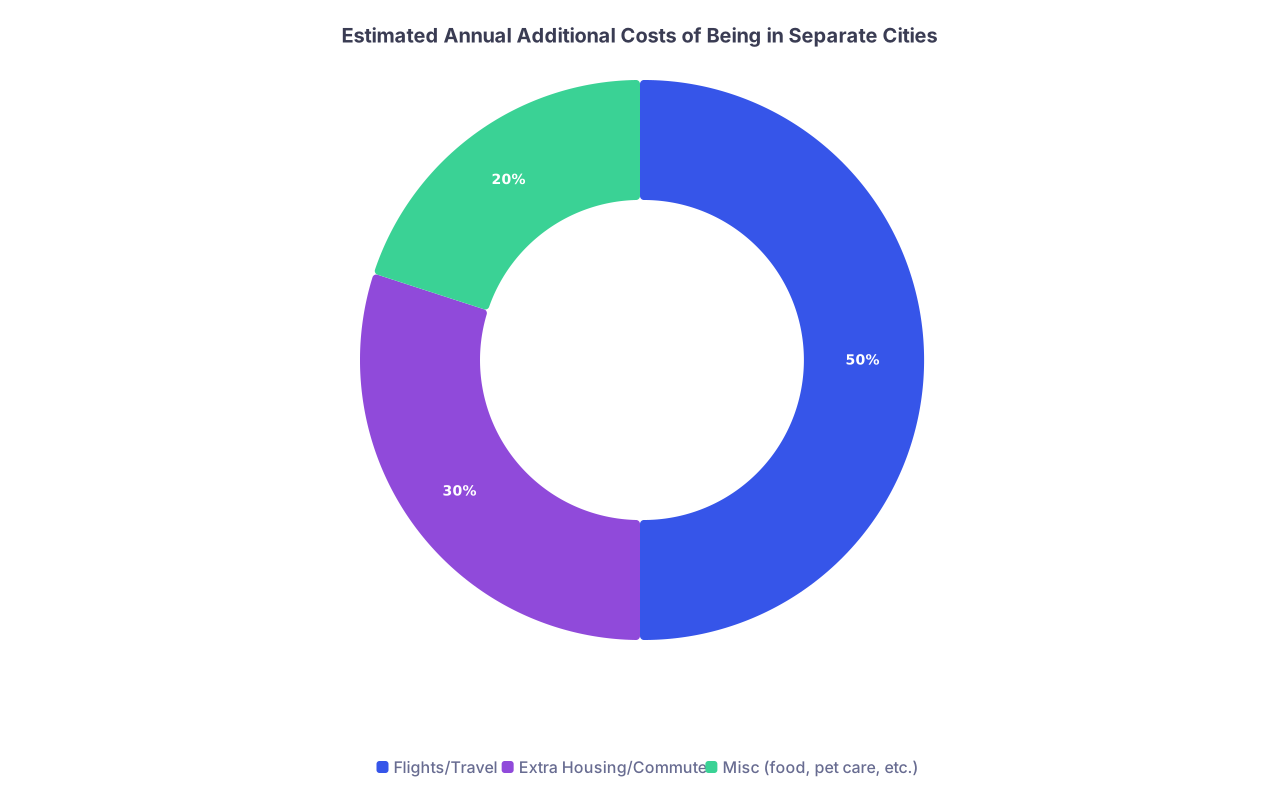
| Category | Value |
|---|---|
| Flights/Travel | 5000 |
| Extra Housing/Commute | 3000 |
| Misc (food, pet care, etc.) | 2000 |
12. Believing “We Will Re-Match Together Later” Will Fix Everything
The last and ugliest geographic fantasy:
“If it is bad, we will just re-match together in a couple of years.”
No. You might. But you probably will not.
Barriers people underestimate:
- Many specialties do not have tons of open PGY2+ spots.
- Both of you finding openings in the same city at the same time is rare.
- You will be more tied down later (board exams, research, mentors, maybe kids).
- PDs do not love residents who look halfway out the door.
You may get stuck in:
- One of you re-matches.
- The other cannot find a spot in the same region.
- Now you have added instability on top of already bad geography.
Re-matching is a last-ditch emergency tool. Not a “backup plan” to compensate for reckless rank lists. Treat it like needing a second transplant, not like changing apartments.
Final Reality Check
If you forget everything else, keep this:
- Geography is not a soft factor. It is the skeleton your entire relationship and residency life will hang on. If you get it wrong, everything else hurts more.
- Be aggressive about clustering your rank list around realistic, livable regions for both of you. Put real boundaries on distance, cost, and environment—and actually obey them.
- Do not lie to each other—or yourselves—about what you can tolerate. Commutes, climate, family distance, city size, culture. The resentment from ignored realities lasts longer than any program prestige ever will.


