

The couples who pretend they “won’t need SOAP” are exactly the couples who get crushed by it.
If you’re entering the Couples Match without a concrete SOAP plan, you are gambling your careers, your relationship, and your sanity on a single Thursday email. That’s not brave. It’s reckless.
Let me be blunt:
You hope you’ll both match.
You plan like you definitely won’t.
This is where most couples screw up.
They treat SOAP as an abstract disaster scenario instead of what it really is: a process with rules, deadlines, and brutal constraints that will not care about your relationship, your preferences, or your mental health. If you do not walk into Match Week with a clear, written, realistic SOAP strategy as a couple, you’re setting yourselves up for panic-driven, emotional decisions at the exact time you’re least capable of making good ones.
Let’s fix that.
The Most Dangerous Lie: “We’re Competitive, We’ll Be Fine”
Here’s the first fatal mistake couples make:
They confuse “individually competitive” with “safe as a couple.”
I’ve seen versions of this conversation way too many times:
“My Step 2 is 245, hers is 242, we both have solid letters. We’re not going to SOAP. That’s for people who didn’t plan.”
This thinking is how you end up on the floor on Monday of Match Week, refreshing your inbox, realizing both of you are unmatched and you have no joint strategy.
As a couple, your risk is multiplied, not averaged. It only takes one of you missing for the entire shared plan to blow up.
You need to accept three ugly truths:
- You can be strong applicants and still not match as a couple.
- You can partially match (one matched, one not), which is actually harder emotionally and logistically than both missing.
- SOAP is not a generous safety net. It is narrow, fast, and unforgiving.
Look at how quickly your odds can shift:
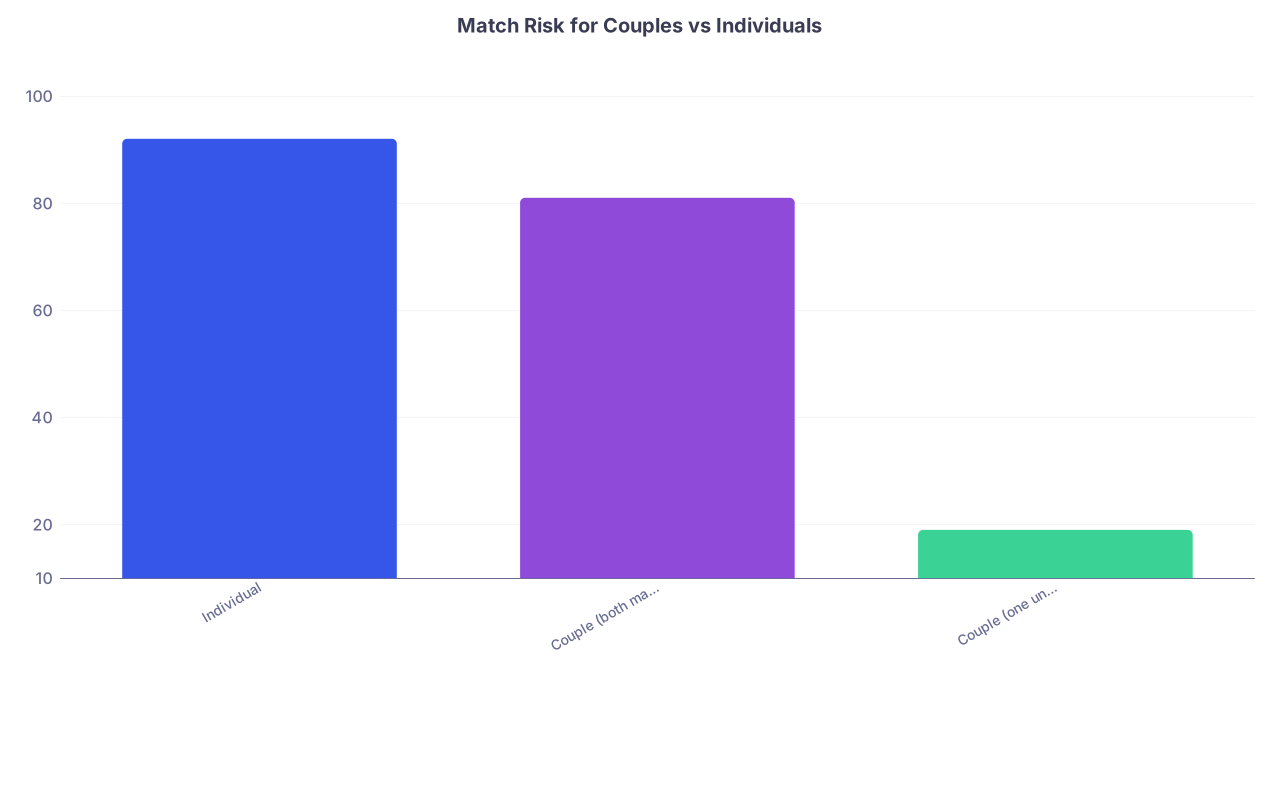
| Category | Value |
|---|---|
| Individual | 92 |
| Couple (both match) | 81 |
| Couple (one unmatched) | 19 |
Those are illustrative style numbers, but the point stands: when you link your fates, the system becomes more brittle.
If you’re telling yourselves, “We’ll just see what happens,” that’s your first big red flag. You’re already behind.
Mistake #1: No Clear Answer to “What If Only One of Us Matches?”
This is the scenario couples hate thinking about, so they don’t. That’s emotional, not strategic.
Then Monday of Match Week arrives.
- Email: “We are sorry, you did not match to any position.”
- One of you matched. The other didn’t.
- You stare at each other, and neither of you knows what happens next.
If you’re waiting until that moment to decide your priorities, you’re cooked. Because here’s what actually happens in SOAP:
- You have very little time.
- You have emotionally wrecked brains.
- You must make high-stakes decisions rapidly.
You need a pre-agreed hierarchy of priorities before Match Week. Not vague values. Actual rules you both can live with.
Spell out answers to these questions in writing:
If one of us matches and the other doesn’t, do we:
- Prioritize both being in some residency, even if in different cities?
- Prioritize staying geographically close, even if it means a prelim or less desirable specialty for one?
- Ever consider the matched partner giving up their spot (yes, people do this—usually in panic—and often regret it long-term)?
What is absolutely off the table?
- Withdrawing from SOAP to reapply next year?
- Refusing certain specialties under any circumstances?
- Living apart more than X hours by car or flight?
What is our “break glass” option?
- Worst-but-acceptable scenario you’d take rather than both going unmatched entirely.
You don’t need to like these scenarios. You just need to have decided.
Couples who skip this conversation end up screaming, crying, or going silent on each other right when SOAP opens. And then they make rushed, emotionally driven choices that hurt both careers.
Do not let Match Week be the first time you find out you have completely different thresholds for sacrifice.
Mistake #2: Ignoring How SOAP Actually Works for Couples
Too many couples talk about SOAP in fantasy terms:
“We’ll just see what’s available and then choose together.”
That is not how this works.
SOAP is a rule-bound process with system constraints that are not Couples Match–friendly. If you do not understand those constraints before Match Week, you will waste precious time during it.
Here’s what trips couples up:
1. You SOAP as individuals, not as a “linked couple”
Your Couples Match “link” doesn’t follow you into SOAP. You’re just two separate applicants now, chasing individual positions.
You can try to align applications, but the system won’t treat you as a package deal. Programs don’t have to coordinate with each other. They often don’t.
2. The time pressure is brutal
SOAP happens on a rapid-fire schedule. You get:
- A short list-release window (unfilled programs)
- A narrow submission window for applications
- Then waves of offers that expire fast
You will not have peaceful evenings to weigh pros/cons for each opportunity as a couple.
If this is your first exposure to the intensity of SOAP:
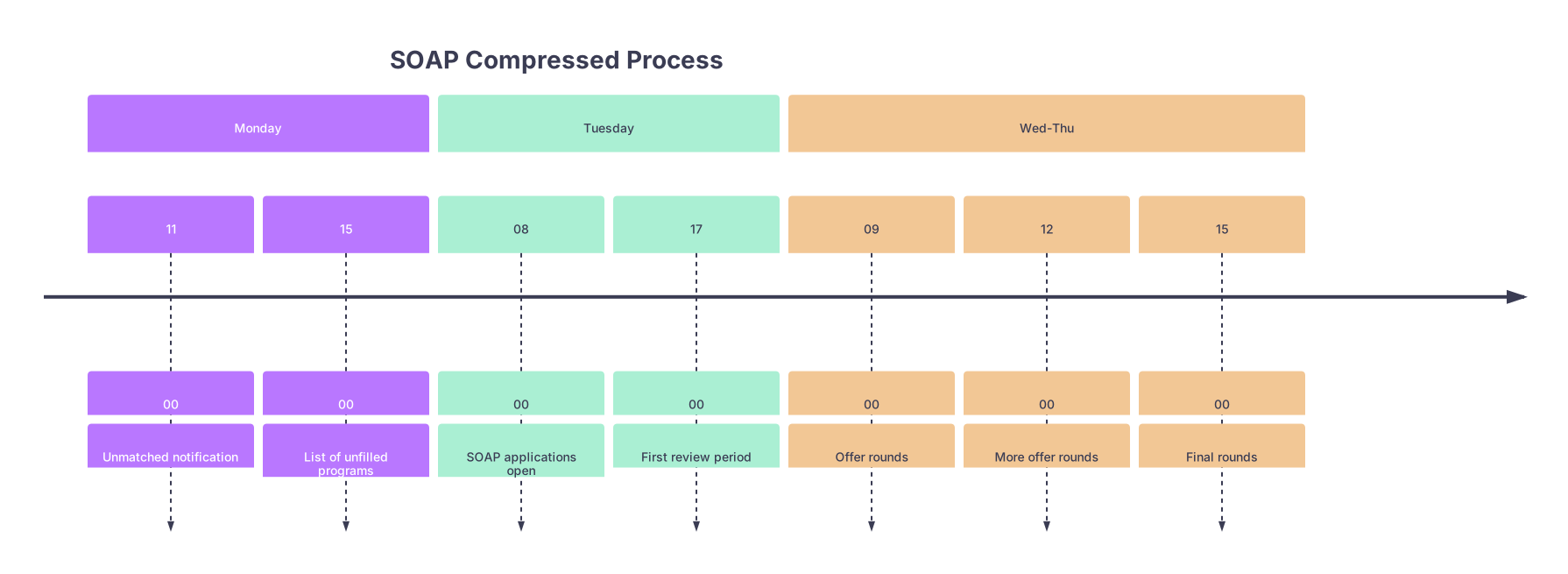
| Period | Event |
|---|---|
| Monday - 11 | 00 |
| Monday - 15 | 00 |
| Tuesday - 08 | 00 |
| Tuesday - 17 | 00 |
| Wed-Thu - 09 | 00 |
| Wed-Thu - 12 | 00 |
| Wed-Thu - 15 | 00 |
You cannot build a couples strategy during that.
You should already know:
- Our target regions if SOAP happens
- Which specialties we’re open to in SOAP
- How much separation we’d accept
- Which combinations are no-go
3. The menu is limited and ugly
SOAP is not a second full buffet. It’s what’s left after everyone else already filled their plates.
That means:
- Lots of community programs
- Lots of prelims
- Odd locations
- Highly variable training quality
If you enter SOAP expecting to “fix” your Couples Match misses with a perfect matched pair in your favorite city, you’re delusional.
You’re there to salvage. To stabilize your trajectory. To live to fight another day.
If you haven’t made peace with that before Monday, you’ll waste time in denial during SOAP and miss real, workable options.
Mistake #3: No Pre-Made Shortlists or “If X Then Y” Rules
The worst SOAP decisions come from staring at a giant list of unfilled spots while panicking and arguing about what matters more: geography, specialty, or staying together.
Here’s where sane couples win:
They do the thinking before they’re flooded with adrenaline.
You need:
- A list of regions in rank order.
- “If we can’t both be in City A, next best is Region B, then C.”
- A list of acceptable specialties for SOAP.
- Including: Would one of you ever take a prelim year? In what fields?
- A “map” of distance tolerances.
- Same city > within 2 hours > same state > same region > anywhere.
Then you translate that into concrete rules like this:
- “If one of us can SOAP into categorical IM in City X and the other can SOAP into FM or prelim surgery within 2 hours, we’ll take it.”
- “If the only option for one of us is prelim medicine in a city more than 5 hours away from the other’s best SOAP option, we’ll accept it for one year, and the other will reapply next cycle closer.”
- “If neither of us gets any categorical offers by the second day of SOAP, we’ll both accept prelims if offered and plan coordinated reapplications.”
You build these now. When your brains are intact. When your relationship is not under acute threat.
If you wait, here’s what actually happens:
- One of you clings to specialty pride (“I’m not going FM, no way.”)
- The other clings to geography (“I’m not doing long-distance, that’s insane.”)
- Offers expire while you fight.
People have actually declined viable SOAP offers because they “needed to think about it as a couple,” then ended up completely unmatched. That is a preventable disaster.
Mistake #4: Refusing to Talk About Worst-Case Sacrifices
Here’s the dark part nobody wants to say out loud:
Sometimes, one career has to take a temporary hit to protect the bigger picture.
If you don’t talk about that in advance, resentment festers for years.
Common patterns I’ve seen:
- One partner ends up doing a prelim year in a specialty they never wanted, solely to stay in the same city, and quietly resents the other for getting their dream categorical spot.
- One partner moves alone to a less desirable program in a remote area while the other stays in a “better” city, and both resent each other and the distance.
- One partner refuses all but a narrow set of SOAP options, goes unmatched, while the other starts residency. It fractures the relationship.
You must answer, together, with brutal honesty:
- Whose specialty is less flexible long-term?
- Whose geographic constraints are tighter (family, immigration, visas)?
- Are you both truly willing for either person to:
- Do a prelim year?
- Switch to a less competitive field?
- Move somewhere you both swore you’d never live?
If the answer is no, fine—but then own what that means.
It means accepting a higher chance that one or both of you might go unmatched this year.
The dangerous move is pretending you’d “do anything to stay together” while silently knowing you wouldn’t actually change specialties or cities when it comes down to it.
Write this down:
- “I would be willing to take: [prelim IM / prelim surgery / FM / psych / etc.] to be within [distance] of you.”
- “I am not willing to: [change specialty entirely / live more than X hours away / leave the country].”
You’re not being dramatic. You’re being honest.
Mistake #5: Not Understanding How Fast Emotions Hijack SOAP
I’ve watched couples walk into Match Week “strong” and walk out barely talking.
Why? Because nobody warned them how dirty the emotional storm gets when:
- One of you matched and the other didn’t.
- Or both of you didn’t.
- And suddenly your self-worth, your relationship, and your future are all mixed together.
Here’s what tends to show up fast:
- Guilt: “You matched because you ranked that program higher for me.”
- Blame: “You insisted we rank that city, and look where we are.”
- Shame: “I dragged us down. It’s my fault we’re here.”
- Panic bargaining: “I’ll just quit. I’ll reapply. I’ll go anywhere. I don’t care.”
You will not have your best communication skills online that week. Don’t flatter yourself.
That’s why your SOAP plan should be:
- Written, not just “we talked about it once.”
- Shared, so both know the rules.
- Specific, so you can say: “We agreed on this; we’re just executing.”
Think of it as your emergency protocol.
You don’t design an evacuation plan while the building is on fire. You follow the one you already made.
If you both value your relationship, you protect it from Match Week by taking these high-stakes decisions out of the chaos zone.
Mistake #6: Ignoring Data and Overestimating Your “Exceptions”
The classic couple error: “Those stats don’t apply to us.”
You know better.
Couples Match is statistically riskier than individual match, especially when:
- You’re both in competitive specialties.
- You’re both geographically restrictive.
- You both refuse major specialty compromises.
Now add SOAP. The pool is smaller. The options are worse. Your leverage is weaker.
Look at a very simplified view of how options shrink:
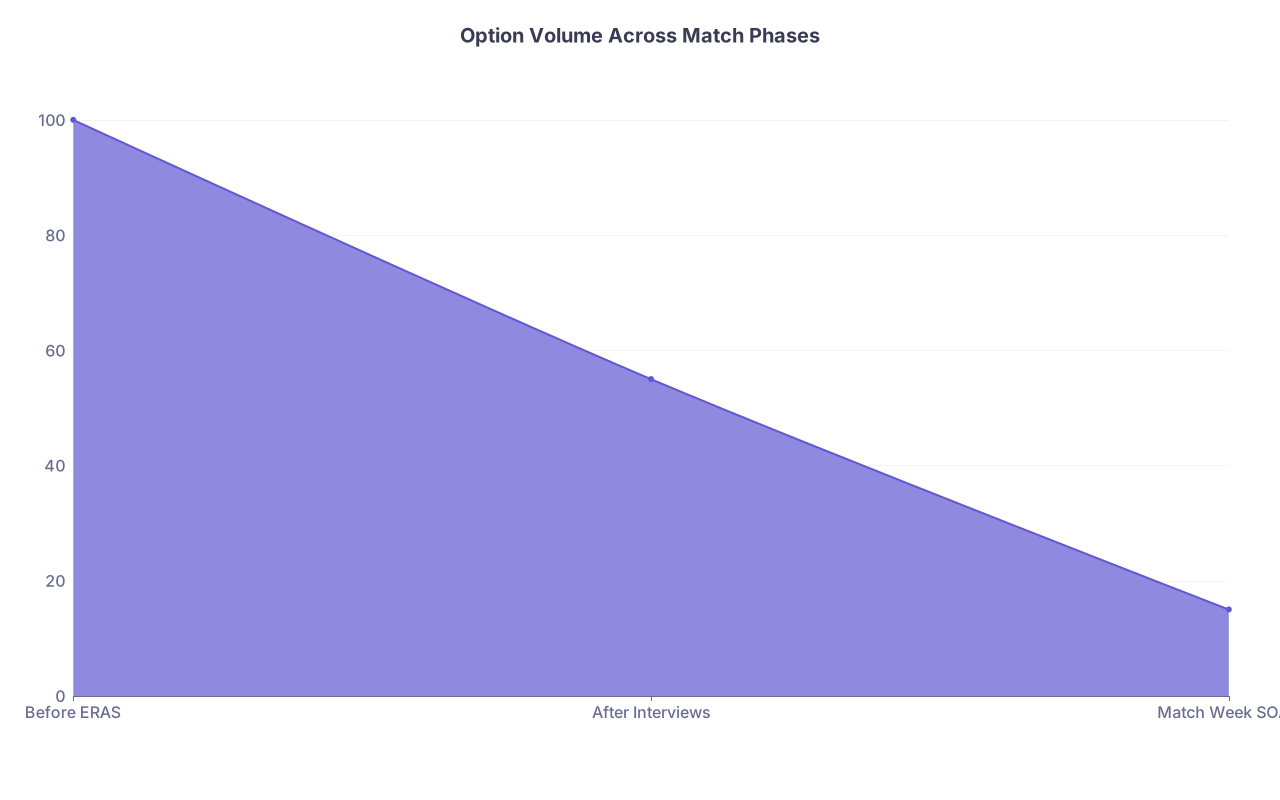
| Category | Value |
|---|---|
| Before ERAS | 100 |
| After Interviews | 55 |
| Match Week SOAP | 15 |
By SOAP, you’re operating on leftovers. That doesn’t mean “give up,” but it does mean: stop assuming you’ll land an outcome that looks like your original Couples Rank List.
Let data humble you before Match Week, not during.
Make yourself answer:
- “If we were each solo applicants with these stats, would we still feel 100% safe?”
- “What’s our plan if our ‘reach’ Couples strategy doesn’t work out?”
If your answer is “we’ll figure it out,” that’s not a plan. That’s denial dressed up as optimism.
Mistake #7: Failing to Prepare Logistically for a SOAP Scenario
Most couples prepare mentally only. They don’t prepare practically.
Then SOAP hits and you realize:
- You don’t even have an updated CV ready to tailor.
- You have no organized list of programs you might SOAP into.
- You’re scrambling to remember which mentors can answer a call quickly.
Practical SOAP prep for couples should include:
Each of you with:
- A polished, up-to-date CV.
- A short list of faculty who’ve agreed to be responsive that week.
- A one-page summary of your story / strengths you can quickly adapt to emails or calls.
As a couple:
- A shared spreadsheet of:
- Regions you’re open to.
- Types of programs you’d consider.
- Distance thresholds (same hospital, same city, up to X hours).
- Clear notes like: “If she gets psych in City X, he is willing to take IM / FM / prelim within 2 hours.”
- A shared spreadsheet of:
You don’t need a 40-tab monster spreadsheet. You just need something you can open under stress that tells you what to do.
Here’s a simple structure you can copy:
| Priority | Region/City | Partner A Options | Partner B Options |
|---|---|---|---|
| 1 | Home City | IM, FM, Prelim | Psych, FM |
| 2 | Region A | IM, FM | Psych, Neuro |
| 3 | Region B | Any prelim | Psych, Prelim |
If you think you’ll “remember” all this when the list of unfilled spots drops, you’re kidding yourself.
Mistake #8: Letting Others’ Opinions Dictate Your SOAP Choices
Match Week has too many voices:
- Classmates bragging about where they matched.
- Seniors telling horror stories or success stories that don’t apply to you.
- Family members saying, “Just stay together no matter what,” or “Just do what’s best for your career.”
None of them are responsible for living your actual life.
You and your partner are.
I’ve seen couples reject decent SOAP options because:
- “My mentor said that program is ‘lower tier.’”
- “My parents said long-distance is a terrible idea.”
- “Everyone on Reddit says that specialty is a dead-end.”
Then those couples end up with no spots at all—and those other people move on with their lives.
Your SOAP plan has to be anchored to your priorities:
- What level of training quality is “good enough” for now?
- What sacrifices are acceptable short-term vs long-term?
- What’s worse for you as a couple: 1–3 years of distance, or both being delayed a full year?
You can invite advice before Match Week. Fine. But once that week starts, you should already know whose voices matter—and whose don’t.
Mistake #9: Forgetting That SOAP Is Not Your Final Form
Here’s the mindset error that paralyzes people:
“If I accept this SOAP position, I’m locked into a second-rate career forever.”
No. That’s not how it works.
Reality:
- Many people SOAP into prelim years or less ideal programs, then reapply or transfer.
- Many couples use one partner’s “less ideal” SOAP year as a bridge to realign later.
- Future fellowship, relocation, and career building are still very real.
SOAP is stabilization, not perfection.
The couples who make better choices see it this way:
- “This might be a one-year sacrifice for a 30-year career.”
- “We can fix geography later.”
- “We can change programs or specialties if absolutely necessary after we’re in the system.”
The trap is thinking: “If it’s not perfect now, we’ll just skip it and try again next year.”
Sometimes that’s the right call. But many times, it’s not. Especially if:
- You’re both international grads.
- You’re already on the weaker side of competitiveness.
- You don’t have unlimited financial runway for another unstructured year.
Your SOAP plan should include:
- “Acceptable ‘bridge’ options” we’d take now, planning to adjust later.
- “Absolutely-not” options we’d still refuse, even as a bridge.
You’re not locking in your forever life. You’re getting yourselves onto the board.
Pulling It Together: What a Real SOAP Plan Looks Like for Couples
No fluff. This is what you need before Match Week:
A shared, written document that answers:
- What if both match? (Great, done.)
- What if one matches, one doesn’t?
- What if both don’t?
Pre-agreed priorities:
- Which matters more in SOAP: specialty vs geography vs staying together?
- How far apart you’d tolerate living, and for how long.
- Which temporary sacrifices each of you is genuinely willing to make.
Clear decision rules (“if X, then Y”):
- If Partner A gets categorical IM within 1 hour of City X, Partner B will accept psych/FM/prelim within 2–3 hours max.
- If only prelims are available for one of us, we accept and plan reapplication rather than stay completely unmatched.
- If offers conflict, we’ll prioritize [staying same city / getting any spot for both / best long-term specialty fit].
Logistical prep:
- Updated CVs and personal statements.
- List of likely SOAP-friendly specialties and regions for each partner.
- Mentors on standby who understand your couples priorities.
Do that, and if SOAP never comes? Great.
You wasted a few hours to protect your futures.
Do not do it, and if SOAP does come? You’ll be trying to build a parachute while already falling.
The Bottom Line
Three things I want you to walk away with:
- As a couple, you must have a concrete SOAP plan even if you think you’ll never need it. Hope is not a strategy.
- The worst SOAP decisions come from trying to align values, priorities, and sacrifices during Match Week. Do that work now, in writing, with brutal honesty.
- SOAP is not your final chapter. It’s a damage-control tool. Use it strategically as a couple, and you can protect both your careers and your relationship from a process that doesn’t really care about either.
Do not be the couple that pretends SOAP doesn’t exist.
You’ll remember that mistake for a very long time.


