

Couples do not go unmatched because the algorithm is unfair. They go unmatched because they misjudge how competitive they really are—together.
If you and your partner are couples matching and you think, “We’re solid applicants, we’ll be fine with a reasonably ambitious list,” you’re already walking toward the cliff.
You’re not matching as “two strong individuals.” You’re matching as one fragile unit. And that unit is only as strong as the weaker application, constrained by the more competitive specialty, and capped by the geographic radius you insist on.
Let me walk you through how couples overestimate, overreach, and end up staring at a Thursday NRMP email they never thought would be theirs.
The First Big Lie: “We’re Competitive Enough for This Strategy”
The most dangerous sentence I hear from couples:
“We’re both reasonably competitive for our specialties, so we should be okay.”
No. That’s not how this works.
When you couples match, the question changes from:
- “Can I match somewhere in my specialty?”
to:
- “Can we both match in acceptable programs in the same area at the same time?”
That’s a much harder problem. And most couples don’t adjust their risk tolerance accordingly.
Where people misjudge their competitiveness
Couples routinely screw up their self-assessment in three predictable ways:
They judge themselves by their medical school bubble
- “I’m in the top half of my class at a mid-tier MD school”
- “My home PD said I should be fine”
- “People with scores like mine matched last year”
They forget:
- Applicant pools shift.
- People lie or omit bad outcomes.
- “Fine” as a solo applicant is not “fine” as a couple.
They ignore the weaker partner’s constraints
One partner is a strong EM applicant at a university program level.
The other is a borderline Internal Medicine applicant with average scores, no research, and mediocre letters.The strong partner builds a list as if they’re solo-competitive for urban academic EM.
The weak partner builds a list as if geography doesn’t matter.
Together, they create a list that assumes they both punch above their true combined weight.They treat “likely to match somewhere” as “likely to match in this specific region and combination”
Very different. You can be:- 90% likely to match somewhere in IM
- But only 40% likely to match in “upper East Coast academic + same city as partner matching OB/GYN”
Couples ignore regional competitiveness and treat “IM is less competitive” as a guarantee. It isn’t.
The Math Problem Couples Don’t Respect
You’re not matching one applicant to one program. You’re creating pairs of acceptable outcomes. That destroys your safety margin if you’re not careful.
Think like this.
Say:
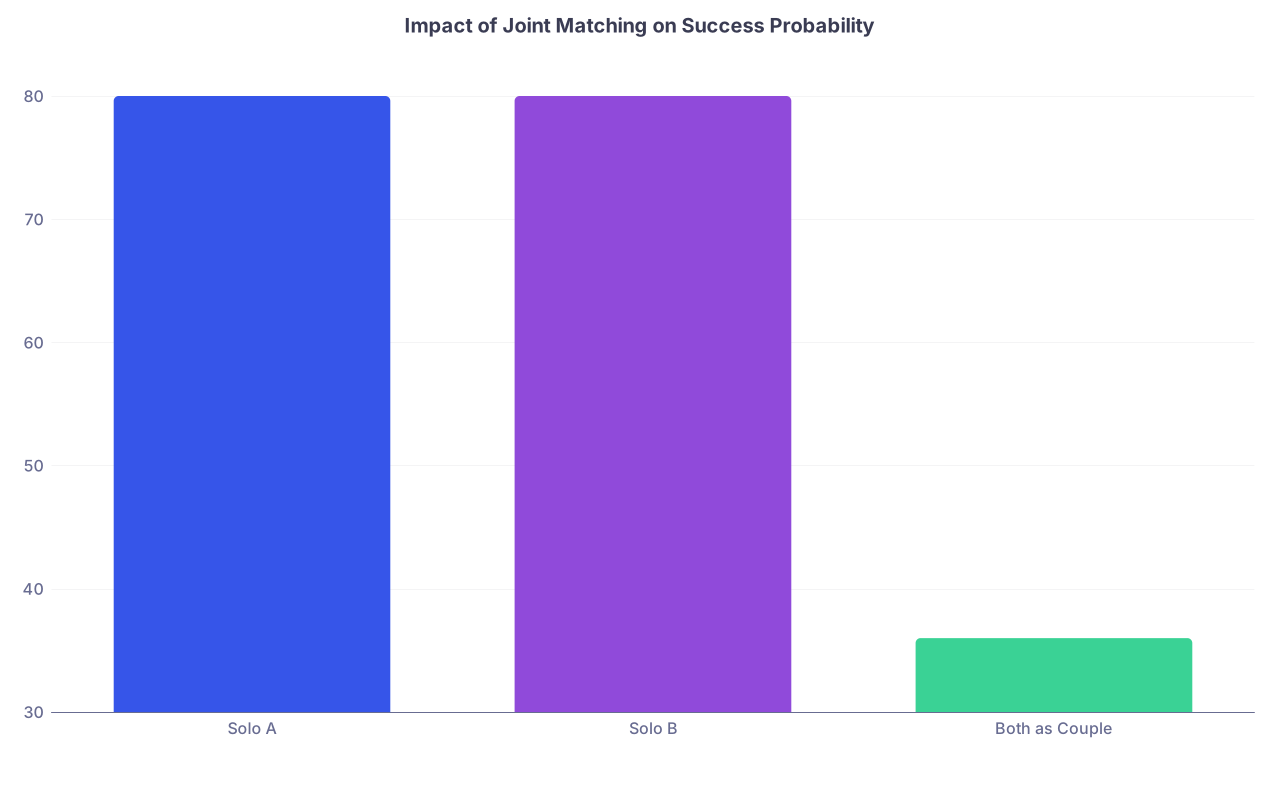
- Partner A: 80% chance to match somewhere in their specialty.
- Partner B: 80% chance to match somewhere in theirs.
Individually, those odds feel decent.
But for both to match in a configuration you ranked together?
That’s not 80%.
The effective probability drops because:
- You’ve limited cities.
- You’ve limited program tiers.
- You’ve created “acceptable” pairings only in certain combinations.
If, realistically, each partner only has a 60% chance to match within the shared geographic and program constraints, then:
- Joint probability: 0.6 × 0.6 = 0.36 → 36%
Plenty of couples walk into Match Week sitting on solo-competitive applications and a joint match probability that’s closer to a coin flip. And they never see it coming.
| Category | Value |
|---|---|
| Solo A | 80 |
| Solo B | 80 |
| Both as Couple | 36 |
That’s how people with “good applications” still don’t match as a couple. They’re playing the wrong game.
Classic Overreach Patterns I See Every Year
Most couples don’t blow it in some exotic, creative way. They make the same few mistakes, over and over.
1. The “We’re Both Above Average” Fantasy
Scenario I’ve seen multiple times:
- Partner A: 245 Step 2, solid mid-tier MD, mid-range research, wants Dermatology, applied to ~70 programs.
- Partner B: 235 Step 2, average application, wants Radiology, ~60 programs.
By themselves?
- Derm applicant: Possibly competitive with a realistic mix of programs.
- Rads applicant: Reasonable with a broad list.
As a couple?
They:
- Refuse to rank community-heavy cities.
- Aim mostly at large academic centers in high-demand metros.
- Under-rank “safety” combos like:
- One at academic, one at community in same metro
- One specialty 30–40 minutes away
They go barely matched or unmatched because they treated “above average” as “we can both push high-tier programs in high-tier cities simultaneously.”
You are not applying in a vacuum.
You are competing with:
- Single applicants who are more flexible
- Couples who are more realistic
- People willing to go where you think you’re “too good” to go
2. The “Prestige or Bust” Trap
Another common disaster:
- One partner at a T10 med school with a strong academic profile.
- The other at a mid/low-tier school, weaker scores, minimal research.
The high-flyer decides:
- “We’re not ranking community programs; it would hurt my career.”
- “We’ll be fine with academic places; my CV lifts us.”
Reality:
- Programs do not admit couples to rescue one person’s ego.
- The less competitive partner’s application still has to clear their own bar.
- Many academic departments are already over-selective for both applicants.
Result:
- List heavily skewed to big-name programs and oversubscribed cities.
- Very few true backup pairs where the weaker applicant is safely above the bottom of the pool.
And then they’re shocked that the “super strong” partner and “okay” partner can’t both land in the same academic orbit.
I’ll be blunt:
If you’re couples matching and you refuse to rank any program that looks “below your level,” you’re volunteering for unmatched.
3. The “We’ll Just Add More Programs” Cop-out
Some couples try to brute force the problem with volume.
- Each partner applies to 80–100 programs.
- On paper, that sounds like a safety net.
- In practice, they:
- Apply to dozens of places neither actually wants
- Fail to realistically model which pairs of programs are both viable
- End up with a long but strategically useless rank list
Higher number of applications ≠ lower risk if:
- You cluster most of them in hyper-competitive cities (NYC, Boston, SF, Seattle, Chicago)
- You pile on reach programs and barely improve your odds in safety locations
I’ve watched couples waste thousands of dollars “casting a wide net” in all the wrong waters.
The Geography Delusion: “We Won’t Be Happy There”
Geography destroys couples’ chances more than any single factor.
Individually, many applicants would say:
- “I’d go to a solid community program in the Midwest if I had to.”
- “I’d take a program in a smaller city if it meant matching safely.”
But together? The story changes:
- “We don’t see ourselves in the South.”
- “We refuse to live anywhere that’s not a major coastal city.”
- “We’d be miserable in the Midwest, so it’s not worth ranking.”
That’s how they end up with a tiny, fragile rank list that assumes:
- Both match in one of 3–5 major metros, often the most competitive ones.
- Both land at the same hospital or within a narrow commute.
You know what makes people miserable? Not having a job in your specialty.
Be wary of these red flags in your thinking:
- “We’ll just couples match in [hot city]—they have tons of programs.”
Translation: Tons of applicants too. It’s often more competitive, not less. - “We have family there, so we’re prioritizing it.”
Fine. As long as you don’t sacrifice your entire safety floor for that preference. - “If we don’t end up in [coastal metro], it’s not worth it.”
That’s how you talk yourself into unranking perfectly good, match-saving options.
If you would individually rank a program as a solid backup, but as a couple you cross it off because the city isn’t exciting enough, you’re gambling with the entire match.
Specialty Combinations That Invite Overreach
Some couples are playing this game on “easy mode.” Others are not.
Here are combinations that are especially dangerous when you overestimate competitiveness:
| Partner A | Partner B | Risk Level | Why Risky |
|---|---|---|---|
| Derm/Plastics | Any | Extreme | Ultra-competitive + limited spots |
| Ortho | Ortho | High | Location + both in competitive field |
| ENT/Urology | Any competitive | High | Fewer programs, uneven geography |
| EM | EM | High | Market shifts, regional saturation, limited dual positions |
| OB/GYN | Pediatrics | Moderate-High | City overlap but uneven program densities |
Couples in these buckets often:
- Overestimate “how special” their applications are.
- Underestimate the difficulty of landing two spots in the same place.
- Misread last year’s success stories as evidence that their similar stats = same outcome.
If you’re in a high-risk combination and your Step 2 score, research, or letters are merely “average for the field,” you do not have the margin to also be geographically picky and program-tier snobby.
The Rank List Mistakes That Kill Otherwise Good Applications
The worst overreach usually shows up in the rank list strategy, not just in the application phase.
Common fatal errors:
1. Too Few “Reality-Based” Pairs
Couples will rank:
- 10–15 combinations in very competitive cities.
- 5–10 in moderately competitive cities.
- Maybe 3–5 in places they consider “last resort.”
But when you look closely:
- Many of those pairs hinge on both applicants matching into aspirational programs.
- They’re missing the pairs where:
- One is at academic, the other at community.
- One commutes 30–60 minutes.
- One takes a slightly lower-tier program in a more forgiving city.
You need a thick bottom to your rank list—lots of combinations where:
- At least one partner is matching below their best-case tier.
- Geography is less glamorous but more forgiving.
2. Refusing to Split Cities or Hospital Systems
Couples often anchor to:
- “Same hospital or nothing”
or - “Same city or nothing”
But the algorithm does not care about your shared commute fantasy.
You drastically increase your safety if you’re willing to:
- Be in the same city but different hospital systems.
- Be in adjacent cities within a commutable radius (e.g., one in Durham, one in Raleigh).
I’ve seen couples go unmatched because they ranked:
- 30 combinations in 3 cities…
- But refused to include combinations where one partner was at another nearby program they also interviewed at.
That’s self-sabotage disguised as “wanting to be together.”
3. Not Respecting the Weaker Application
Every couple has a weaker application. Sometimes slightly weaker, sometimes much.
Common mistake:
- Rank list anchored to the stronger partner’s interview set.
- Weaker partner lists many programs where they barely scraped an interview or felt lukewarm feedback.
- Stronger partner refuses to heavily rank the programs where the weaker partner is genuinely solid.
You must build your rank strategy around:
- Where the weaker partner is clearly above the bottom of the pile.
- Where their letters, fit, and geographic alignment were strongest.
If you ignore that, you’re silently betting the entire match on the one person with less leverage.
A Safer Way to Judge Your Real Competitiveness as a Couple
You want to avoid overreach? You need a brutally honest self-assessment. Not vibes. Not “people like us matched.”
Here’s a stripped-down diagnostic:
Step 1: Separate Solo From Couple Risk
For each partner:
- What’s your realistic solo match probability?
(Ask advisors who are willing to be blunt, not just supportive.) - What tier of programs are your true safeties?
(Where you felt clearly in the top half of the interview day.)
Now adjust for couples:
- How many of those safety programs exist in overlapping cities?
- How many places both of you would genuinely rank?
If your true overlapping safety list is under ~10–15 realistic combinations, that’s a red flag.
Step 2: Map Your Geographic Ego
Write down:
- All cities/regions where either of you interviewed.
- Rank them in three columns:
- Places we’re excited about
- Places we’re neutral but fine with
- Places we think we “don’t want”
Be careful:
- If 80% of your “acceptable” options are in the “excited” column and you’ve crossed out most of your neutral cities, you’re overestimating how much leverage you have.
Step 3: Reality-Check With Data, Not Anecdotes
Where couples go off the rails is listening to:
- “My friend matched here with similar stats.”
- “Our school tends to do well in [City].”
- “The PD said we’d be competitive.”
Instead, look for:
- Specialty competitiveness trends (NRMP Charting Outcomes, specialty society data)
- Where your school’s last 2–3 years of grads with similar applications actually matched
- How many interviews you each got in each region and tier
If you each:
- Got 1–2 interviews in a city…
- You rank 10+ pair combinations there…
You’re not building a rank list; you’re writing fan fiction.
How to Build a Rank List That Doesn’t Implode
You can still have ambition. Just don’t build a house with no foundation.
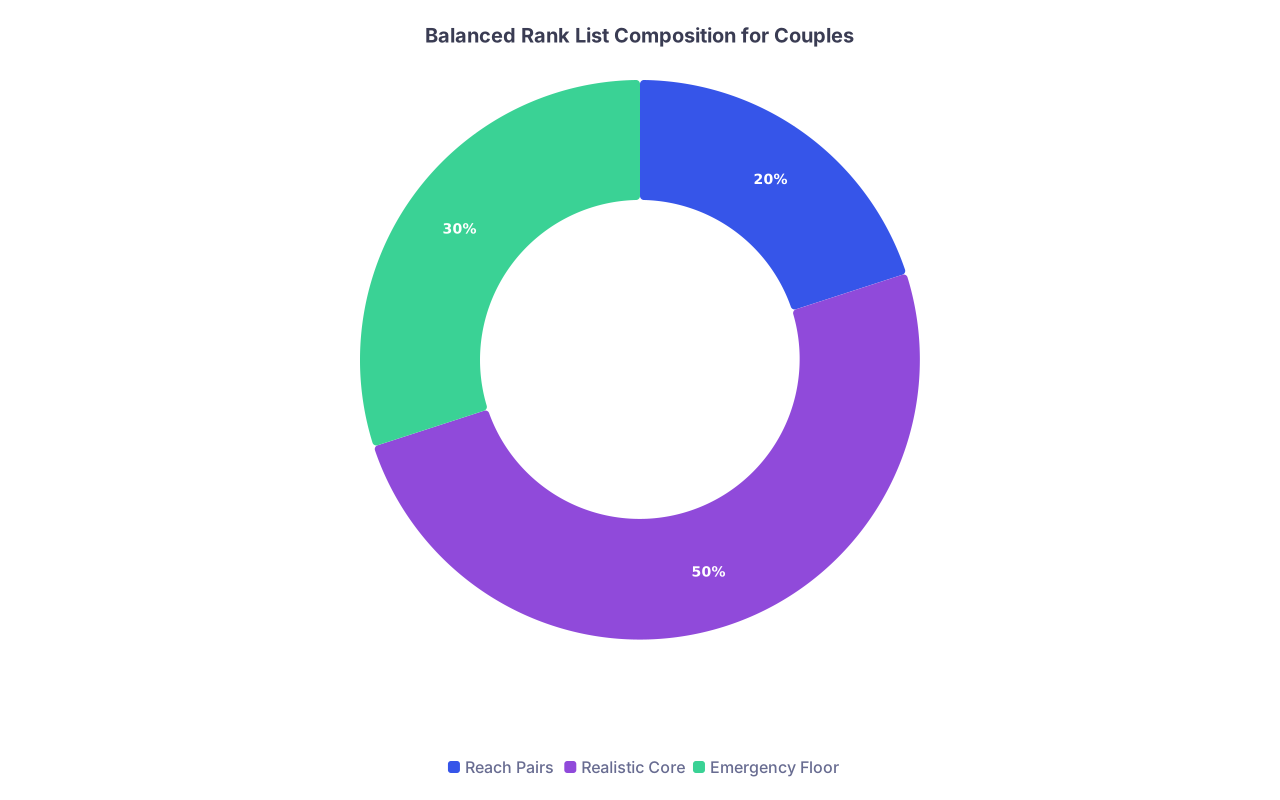
Think in three layers:
Reach combinations
- Both at higher-tier programs and/or prime locations
- Sure, put them at the top. Fine.
Realistic core
- Mid-tier and slightly-below-mid-tier programs
- Multiple cities you’re at least neutral about
- Mix of academic + strong community
Emergency floor
- Places you might not love on paper, but you can tolerate
- Programs where the weaker applicant is truly in good shape
- Cities that are less trendy but safer match markets
| Category | Value |
|---|---|
| Reach Pairs | 20 |
| Realistic Core | 50 |
| Emergency Floor | 30 |
Red flag pattern:
- 50–70% of combinations in the Reach bucket.
- Almost no true Emergency floor.
- Then a shocked email to the dean on Monday of Match Week.
The Emotional Trap: “We’ll Be Miserable If…”
Last piece. This one’s not about numbers; it’s about pride and fear.
Couples tell themselves:
- “If we end up in a smaller city, we’ll be miserable.”
- “If one of us has to go to a community program, that’s a failure.”
- “If we’re not together at the same hospital, what’s the point of couples matching?”
And then they rank as if those statements are unquestionable facts.
I’ve watched the same couples, after going unmatched, accept:
- A prelim year in a small city they refused to rank.
- A community program they’d previously called “a step down.”
- A long-distance arrangement they swore they’d never do.
You know what changed? Not the location. Not the program.
Their sense of what “miserable” really is.
I am not telling you to kill all your dreams. I am telling you to not blow up your entire early career because you refused to build a realistic floor under your goals.
Today’s Move: Do a Ruthless Rank List Autopsy
Before you get locked into a dangerous overreach, do this:
- Open your draft rank list.
- For each city and program pair, ask:
- “If I were solo, would I still rank this program as a safety or realistic option?”
- “Are we crossing this off for real reasons…or vanity and fear?”
- Then identify 5–10 additional combinations where:
- One or both of you are stepping slightly down in tier or city glamour
- But both of you still get trained, paid, and moving forward
Add them. Even if it stings your ego.
Because the bigger mistake is not ranking “somewhere less ideal.”
The bigger mistake is waking up on Match Week with nothing—just because you were sure you were more competitive than you really were as a couple.


