

What happens when you open your final couples rank list and realize… it looks suspiciously like one person’s dream and the other person’s worst-case scenario dressed up as “teamwork”?
That’s the quiet disaster of the Couples Match: when one partner compromises so much that it stops being a partnership and starts being a slow-burn resentment factory.
Let me be blunt. The most painful Couples Match stories I’ve seen weren’t about not matching together. They were about couples who did match together—on a list built on one-sided sacrifice—then spent the next 3–7 years living with that decision.
This is the mistake you cannot afford to make.
The Core Error: Calling It “Compromise” When It’s Actually Capitulation
There’s healthy compromise: you both give a little, you both get a little, you both stay aligned with your core values.
Then there’s what I see every match season:
- One partner tanks their specialty choice to “make it easier”
- One partner gives up all geographic preferences
- One partner applies way below their competitiveness “just so we stay together”
- One partner quietly accepts being the “trailing spouse” in their own career
And everyone around them calls it “compromise” or “being a team player.”
No. That’s capitulation.
The red-flag pattern usually looks like this:
- Stronger application partner (on paper) says, “I just want us together; I’ll go anywhere.”
- Weaker application partner feels guilty, but also terrified of not matching, so they accept that “gift.”
- Rank list slowly morphs into: “Where can I match?” for one person, and “I’ll follow” for the other.
- After Match Day, reality hits: one person’s training, network, and opportunities were massively downgraded.
- Five years later, resentment shows up in ways neither of you connect back to that spreadsheet in January.
You do not feel the full cost of capitulation during rank list week. You feel it year 2 of residency when one of you is in your dream field at a solid program and the other is trapped in a program they never wanted, in a city they actively dislike, with no easy exit.
How One-Sided Compromise Actually Shows Up (Real Patterns)
I’m going to spell this out in scenarios I’ve actually seen versions of. If you recognize yourself in any of these, you need to stop and reassess now, not the week before rank submission.
Scenario 1: “I’ll Just Switch to a Less Competitive Specialty”
- Partner A: Wants Dermatology, strong stats (250+, AOA, strong research).
- Partner B: Wants Psychiatry, solid but not stellar app.
Plan they land on:
Partner A “decides” to do IM or FM “so we have better odds of matching together.”
What goes wrong:
- Partner A spends all of intern year watching derm residents rotate through and feels physically sick.
- Every time someone says, “You were strong enough for derm, right?”, there’s a gut punch.
- Partner B now feels their entire relationship is sitting on top of Partner A’s quiet sacrifice—pressure, guilt, and a constant fear that if anything goes wrong, it’s “their fault.”
The mistake: They treated the Couples Match like a hostage negotiation instead of asking: “Is there a path where we both still pursue our real fields, even if that means temporary distance?”
Scenario 2: “We’ll Just Go Wherever Your Family Lives”
- Partner A: Deeply tied to hometown, family-heavy, wants to stay near support system.
- Partner B: Open geographically, but has always dreamed of high-acuity training at big academic centers.
Plan: Rank almost exclusively one small region where Partner A’s family lives, centering Partner A’s preference.
What goes wrong:
- Programs in that region for Partner B’s specialty are mid-to-low tier, weak in their area of interest (say, no strong cardiology or no peds subspecialty fellowships).
- Partner B graduates with weaker training and fewer connections, making fellowships or competitive jobs harder.
- Partner B starts to quietly resent family events, holidays, even weekend dinners, because all of it now represents “what I gave up.”
The mistake: They never had the hard conversation: “What is the career cost of this geographic choice—for both of us?”
Scenario 3: “I’ll Be the Backup Plan”
- Partner A: Has a riskier specialty choice (Ortho, ENT, Derm).
- Partner B: Flexible specialty (IM, FM, Psych) and says, “I’ll just aim low and be the fallback. We just need you to match.”
Plan:
Partner B applies very broadly, including weak programs or places they genuinely don’t want to live, “so that there’s always something” for the couple.
What goes wrong:
- The couple matches at a place where Partner A is happy-enough, but Partner B is in a malignant, under-supported program with poor board pass rates and toxic culture.
- Whenever Partner B expresses unhappiness, everyone unconsciously responds with, “Well at least you’re together,” which is basically a gag order.
- Partner A feels trapped between defending their own happiness and acknowledging the imbalance.
The mistake: They treated Partner B’s career as a safety net rather than an equal priority.
The Hidden Math: Where One-Sided Compromise Sneaks In
Let’s talk concrete structure. The couples algorithm doesn’t care about your emotions; it cares about line items.
The most dangerous part: that innocent-looking grid you build for your rank list.
| Rank Pair | Partner A Program | Partner B Program |
|---|---|---|
| 1 | A #1 Dream | B #5 |
| 2 | A #2 | B #7 |
| 3 | A #3 | B #9 |
| 4 | A #4 | B #10 |
| 5 | A #5 | B #12 |
If your grid looks like this—A’s top 5 with B sliding further and further down their own preference list—you already have the answer to “who compromised.”
You should be suspicious if:
- One partner’s top 3 programs don’t even appear in any of the ranked pairings
- One person has no programs in their top 5 that are realistically rankable with the other
- Your “together at all costs” pairs mostly feature one person at C-tier or D-tier choices while the other sits happily in A/B-tier
The algorithm will give you what you tell it to prioritize. If your list systematically pushes one partner down their own preferences to keep the other near the top of theirs, you are literally encoding one-sided compromise into the math.
Red Flags You’re the One Compromising Too Much
If you see these, stop and re-evaluate before you click “certify” on that list.
Your top 3 true dream programs “for you” are absent from the couples list
You tell yourself, “There’s no way we’d both match there, so why bother.” That’s cowardice disguised as realism.Your specialty choice changed after serious couples planning started
And the main reason was “it’ll be easier for us as a couple,” not your own genuine shift in interests.Every time you imagine matching at your top combined rank, your first feeling isn’t joy—it’s unease or grief
That’s your brain politely screaming at you.Your mentors are noticeably more concerned about your choices than you are
If an attending says, “You’re aiming low for what you’re capable of,” and your answer is always, “Yeah but we’re couples matching,” you’re selling yourself short.You catch yourself minimizing your own goals
Phrases like:- “It’s fine, I don’t need a big academic place.”
- “I can probably be happy anywhere.”
- “I mean, any derm/ortho/anesthesia spot is good enough, right?”
Sometimes that’s maturity. But too often it’s self-erasure.
The Cost of Over-Compromise (That No One Mentions on Interview Day)
Here’s what over-compromising actually costs, beyond the Match postcard photos.
1. Career Trajectory
Your residency program shapes:
- Your fellowship options
- Your letters of recommendation
- Your exposure to complex cases
- Your professional network
If you deliberately opt for weaker training “for the relationship,” that cost doesn’t vanish after PGY-3. It shows up as:
- Harder time matching competitive fellowships
- Fewer job offers in preferred locations
- Lower comfort with complex patients
- Needing extra years or extra moves to “catch up”
2. Relationship Dynamic
If one person shoulders most of the sacrifice:
- Power imbalance creeps in
- Future decisions (jobs, kids, geography) get distorted by unspoken “I already compromised more” ledgers
- Arguments get contaminated with historical resentment: “You got your dream; I didn’t.”
I’ve seen couples where every big life choice after residency became a referendum on The Match Decision. That’s how something that took place on one ranking night keeps echoing a decade later.
3. Burnout and Mental Health
If you hate your program or your city, but stay anyway “because at least we’re together,” your buffer against burnout disappears.
Living with these:
- A toxic program culture
- A city that doesn’t fit your personality
- No social support or hobbies that feel like “you”
…while on 28-hour calls and q4 weekends is not sustainable.
And if your internal story is, “I did this so we could be together,” any struggle you have now feels dangerously tied to your partner.
How to Compromise Without Destroying One Person’s Future
You’re not doomed. Couples Match can absolutely work without anyone sacrificing their entire career. But you have to be strategic and brutally honest.
Step 1: Name Non-Negotiables Separately—Then Together
Each of you should independently list your true non-negotiables:
- Specialty (not just “I guess I could do IM”)
- Program type (community vs academic, malignant vs supportive)
- Bare-minimum geography (regions you absolutely cannot live in)
- Dealbreakers (eg. no program with repeated ACGME citations, no program with 0 women faculty in leadership, etc.)
Only after that do you sit down and merge.
If one person has quietly erased all their non-negotiables “for the relationship,” that’s not healthy compromise. That’s self-abandonment.
Step 2: Build a Rank List That Shows Symmetry, Not Martyrdom
Healthy couples lists usually show patterns like:
- Both partners have at least some top-5 programs represented
- There are multiple rank pairs where both are at acceptable (not bottom-of-barrel) spots
- Truly one-sided pairs (one person’s #1 and the other’s #15) are rare and intentionally placed, not the core of the list
You can even sanity-check yourself:
- Highlight your name in one color and your partner’s in another on your personal solo rank lists.
- Now check which of those colors actually show up in your combined list.
If your color basically disappears above the midway point, there’s your answer.
Step 3: Consider “Apart for a Year” as a Legitimate Option
People treat temporary distance like the worst-case scenario. Often, it isn’t.
Sometimes the best move is:
- Both pursue appropriate programs at your true competitiveness level
- Accept that one year—or even full residency—might be at different institutions but in overlapping regions
- Plan intentionally for future alignment via fellowship or job choice
I’ve seen couples:
- Do IM in two different cities, then reunite for cards/ID/fellowships in the same place
- Do one person at a top 10 program, the other at a solid mid-tier in the same broad region, then job-hunt together
Was it easy? No. Was it easier than one person throwing away their career aspirations? Absolutely.
A Simple Framework: Are We Both Compromising?
Ask these questions out loud. Honestly.
Is each of us giving something up that matters to us?
Not one person giving up everything while the other gives up “eh, not that important” extras.Could either of us talk about this decision to a mentor we respect and not be embarrassed?
If you’d hide the truth from your mentor, that’s a bad sign.If our roles were reversed—stats, specialty competitiveness, family needs—would the decision still look the same?
If not, you’re not compromising; you’re defaulting to the “higher risk” partner.Can both of us imagine looking back in five years and saying, “I still recognize myself in this choice”?
If one person’s answer is no, the compromise is too lopsided.
Specific Mistakes to Avoid in the Final Weeks Before Ranking
Here’s where people panic and make terrible decisions:
Mistake 1: Turning Off Your Own Ambition Late in the Game
I’ve heard:
“I interviewed at that amazing program, but we didn’t find a pair that works, so I’ll just drop it from my list.”
Don’t automatically erase dream programs. Sometimes including “solo” outcomes as lower-ranked contingencies is better than both of you landing in misery.
Mistake 2: Letting Fear of Distance Overpower Fear of Regret
Short-term fear (being apart) talks a lot louder than long-term regret (hating your specialty or program).
If you build your list entirely around avoiding distance but ignore program quality and fit, you’re making a fear-based decision, not a wise one.
Mistake 3: Not Running the “Worst Plausible Outcome” Thought Experiment
For each of your top 5–10 rank pairs, ask:
“If we land here, and nothing changes for 3–5 years—no transfers, no miracles—can each of us live with that?”
If either of you says, “Only if I could eventually transfer,” then it is not an acceptable outcome. Transfers are not a plan. They’re a rare rescue.
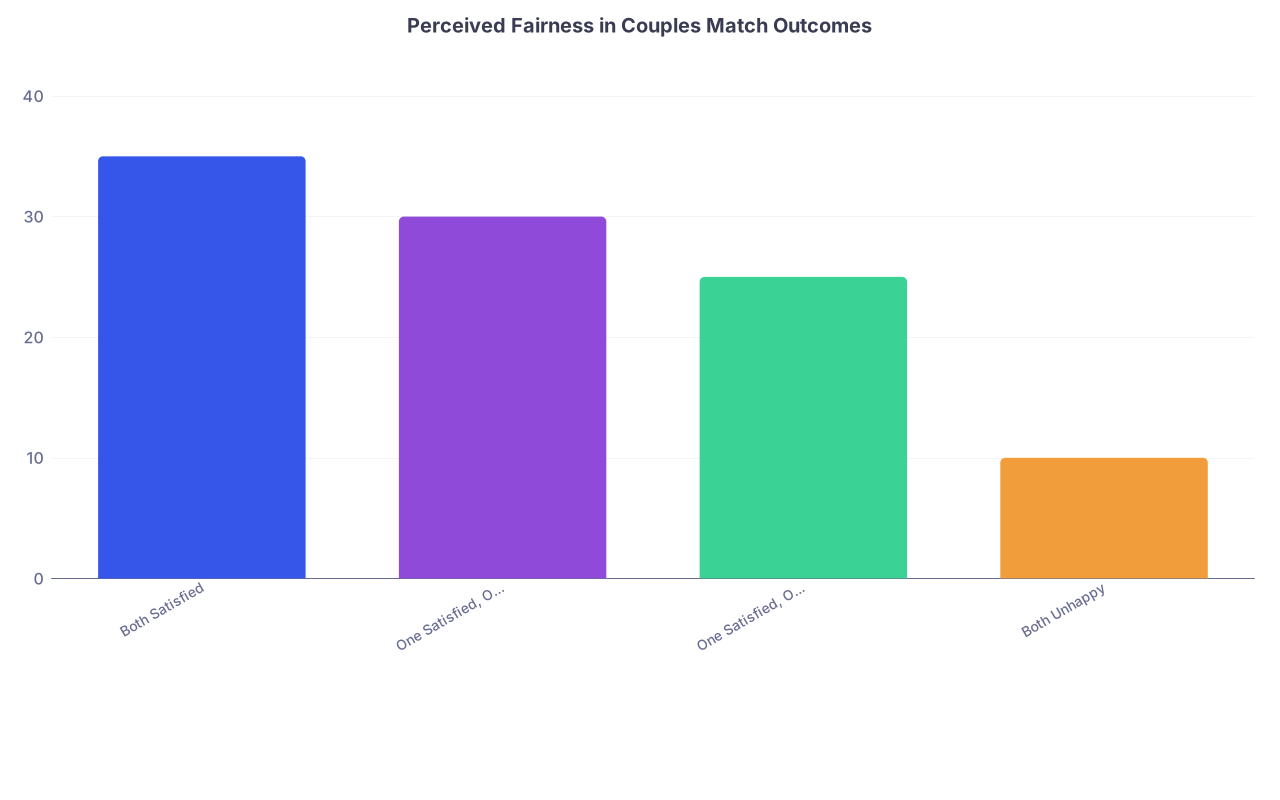
Quick Visual: Balance vs. Imbalance in Couples Match Outcomes
| Category | Value |
|---|---|
| Both Satisfied | 35 |
| One Satisfied, One Neutral | 30 |
| One Satisfied, One Unhappy | 25 |
| Both Unhappy | 10 |
The danger zone is obvious: “One satisfied, one unhappy.” That’s exactly what happens when one partner compromises too much and everyone pretends it’s “fine.”
Your goal is to keep your list construction away from that category as much as possible—even if that means fewer “together at all costs” pairs.
How to Talk About This Without Blowing Up Your Relationship
You’re probably thinking, “If I bring this up now, it’ll start a fight.”
Maybe. Bring it up anyway.
Some ways to start:
- “I’m worried our rank list reflects more of your goals than mine. Can we look at that together?”
- “If we matched at our #1 pair, I’m not sure I’d be happy. That scares me.”
- “I think I’ve been minimizing what I want because I was afraid of being apart. I don’t want to resent you later.”
If your partner can’t tolerate this conversation at all—if they shut it down, guilt-trip you, or imply you’re selfish for wanting a future you recognize yourself in—that’s a data point about the relationship, not just the match.
A real partner wants you to become the physician you’re capable of being, not just the one who’s physically nearby.
FAQ: Couples Match Compromise
1. Is it ever okay for one partner to compromise more than the other?
Yes—but it has to be conscious, named, and freely chosen, not assumed. If one partner says, “I genuinely care less about prestige/location/specific specialty than you do, and I’m okay with that,” and repeats that consistently over time, that can be legitimate. The danger is when compromise is driven by fear, guilt, or pressure and never spoken about directly.
2. How do we know if our rank list is too heavily skewed toward one person?
Print your individual rank lists (solo) and your couples list side by side. For each couples rank pair, write the solo rank number next to each program (e.g., A=3, B=11). If you see a consistent pattern where one partner is in their top 5–7 and the other is in their bottom half, your list is skewed. You want some asymmetry, not systemic imbalance.
3. What if my partner is willing to sacrifice their dream specialty for us to match together?
You should take that extremely seriously—and not just say “Okay, thanks.” Tell them to discuss it with a trusted mentor who has zero stake in your relationship. If their mentor says this is an acceptable and informed decision, and your partner still wants it, maybe it’s real compromise. But if they’d be embarrassed to admit this to faculty, you’re walking into a long-term problem.
4. Is it better to risk being in different cities than to have one person match somewhere they hate?
In most cases, yes. Being apart for a few years is hard but survivable, especially with a clear plan for reunification. Being trapped in a field or program you hate, in a city that drains you, while your partner thrives—that’s how careers, mental health, and relationships erode. The Couples Match is supposed to help you build two lives that can run side by side, not one life riding on top of the other.
Open your draft couples rank list right now and circle every pair where you’d quietly dread matching. Then ask yourself: are those circles mostly on your side? If yes, it’s time to renegotiate—before the algorithm locks in decisions you’ll be living with for years.


