

The uncomfortable truth: when only one partner is competitive in the couples match, most program directors immediately think, “Do I want to pay the tax for the weaker partner?”
They do not say it out loud. They will never write it in an email. But they absolutely talk about it in ranking meetings. I’ve sat in those rooms. I’ve heard the exact words: “She’s strong. He’s… fine. Are we willing to take him to get her?”
You wanted the inside view. Here it is.
How PDs Actually See a Couples Match Pair
When your ERAS file hits a program director’s screen, you do not show up as a romantic story. You show up as a logistical problem.
Individually, you’re “Applicant A: 255/strong letters/AOA” or “Applicant B: 222/pass, average MSPE, no real research.” Together, as a couple, you become a package with leverage and liability.
Program directors at mid-to-large institutions mentally sort couples like this:
| Couple Type | PD Reaction Summary |
|---|---|
| Both strong | "Try to land both if we can" |
| One strong / one mid | "Maybe, if cost is low" |
| One strong / one weak | "Is the tax worth it?" |
| Both mid | "Fine, neutral" |
| Both weak | "Low priority" |
You’re concerned about the gap between you more than the absolute numbers. PDs are too. Because the bigger the gap, the clearer the tradeoff.
Here’s the unfiltered internal monologue:
- “If she weren’t coupled, she’s an automatic rank-to-match for us.”
- “With him attached, we may have to burn a spot on someone we’d normally screen out.”
- “Do we like her enough to ‘pay’ for him?”
That “pay” is real: it might mean giving up a research-heavy resident in internal medicine, taking a weaker surg prelim, or blowing one of their precious few interview slots.
I’ve seen very competitive candidates quietly advised by mentors to not couples match with a significantly weaker partner. That advice is brutal, but it’s not theoretical. It comes from watching exactly how these ranking conversations go.
What “Competitive” Actually Means To Them
You and your partner obsess over one thing: scores and school name. PDs look wider than that, but in lopsided couples, three factors dominate the conversation:
- Step scores / exam performance
- School and grading system (AOA, class rank, quartiles)
- Specialty competitiveness + institutional needs
For the “strong” partner, they’re thinking:
- “Is this someone we’d normally be thrilled to match?”
Example: 250+ Step 2, strong letters, home program chair calling personally.
For the “weaker” partner, they’re thinking:
- “If this person applied alone, would we:
– Eagerly interview?
– Interview as a courtesy?
– Screen out early?”
If the answer is “screen out,” the entire discussion flips to: “How much do we care about the stronger partner?”
Here’s the part applicants never believe until it’s too late: the weaker partner’s file gets dissected harder in a couples situation, not softer. Because now that file is tied to a cost. PDs will say things like:
- “I could live with that 220 if the rest of the file was great, but the MSPE is lukewarm.”
- “Her transcript is fine, but those narrative comments are rough. ‘Needs close supervision’ is not what I want to hear.”
- “We already have a marginal trainee on a remediation plan. I’m not adding another borderline resident by choice.”
They are not just asking, “Can this person survive our program?” They’re asking, “Is this person worth bending our usual standards to keep their partner?”
How Programs Actually Use Couples Match in Rank Meetings
Let me walk you through a typical rank meeting scenario when only one partner is clearly competitive.
Internal medicine PD, large academic center, midwest. Whiteboard with 60 names. Couple is circled.
Applicant 14: Strong partner – 254, AOA, multiple publications, stellar chair letter.
Applicant 49: Weaker partner – 221, no honors, generic letters, MSPE describes “gradual improvement” and “benefits from direct feedback.”
What happens in the room sounds like this:
APD: “She’s exactly what we want. He’s marginal for us. If she were solo, she’d be top-15 on our list, no question.”
PD: “Where would he fall if he was alone?”
APD: “Honestly? Below the cut line. We probably wouldn’t have interviewed.”
PD: “So what’s the upside? Do we think we can realistically get both if we bump them?”
Chief: “She’s got interviews at [higher tier institutions]. We’re probably not her first choice either way.”
PD: “Then I’m not burning a spot on someone I normally wouldn’t take.”
Result: she stays decently high on the list, but they quietly pretend the couples tag doesn’t exist when it comes to him. He’ll get ranked low or not at all.
And here’s the key: they are betting you will make it work somewhere else. PDs assume you’re listing dozens of combinations. They feel less guilty about passing on the weaker partner because “the algorithm will find them a middle ground somewhere.”
But.
At places where they actually want your stronger partner badly enough, you’ll hear ideas like:
- “Could we take him prelim and hope he finds a categorical later?”
- “Could we call our [other specialty] PD and see if they have room for him?”
- “Is there a way to pair them so she’s here categorical, he’s nearby in community?”
This is where institutional relationships matter: if your specialties are different, sometimes the weaker partner gets saved by being the “favor” between PDs.
The Inflation and the Discount: Silent Math PDs Use
There’s a mental spreadsheet PDs run, even if they never show it on paper.
Think of it as two hidden adjustments:
– An inflation on the strong partner’s rank position if they like the couple.
– A discount on the weaker partner’s usual standards if the strong partner is very desirable.
I’ve literally heard: “We’d never take him alone, but with her? Okay, we can live with that.”
Here’s how this looks strategically:
| Partner | Normal Category | Couples Adjustment |
|---|---|---|
| Strong partner | Top 10–20 on ROL | May bump 5–10 spots |
| Weaker partner | Below interview line | Might move into mid-list |
| Weaker partner | Borderline interview | Moves into safe mid-tier |
None of this is formal. There’s no written “+10 for partner” rule. It’s mood, gut, and politics. But it happens.
The risk for you: sometimes the adjustment doesn’t happen, and PDs quietly rank you as if you were independent. They assume “the algorithm will sort it out” and refuse to sacrifice a spot.
So the real question PDs are asking is brutal but simple:
“Are we willing to distort our rank list for this couple?”
If only one partner is clearly excellent, the answer is usually: “Only a little. Maybe.”
Specialty Matters More Than You Think
The couples match is not symmetric across specialties. Some programs feel they can “afford” a weaker partner. Others absolutely cannot.
Let me be blunt about the usual attitudes.
Competitive surgical fields (ortho, neurosurg, ENT, plastics):
They rarely pay a big tax. They feel overrun with high-stat applicants. If you’re the strong ortho applicant and your partner is weaker in FM or psych, they’ll often just rank you normally and assume you’ll land somewhere anyway. They do not feel obligated to rescue your partner.Medicine and peds:
More flexible. I’ve seen IM PDs say, “Sure, we can take the weaker peds partner; peds always needs people, and they can probably stretch.”Psych, FM, IM prelims, TYs:
These sometimes function as “landing pads” for the weaker partner if local PDs coordinate. This is the backchannel world no applicant ever sees: a PD emails another, “I’ve got a rockstar derm candidate coupled with a borderline psych applicant. Can you take a look at her file?”Very small programs:
Far less flexible. A program with 3 categorical spots will not gamble on a marginal trainee just to keep a couple together. They simply cannot afford a bad fit.
For a lopsided couple, the harsh reality is: the weaker partner’s specialty often dictates how much sympathy they get. Some fields view “average but safe” as acceptable. Others would rather leave a spot unfilled than take a trainee they’re not confident about.
Where Couples Hurt You vs. Where They Quietly Help
Program directors won’t tell you this, but the couples tag is not neutral.
When one partner is clearly stronger, here’s what actually happens behind the curtain.
Where it hurts you
At ultra-competitive programs who don’t want to feel “leveraged.”
They resent the idea of paying a “partner tax.” They’ll say things like, “We don’t chase couples; we rank who we want.” Translation: if your partner doesn’t meet bar, they’re out, and you might drop a bit because of the hassle.At small programs with limited spots.
A community surgery program with three residents per year won’t take someone they’re uneasy about just to land your higher-scoring partner. They’re already terrified of a single bad hire.When your weaker partner barely meets visa, remediation, or professionalism thresholds.
If there’s even a whiff of prior issues, the couple factor becomes a liability, not a warm story. “I am not signing up for two years of paperwork because someone is dating our star intern.”
Where it can help you
Mid-tier academic or solid community programs that are “aspirational.”
These programs want at least a few residents each class who punch above their weight. They might gladly accept a slightly weaker partner to land someone who’d usually overlook them.Institutions with many residencies and PDs who like each other.
The internal email chains change the game: “I’ll take her in medicine if you can find a spot for him in prelim or FM.” This never shows up in official policy but it absolutely shapes lists.Programs in less desirable locations.
Rural or Rust Belt institutions know geography is their enemy. A couple willing to come together is more likely to actually stay and less likely to transfer out. They’ll sometimes take a weaker partner as part of that stability bet.
What You Can Do To Make PDs Less Nervous
You can’t magically erase a score gap, but you can blunt the fear around the weaker partner. PDs mostly worry about three things with that applicant: competence, work ethic, and drama.
Here’s what quietly reassures them:
Letters that scream “safe pair of hands,” not just “nice person.”
The weaker partner’s letters need to say things like: “Reliable, excellent team member, no concerns about clinical performance, responds well to feedback.” That language matters far more than generic praise.No red flags in professionalism.
One vague MSPE line about “required meetings with professionalism committee” will kill any appetite to take a risk. If such issues exist, they must be clearly resolved and framed as growth.A realistic, consistent story in the personal statement.
The weaker partner should not oversell. PDs smell that instantly. A humble, credible narrative of progress and self-awareness plays better than “I’ve always been top-notch” when the file says otherwise.Signals that you understand geography and tiers.
If you insist on only top-15 programs in a big coastal city, PDs know your couple is trying to thread a needle. If your list shows a willingness to consider strong but less flashy programs in multiple regions, they trust the algorithm more and feel less boxed in.
And a quiet but powerful tactic: the stronger partner’s faculty advocates can sometimes explicitly vouch for the couple as a unit. I’ve seen a big-name chair call and say, “He’s your superstar, but she’s absolutely solid and will not be a problem. You can take them both without regret.” That kind of reassurance moves the needle more than you think.
How Couples Rank Lists Look From the PD Side
Your rank list is a thousand line items and anxiety. PDs see it differently: they’re trying to guess how constrained you actually are.
This is where being wildly unrealistic backfires.
If you’re a lopsided couple both only ranking hyper-competitive urban academic centers as your top 15 options, PDs assume:
- “They may not match here anyway; don’t overcommit to saving them.”
- “If we stretch for the weaker partner, we might still not get the stronger one.”
So they become conservative. They avoid going out on a limb for you.
If instead your list pattern signals that you understand your different competitiveness levels—mix of safety, mid, and reach—PDs are more willing to nudge. Because they know if they rank you sensibly, the algorithm actually has a fair shot at placing you.
Think of it this way: the more your behavior signals insight into your situation, the more PDs trust that you won’t “force” them into bad outcomes. That trust translates into slightly braver rankings.
The Dark Question: Ever Un-Couple To Protect The Stronger Partner?
Faculty talk about this in hushed tones with their strongest applicants. You won’t see it on Reddit because nobody wants to admit it publicly.
Yes, mentors sometimes quietly suggest: “You might want to think seriously about not couples matching if your partner is significantly weaker and you’re aiming for top-tier programs.”
Why? Because some PDs really do penalize the stronger partner’s chances—subtly—if they feel cornered into a two-for-one they don’t want. They won’t say, “We dropped you because of your partner.” They just nudge you lower than you’d be on an independent list.
If you are an ultra-competitive applicant in a brutally competitive specialty (ortho, derm, neurosurg, ENT) and your partner is truly below the usual threshold for their field, every PD in that world will think: “Without the couple tag, I’d rank you higher.”
I’m not telling you what to do with your relationship. I am telling you that this calculus is absolutely happening in the background.
If you decide to couples match anyway, walk in with your eyes open: you are trading a bit of individual ceiling for a joint floor. PDs know that. Some will help you. Some won’t.
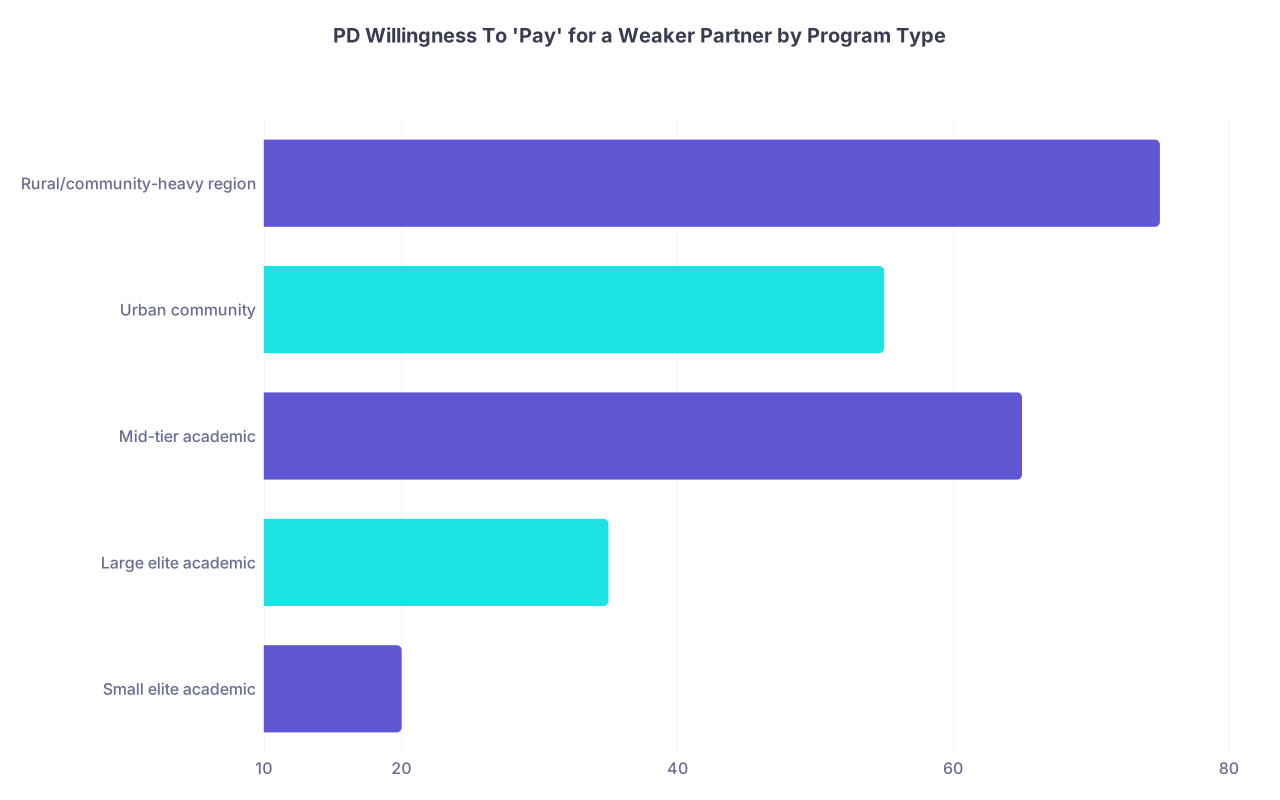
| Category | Value |
|---|---|
| Small elite academic | 20 |
| Large elite academic | 35 |
| Mid-tier academic | 65 |
| Urban community | 55 |
| Rural/community-heavy region | 75 |
Strategic Moves That Actually Matter (Not the Fluff You Hear Online)
The internet is full of magical thinking: “If we just explain our story, PDs will understand!” No. They will understand, then still rank based on risk and utility.
Here are the levers that actually influence what PDs think when only one of you is competitive:
Target regions with density.
Places with many programs and multiple hospitals in a city or region (think Philly, Chicago, Houston) give PDs granular options: “We’ll take her, surgery will take him, they’ll live 20 minutes apart.” Rural or single-hospital towns give them nothing to work with.The weaker partner must be aggressively realistic on specialty and tier.
If the weaker partner insists on applying to the same stratosphere as the stronger one, PDs roll their eyes and assume lack of insight. When the weaker partner shows clear awareness (broader range, cushioned list), PDs are more willing to stretch.Third-year and early fourth-year performance for the weaker partner matters more than ever.
PDs look for a late bloom story they can believe: “Yes, rough preclinicals, but last year has been excellent.” A solid upward trend gives them cover to justify supporting the couple.Faculty advocacy should be coordinated, not chaotic.
Random emails from random attendings help no one. One or two well-placed calls from people PDs actually know and respect, who vouch for both of you, can soften their resistance to “paying the tax.”

| Step | Description |
|---|---|
| Step 1 | Review couple files |
| Step 2 | Rank each individually, minimal stretch |
| Step 3 | Do not distort list, maybe drop couple |
| Step 4 | Small bump for strong, small discount for weak |
| Step 5 | Coordinate with other PDs if possible |
| Step 6 | Is stronger partner highly desirable? |
| Step 7 | Is weaker partner at least safe? |
| Step 8 | Can program absorb a tax? |
FAQs About Lopsided Couples Match (What You’re Afraid To Ask Out Loud)
1. Will PDs actually rank me lower because I’m coupled with a weaker partner?
Sometimes, yes. Not dramatically, but enough to matter at the margins. If a PD feels boxed into accepting someone they dislike to get you, and they do not think they can realistically land both anyway, you may quietly slide down a few spots. They’ll justify it as “protecting the program.” This is more common in very competitive or very small programs.
2. Can the weaker partner ever be a true asset, not just a liability?
Rarely, but it happens. If the weaker partner is in a less competitive but hard-to-fill field (say, rural FM or psych in an unpopular location) and the stronger partner is bringing significant prestige, a PD may view the pair as “package stability.” They fill two difficult spots at once and gain a resident who lifts the program’s profile. But that requires the weaker partner to be clearly safe and functional.
3. Should we tell programs we’re willing to live apart for a year if needed?
Careful. If you emphasize that too loudly, you erase most of the leverage the couples match gives you as a unit, and PDs simply rank you as if you were independent applicants. Quiet realism is better than loudly announcing you’ll split. If asked directly, a measured answer like, “Our goal is to be together, but we understand the realities of the match and have built a list with that in mind,” plays better than extremes.
4. How many programs should a lopsided couple apply to?
More than you want to. I’ve seen reasonably competitive solo applicants match comfortably with 40–50 programs, but lopsided couples are playing a higher-constraint optimization problem. Think 60–80 for most fields, higher if one partner is in a brutally competitive specialty or has significant weaknesses. The weaker partner’s risk profile sets the floor, not the stronger partner’s confidence.
5. If we don’t match together, do PDs feel bad or second-guess their strategy?
No. They move on in about 48 hours. They have resident schedules, onboarding, and accreditation headaches to deal with. They are not sitting around regretting not stretching more for your couple. That sounds harsh, but it’s freeing too: you are the one who has to protect your future. Build your list like no one is coming to save you—because they aren’t.
Key takeaways:
First, program directors think in terms of “partner tax” when only one of you is clearly competitive. Some will pay it a little, very few will pay it a lot.
Second, the weaker partner’s file is under more scrutiny, not less, in a couples match. Your best defense is a safe, drama-free, obviously competent profile with realistic applications.
Third, the couples match is not romantic from the PD side; it’s a resource allocation puzzle. If you understand that cold reality and plan accordingly, you give yourselves the best chance of ending up in the same city with both careers intact.


