
The biggest mistakes couples make when emailing program directors do not get talked about publicly—because they make faculty uncomfortable to admit how much this actually sways things.
Let me tell you what really happens.
When your email hits a PD’s inbox, they do not see “two committed applicants making thoughtful plans.” They see one of three things:
- A strategic opportunity to fill two spots with one negotiation.
- A logistical headache.
- A red flag that you’ll be a problem before you even sign your contract.
Which one you become is entirely about how you email.
Couples emails can absolutely get you extra interviews and even move you up the rank list. I’ve watched it happen. I’ve also watched chairs read a couples email out loud, roll their eyes, and say, “Nope, we’re not doing this drama.”
You want to be in group #1, and avoid #2 and #3 like the plague.
Let’s walk through how that actually works—behind the scenes—and the unspoken rules you need to follow.
What PDs Really Think When Couples Email
Most official advice sugarcoats this. Faculty will say, “Oh, just let us know you’re couples matching, we’re happy to consider it.” That’s… selectively true.
Here’s the quiet part: programs have very different tolerance for couples.
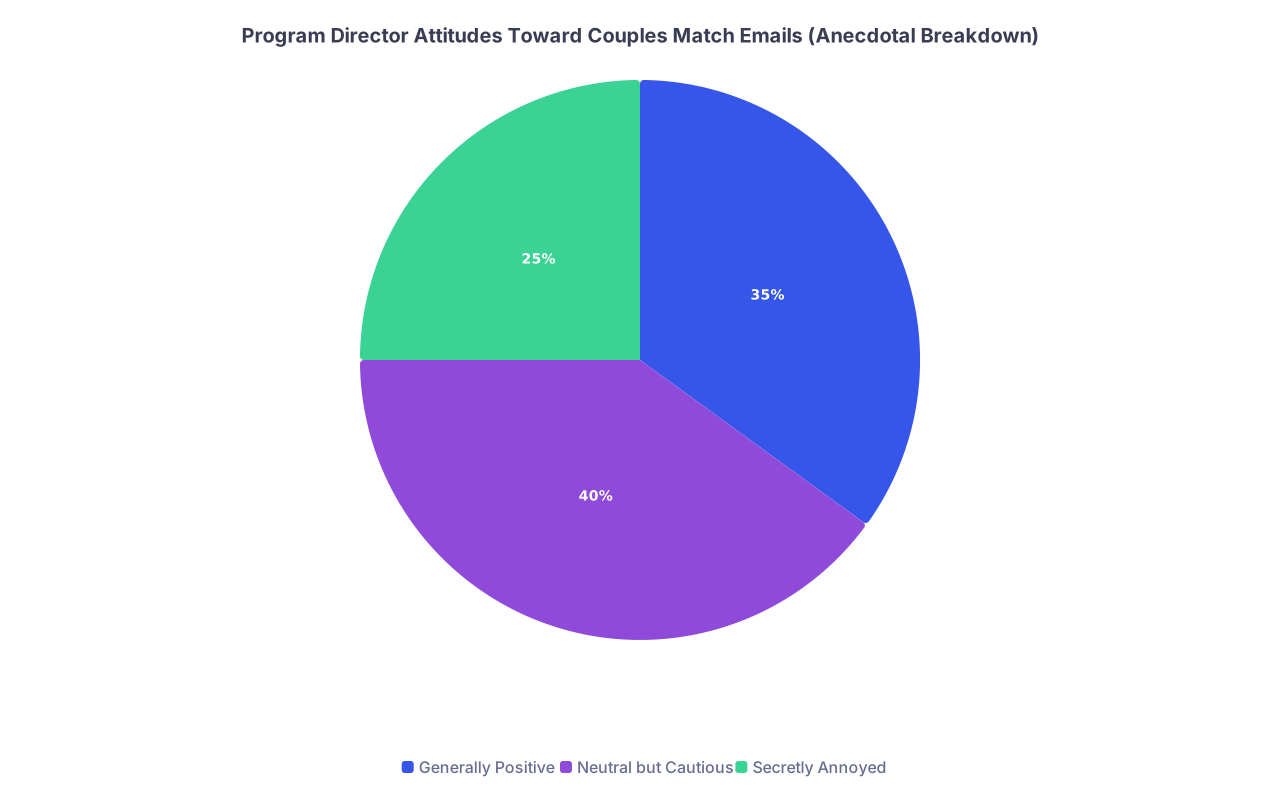
| Category | Value |
|---|---|
| Generally Positive | 35 |
| Neutral but Cautious | 40 |
| Secretly Annoyed | 25 |
I’ve sat in rooms where:
- A PD in Internal Medicine said: “If we like both individually, I love couples. They’re usually more stable and less likely to leave.”
- A PD in a surgical specialty said: “I don’t want to be held hostage by someone else’s relationship.”
- A community FM PD shrugged: “If they’re reasonable and not demanding a package deal, fine. If they’re pushy, they go to the bottom.”
So your job with email is to:
- Show you are two strong independent applicants first.
- Present the couple status as a bonus, not a demand.
- Make it incredibly easy for the PD to help you.
Any email that smells like leverage—“we will rank you higher if…”—is radioactive. PDs may smile in their reply, but you’re done.
The Timing Game: When Couples Should Actually Email
Most couples are either way too early or too late. Both are a problem.
Before interviews
If one of you has an interview and the other does not, strategic email can get the second person looked at again. But not before interview invites start going out.
The informal rule:
You usually get one meaningful nudge per program. Blow it too early, and you’re just background noise.
The most effective windows:
Early interview season (late September–October for NRMP)
If one partner has an interview invite and the other hasn’t heard a thing, a short, clean email can help trigger a second look.After both of you have interviewed at different programs in the same city
You can sometimes turn a solo-city configuration into a dual-city or dual-program setup through smart, respectful outreach.
Where it doesn’t work well:
- Mass emailing every program before invites go out: looks frantic and entitled.
- Emailing the same PD multiple times with “just checking in” messages: that gets noticed, and not kindly.
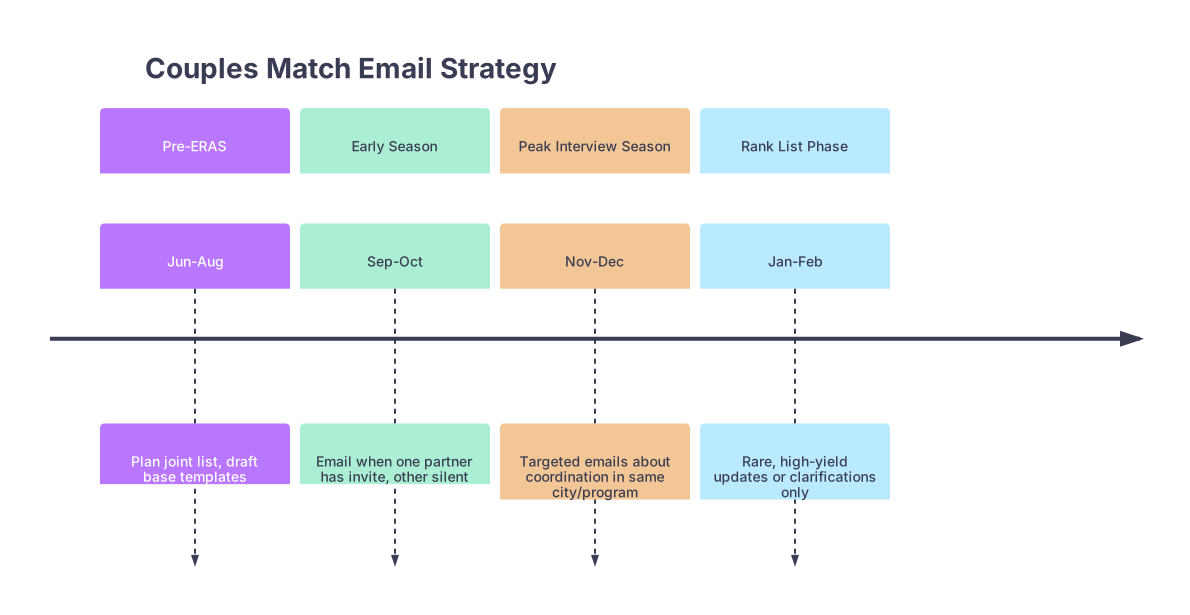
| Period | Event |
|---|---|
| Pre-ERAS - Jun-Aug | Plan joint list, draft base templates |
| Early Season - Sep-Oct | Email when one partner has invite, other silent |
| Peak Interview Season - Nov-Dec | Targeted emails about coordination in same city/program |
| Rank List Phase - Jan-Feb | Rare, high-yield updates or clarifications only |
Bottom line: if you’re emailing in August, you’re early and a bit naive. If you’re emailing for the first time in late January, you’re late and mostly begging.
The Unspoken Content Rules: What PDs Want to See (and Hate)
Here’s the part people never tell you: a lot of PDs skim emails in under 10 seconds. Their eyes land on:
- Your names and schools
- Your specialties
- Whether you’re already invited or just fishing
- Whether this email will create extra work or solve a problem
So every couples email needs three things, fast:
- Who you are (individually)
- Your connection to the program/location
- A specific, low-drama ask
Anything beyond that is decoration.
The “We, us, our” problem
Couples love to write in the plural. PDs hate it.
“I’m writing on behalf of my partner and myself…”
“We are very interested in training together…”
“Our goal is to match in the same city…”
You think it sounds unified. Faculty read it as: “They’re a package deal, and if one is weak, I’m stuck.”
The trick: individualize first, then connect.
Start as you:
My name is Alex Smith, MS4 at U of X, applying in Internal Medicine…
Only after that:
I’m participating in the Couples Match with my partner, Taylor Johnson, who is applying in Pediatrics…
You’re two individual applicants who happen to be linked—not a two-headed monster expecting special handling.
Concrete Scenarios: How This Actually Plays Out
Let’s walk through what PDs actually say when your email comes up in discussion. These are real patterns I’ve seen.
Scenario 1: One partner has an interview; the other doesn’t
This is the classic one.
Example: You have an IM interview at MidTown Medical Center. Your partner is applying to EM there and hasn’t heard back.
What you think:
“If they know we’re a couple, maybe they’ll at least review my partner’s file again.”
What actually happens inside:
- PD or APD sees your email.
- If your file is strong and they like you, they forward the email to the other department with a quick line: “We’ve invited this IM applicant; their partner is EM. Any chance you can take a second look?”
- If they barely remember you or you’re borderline, your request has much less pull.
So the real rule: your own strength drives how much your partner benefits, not the other way around.
And yes, departments do talk, especially in smaller hospitals and mid-sized academic centers.
| Situation | Typical PD Response |
|---|---|
| Strong IM applicant, average EM partner | EM PD will often re-review, may offer interview if borderline |
| Strong EM applicant, weak IM partner | IM PD may glance but often passes unless need is high |
| Both above-average | High chance both get serious consideration, sometimes coordinated scheduling |
| One clearly below cutoff | Email rarely overcomes hard screen, even with plea |
Scenario 2: Both of you have interviews at the same program
This is where couples often overplay their hand.
You both have interviews. You’re thrilled. Then you email some version of:
If we match here together, we’ll rank you highly.
PDs read that as rank manipulation, which they are trained to ignore and slightly resent.
What you can do that actually helps:
- Clarify genuine geographic commitment.
- Explain that training together in that city would make you much more likely to stay long term.
- Offer short, concrete details that signal maturity, not desperation.
Something like:
We both grew up in this region and have close family nearby. If we’re fortunate enough to match in the same city, we expect to stay here to practice long term.
That frames you as retention wins, not as leverage players.
Scenario 3: You matched one interview, zero at the partner’s side in that city
This is where you’re tempted to send a panicked, emotional email. That’s exactly what blows up your chances.
What programs quietly respond to:
- Calm, factual explanations of your couples situation.
- Genuine ties to city or program.
- Clear evidence that your partner is at least somewhat within their usual range.
What kills you:
- Guilt trips.
- Over-sharing personal drama.
- Telling them you’ll rank them first if they give your partner an interview.
No PD wants emails that feel like emotional blackmail. They might respond politely, but internally they’re done.
The Structure of a High-Yield Couples Email
Let’s build the skeleton the way PDs actually scan it.
- Subject line
- Short intro (who you are, what specialty)
- Couples match context (one sentence)
- Why this program / city (2-ish lines, max)
- The ask (specific, modest)
- Gratitude and clean closing
The unspoken rule: your email must be easy to forward.
That’s what actually happens when they’re interested—they forward your note to another PD, coordinator, or faculty with “see below.” If your email is long, messy, or emotional, it does not get forwarded.
Subject line rules
Program directors skim subject lines like everyone else. You want three things in there:
- Your specialty
- The word “Couples Match”
- Something that doesn’t sound like a mass blast
Examples that work:
- “IM Applicant – Couples Match with EM Partner – [Your School]”
- “Couples Match Inquiry – Pediatrics & IM – [Your Name]”
Examples that look bad:
- “URGENT Couples Match Situation”
- “PLEASE HELP – Couples Match”
- “Very Interested in Your Program!!!”
That last one screams: no judgment, no restraint. PDs see enough of that already.
Advanced Insider Rules Most People Never Hear
Now we get into the stuff I’ve only ever heard behind closed doors.
1. Some PDs will quietly bump you up if they believe you stabilize the other partner
Programs care about “flight risk” more than they’ll admit.
If you’re couples matching into a less competitive specialty in a less glamorous city, and your partner is in something shiny (Derm, Ortho, ENT, etc.), your presence can make that shiny partner less likely to leave.
So yes, sometimes:
- They like your partner a lot.
- They’re medium on you.
- They rank you higher anyway, because keeping your partner is worth it.
Does that feel unfair to single applicants? Maybe. But this is how human beings make decisions in a system that pretends it’s “purely holistic.”
2. Coordinators matter more than you think
You picture PDs reading every email. Often, it’s the coordinator first.
If your email is:
- Overlong
- Confusing
- Missing key identifiers
…it gets mentally tagged as “drama.” Coordinators talk. When the PD asks, “What’s the story with this couple?” the coordinator’s tone tells you whether you have a shot.
So make their lives easier:
- Both full names
- Both AAMC/NRMP numbers, or at least both specialties and schools
- Clear subject line
- No attachments unless specifically requested
3. Mass templates get spotted
Faculty see patterns. They’ll literally say, “We’ve been getting the same couples email from five different schools; someone must be telling them to do this.”
If your med school advisor gave you a template, that’s fine—but you need to humanize it. Change the rhythm. Personalize the “why this place” line. Do not copy-paste generic fluff.
If your email reads exactly like 20 others, it screams “not selective, not thoughtful.”
Sample Language You Can Adapt (Without Being a Robot)
I am not giving you a script to copy; that’s lazy, and PDs can tell. But here’s the shape of something that flies well.
Scenario: One partner has invite, the other does not (same program)
Subject: IM Applicant – Couples Match with EM Partner – [Your School]
Dear Dr. [PD Last Name],
My name is [Your Name], an MS4 at [School], applying in Internal Medicine. I’m very grateful to have received an interview invitation at [Program Name] on [date].
I’m participating in the Couples Match with my partner, [Partner Name], who is applying to Emergency Medicine and has also applied to [Program Name]. We’re both strongly interested in training in [City/Region] because of [family ties/previous training/long-term plans].
I realize interview offers are limited and understand if no further changes are possible. If there is an opportunity for [Partner Name]’s application to be re-reviewed, we would both be very appreciative.
Thank you for your time and consideration.
Sincerely,
[Your Name], MS4
[School]
What that email does right:
- Zero drama
- Signals gratitude and humility
- Puts the “ask” in realistic terms
- Is easy to forward to EM PD with a quick “see below—any room?”
Scenario: Both have interviews, you want to express strong interest in that city
Subject: Couples Match – IM & Pediatrics Applicants – [Your Names]
Dear Dr. [PD Last Name],
My name is [Your Name], an MS4 at [School], applying in Internal Medicine. I’m scheduled to interview at [Program Name] on [date]. I’m couples matching with [Partner Name], a Pediatrics applicant who is also interviewing at [Partner Program Name] in [same city].
We both have strong ties to [City/Region], including [brief concrete detail: family, prior work, military, etc.], and we hope to remain here long term. Matching in the same city would make that possible.
I wanted to sincerely thank you for the opportunity to interview and let you know how meaningful it would be for us to train in [City].
Best regards,
[Your Name]
No ranking promises. No “we will rank you #1.” Just clear interest and context.
When You Should Not Email
There are a few situations where silence is better than outreach.
You’re extremely borderline on paper and you know it
Weak board scores, multiple failures, big professionalism issues—email will not fix structural problems. It just puts a spotlight on them.You’ve already sent two emails to that PD
Past one thoughtful outreach, you cross the line into “persistent” and then into “annoying.” Programs remember that.You’re asking for guaranteed pairing or special treatment
“Can you guarantee we’ll rotate on the same services?” or “Will you rank us at similar positions?” is instant nope. They cannot promise that even if they want to.You’re emotional and writing at 2 a.m.
If either of you is upset, do not write. Draft, sleep, then edit in the morning like a professional.
How This Plays Into Rank Lists (The Part Nobody Explains)
You wonder: “Does my email actually move me up the list?”
Sometimes, yes.
I’ve seen this:
- PD really likes one partner.
- They’re lukewarm on the other.
- Couples email shows both are thoughtful, tied to the area, low-drama adults.
- In rank meeting, someone says: “If taking both keeps them here, I’m fine nudging [weaker partner] up a bit.”
- Boom. Micro-move. But enough.
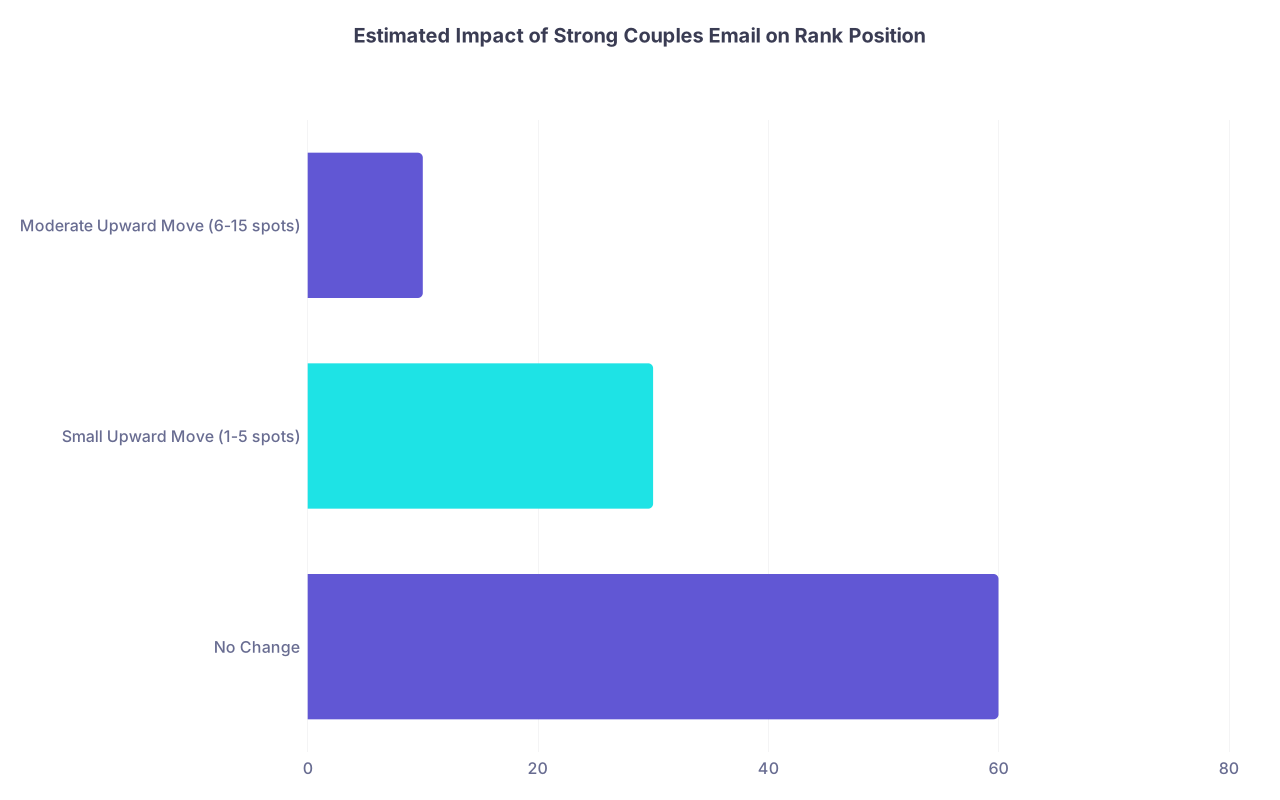
| Category | Value |
|---|---|
| No Change | 60 |
| Small Upward Move (1-5 spots) | 30 |
| Moderate Upward Move (6-15 spots) | 10 |
Is this guaranteed? Of course not. But it happens more than PDs will ever admit to you.
What never helps:
- Trying to negotiate ranks.
- Mentioning other programs by name.
- Playing “we’ll rank you higher if…” games.
They’re obligated—ethically and often institutionally—to ignore that. And they do. Sometimes with a bit of resentment.
FAQs
1. Should both of us email the PD, or just one?
Usually one email is enough, sent from the person who already has the interview (if applicable). If both of you write, it should not be copy-paste clones. That looks orchestrated and artificial. One clean, joint-context email is more efficient and more professional.
2. Is it okay to say we’ll rank a program highly if they take both of us?
Do not do this. You can express strong interest in the program and city. You can talk about long-term plans and fit. But explicit rank talk sounds manipulative and puts PDs in an uncomfortable position. They’ve heard “you’re my top choice” a thousand times; it’s meaningless.
3. Can emailing actually hurt our chances?
Yes, if you do it badly. Overly long, emotional, demanding, or repeated emails absolutely leave a mark. PDs and coordinators remember the applicants who created pre-match headaches. The last thing anyone wants is someone who’ll be a constant “issue” once they start residency.
4. Should we mention we’re couples matching in our original ERAS application too?
Yes. That should be indicated in ERAS and often can be mentioned briefly in your personal statement or experiences if it fits naturally. The email isn’t the first place they learn you’re a couple—it’s the place you clarify logistics or interest when there’s a specific opportunity or gap.
5. What if we’re couples matching in different specialties at different hospitals in the same city—do we still email?
You can, but be precise. Each of you emails your own specialty PD at your own program. You can reference that your partner is applying or interviewing across town, and that matching in the same city is your main goal. Don’t try to make two separate institutions coordinate around you; just make your case as someone deeply committed to that city and likely to stay.
Two final points to remember:
- You’re two independent applicants first; a couple second. Your emails need to reflect that.
- The best couples emails make the PD’s life easier—not harder—while quietly showing that taking both of you is a strategic win, not a favor.
If you can pull that off, your emails stop being noise and start being leverage. The right kind.