

It is late January. You are both staring at the NRMP rank order list screen.
One of you has categorical Internal Medicine, Neuro, and Anesthesiology interviews. The other? Only Transitional Year and preliminary medicine spots. No categoricals. No advanced positions that line up neatly.
The clock is ticking, you have 20–30 line pairs to fill, and every combination seems to break something: geographic separation, program quality, or just pure logistics. The “standard” Couples Match advice you find online assumes both partners have the same type of positions. You very clearly do not.
This guide is for your exact situation:
- Partner A: applying mostly or entirely to preliminary-only or TY spots (no or very few advanced / categorical positions).
- Partner B: applying to categorical or advanced positions in a core specialty.
Let me break this down specifically.
1. Get Absolutely Clear On What “Preliminary-Only” Actually Means
The first mistake I keep seeing is couples not understanding the structural difference between the positions they are pairing.
The three buckets you must distinguish
You need to classify every interview / program into one of three buckets, per partner.
Categorical (CAT)
Complete training in one program. No separate PGY‑1 needed.
Examples: categorical IM, categorical Peds, categorical Psych, categorical Neuro (if 4-year), FM, EM (4-year single program), OB/Gyn.Advanced (ADV)
PGY‑2+ position. Requires separate PGY‑1 (prelim or TY).
Examples: Neurology (3-year starting PGY‑2), Anesthesia (3-year starting PGY‑2), Radiology, Derm, Ophtho, PM&R (depends), Rad Onc.Preliminary / Transitional Year (PRELIM/TY)
PGY‑1 only. One year. Does not guarantee anything after that.
Examples: Prelim IM, Prelim Surgery, TY positions.
Here is the scenario you are in:
One of you is almost entirely in bucket 3 (PRELIM/TY), potentially without a secure follow-on position. That is dangerous if you treat it like a normal Couples Match.
Why your structure is fundamentally different
When both partners have full-length training (CAT or ADV+secured prelim), your Couples Match problem is “Where do we both end up for our entire residencies?”
When one is preliminary-only, you actually have two different time horizons:
- Partner B: 3–7 years in one place (or known places).
- Partner A: 1 year guaranteed, maybe more later, maybe not, maybe somewhere else.
You are not solving “one match problem.” You are solving:
- A short game: where will we both be for PGY‑1?
- A long game: where will preliminary-only partner end up PGY‑2+ (if at all)?
If you do not explicitly separate these time horizons, your rank list will be incoherent.
2. Map Out Your Structural Constraints Before You Touch The Rank List
Do this on paper or spreadsheet. Not in your head.
Step 1: Categorize by type and geography
For each partner, make a table with: program name, city, program type, and strength.
| Partner | Program Type | City | Relative Rank |
|---|---|---|---|
| A | Prelim IM | Boston | #1 |
| A | TY | Hartford | #2 |
| B | Categorical IM | Boston | #1 |
| B | Categorical IM | Providence | #2 |
| B | Advanced Neuro | Boston | #3 |
Do not rank them yet. Just organize:
- All prelim/TY spots for Partner A by city and desirability
- All categorical and advanced spots for Partner B by city and desirability
- Note which locations overlap
Step 2: Identify your “anchor” partner
Reality: in most prelim-only couples, one partner is structurally the anchor. That is usually the partner with:
- Categorical offers
- Or advanced positions in a competitive specialty
If Partner B has 12 solid categorical IM interviews scattered nationally, and Partner A has 4 prelim medicine in the Northeast only, you do not actually have symmetric bargaining power. Pretending you do is how couples end up unmatched or in awful positions.
You must answer honestly:
- Whose match outcome is hardest to replicate in SOAP or a reapplication year?
- Whose specialty is more competitive, with fewer spots and fewer second chances?
- Who has more geographic flexibility?
That partner is the anchor. You should usually preserve their match quality first, then optimize the prelim partner around that.
And yes, occasionally that means the prelim partner takes a suboptimal year one location to protect the anchor’s 3–4 year trajectory.
3. Understand Exactly How the Couples Match Algorithm Treats Your Situation
You cannot game a system you do not understand.
The key rule for couples when one is prelim-only
The algorithm pairs combinations of ranks. Not individual programs. Each line on your Couples list is:
(Partner A: program X) + (Partner B: program Y)
The algorithm goes line by line:
- It looks at your first pair.
- If both programs can accept you there, it will tentatively match you both.
- Then it will keep trying to improve everyone else’s matches, which may dislodge you.
- It proceeds until stable.
You do not get:
- “We will at least get our best joint preliminary year then they will figure out the later year.”
No. The match is blind to your long-term problem if there is no actual advanced / categorical slot for A.
If Partner A has only prelim or TY entries on their side of the couples list and no linked advanced positions, their half of each pair is literally a 1-year job. The algorithm does not care what happens after that.
4. The Four Common Configurations When One Partner Is Prelim-Only
Let me break down specific patterns I have seen, with pros, cons, and what your rank list needs to reflect.
Configuration 1: One partner categorical; other truly prelim-only with no clear PGY‑2 plan
Example:
- Partner A: Prelim IM / TY only (no advanced / no secured PGY‑2).
- Partner B: Categorical IM, Peds, FM, Psych, etc.
This is the most unstable structurally, and the one that scares me the most when couples still try to force “perfect togetherness” in PGY‑1.
Core truth:
Partner A is at risk of being unemployed in 12 months. That is much more consequential than whether you spend PGY‑1 in the same city or 60 miles apart.
Your priorities, in order:
- Get Partner B the best possible categorical position they can reasonably secure.
- Get Partner A any reasonable prelim/TY in the same region as Partner B if it does not seriously sabotage #1.
- Prepare now for Partner A’s PGY‑2+ plan: supplemental applications, networking, research, or a second full Match application.
Concretely, if Partner B has MGH, BWH, BIDMC categorical IM interviews, and Partner A has a TY at a smaller community program in suburban Boston plus a decent prelim IM in Providence, you:
- Do not drag Partner B down to a much weaker categorical program in Providence just to align perfectly if Boston would materially advance their career.
- You do try to pair Boston categorical for B + Boston-area TY/prelim for A high on the list.
- You also create backup lines where B’s strong categorical stands alone and A is slightly further away but still in driving distance.
Configuration 2: One advanced; other prelim-only; no PGY‑2 for the prelim partner
Example:
- Partner A: prelim-only.
- Partner B: Advanced Anesthesiology starting PGY‑2 (with or without a linked prelim at that same institution).
Here, PGY‑1 for Partner B is also some kind of prelim or TY. You now have two short-game pieces and one long game (B’s advanced spot).
Structure:
- Year 1 (PGY‑1): both in prelim/TY
- Years 2–4+: B = advanced at X; A = unknown
Ranking strategy:
- You pair B’s combined prelim+advanced tracks (e.g., “Anesthesia at Mayo + linked Prelim IM at Mayo”) with A’s best local prelim/TY spots.
- You accept that A’s PGY‑2 plan will be a separate battle.
The mistake here is couples who:
- Over-prioritize “same hospital, same year 1” by sacrificing B’s advanced position quality.
- Underestimate how brutal it is for A to find a non-catastrophic PGY‑2 if they spend PGY‑1 at a random small hospital with zero specialty exposure.
Partner A should target prelim/TY programs that:
- Are in major academic hubs (Boston, NYC, Chicago, Houston, etc.).
- Have multiple categorical residencies and advanced programs.
- Actually graduate prelims into advanced positions elsewhere (ask explicitly on interview day).
5. Building the Rank List: Stepwise, Not Magical
Here is the part everyone messes up: they jump straight to the couples pairing screen and start randomly dragging pairings around.
Do this in order.
Step 1: Each partner builds a solo rank list
Individually, as if you were not couples matching. Brutally honest:
- Partner B: list categorical / advanced + associated prelims in true order of desirability.
- Partner A: list prelim/TY programs by desirability, independent of geography for now.
This gives you a “true north” for each of you.
Step 2: Mark mandatory “no-go” and “must-have” constraints
Examples:
- Must be within 1 hour of a specific city due to kids/family/visa.
- Absolutely cannot go to a prelim program with malignant reputation even if it is next to partner’s dream institution.
- Need a program that supports visa category X.
You cross off anything that clearly violates non-negotiables. Do this before pairing.
Step 3: Identify overlapping geographic clusters
For every city / region, ask:
- Which B programs are here?
- Which A prelim/TY are here?
Mark them as “same hospital,” “same city,” “same metro area but different hospital,” “within 1–2 hours drive,” “plane commute only.”
That matters. “Same metro area but different hospital” is often a perfectly fine compromise when one partner has only prelim options.
Step 4: Start building your top 5–10 pairs by principle, not by panic
You usually want your top 5–10 pairs to reflect:
- B’s very top program(s) whenever there is a reasonably tolerable prelim/TY for A in that metro area.
- Pairs that keep you in the same city if possible, or at least drivable.
For example, your top might look like:
- (A: Prelim IM at Beth Israel Deaconess) + (B: Categorical IM at MGH) – same city, top-tier for B, strong prelim for A.
- (A: TY at Lahey) + (B: Categorical IM at BWH) – still Boston region.
- (A: Prelim IM at Rhode Island Hospital) + (B: Categorical IM at Rhode Island Hospital).
- (A: Prelim IM at Hartford Hospital) + (B: Categorical IM at UConn).
- (A: Prelim IM at Baystate) + (B: Categorical IM at Baystate).
You then branch outward:
- Add lines where B’s ideal categorical is maintained even if A is in a nearby but not identical city.
- Only much lower on the list do you sacrifice B’s program quality for perfect co-location, unless life factors force otherwise.
Step 5: Use “A: No rank / B: Program X” strategically for safety
Critical point: In Couples Match, you can create pairs where one partner ranks a program and the other ranks “No program”. That means:
(Partner A: No rank) + (Partner B: Program Y)
This tells the algorithm:
“We are willing for B to match here, even if A gets nothing at this line.”
You deploy this for:
- Protecting B’s best opportunities if A has very few prelims and a non-trivial chance of not matching.
- Avoiding the outcome where both go unmatched because the only allowed pairs were joint positions.
However, you do not put these “No rank” pairs at the very top unless you explicitly prioritize B matching even at the cost of A going completely unmatched. Most couples place these as safety nets in the mid-to-lower section of the list.
6. When To Stop Forcing Proximity And Protect The Anchor Career
There is an ugly but real threshold you need to acknowledge.
If Partner B has:
- High-tier categorical positions (e.g., UCSF IM, Hopkins Neuro, BWH Anesthesia)
- And Partner A has only mid/low-tier prelims or TYs in different regions
At some point:
- You either drag B down to a significantly weaker categorical for the sake of co-location
- Or you accept some degree of distance for 12 months
My bias is clear: It is almost always a mistake to sabotage a once-in-a-lifetime categorical / advanced spot in a strong program purely to align with a single year prelim that:
- Will not guarantee A’s long-term future
- Might even harm A’s long-term prospects if that prelim is weak or obscure
But you need data, not vibes.
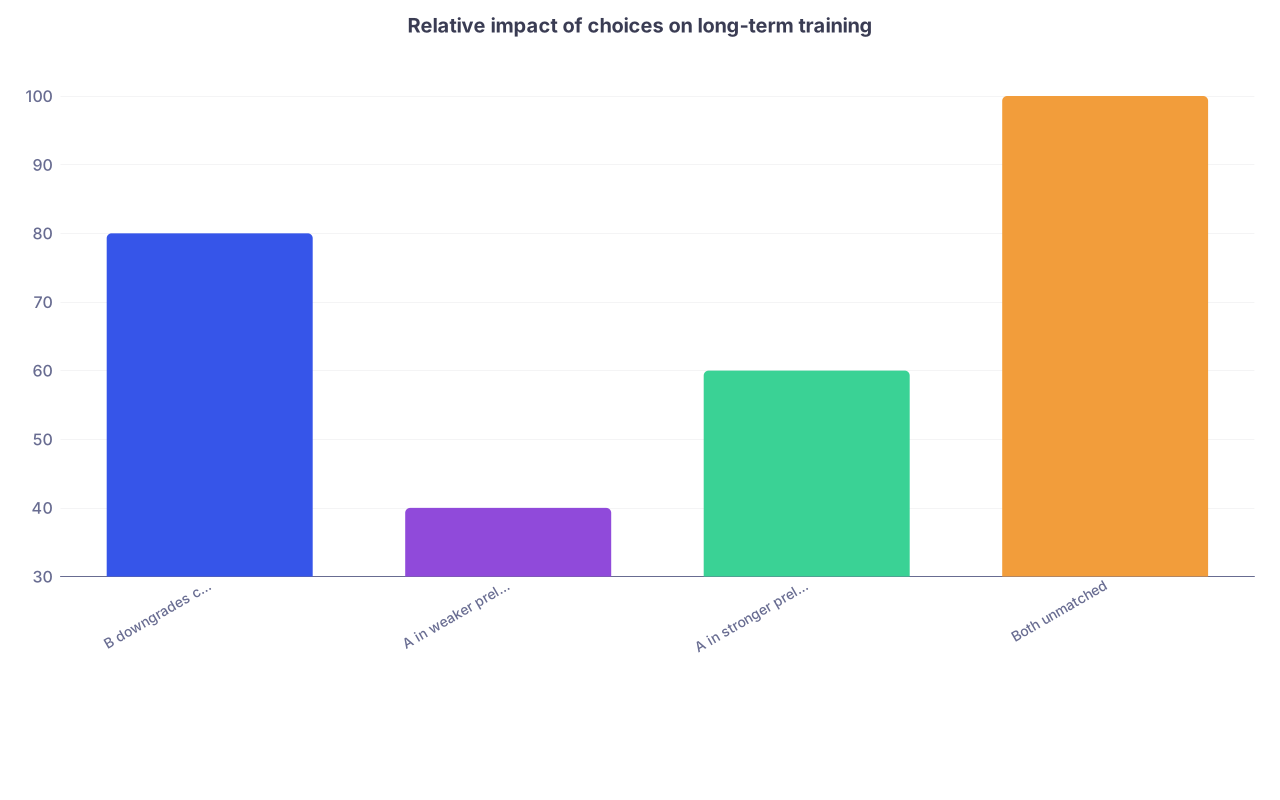
| Category | Value |
|---|---|
| B downgrades categorical | 80 |
| A in weaker prelim nearby | 40 |
| A in stronger prelim farther | 60 |
| Both unmatched | 100 |
Interpretation (rough heuristic scale of “potential harm” from 0 to 100):
- Forcing B to downgrade categorical: high harm (80).
- Keeping both close but at a weak prelim for A: moderate harm (40).
- Allowing A to go to a stronger prelim farther away: moderate-high but sometimes necessary (60).
- Ending with both unmatched due to over-constraining: catastrophic (100).
You are balancing real risks, not chasing a fairy tale of “together no matter what” with no career cost.
7. Advanced Tactics Specific To The Prelim-Only Partner
Let us talk directly to the preliminary-only partner now.
You have three jobs simultaneously:
- Maximize the quality of your PGY‑1 experience.
- Optimize proximity to your partner’s position within reason.
- Set up your PGY‑2+ survival strategy.
What makes a prelim/TY “good” for you?
Not just “less malignant call schedule.” You want:
- Evidence that prelims from this program successfully transition into advanced or categorical programs.
- Exposure to your desired field (if you have one) – e.g., ability to do electives in Neuro/Anes/Rads etc.
- Strong teaching, letter-writing attendings, formal eval culture (not just service work).
- Program leadership that actually knows how to help prelims navigate the second match or off-cycle PGY‑2 hunt.
You ask on interview day:
- “Where do your prelims typically go after this year? Can you give examples from the last 2–3 classes?”
- “Do your prelims ever transition into your own categorical spots?”
- “How does the program help prelims secure PGY‑2+ positions?”
If you hear vague answers or they cannot name where people went, that is a red flag.
Your PGY‑2+ strategy starts now
Flow of your next two years if you are prelim-only:
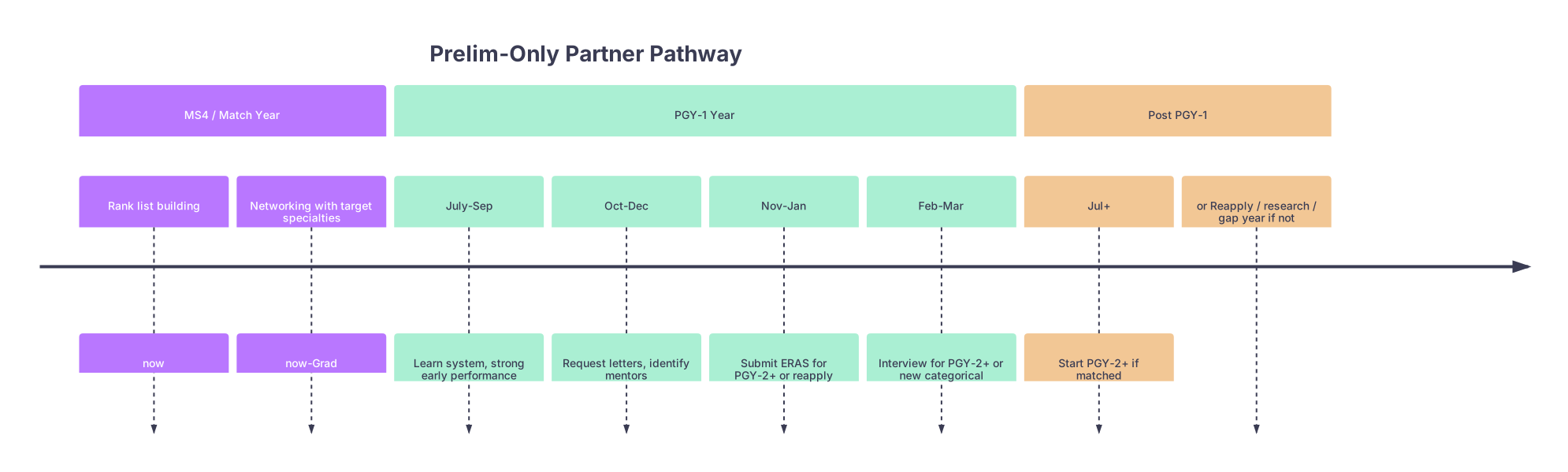
| Period | Event |
|---|---|
| MS4 / Match Year - Rank list building | now |
| MS4 / Match Year - Networking with target specialties | now-Grad |
| PGY-1 Year - July-Sep | Learn system, strong early performance |
| PGY-1 Year - Oct-Dec | Request letters, identify mentors |
| PGY-1 Year - Nov-Jan | Submit ERAS for PGY-2+ or reapply |
| PGY-1 Year - Feb-Mar | Interview for PGY-2+ or new categorical |
| Post PGY-1 - Jul+ | Start PGY-2+ if matched |
If you pretend this problem does not exist until January of your intern year, you will be stuck. Start now:
- Decide whether you are open to a second full Match cycle for categorical positions.
- Identify 5–10 programs that commonly take PGY‑2 transfers and are in regions where your partner might land.
- Tell your prelim PD early: “I am prelim-only, and my goal is to land X for PGY‑2. I will need strong support and letters by November.”
8. Visa, SOAP, and “Disaster Plan” Considerations
You also need a back pocket plan for when the match does not give you what you want.
For international graduates / visa-dependent prelim partner
You cannot afford:
- Gaps in training due to visa expiration.
- Geographic constraints where only certain states / hospitals sponsor your visa type.
Make sure:
- Every prelim you rank actually sponsors your visa category.
- You understand whether you can remain in the U.S. between PGY‑1 and any later PGY‑2 start if there is a gap.
Sometimes the anchor partner might strategically choose a location with more opportunities for the visa-dependent partner’s PGY‑2+ options, even if it is not their theoretical “dream” institution.
SOAP and post-match reality
If the prelim-only partner fails to match:
- The SOAP often has prelim IM and TY spots.
- It almost never has lots of high-quality categorical spots in competitive specialties.
So in your ranking logic, do not assume, “If this goes badly, SOAP will fix it.”
SOAP is a safety net, not a good plan.
Most couples find it less disruptive if:
- The anchor partner matches cleanly;
- The prelim-only partner does whatever is needed through SOAP or a research year to stabilize;
- Then you plan a serious geographic reunification strategy later.
It is rough emotionally. But it is better than both going unmatched because you overconstrained your Couples list.
9. Concrete Example: Walking Through A Realistic Pairing
Let me give you a stylized but realistic scenario and walk the rank logic.
The setup
Partner A (prelim-only):
- Prelim IM: BIDMC (Boston), Rhode Island Hospital (Providence), Hartford Hospital, Baystate.
- TY: Lahey (Burlington, MA).
Partner B (categorical IM):
- MGH, BWH, BIDMC, Rhode Island Hospital, Hartford, UConn, Baystate.
Solo honest rank lists (before couples coupling):
Partner A solo:
- Prelim BIDMC
- TY Lahey
- Prelim Rhode Island
- Prelim Hartford
- Prelim Baystate
Partner B solo:
- MGH
- BWH
- BIDMC
- Rhode Island
- Hartford
- Baystate
- UConn
Now, couples.
Top line pairs (protecting B’s high tier, optimizing A nearby)
First 5–7 might look like:
- (A: Prelim BIDMC) + (B: Categorical BIDMC) – same hospital, excellent for both.
- (A: TY Lahey) + (B: MGH) – same metro, great for B, very solid for A.
- (A: TY Lahey) + (B: BWH) – same metro.
- (A: Prelim BIDMC) + (B: MGH) – same city, short commute, B’s #1.
- (A: TY Lahey) + (B: BIDMC) – same metro.
- (A: Prelim Rhode Island) + (B: Categorical Rhode Island) – same hospital.
- (A: Prelim Hartford) + (B: Hartford).
Then you place some “safety but still paired” options:
- (A: Prelim Baystate) + (B: Baystate).
- (A: Prelim Hartford) + (B: UConn).
Finally, you protect B with “No rank” pairs lower down:
- (A: No rank) + (B: MGH).
- (A: No rank) + (B: BWH).
What this does:
- Strongly tries to keep you together in Boston/Providence/Hartford first.
- Does not sacrifice B’s top programs unnecessarily.
- Includes contingency where B still lands at a dream program even if A falls through.
Is this emotionally easy? No. But structurally, this is how you avoid catastrophic mismatch.
10. How To Think About The Emotional Piece Without Letting It Wreck The Strategy
You are not robots. You are a couple. The whole point of Couples Match is not just cold optimization.
But I have seen couples do real damage to both careers by treating the algorithm like a loyalty test rather than a planning tool.
A few framing points:
Togetherness in PGY‑1 is not the whole story.
Many couples will tell you: the second and third years of residency matter more for quality of life and long-term career than the intern year.“Separate for one year, stronger later” is sometimes healthier than “together in misery.”
Being side by side in a malignant hospital, both drowning, no time for each other, can break you faster than temporary distance.You can intentionally plan for reunification.
If you accept a 1-year geographic mismatch, document the plan:- When will the prelim-only partner apply for PGY‑2 / new categorical, and where?
- Can the anchor partner transfer later if needed?
- What is your timeline to be in the same city again?
That way you are not “hoping it works out.” You have a two-year plan.
11. When One Partner Should Seriously Consider Reapplying As Categorical Instead
I will be blunt: sometimes the “prelim-only” situation is a symptom of a weak or misaligned application, not just bad luck.
Patterns that should prompt a hard conversation:
- The prelim-only partner aimed for a highly competitive specialty (Derm, Ortho, integrated Plastics) with marginal stats and ended up with only prelims.
- They have little genuine attachment to the competitive field and could realistically be happy in categorical IM, Peds, or Psych.
- They accepted the prelim as a “placeholder” with a vague hope of later sliding into that competitive field.
If that is you, you should strongly consider:
- Using the prelim year as a chance to rebuild your CV;
- Then reapply deliberately as categorical IM / Peds / etc. rather than chasing PGY‑2 in a saturated specialty.
This is not failure. It is course correction. And it often makes the Couples Match puzzle solvable in the long term.
12. Pulling It Together: Your Next 10 Concrete Actions
Let me give you a clean, sequential list so you are not just absorbing theory.
- Each of you writes your solo rank list as if not couples matching.
- Identify the anchor partner based on specialty competitiveness and offer quality.
- Make a city-by-city map of all programs you both have, with distance and hospital overlap.
- Mark non-negotiables: visa, kids, family, support needs, program red flags.
- Preliminary-only partner: classify prelim/TY options by:
- training quality,
- track record of placing graduates,
- alignment with long-term goals.
- Build top 5–10 paired lines that:
- preserve anchor partner’s top programs whenever there is a reasonable prelim/TY nearby;
- aim for same institution or same city first, same metro area second.
- Add secondary pairs expanding geography modestly, without sacrificing anchor partner into clearly inferior options unless life factors absolutely require it.
- Insert “No rank” lines for the anchor partner’s very top programs lower on the list as protection.
- Preliminary-only partner: begin PGY‑2+ planning now:
- identify target programs,
- plan for letters and research,
- talk early with future PDs.
- Sit down together and write a 1–2 page two-year plan:
- where you might each be PGY‑1 and PGY‑2,
- how and when you reunify,
- what you will do if one or both do not match.
You are in a structurally tricky position, but it is not unworkable. The couple that wins here is the one that treats the prelim-only status as a real constraint, not an embarrassing footnote.
If you approach this like two adults running a joint project—mapping the structure, defending the anchor career, and designing a deliberate PGY‑2+ strategy for the prelim partner—you will come out of this with far fewer regrets.
With these mechanics understood and your rank list strategy built on actual structure, you are ready for the next phase: executing during intern year so that the prelim-only partner’s short game turns into a real long game. That, though, is an entire strategy guide on its own.


