

The biggest mistake IMG couples make is assuming “we’ll figure out the visa later.” You will not. The visa is the strategy if you are matching as a couple.
Let me break this down specifically, because this is where I see otherwise strong dual-IMG or mixed-citizenship pairs quietly sabotage their Couples Match: they do not build a joint visa + geography + specialty plan before ERAS opens. By the time interviews roll in, the damage is baked in.
This is fixable. But you have to be intentional, and you have to be blunt with each other.
1. The three archetypes of IMG couples (and why they matter)
Before talking visas, you need to know which “type” you are as a couple. Because the optimal strategy for a dual-IMG pair on J-1 looks nothing like a US-citizen + IMG on H‑1B.
A. Dual non-US citizen / non-GC IMGs
Both of you:
- Need visa sponsorship
- Are usually eligible for J‑1
- Might be eligible for H‑1B in some programs if you meet USMLE and timing requirements
This is the highest logistical risk group. You are asking programs to:
- Take two IMGs
- Sponsor two visas
- In the same location or within commutable distance
Reality: you must compromise on at least one of these:
- Prestige
- Geography
- Specialty
If you go for all three (top tier / NYC / competitive specialty), expect pain.
B. Mixed-citizenship: US citizen or GC + IMG
One of you:
- Is a US citizen or permanent resident (no visa issues)
The other:
- Is an IMG needing J‑1 or H‑1B
This is more manageable. But people underestimate how much the IMG partner still drives the entire geography strategy.
The “free” partner (citizen/GC) must be flexible:
- On specialty prestige (e.g., might need to pick community IM over brand‑name academic IM)
- On program “tier”
- On taking categorical vs prelim positions if that keeps you together
The IMG’s visa options and competitiveness set the realistic map. Not the other way around.
C. Dual IMGs, one with US citizenship/GC through other means
Version where both trained abroad, but one already has US citizenship/GC (e.g., naturalized, family-based, DV lottery).
From a program’s perspective:
- You are not “two visa issues”
- You are: 1 visa-dependent + 1 visa-free applicant
This opens a bit more room for geographic and specialty ambition. But only if you use it strategically when building rank lists and messaging programs.
2. Visa types in residency: J‑1 vs H‑1B without the fluff
The theory is boring, but if you do not internalize the constraints you will mess up your couples strategy. So I will be blunt.
| Feature | J-1 | H-1B |
|---|---|---|
| Sponsoring entity | ECFMG | Hospital/program |
| USMLE requirement | Step 1 & 2 CK (pass) | Step 3 usually required by start |
| Waiver needed after training | Yes (2-year home rule or waiver) | No J-1 home rule |
| Common in residency? | Very common (default for IMGs) | Less common, program-dependent |
| Processing complexity | Standardized, predictable | Variable, legal-heavy, slower |
J‑1 basics (what most dual-IMG couples end up on)
- Sponsored by ECFMG
- Requires:
- Valid ECFMG certification
- USMLE Steps done (1 + 2 CK; Step 3 not required for visa)
- Two-year home-country physical presence requirement after training unless you get a waiver (Conrad 30, hardship, persecution, etc.)
Why programs like it:
- Well‑standardized
- They do this every year
- Legal risk is lower
- Straightforward renewal as you move from PGY1→PGY2 etc.
Why it matters to couples:
- You both might be J‑1
- You both will face the two-year home rule or waiver issue
- Waiver jobs are geographically concentrated and limited → your post-residency couple geography is affected too
H‑1B basics
- Employer-sponsored, dual intent (friendlier for long-term immigration)
- Many programs require Step 3 passed before they file
- Expensive for a program: legal fees + filing fees
- Capped at 6 years (with extension mechanisms if green card process underway)
Why some IMG couples chase it:
- No J‑1 home return rule
- Can transition to H‑1B waiver-like positions, academia, or private practice more flexibly
- Slightly better long-term immigration pathway in some cases
Why many programs avoid it:
- Costly and time-consuming
- Harder if hospital legal is conservative
- Some hospitals have explicit “No H‑1B for residents” policy
For you as a couple:
- If both need H‑1B, your program list shrinks dramatically
- If one needs H‑1B and the other is US citizen/GC, that is easier—but geography still gets constrained
3. How visa type should shape your Couples Match strategy
This is where most couples are vague. “We prefer H‑1B if possible” is not a plan. You need explicit rules like:
- “We will prioritize J‑1 friendly programs across a wide geographic area, with the citizen partner flexing on prestige.”
- Or: “We will only seriously pursue H‑1B at a small, targeted list of programs that historically sponsor it, and accept that we may need to un-couple if those do not pan out.”
Let’s map the main archetypes.
Scenario 1: Dual-IMG, both need visas, both open to J‑1
This is the most workable path.
Strategic implications:
- Your program search starts with:
- “Sponsors J‑1” filter ON
- US News ranking filter OFF
- You spread applications widely:
- Broad specialties (FM, IM, Peds, Psych) if competitiveness is marginal
- Some mid-tier academic + solid community programs
- You treat H‑1B offers as “bonus,” not as your baseline expectation
Key point: the pair of you should think of yourselves as a package that needs two J‑1 slots in the same city or region. That alone is a big ask in NYC, Chicago, California if you are not both very strong applicants.
Scenario 2: Dual-IMG, one wants J‑1, the other insists on H‑1B
This is where I see couples lose the plot.
Reality:
- Programs that are flexible enough to give one H‑1B and one J‑1 in the same year—and also like both of you—exist. They are just rare.
- If the “H‑1B-only” partner is not significantly stronger on paper (scores, research, US experience), the insistence on H‑1B may just lower both your odds of matching together.
This scenario demands brutal honesty:
- Is the H‑1B insistence about long-term immigration fear, or actually about realistic opportunity?
- Would a J‑1 with a strong waiver strategy later be safer than gambling the match now?
In practice, I have seen more couples succeed when they both accept J‑1, match somewhere solid, and then tackle the waiver / immigration questions during residency year 2–3.
Scenario 3: US citizen/GC + IMG (visa-dependent)
Now the map is drawn by the IMG’s options.
Strategic implications:
- Decide early: is the IMG ok with J‑1, or targeting H‑1B-heavy programs only?
- The citizen partner must be ready to:
- Apply widely across programs that sponsor that visa type
- Step down in “prestige” if needed to stay geographically aligned
If the IMG is average strength and only wants H‑1B:
- You are basically choosing: “Potential separation + maybe better long-term immigration” vs “J‑1 together + more waiver hassle later.”
- Most couples, when they are honest, prefer being in the same city on J‑1 over being split on different coasts with different visa paths.
4. Program selection: building a couples list that does not sabotage you
This is the most tactical section. You cannot “vibe” your way through this; you need a spreadsheet and hard filters.
Step 1: Define your must-haves and flexibles
Across three domains:
- Visa
- Geography
- Specialty / program type
You need to explicitly categorize each as:
- Non-negotiable
- Strong preference
- Flexible
Bad example:
- “Big coastal city, H‑1B, academic IM for both.”
Better example for dual-IMG/J‑1 open:
- Visa: J‑1 accepted for both (non-negotiable), H‑1B is a plus
- Geography: Same city; any state except extremely rural outliers (strong preference)
- Specialty: At least one of us in IM/FM/Peds/Psych if needed (flexible), other can try something more competitive but with backup plans
Step 2: Use filters properly
You should be doing all of this before ERAS opens.
Check FREIDA and program websites:
- Do they explicitly say “Sponsoring J‑1 only”, or “No visa sponsorship”, or “Consider H‑1B”?
- Do they regularly take IMGs at all?
Build separate columns for each program:
- J‑1: Yes / No
- H‑1B: Yes / No / Case-by-case
- IMG friendly: High / Medium / Low (based on % of current residents)
- Geography zone code (e.g., “NYC metro,” “Midwest big city,” “rural South”)
This is not overkill. For couples, this is survival.
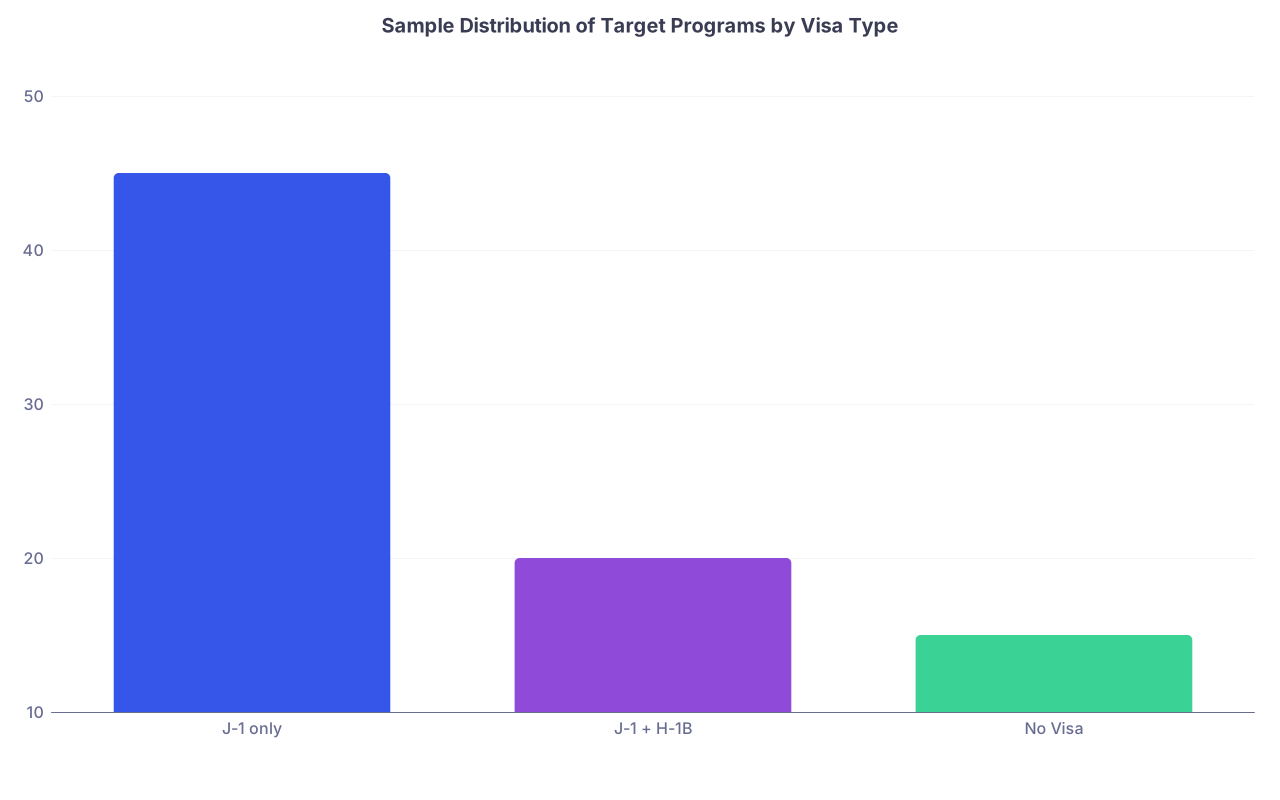
| Category | Value |
|---|---|
| J-1 only | 45 |
| J-1 + H-1B | 20 |
| No Visa | 15 |
If your sheet shows:
- 10 programs where both of you are realistically competitive and that sponsor your needed visa
That is weak.
If you can get:
- 40–60 viable overlapping programs across your combined specialties
Then you are giving yourselves a fighting chance.
Step 3: Use proximity tiers, not only “same hospital”
For Couples Match, you can rank:
- Same program / same institution
- Different institutions in the same city
- Nearby cities with commutable distance
Define “commutable” for you:
- Daily commute? Under 60–75 minutes door-to-door is realistic
- Weekly long-distance (one partner drives/flys on weekends)? Risky, but some do it
Example:
- Partner A interviews at UPMC IM in Pittsburgh
- Partner B interviews at Allegheny General Psychiatry
Both in same metro → rank as a strong pair.
I have seen couples ignore these second-institution options and then panic later.
5. Specialty choice and competitiveness when visas are in play
Visas amplify competitiveness differences. An IMG seeking J‑1 in IM is one thing. Two IMGs seeking H‑1B in Radiology + Derm is fantasy.
Let me be direct about common patterns.
Safer specialties for visa-dependent IMGs
Not “easy.” Just less suicidal as a couple needing visas:
- Internal Medicine (especially community / mid-tier academic)
- Family Medicine
- Pediatrics
- Psychiatry
- Neurology (somewhat middle-of-the-road)
These give you:
- More total positions
- More community programs willing to sponsor J‑1
- Slightly more tolerant of non-traditional pathways
Higher-risk specialties, especially with visas
- Dermatology
- Plastic surgery
- Orthopedics
- ENT
- Ophthalmology
- Radiation oncology
- Radiology and Anesthesiology to some extent for weaker profiles
If one of you is going for these:
- The other should strongly consider anchoring with a safer specialty in the same geography.
- You must have a realistic backup strategy:
- Either prelim + reapply
- Or dual-application (e.g., one partner applies to both categorical IM and Neurology, etc.)
6. How to communicate the “couple + visa” combo to programs
Programs are not mind readers. And they are risk-averse when they see:
- IMG + needs visa + Couples Match
You need to de-risk yourselves.
Use the ERAS Couples Match flag properly
- Yes, check the “Couples” box. Do not try to hide it.
- Make sure both of you list the same partner AAMC ID.
But that is the bare minimum. You also need targeted communication.
When and how to email programs
Good use cases to email:
- Program clearly sponsors your visa type
- You both have applied to the same program / geographic area
- You are not spamming 100 PDs; you are choosing ~15–25 key programs
A tight email from each of you separately (not one joint email) can contain:
- Short intro (name, specialty, applicant ID)
- Explicit, one-sentence note that you are in the Couples Match with an IMG partner needing [J‑1/H‑1B]
- Clear expression that you both are very interested in their institution and geography long-term
- One or two specific ties (family in the region, visited, previous observership, etc.)
Programs appreciate clarity. They hate drama and vagueness.
Do not:
- Demand that they interview your partner
- Write emotional essays about your relationship
- Guilt-trip them about separation risk
You are solving their concern: “If we invest in one of them, will the other drag in a complicated visa or expectations?” Your tone: calm, organized, realistic.
7. Logistics during interview season for IMG couples
Interview season is where the hidden logistics start to hurt: cost, travel, scheduling.
Coordinating invites
Set up:
- A shared spreadsheet with:
- Program name
- City
- Interview date options for each of you
- Visa type and friendliness
- Priority level
When one of you gets an invite:
- Check immediately if the program is in a city where the other has applied
- If the partner has not heard yet:
- They can send a very short, polite interest email mentioning they are in Couples Match and their partner received an invitation
Sometimes this nudges the second invite. Sometimes it does nothing. But it is a legitimate, non-pushy strategy.
Handling visa interviews / travel as an IMG
If you need to go back for visa stamping or have prior travel issues:
- Schedule non-US travel away from peak interview weeks as much as possible
- Document everything clearly; do not spring unplanned international trips during late November–January when interview offers are still moving
The mixed-citizenship partner should understand:
- The IMG’s international travel risk (221(g), admin processing, etc.) is a real constraint.
- Overstacking December/January interviews may backfire if the visa gets delayed.
8. Ranking as a couple when visas are involved
Couples Match ranking is an optimization problem with emotions all over it. The trick is to structure it ruthlessly first, then feel things later.
Understand the risk zones
For a visa-dependent couple, the key failure modes:
One matches, other does not
- Worst if the visa-dependent IMG is unmatched, citizen partner matched far away.
- For dual-IMG, this can destroy both immigration and relationship plans.
Both match, but in different cities with incompatible commutes
- Very common when couples are sloppy about geography tiers.
Neither matches because the list was too narrow or too aspirational
- Seen this too often with couples demanding same hospital + H‑1B + competitive specialty.
Practical ranking structure
You want three broad tiers in your couples list:
Ideal or close-to-ideal pairs
- Same institution / same city
- Both categorical positions (unless prelim is part of a clear plan)
Acceptable but lopsided pairs
- One at a stronger program, the other at a less desired program in same metro area
- One categorical, other prelim with realistic pathway
Safety togetherness pairs
- Programs that are maybe lower on your individual prestige list but:
- Sponsor your visa reliably
- Are in the same or nearby city
- Have decent training
- Programs that are maybe lower on your individual prestige list but:
If you are dual-IMG on visas and skip tier 3 because you feel “we deserve better,” you are gambling your entire match on ego.
Explicitly include “one matches / one does not” outcomes
This is where couples get squeamish. You need to discuss:
- Are there any cases where one of you is ok matching somewhere while the other goes unmatched?
- Does it differ based on who is visa-dependent vs citizen/GC?
- Would you ever rank a pair where one is “No match” and the other is “Program X”?
There is no universal right answer. But pretending you will “figure it out later” is wrong. You either rank those pairs or you do not.

| Step | Description |
|---|---|
| Step 1 | Build individual program lists |
| Step 2 | Filter by visa sponsorship |
| Step 3 | Group programs by city/region |
| Step 4 | Create ideal pair combinations |
| Step 5 | Add acceptable lopsided pairs |
| Step 6 | Add safety togetherness pairs |
| Step 7 | Decide on solo match scenarios |
| Step 8 | Finalize couples rank list |
9. Mixed-citizenship couples: extra nuances
When one of you is a citizen/GC, you have more leverage. Most couples underuse it.
Let the visa-dependent partner drive geography
Example:
- IMG partner can only realistically get interviews in Midwest and South because of scores + visa.
- Citizen partner really wants NYC/Boston.
If you insist on chasing coastal academic IM as the citizen partner:
- You risk splitting the match in a way that is hardest on the IMG (emotionally, legally, logistically).
More pragmatic approach:
- Citizen partner targets strong programs in the same Midwestern/Southern regions
- Maybe gets somewhat lower-brand-name but still solid training
- Both of you preserve co-location, and the citizen partner’s flexibility massively reduces total risk
Consider deliberate asymmetry in ambition
Sometimes the best couples strategy is:
- Visa-dependent partner applies conservatively (safer specialties, more IMG-friendly zones)
- Citizen partner pushes harder on slightly more competitive tracks within the same geography (e.g., University-affiliated hospitals in the region, subspecialty-friendly IM programs, etc.)
That way, the floor is not falling out for the visa-dependent partner.
10. Common bad advice you should ignore
I see the same half-baked ideas passed around WhatsApp IMG groups every year. Some of them are genuinely harmful for couples.
“Programs will bend over backwards for couples.”
- No. Some are supportive, yes. But they will not create visas, positions, or exceptions out of nowhere.
“You must avoid J‑1 at all costs.”
- Overstated. J‑1 is the default path for thousands of IMGs who go on to successful careers and green cards. For couples, it is often the only realistic route to training together.
“Never email programs; it annoys PDs.”
- Mass-spam, yes, that annoys them. Targeted, respectful, clearly reasoned emails about a real couple + visa situation? Those are fine, and sometimes help.
“Just rank what you love, Match will work out.”
- This is childish. Couples Match is math plus risk management, not manifestation.
11. What you should be doing at each phase as a dual-IMG or mixed-citizenship couple
To make this concrete, here is a skeletal timeline.
| Phase | Key Tasks |
|---|---|
| 6–9 months pre-ERAS | Decide visa preferences, specialties, geography tiers |
| 3–6 months pre-ERAS | Build program list with visa filters, confirm exam timelines (Step 3 if chasing H-1B) |
| ERAS submission | Explicit Couples Match decision, tailored PS if needed, early outreach to priority programs |
| Interview season | Track invites jointly, send targeted couples/visa emails, adapt travel/logistics |
| Rank list period | Build structured pair list (ideal → safety), decide on solo-match scenarios |
You should not still be debating “J‑1 vs H‑1B” the week before rank lists are due. That conversation belongs in the early planning phase.
You and your partner are not just two applicants. You are a combined optimization problem with immigration constraints, geography constraints, and two evolving careers.
If you treat visas as an afterthought, Couples Match will feel chaotic and unfair. If you treat visa strategy as your central design constraint—then build specialty, program list, and geography around it—you give yourselves a real shot at training in the same place without losing years to reapplications and long-distance stress.
With the logistics clear, the next hard part is psychological: how you negotiate ambition vs togetherness, prestige vs stability, and what happens if the match separates you anyway. That negotiation between you two is just as important as anything in FREIDA. But that is a conversation for another day.


