

Most couples get board score mismatches wrong—and it costs them interviews, leverage, and sometimes the match.
You are not dealing with a “relationship problem.” You are dealing with a cold, algorithmic market that treats you very differently once one partner’s scores fall below the competitive line for your chosen specialty—especially in a couples match.
Let me break this down specifically.
The Real Problem: Two Markets, One Rank List
When one partner is in a competitive field (derm, plastics, ortho, neurosurgery, ENT, urology, ophtho, radiation oncology), and the other partner has a significantly lower Step score—or a red flag—you are not in one market. You are in two.
Programs see:
- Candidate A: Highly competitive applicant for a tight specialty
- Candidate B: Solid / marginal / concerning metrics, depending on the case
The algorithm sees:
- A coupled unit that must be placed together (geographically or tightly clustered), not just two individuals.
If you act like you are both in the same market, you over-reach, under-protect, and set yourself up for “how did we not match?” conversations.
I have watched:
- 250+ Step 2 derm applicant + 220-ish FM applicant aim only at “exciting cities” → derm partner matched, FM partner unmatched.
- Ortho applicant with strong SLOEs + low-scoring IM partner only rank big-name university IM programs in three cities → both unmatched.
- Smart couple (ENT + peds) with 15-program safe peds list and 30 ENT programs in three tiers → matched in same city with options.
The difference was not love, effort, or “fit.” It was ruthless, accurate assessment of competitiveness and adjusting the couple’s strategy, not their relationship.
Step One: Quantify the Disparity, Not Just “High vs Low”
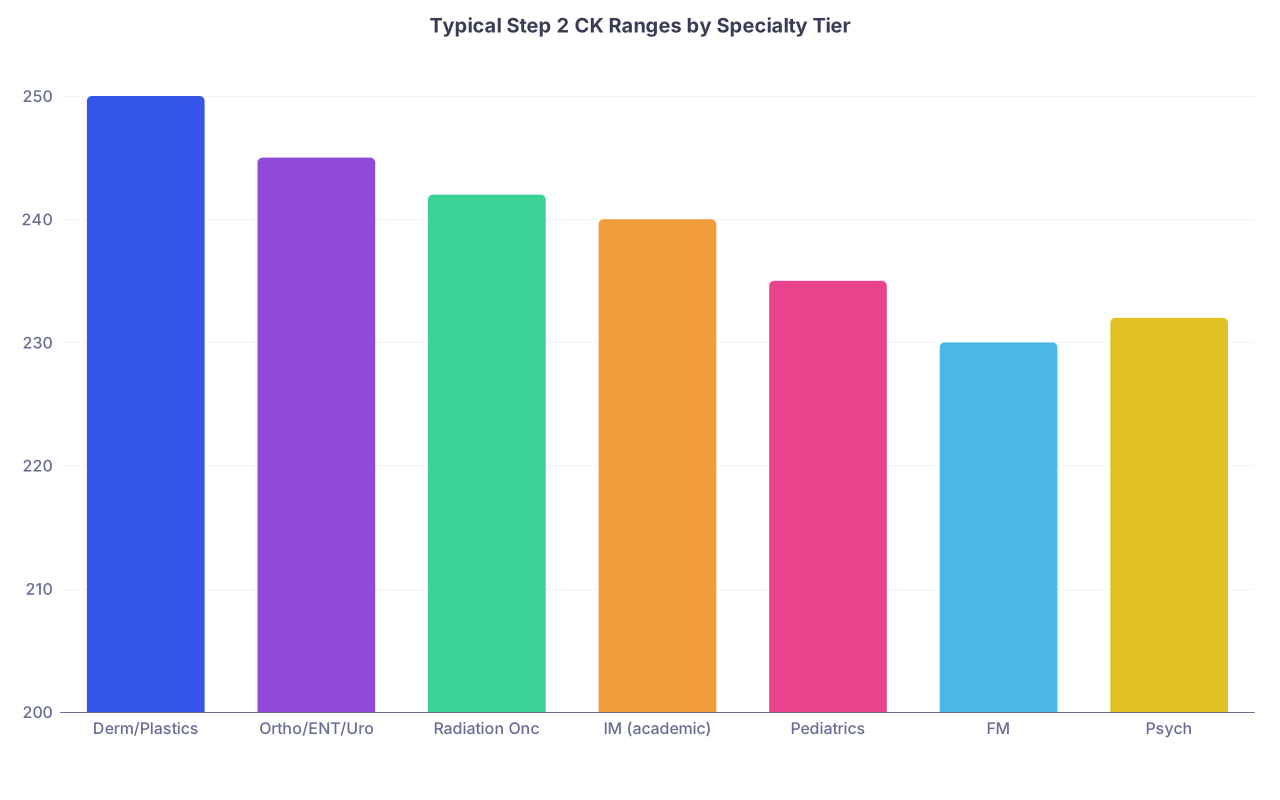
“High” and “low” are useless. You need to classify each partner against their specialty’s norms.
| Category | Value |
|---|---|
| Derm/Plastics | 250 |
| Ortho/ENT/Uro | 245 |
| Radiation Onc | 242 |
| IM (academic) | 240 |
| Pediatrics | 235 |
| FM | 230 |
| Psych | 232 |
Those are not cutoffs. They are rough “you are comfortably competitive at most places” zones. Now map yourselves.
Classify each partner
For each partner, ask:
- What is my Step 2 CK score relative to my specialty’s average matched applicant?
- What is my application strength beyond scores: home program, away rotations, research, AOA, class rank, letters, red flags?
- Are there geographic constraints besides the relationship (family care, visas, kids)?
Then classify:
Partner is Strongly Competitive for Specialty X
Typically: Step 2 CK ≥ “typical competitive” range for that field, good letters, no red flags.Partner is Borderline / Regionally Competitive
Step 2 a bit below where the “average” matched student sits, or in range but with weak letters / no home program / few interviews expected unless they apply very broadly.Partner is Underdog / Needs Rescue Plan
Step 2 substantially below the field’s norms, or failed Step 1/2, or a significant professionalism or academic concern. They can match—but not with the same strategy as their classmates.
Here is how this usually plays out for couples:
| Couple Type | Example |
|---|---|
| Both Competitive | ENT (250) + IM (245 academic track) |
| One Competitive, One Borderline | Derm (255) + Peds (222) |
| One Competitive, One Underdog | Ortho (245) + FM (210, Step 1 fail) |
| Both Borderline/Underdog, Comp Fields | Ortho (232) + ENT (230) |
Your strategy changes dramatically depending on which row you live in.
Understand How the Couples Match Algorithm Actually Punishes Risk
You cannot beat the algorithm with vibes. You beat it with probability mass.
Couples match works by pairing rank list positions:
- Each couple submits two rank lists: List A for Partner 1, List B for Partner 2.
- The algorithm tries to place you in the best joint combination according to your paired ranks (same program, same city, nearby programs, or “one matched / one unmatched” if you ranked that).
Here is the thing most couples underestimate:
If one partner only gets 5–6 interviews in a competitive field and the other partner’s list is heavily skewed toward prestige or small geographies, your joint permutation space shrinks to almost nothing.
Fewer interviews = fewer rankable programs = fewer viable joint combinations.
You must design both partners’ strategies to maximize viable joint pairs, not just individual desirability.
Specialty-Specific Reality Checks When Scores Differ
Let us go niche. Because this is where people actually miscalculate.
Scenario 1: Competitive specialty + primary care / peds partner, lower score
Common pair:
- Partner A: Derm / Ortho / ENT / Urology (strong scores: 245–260)
- Partner B: FM / IM / Peds / Psych (Step 2 215–225, maybe a bump in clerkship narratives)
Risky assumption: “Primary care always matches easily, so we just need to worry about the competitive partner.”
Wrong. The lower-scoring partner often becomes the rate-limiter geographically, especially in desirable metros with applicant-saturated primary care programs.
Specific pitfalls I have seen:
- Peds applicant with Step 2 218 only ranking top-10 children’s hospitals in three cities because “that is where derm/ENT is.” Result: competitive partner has interviews; peds partner has 2–3 interviews → catastrophic couples risk.
- FM applicant with red flags insisting on only university-affiliated programs near partner’s ortho interviews → FM ends up with 1–2 interviews, both reach for their profile.
Safer, more honest pattern:
- Competitive partner applies broadly nationwide (often 60–80+ programs).
- Primary care partner applies extremely broadly, with aggressive inclusion of community, lower-tier university, and less popular locations near each of the competitive partner’s realistic targets.
Your questions for the lower-score partner:
- Am I willing to train at a community or smaller program if it dramatically increases our chance to be together?
- Do I understand that my “I only want big city, famous children’s hospital” stance may be the actual thing that leaves us unmatched?
If the answer is “no,” then the couple needs to admit a tougher truth: you are not jointly maximizing match probability; you are jointly prioritizing prestige / lifestyle and accepting more non-match risk.
Nothing wrong with that. But say it out loud.
Scenario 2: Both in competitive fields, one clearly weaker
Example:
- Partner A: ENT, Step 2 254, strong letters, 3 sub-I’s.
- Partner B: Ortho, Step 2 233, average letters, no home program.
This is not “two strong competitive applicants.” This is one strong, one borderline/underdog for that field.
In this setup:
- Partner B must apply absurdly broadly and strategically: mid-tier community programs, less desirable regions, places that love DO / IMGs if relevant.
- Partner A needs to be willing to match “down” (less prestigious or less ideal city) to stay in range of partner B’s actual interview geography.
What you cannot do is this:
- Both apply “prestige-first,” limit geography to 2–3 cities (NYC, Boston, SF), and then act surprised when the lower-score partner’s interview count is grim.
For two competitive specialties, mismatch in scores should result in:
- Asymmetric “reach”: Stronger partner can reach higher; weaker partner needs more safeties and geographic spread.
- Brutally honest list design: Where does weaker partner actually get interviews? That becomes your center of gravity.
If after interview season Partner B has < 8–10 interviews in their field, you need to consider:
- Adding a parallel backup rank list for Partner B (prelim/TY, categorical IM/FM) paired with Partner A’s realistic programs.
- Being comfortable with a one-year separation if Partner B goes prelim then reapplies.
Most couples ignore this until February. That is late.
Scenario 3: Red flags + couples match = different game
Red flags: Step failure, professionalism write-up, extended leave, major clerkship failures.
Here is the harsh truth: if one partner has a clear red flag, the couple should plan as if that partner is in the underdog category regardless of specialty.
What this means concretely:
- That partner applies in a less competitive specialty (FM, psych, peds, sometimes IM) unless they have extraordinary mitigating factors.
- They apply very broadly, heavily community-focused, with strong advisor input on which programs are realistically receptive.
- The couple seriously considers decoupling specialties so the non-flagged partner does not also have to choose a “safe” field solely to protect the match.
You cannot wish a failed Step 1 away. You compensate with:
- Sheer volume of applications
- Very safe specialty selection
- Willingness to train at less prestigious institutions
If the other partner is aiming for derm or neurosurgery and refuses to flex on geography or tier, you are putting the flagged partner in an impossible position.
How to Build a Rational Application Strategy as a Couple
Let me walk you through a stepwise decision framework that actually works.

| Step | Description |
|---|---|
| Step 1 | Start: Identify Specialties |
| Step 2 | Standard couples match strategy |
| Step 3 | Classify each partner: strong/borderline/underdog |
| Step 4 | Map realistic program tiers & regions for lower-leverage partner |
| Step 5 | Competitive partner expands list around those regions |
| Step 6 | Decide on backup specialty/track if needed |
| Step 7 | Build joint rank strategy based on actual interviews |
| Step 8 | Any competitive specialty? |
| Step 9 | Partner with lowest leverage? |
Step 1: Decide if separation is off the table or a last-resort option
You and your partner must answer this first, not in February when interviews are done.
There are three real stances:
- We must be in the same city, non-negotiable.
- We strongly prefer same city, but could handle 1 year apart with a solid plan.
- We can tolerate 1–2 years apart if it preserves both career goals.
Your answers change everything. If you are truly in category 1, you cannot also both chase max prestige in ultra-competitive fields with a big score gap and pretend risk is low.
Step 2: Build a realistic program target map for the weaker partner
Not “where you want to live.” Where your application could reasonably land you interviews.
That depends on:
- Scores
- School reputation
- Home program presence
- Visa status
- Red flags
- Timing of exam completion
Then ask:
- If I were single, where would I apply to maximize my match probability?
That is your anchor list. Now you place the stronger partner’s program choices around that.
Step 3: Competitive partner adjusts, not just the weaker partner
This is where ego creeps in. The higher-scoring / more competitive partner often implicitly expects the entire couple strategy to bend around their vision.
If you insist on:
- Only top-20 programs
- Only 2–3 large metros
- Only prestige-heavy academic centers
…while your partner has 215 Step 2 and a red flag from second year, the math does not work.
Competitive partner needs to:
- Broaden geography.
- Include mid-tier programs in cities where the weaker partner is likely to get primary care interviews.
- Stop assuming “my competitive specialty is the limiting factor.” Sometimes it is not.
Post-Interview Reality: Adjusting the Rank List to Actual Data
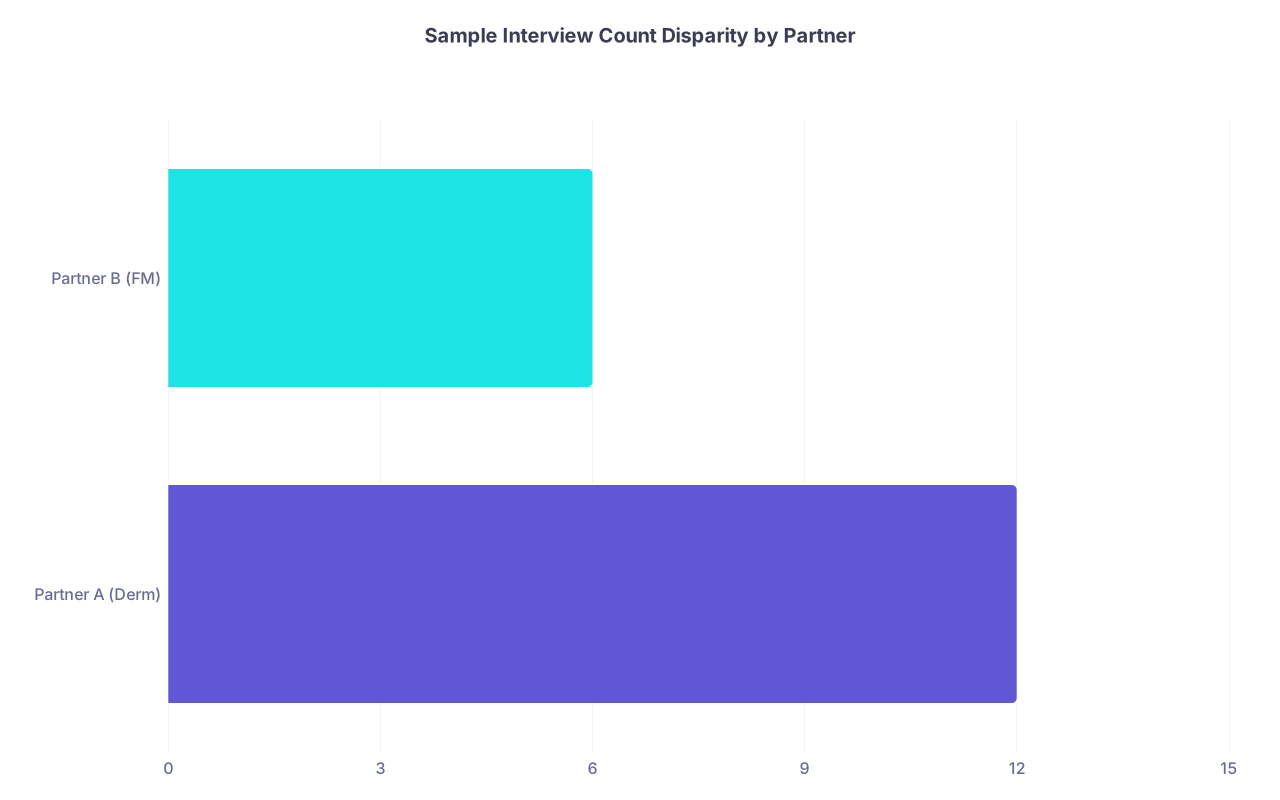
Your final couples rank strategy should be built after you see interview distributions.
| Category | Value |
|---|---|
| Partner A (Derm) | 12 |
| Partner B (FM) | 6 |
In this example, Partner A has 12 derm interviews; Partner B has 6 FM interviews.
Your risk is not derm. Your risk is FM. Specifically:
- Where do the 6 FM programs physically sit?
- How many derm interviews are in those same cities or within a commutable radius (depending on your tolerance)?
- What backup pairs do you rank if FM does not work out (e.g., derm + FM-prelim mismatch vs derm + unmatched vs derm + different metro)?
Concrete steps:
Plot interviews on a map.
Literally. I have seen couples do this on Google Maps with colored pins.Group interviews into regions.
Example: Northeast corridor, Midwest cluster, West Coast.Assign each region a viability score based on how many programs each partner has there.
- Region where Partner A has 5 interviews and Partner B has 1 = fragile.
- Region where Partner A has 3 and Partner B has 4 = strong.
Rank regionally, not romantically.
It may feel more romantic to dream about that one city you love where one of you has 1 interview. You want the place where both of you have 3–5 interviews each.
Handling Backup Plans Without Destroying Either Career
This is the part no one wants to talk about on rounds, but they whisper in the call room.
There are several backup patterns you should at least understand.
1. Parallel backup specialty for the lower-score partner
Example:
- Partner A: Strong ENT applicant
- Partner B: Weaker ortho applicant who may struggle to land enough interviews
Backup: Partner B also applies to categorical IM or prelim surgery in the same cities as A’s interviews. Rank list includes pairs like:
- A: ENT Program X + B: IM Program X
- A: ENT Program Y + B: Prelim Surgery Y
This protects against the scenario where B gets very few ortho ranks but is still matchable in IM/Prelim.
Downside:
- More money, more applications, more personal identity turbulence.
- B has to accept possibility of never becoming an ortho, or at least delaying it.
2. One-year distance with a reapply strategy
Sometimes the most rational play is:
- Competitive partner matches into their specialty where they fit best.
- Lower-score partner takes a TY/prelim year or a research year in the same city or a different one, then reapplies with strengthened application.
This works best when:
- The weaker partner’s main problem is “late blooming” (late exams, late letters) rather than irreparable red flags.
- The couple can tolerate one year apart financially and emotionally.
3. Both “downshift” specialty to stay together
Example:
- Partner A: Borderline ortho applicant.
- Partner B: Low-score peds applicant, visa issues.
They jointly choose:
- A switches to categorical IM or anesthesia.
- B applies to FM or psych.
- They target the same set of mid-tier programs in 3–4 cities.
Is that ideal for the ortho applicant’s ego? No. Does it sometimes produce a better overall life outcome than both going unmatched chasing a dream that their numbers will not support? Yes.
I am not saying everyone should do this. I am saying you should have the guts to discuss it before ERAS opens.
Communication Checklist for Couples with Score Disparities
You can have the right numbers and destroy your odds with poor communication between you, your advisors, and programs.
Here is what I have seen work.
Between you and your partner:
- Share full score reports, not just headlines.
- Say explicitly: “Here is what I am willing to flex on: specialty vs location vs prestige vs being together.”
- Revisit this conversation once you see actual interview counts.
With advisors:
- Talk to separate advisors for each specialty. Then have a joint conversation with someone who understands couples match mechanics.
- Do not hide the disparity. Good advisors need to know your real numbers to build a real plan.
With programs (selectively):
- Some competitive programs genuinely like couples and will ask. Be honest about couples matching.
- Do not overshare or sound entitled. A simple, “I am couples matching with my partner who is applying in X; we are very interested in this region together,” is enough.
A Quick Reality Table: What You Can and Cannot Control
| Category | You Control |
|---|---|
| Scores already taken | No – but you control interpretation |
| Specialty choice | Yes, within reason |
| Program list breadth | Yes |
| Geographic rigidity | Yes |
| Rank list design | Yes |
| Program biases | No |
| Interview offers | No |
You do not control that derm likes 255+ and stellar research.
You do control whether the FM partner only ranks university programs in the same 2 cities.
That is where couples win or lose this.
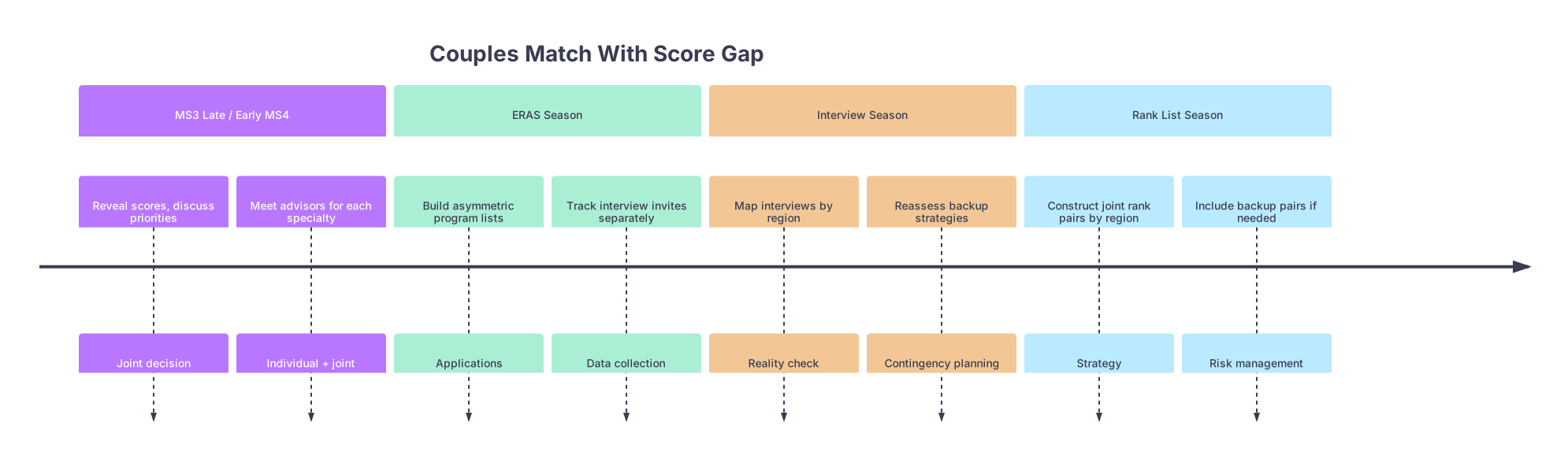
Visualizing a Rational Timeline (So You Do Not Panic in February)
| Period | Event |
|---|---|
| MS3 Late / Early MS4 - Reveal scores, discuss priorities | Joint decision |
| MS3 Late / Early MS4 - Meet advisors for each specialty | Individual + joint |
| ERAS Season - Build asymmetric program lists | Applications |
| ERAS Season - Track interview invites separately | Data collection |
| Interview Season - Map interviews by region | Reality check |
| Interview Season - Reassess backup strategies | Contingency planning |
| Rank List Season - Construct joint rank pairs by region | Strategy |
| Rank List Season - Include backup pairs if needed | Risk management |
The point is simple: do not wait until rank list week to admit there is a gap and that it matters.
Key Takeaways
- Score disparities in couples—especially when one or both are in competitive specialties—create two different markets that must be reconciled deliberately, not optimistically.
- The lower-leverage partner’s interview geography and program tier should anchor your joint strategy; the stronger partner then broadens and flexes around that reality.
- Serious couples talk early about what they are willing to flex on—prestige, specialty, geography, or time together—and build application and rank strategies that match those actual priorities, not fantasy versions of them.


