

It is late November. You and your partner are both on ICU nights, trading 3 a.m. cross-cover pages and whispered conversations at the workstation. Between labs and orders you have a shared Google Sheet open with 120 programs, 40 cities, and one big question:
“He’s applying general surgery. I’m going internal medicine. Are we about to blow up our match by couples matching?”
Let me be blunt: couples matching with one surgical and one non-surgical applicant is absolutely doable. I have seen plenty of GS + IM, Ortho + FM, ENT + Neurology couples match very well. I have also seen very strong applicants end up in cities they never once considered living in, or one partner taking a clear quality hit in program caliber to stay together.
You are deciding where you want to live, train, and frankly suffer for 3–7 years. This is not just logistics. It is lifestyle, sleep, fertility timing, debt, and career trajectory.
Let me break this down specifically.
1. The Structural Reality: Surgery vs Non-Surgical in the Couples Match
First, you need a realistic map of the terrain you are about to step into.
How the Couples Match Actually Treats You
You do not apply as “one super-applicant.” You apply as two individuals whose rank lists are mathematically paired.
The Match algorithm looks at pairings of programs (A1–B1, A1–B2, A2–B1, etc.) in the order you rank them. It tries to place you in the highest-ranked pair where:
- Program X wants Applicant 1
- Program Y wants Applicant 2
…and both can be satisfied simultaneously. If not, it moves down the paired list.
So for a general surgery + internal medicine couple, your rank list lines might look like this:
- Line 1: [Her: MGH IM] + [Him: MGH Gen Surg]
- Line 2: [Her: MGH IM] + [Him: BIDMC Gen Surg]
- Line 3: [Her: BI IM] + [Him: BI Gen Surg]
- Line 4: [Her: MGH IM] + [Him: “No match”] (if you include this)
- Line 5: [Her: “No match”] + [Him: MGH Gen Surg]
Those “No match” lines are exactly what they sound like: one person matches, the other does not, by choice, to protect someone’s ceiling.
The algorithm cares zero about whether one field is surgical or not. It only cares about whether each of you is high enough on the programs’ lists to create a stable pair.
But the fields change the dynamics in three big ways:
- Fill rate / competitiveness
- Program distribution by geography
- Training length and lifestyle spread
Hard Numbers: Fill and Competitiveness
Let us look at a simplified view (numbers rounded, patterns are the key):
| Specialty Type | Example Fields | US MD Fill % | Positions (approx.) |
|---|---|---|---|
| Competitive Surgical | Ortho, ENT, Plastics | 95–99% | 700–1000 |
| Core Surgical | General Surgery | 90–95% | 1100–1300 |
| Competitive Non-Surg | Derm, Rad Onc | 95–99% | 400–600 |
| Large Core Non-Surg | IM, Peds, FM | 95–99% | 7000–8000 |
| Mid Non-Surg | Neuro, Psych, EM | 90–98% | 2000–3000 |
The bottom line:
- Non-surgical big fields (IM, Peds, FM, Psych) exist almost everywhere and in large numbers.
- Surgical fields are concentrated: fewer programs, fewer spots, often stacked in academic centers.
A GS applicant + IM applicant in Boston has many more viable pairs than, say, an Ortho + Psych couple trying to stay in a mid-sized Midwest city.
2. Core Tradeoffs: What You Are Actually Giving Up
You are not just balancing “together vs apart.” You are trading off four specific buckets: geography, program caliber, lifestyle mismatch, and risk of not matching.
2.1 Geography: The First Thing That Breaks
Here is what usually happens when one person is surgical:
- You go from “we’d like East Coast big city”
- To “we’re open to anywhere in the Northeast or Midwest with decent airports”
- To “we are ranking a city we mocked in M1 because they are the only place with Ortho + Psych + decent IM”
You will almost certainly need:
- A bigger geographic net than a non-couples applicant, and
- A bigger net for the surgical partner than the non-surgical partner, since surgery options are more limited.
If the surgical partner is highly competitive (top 10–20% of applicants) and the non-surgical partner is average, you can still anchor to major metros. If both are mid-pack, you either expand geography or accept meaningful asymmetry in program quality.
2.2 Program Caliber: Who Takes the Hit?
This is not equal-opportunity sacrifice.
In surgery vs non-surgery couples, the typical compromise patterns I have actually seen:
Scenario A: Surgical partner is stronger
- Surgical partner lands at a solid mid-high academic program.
- Non-surgical partner lands at a slightly weaker IM/FM/Neuro program in the same city that they would not have ranked that high if they were solo.
Scenario B: Non-surgical partner is stronger
- Non-surgical partner passes on top-10 IM/Psych targets to rank mid-tier academic/community-heavy cities where the surgical partner has mid-tier or safety options.
- Their ceiling comes down more than the surgical partner’s.
Scenario C: Both mid-range
- Geographic flexibility goes way up. Coasts become harder. You start seeing “We matched in Ohio / upstate New York / Midwest college town we never visited before this year.”
If you try to both “protect your own ceiling” and stay geographically tight, you increase the risk of at least one of you not matching. The algorithm cannot invent positions.
2.3 Lifestyle Mismatch: Every Day for Years
This is the underestimated part.
Surgery residency is:
- Longer: 5–7 years vs 3–4 for most non-surgical
- More front-loaded: brutal PGY1–3, sometimes softer later
- Less predictable: add cases at 4 p.m., cases going late, weekend call, Q4–Q6 24-hour calls
Non-surgical core fields (IM, Peds, Psych, FM) have:
- 3–4 years total
- More predictable (not easy, but more “programmable”) schedules
- Often more flexibility with days off, clinic vs wards
What that looks like in real life:
- IM intern gets home at 6:30 p.m. Surgical PGY2 stumbles in at 10 p.m.
- Holiday coverage—surgery is constantly short; guess whose Christmas gets pulled.
- One partner finishes training years earlier and may be ready to move, have kids, or buy a house while the other is still a PGY4 on trauma.
You are not just picking cities. You are picking how much of your 20s/30s you will actually spend in the same room while awake.
2.4 Risk of Not Matching (Either or Both)
Couples matching has a small but real increased risk of:
- One partner not matching
- Both matching, but in programs that would have been much lower on your lists if you were solo
Risk goes up when:
- One or both are in competitive small fields (ENT, Ortho, Derm)
- You insist on narrow geography (eg, “Northeast academic only”)
- You over-rank “reach” pairs and under-rank realistic pairs
You lower risk by:
- Ranking many realistic pairs (not just fantasy combos)
- Being honest about your competitiveness by specialty
- Deciding ahead of time what is an acceptable non-match scenario (we will get to that)
3. Tactical Planning: Building a Rational Strategy for Mixed Fields
Let us move to what you actually need to do.
3.1 Start With a Brutally Honest Competitiveness Assessment
You cannot design a good couples strategy on fantasy self-assessment. You need real numbers and feedback.
Each of you should write down, specialty-specific:
- USMLE/COMLEX scores (Step 2 is king now)
- Class rank / AOA / Gold Humanism
- Number and quality of letters (home vs away rotation letters, from known names or not)
- Research output relative to your specialty norms
- Red flags: LOA, professionalism issues, step failures
Then map yourselves into buckets for your field:
- Top 10–20% of applicants
- Solidly average
- Slightly below average
- At-risk
If you are both top 20% in your respective fields, you have real leverage, especially in large metros.
If one is top 20% and the other is average, your strategy must protect the weaker portfolio more carefully. Not out of pity—out of math.
3.2 Build a Combined Program Universe First, Not Separate Wish Lists
The stupid way to do this (that I see constantly): each of you picks “your” dream list, then you try to overlay them and get sad.
The better way:
List cities / hospital systems that have both fields.
For example, suppose you are Ortho + Psych.- Strong overlap cities: Boston, NYC, Philly, Chicago, LA, SF, Seattle, Durham, St. Louis, etc.
- Secondary markets: mid-size cities with at least one academic center and a few community hospitals.
For each city, build a grid of all possible combos.
Example: Durham/Chapel Hill
- Ortho programs: Duke Ortho, UNC Ortho
- Psych programs: Duke Psych, UNC Psych, VA Psych (maybe)
Potential pairs: Duke–Duke, Duke–UNC, UNC–Duke, UNC–UNC, etc.
Score combinations by realism.
Use a 1–5 realism score based on your actual competitiveness.
The key: you are not “adding” two independent lists. You are building a set of pairs from the beginning.
3.3 Think Deliberately About Program Type Symmetry
Mixed surgical/non-surgical couples frequently end up with:
- Surgical partner in a big academic flagship
- Non-surgical partner in a mix of academic-community or county-based program
And that is fine if you decide it is fine.
But do not pretend it is symmetrical. It is not. And for some fields, that matters.
Relatively more sensitive to program quality / brand for first job or fellowship:
- Derm
- Rad Onc
- ENT
- Ortho
- Neurosurgery
- IR, advanced GI, cards fellowship paths (from IM)
Somewhat less sensitive (as long as training is solid and references are good):
- FM
- IM hospitalist paths
- General Psych
- Peds (for general peds practice)
If, for example, one of you is Derm and the other is Gen Surg, it can be rational for the derm applicant to optimize prestige more than the surgeon, because Derm jobs/gaps are more narrow and brand-driven in some markets. But you have to say that out loud, not just “see what happens.”
4. Application Tactics: How to Apply and Interview Without Wasting Shots
4.1 How Many Programs to Apply To (Realistically) as a Mixed Couple
No universal number, but I will give you working ballparks.
Assume:
- Surgical partner: General Surgery, slightly above average
- Non-surgical partner: Internal Medicine, average
Typical individual advice might be:
- GS solo: 40–60 programs
- IM solo: 25–30 programs
As a couple, that is usually not enough.
A more realistic couples strategy in this setting:
- GS partner: 60–80 programs
- IM partner: 50–60 programs—heavier than usual to match the cities/programs GS is targeting
If instead we have:
- Ortho (mid-pack) + Psych (average)
Now you are talking:
- Ortho: 70–90
- Psych: 60–80
And you absolutely need to be geographically broad.
The formula is: more competitive field generally applies broader; the non-surgical partner tracks those cities to create pairable options.
4.2 Letters and Personal Statements: Signal the Couples Match Without Making It Your Only Identity
Do not write your entire personal statement about being engaged to your co-applicant. Programs are not hiring a pair. They are hiring residents.
You should:
- Mention couples match briefly in your ERAS application (there is a field)
- Optionally, one line in your personal statement: “I will be entering the Match as part of a couples pair with my partner, who is applying in [specialty]. We are excited to train in a program that values…”
- Clarify any geographic interest concisely: “We are particularly interested in training in [region(s)] due to family ties and professional goals.”
Be careful: tying yourself to one single city when your surgical partner cannot realistically match there is a good way to scare programs off.
4.3 Coordinating Interview Invitations
This is where people either get organized or drown.
Key principles:
- You both need an up-to-date, shared calendar.
- As invites come in, you prioritize same-city, same-day interviews if possible.
- If not possible, same-week is usually good enough to make a trip workable.
If one partner gets an invite at a hospital in a certain city and the other has not:
Non-invited partner should politely email the coordinator or program director:
- Identify yourself briefly.
- Note that you are couples matching with [Partner Name], who has an interview on [date].
- Express strong interest and ask if your application can be reviewed for possible interview consideration, acknowledging understanding if they are full.
Some programs will help. Some will not. But many coordinators genuinely try to cluster couples.
5. Rank List Engineering: Where Most Couples Screw This Up
The rank list is where people get irrational. Let us keep you out of that trap.
5.1 The Three Outcomes You Need to Define Before Ranking
You and your partner must decide, explicitly, in writing if you can:
- Accept one partner matching and the other not (and which direction you prefer if it comes to that)
- Accept living in a city that is highly suboptimal for one of you academically
- Accept separating for training if needed (rare in couples match, but some decide this)
Here are three typical stances:
Stance 1: “Together no matter what.”
- You do not rank any “No Match / Match” pairs high.
- Risk: both matching at significantly lower choices than one or both could have achieved solo.
Stance 2: “Protect careers first, but try hard to be together.”
- You include “one matches, one does not” options after a certain line on the list.
- You are saying: Above this line, we accept separation/non-match to protect a high-value placement. Below this line, we prefer being together.
Stance 3: “We prioritize one specialty’s ceiling.”
- For example, if one partner is Derm or Neurosurgery with stellar stats, you might protect that placement even if the other is left unmatched, because the reapplication year might be easier for the non-surgical partner.
You cannot decide this on rank day. You decide this months earlier and stick to it.
5.2 The Mechanics of Building Paired Rank Lists for Surgical vs Non-Surgical
Let me give you a concrete sketch.
Say we have:
- Partner A: General Surgery
- Partner B: Internal Medicine
They have interviews at the following cities:
- Boston: A (MGH, BI), B (MGH, BI, Tufts)
- Chicago: A (Northwestern, UChicago), B (Northwestern, UChicago, Rush)
- Mid-size City X: A (State U), B (State U, Community)
- Mid-size City Y: A (Community), B (State U)
A plausible rational pattern:
Top lines: high-caliber overlap
- [A: MGH GS] + [B: MGH IM]
- [A: BI GS] + [B: BI IM]
- [A: Northwestern GS] + [B: Northwestern IM]
- [A: UChicago GS] + [B: UChicago IM]
Next: mixed-strength pairs
- [A: MGH GS] + [B: Tufts IM]
- [A: BI GS] + [B: Tufts IM]
- [A: Northwestern GS] + [B: Rush IM]
- [A: UChicago GS] + [B: Rush IM]
Then: safety-but-together
- [A: State U (City X) GS] + [B: State U (City X) IM]
- [A: State U (City X) GS] + [B: Community (City X) IM]
- [A: Community (City Y) GS] + [B: State U (City Y) IM]
Only after these, if you have pre-decided, might you add:
- [A: MGH GS] + [B: No match]
- [A: No match] + [B: MGH IM]
And so on down.
Notice the discipline: you do not jump randomly between cities. You group by city and realistically possible combinations, ordered by joint desirability.
5.3 Common Rank List Mistakes in Mixed Couples
I see the same problems over and over:
- Ranking “fantasy” pairs (top-5 surgical + top-5 nonsurgical in the hottest cities) way too high and having only a short list of realistic pairs after.
- Failing to include less glamorous cities where you have strong shot as a pair because “we do not really want to live there.” You might change your mind when it is that or SOAP.
- Not including “single match” options at all when one partner has a significantly rare/elite opportunity that may never reappear.
6. Specialty-Specific Patterns: What Changes With Each Match-Up
Let us go through a few common surgical vs non-surgical pairings and what I have actually seen play out.
6.1 General Surgery + Internal Medicine
This is probably the most common mixed pair.
Advantages:
- IM is everywhere.
- GS is broad enough that almost every academic center has it.
- Plenty of overlapping cities.
Tradeoffs:
- IM partner has the most flexibility; they are often the one sacrificing a higher-tier IM program for geography.
- Surgery lifestyle is heavier early; IM partner often shoulders more domestic/social work if you live together.
Tactical advice:
- IM partner should cast a wide geographic net but focus on the same cities where GS is strongest.
- Be okay with IM being at a slightly less prestigious program if GS ends up at the flagship and the city is good.
6.2 General Surgery + Psych / FM / Peds
These behave similarly to GS + IM, with slightly different flavors:
- Psych + GS: psych jobs and fellowships are abundant; city quality can matter more for long-term living than brand, depending on career plans.
- FM + GS: FM programs are everywhere. FM applicant can almost always find something near the GS program unless it is a truly tiny place.
- Peds + GS: big overlap in children’s hospitals / academic centers; Peds may be in a separate hospital system from the adult GS program, depending on the city.
These are among the “easier” mixed combos logistically.
6.3 Ortho / ENT / Neurosurgery + Non-Surgical Core (IM/Peds/Psych)
This is where you need to be more strategic.
Characteristics:
- Far fewer surgical programs total.
- Extremely front-loaded competitiveness.
- Higher probability that the surgical partner has a handful of “must-rank” elite spots and a wide tail of mid-tier programs.
Implications:
- You almost certainly must be geographically broad.
- The non-surgical partner needs to be willing to match at solid but not necessarily “top-name” programs to follow the surgical anchor.
You also need to talk candidly about:
- What if the surgical partner matches at a dream program where the non-surgical partner only has a weak or no local option?
- Are you willing to do long-distance for a few years if that is the only way to preserve a rare surgical training opportunity?
6.4 Competitive Non-Surgical (Derm, Rad Onc) + Surgery
These are unusual but not unicorns.
They behave more like:
- “Two rare birds trying to land on the same few branches.”
You cannot both behave like you are the anchor. At least one of you has to accept more compromise in either geography or program prestige.
Often:
- The derm / rad onc partner gets more leeway to chase top programs because the job market and fellowship pipelines are narrower.
- The surgical partner may anchor them in a particular city/region, but you must carefully analyze where both have realistic high-tier options (this may end up being only a few metro areas).
7. Lifestyle and Long-Game Reality: Not Just Getting the Match, But Surviving It
Let us zoom past R3 day and look at years 1–7.
7.1 Burnout Asymmetry
In a surgery vs non-surgery couple, burnout rarely hits both people at the same time and intensity.
Typical pattern:
- Years 1–2: Surgical partner is more exhausted, more absent. Non-surgical partner feels like they are “holding the relationship together” logistically.
- Years 3–4: Non-surgical partner, now senior, may have more responsibility, and if they are finishing earlier, anxiety about “what next?” while still tethered to the other’s program.
- Years 5+: If surgery is 5+ years, the non-surgical partner may already be an attending or in fellowship, with income and schedule very different from their partner’s.
You need proactive conversations about:
- Money: one partner becoming an attending earlier means potential tension if the other is still a low-paid resident with high hours.
- Kids: if you want them, be realistic about which years are even remotely feasible for pregnancy, childcare, and sleep.
7.2 Second Moves and Fellowships
Another trap: you “succeed” at the couples match, then the fellowship stage blows up your plans.
Surgery fellowships (trauma, surg onc, CT, vascular, etc.) and non-surgical fellowships (cards, GI, heme/onc) are another wave of applications. You will almost certainly not couples match again formally, but you can:
- Stagger: one partner goes straight to fellowship while the other does a gap year nearby or research.
- Common-city target: both aim for jobs/fellowships in the same metros with heavy hospital density (NYC, Boston, Chicago, LA, etc.) to maximize overlap chances.
Think of the couples match as the first major coordination. Not the last.
8. Concrete Planning Sequence: What To Do Month-by-Month
To make this less abstract, here is a simplified planning flow.

| Step | Description |
|---|---|
| Step 1 | MS3 Late / Early MS4 |
| Step 2 | Honest Competitiveness Assessment |
| Step 3 | Agree on Geographic Flexibility |
| Step 4 | Build Overlap City & Program Grid |
| Step 5 | Apply Broadly with Aligned Cities |
| Step 6 | Coordinate Interviews & Communicate as Couple |
| Step 7 | Define Acceptable Outcomes Explicitly |
| Step 8 | Construct Paired Rank Lists by City |
| Step 9 | Review with Mentor or Advisor |
| Step 10 | Submit Lists & Stop Tweaking |
I will translate that into plain English steps:
- Early MS4: get unbiased feedback on your relative strength in your field.
- Agree on 2–3 preferred regions and 2–3 “we can live there if needed” regions.
- Build a shared spreadsheet of all overlapping program pairs by city.
- Apply broadly, letting the surgical partner’s geography guide, the non-surgical partner shadowing those cities.
- During interviews, signal couples match and coordinate dates when possible.
- Decide, in writing: are we willing to let one match and one not, and in which direction.
- Build rank lists by city and realist combinations, not by fantasy.
- Have one or two trusted specialty-specific mentors review your plan, not to change your priorities, but to sanity check your realism.
- Submit. Stop obsessively re-litigating every line.
9. A Quick Visual: Lifestyle and Training Length Spread
Just so you see the time spread problem clearly:
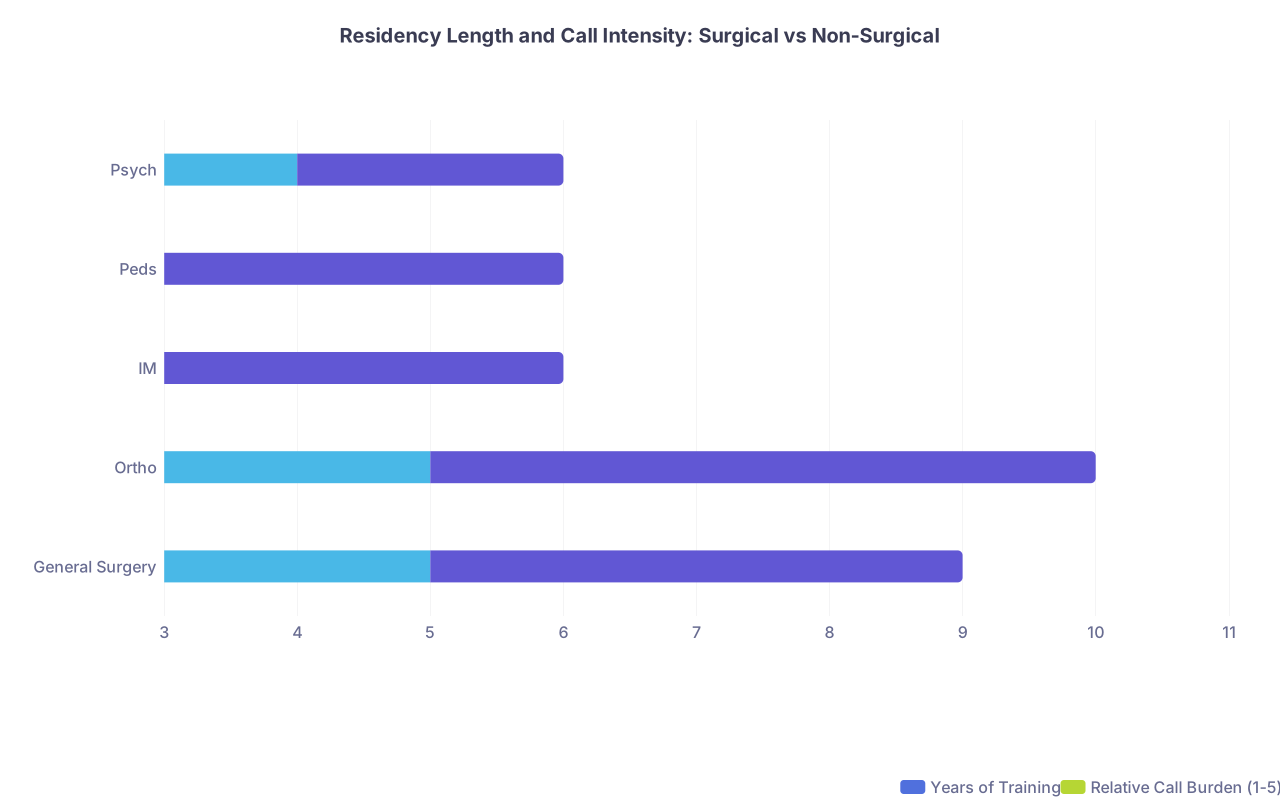
| Category | Years of Training | Relative Call Burden (1-5) |
|---|---|---|
| General Surgery | 5 | 4 |
| Ortho | 5 | 5 |
| IM | 3 | 3 |
| Peds | 3 | 3 |
| Psych | 4 | 2 |
This is crude but directionally correct. You are not just matching fields. You are matching:
- 3 vs 5+ years
- Moderate vs high call intensity
Plan your life around that mismatch.
10. Putting It Together: A Sample Tradeoff Analysis
Let us walk through a fictional couple.
- Alex: applying General Surgery. Step 2: 247. Good letters, 1 home sub-I + 1 away. Above-average but not elite.
- Jordan: applying Psychiatry. Step 2: 235. Solid, a couple of case reports. Average applicant.
They initially say:
- “We really want to be in the Northeast. Boston or NYC ideally. Maybe Philly.”
Based on their competitiveness:
- Alex can probably interview at solid academic GS programs in major cities, but not dozens of them.
- Jordan will have many more options but is tethered to Alex.
If they cling to “Boston or NYC only,” their overlapping realistic pair list might be under 10 strong combinations. That is dangerous.
A stronger strategy:
- Primary target regions: Northeast, Mid-Atlantic, Midwest.
- Alex applies widely: Boston, NYC, Philly, Baltimore, DC, Pittsburgh, Cleveland, Chicago, etc.
- Jordan applies heavily to those exact cities + backup psych-heavy cities.
They decide preemptively:
- They will not rank any “one matches, one does not” lines in the top 10.
- After line 10, they will protect Alex’s GS ceiling slightly more because reapplying in surgery can be brutal; Jordan is willing to reapply in psych in a year or do a research year if needed, if it means Alex does not waste a rare high-tier match.
Their final rank list might include:
- Top 6–8: paired academic programs in big metros (together-first)
- Next 6–8: mixed-tier pairs in less glamorous cities (still together-first)
- Final 4–6: a few “Alex matches, Jordan does not” in dream GS programs, only if they are emotionally and financially ready for a gap year on Jordan’s side.
That is a rational, eyes-open plan.
11. What You Actually Need To Remember
Let me cut this down to the essentials.
One surgical, one non-surgical is absolutely workable, but you are trading geography and symmetry.
The surgical field’s limited footprint and higher competitiveness will shape your map more than the non-surgical one.Be honest about who is the bottleneck and what you are willing to sacrifice.
Decide, early, whether you will ever prioritize one partner’s dream program over being together or both matching. Then build your rank lists to reflect that.Your job is to maximize realistic pairs, not fantasy overlaps.
Start with overlapping cities, score combinations by realism, and build rank lists by city clusters. The more real, acceptable pairs you rank, the safer your match.
If you handle those three well—and you stay honest with each other about career vs relationship priorities—you can make a mixed surgical/non-surgical couples match work without nuking one person’s trajectory. It will not be perfectly “fair.” It rarely is. But it can be deliberate instead of accidental.


