

Only 27% of physician couples end up in the same residency program, yet most of them started the process assuming “it will probably work out.”
That gap is not bad luck. It is bad planning around one core decision that couples routinely underestimate: urban academic vs community programs. The single-program vs two-program debate gets plenty of attention. Geography gets attention. But the type of program in that geography—especially when you are trying to accommodate two different specialties and career goals—often gets treated as an afterthought.
It should not be an afterthought. It should be one of the first filters you apply.
Let me break this down specifically for couples match.
The Real Trade: Reputation vs Control (for Two Careers, Not One)
The classic solo-applicant framing is naïve for couples:
Academic = prestige, complexity, research
Community = lifestyle, autonomy, “real world” medicine
For a couple, the actual trade looks more like this:
- Urban academic centers: higher ceilings, higher chaos, more competition for limited slots, more two-body problems.
- Community programs: more flexibility, more negotiating room, often less structural support for complex couple arrangements.
And under that, the uncomfortable reality: what is good for you may be actively bad for your partner.
The four most common couple combinations
These pairings behave differently when you are choosing between urban academic and community-heavy rank strategies. I see these four again and again:
- Competitive + less competitive (e.g., Derm + FM, Ortho + IM, ENT + Psych)
- Research-heavy + clinically focused (e.g., MD/PhD + “I just want to see patients”)
- Two moderate competitiveness specialties (e.g., IM + EM, Peds + Psych, Anesthesia + IM)
- Two very competitive specialties (e.g., Ortho + Derm, ENT + Ophtho, Rads + Derm when advanced/PGY-1 issues matter)
In each scenario, the type of institution has different leverage. Academic programs can absorb a competitive + less competitive pair differently than community programs. Community-heavy markets sometimes handle two moderate specialties better than one ultra-competitive plus one niche.
Let me make this concrete.
What “Urban Academic” Really Means for Couples
When you say “urban academic,” you are usually talking about:
- A large university hospital or tertiary/quaternary referral center
- Multiple affiliated hospitals
- Multiple accredited GME programs under one umbrella
- High-density program coexistence in the same city (think IM + 7 subspecialties + 3 surgical subspecialties + EM + Peds, etc.)
That structure has specific implications for couples.
Advantage 1: Multiple programs under one GME roof
The biggest structural advantage, and couples underuse it.
In a place like:
- Boston (MGH/BWH/BIDMC/BU),
- Philadelphia (Penn, Jefferson, Temple, etc.),
- Houston (UT Houston, Baylor, HCA-affiliated programs),
- Chicago (UChicago, Northwestern, Rush, UIC),
you often have:
- More than one program for each specialty.
- Shared GME offices or at least shared local culture around couples match.
- A track record of “creative” solutions: off-cycle spots, prelim + advanced maneuvering, or simultaneous offers to keep a couple in the same metro.
If Program A in Internal Medicine wants you, and your partner is a strong EM applicant, an urban cluster of academic programs can sometimes do a quiet behind-the-scenes email: “We really want this IM applicant; would you take a serious look at their spouse for EM?”
No guarantee. But academic centers that care about recruitment will do this.
Community programs rarely have that kind of cross-program network at scale.
Advantage 2: Built-in research and academic paths (for at least one partner)
Academic medicine is still the default pipeline for:
- Physician–scientists (MD/PhD or research-heavy MDs)
- People aiming for competitive fellowships (GI, Cardiology, Heme/Onc, advanced surgical fellowships)
- People who ultimately want leadership roles in academic departments
If one partner wants this trajectory, urban academic programs almost always serve them better.
The question then becomes: does the other partner have to sacrifice too much (schedule, autonomy, burnout risk) to keep the couple together in that environment?
Advantage 3: Subspecialty access when one partner is playing the long game
You see this pattern a lot:
- Partner A: Categorical IM, wants Cards or GI
- Partner B: EM or Anesthesia or Psych, happy clinically but not “academic career or bust”
Urban academic centers:
- Provide built-in access for Partner A to research mentors, big-name letters, and fellowship programs.
- Provide enough total program volume that Partner B can find an EM, Anesthesia, or Psych program in the same city or nearby suburb.
This is where picking urban academic vs community is really picking “does Partner A get a realistic runway to a top fellowship without us having to break up geographically in 3 years?”
If you both match into excellent but regional community programs in different cities, you may have locked in a long-distance fellowship problem before residency even starts.
What “Community” Really Means (And Where People Get It Wrong)
“Community” is not a single thing. There is a world of difference between:
- A robust, high-volume, community-based teaching hospital in a mid-size city with >10 residencies.
- A small community hospital with one or two programs, heavy service load, minimal research.
Lumping them together is how couples blow up their own match strategy.
Key distinctions inside “community”
Here is a simple grid that couples rarely put on paper but absolutely should:
| Type | Typical Features |
|---|---|
| Large community teaching | Many residencies, solid volume, some research |
| Regional referral center | Strong clinical volume, fewer academic tracks |
| Small community program | 1–3 residencies, heavy service, minimal flexibility |
| Community with university affiliation | Hybrid model, some academic pathways |
For couples, the “large community teaching” and “community with university affiliation” categories can actually function more like mid-tier academic centers in terms of:
- Willingness to coordinate couples.
- Openness to off-cycle or custom solutions.
- Ability to support one partner’s academic or fellowship aspirations (within reason).
The “small community” category is where couples get hurt:
- Limited slots in each specialty.
- Crucial staffing gaps make schedule flexibility a luxury.
- Little redundancy across programs—if the one EM program in town cannot take your partner, there is no backup across the street.
Where community helps couples
You get real advantages:
- Program directors often know each other personally across institutions in the same region. That can help when you are asking, “Can you look at my partner’s application?”
- Community programs are sometimes more open to non-traditional pathways, off-cycle acceptances, or last-minute scramble maneuvers if they like you.
- If one partner has a weaker application (low Step, red flags, career switch), a strong community-based program may be much more forgiving than a highly competitive academic center.
So the lazy mantra “academic good, community bad” is nonsense for couples. The right question is: which environment gives the less competitive partner a safe landing while not sabotaging the more ambitious partner’s trajectory?
Urban Academic vs Community: Core Dimensions for Couples
There are six dimensions that matter more for couples than for solo applicants. If you are not explicitly discussing these with your partner, you are guessing.
1. Slot density in each specialty
You care less about “is this a famous program?” and more about “how many seats exist for each of us within a 30–60 minute radius?”
Urban academic clusters usually win this by raw numbers.
Let me show you why density matters.
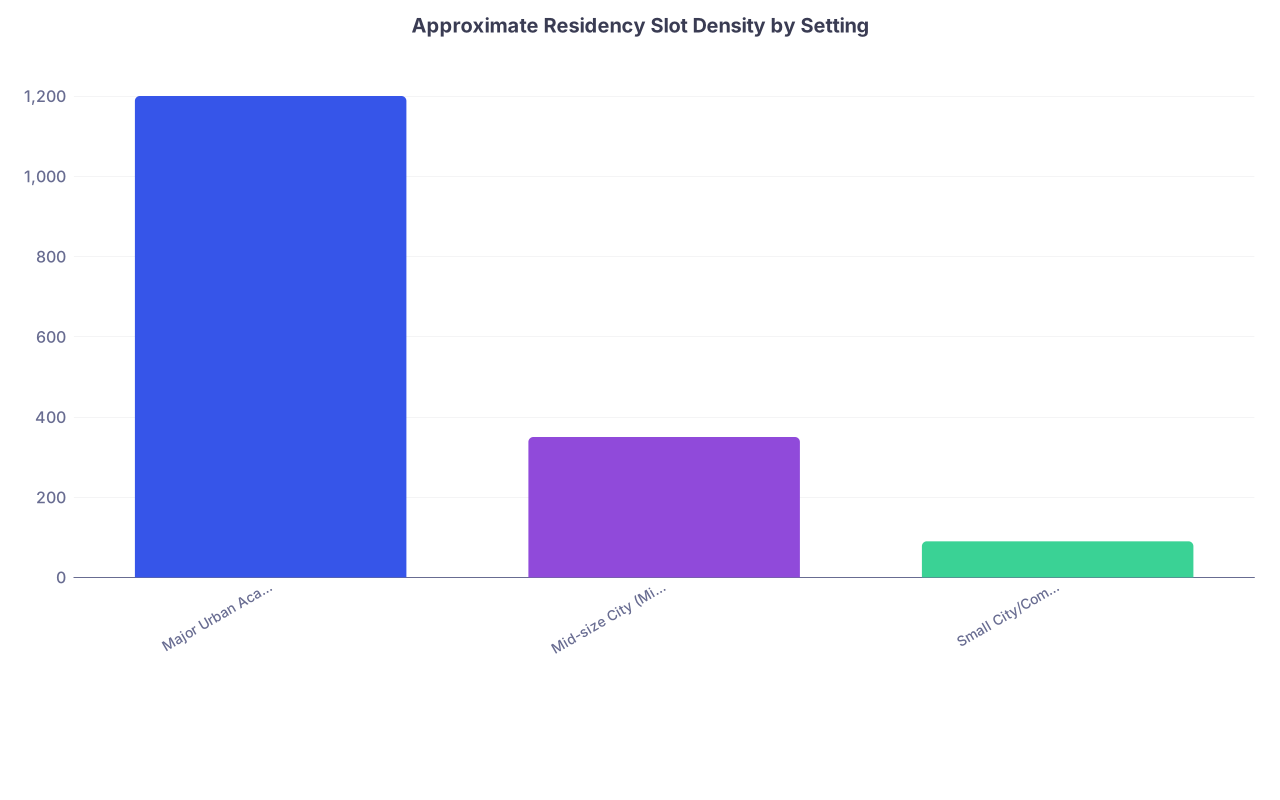
| Category | Value |
|---|---|
| Major Urban Academic Cluster | 1200 |
| Mid-size City (Mixed) | 350 |
| Small City/Community Region | 90 |
In reality, a couple who wants IM + EM, or IM + Peds, or Psych + FM, has radically different odds if they rank:
- 10–12 large urban academic/mixed centers versus
- 10–12 scattered community programs in cities with only one or two residencies each.
Slot density is your friend. Especially for the weaker application.
2. Program hierarchy and prestige asymmetry
Academic ecosystems amplify prestige differences between programs in the same city. That matters for couples.
Example scenario (this is common):
- Partner A: 260+ Step 2, AOA, research, wants the top academic IM program in City X.
- Partner B: 230 Step 2, average application, applying in EM.
City X has:
- Top-tier academic IM (Partner A’s dream)
- Mid-tier academic EM
- One HCA-affiliated EM program
- A community EM program 40 minutes away
The couple’s risk: if Partner A targets only the very top IM programs and Partner B only applies to “good EM” academic programs, they may accidentally construct a rank list where:
- Partner A has 8 realistic IM options in City X and similar cities.
- Partner B has only 2 realistic EM options in those same metros.
Those 2 EM options become the bottleneck, not the 8 IM. And EM in dense urban settings has its own competitiveness spikes.
Urban academic is not automatically “safer” if one partner is chasing a reach-tier program that the other partner cannot realistically pair with.
Community-heavy regions, by contrast, may have less prestige asymmetry. Several programs at roughly similar tier. That can flatten the gradients and make pairing easier.
3. Fellowship goals and timeline misalignment
One partner wants Cards, GI, Heme/Onc. The other wants a stable, humane clinical job.
That is not just a personality difference; it is a structural planning problem.
Tricky parts:
- Academic IM at a strong urban center increases fellowship odds, but those fellowships might be elsewhere. You may be planning a second geographic negotiation in 3 years.
- Community IM at a regional referral center might still get you into Cards or GI, but more likely in-region and with more work. Tighter geographic clustering can help the couple stay together.
You need to decide upfront:
- Are we optimizing for staying physically together for residency only or for the combined 7–10 year path (residency + fellowship)?
- Which partner’s long-term path is less flexible?
For many couples, the correct move is:
- Choose an urban academic or strong hybrid program where:
- The fellowship pipeline is good enough for the academic-minded partner.
- The other partner has at least 2–3 reasonable program options in the same metro.
And avoid the trap of: “I’ll do an insanely competitive IM program in City A, you’ll do a small community EM in City B, and we’ll ‘figure it out’ for fellowship.”
You will not like “figuring it out.”
4. Call structure, commute, and actual time together
Urban academic programs:
- Often have higher call burden, more nights, more complex rotations.
- May have multiple sites, including far-flung VA or county hospitals.
- Commuting across a big city with traffic can turn a “same city” match into a “we see each other 2 days a month” marriage.
Community programs:
- Sometimes have a single primary site, shorter commute, less transit nonsense.
- Or in a smaller city, even if there are two hospitals, 15–20 minute drives both directions are realistic.
Plenty of couples have technically “won” the couples match at two different urban hospitals and then discovered:
- One is at the downtown academic mothership with 28-hour calls, ICU rotations, and cross-town VA months.
- The other is at a suburban community affiliate with 30–40 minute traffic-laden commutes in the opposite direction.
You cannot handwave that away. It becomes your life.
5. Flexibility about schedules and accommodations
Programs differ wildly in their attitude toward couples. Not just in theory, but in “we will heat map your call schedules to reduce nights-on-nights” reality.
Patterns:
- Major academic centers with large classes have more scheduling flexibility—but also more competing constraints (trainees across multiple programs, ICU needs, union rules in some cities).
- Some community programs are fiercely protective of their residents’ wellbeing and will willingly coordinate with another local institution for couples. Others are rigid and understaffed and will not change anything.
When you interview, you should explicitly probe:
- “Do you currently have any couples in your program (or between your program and another in the city)? How has that played out with scheduling?”
- “Has your scheduling team ever coordinated with another program for married residents?”
If the PD or chief says, “We do what we can, but ultimately the schedule is the schedule,” believe them. That may be acceptable. Or not.
How Different Couple Types Should Think about Urban vs Community
Let’s go back to those four common pairings and be blunt.
1. Competitive specialty + less competitive specialty
Example: Ortho + FM, Derm + Psych, ENT + IM.
- The competitive specialty is often anchored to academic centers or high-powered community programs with strong reputations.
- The less competitive specialty has a wider spread of acceptable programs.
Wrong move I see: the less competitive partner “does not want to hold the other back,” so they do not apply broadly to the metro areas that are realistic for the competitive partner. They then only have 1–2 overlapping cities on both lists.
Better strategy:
- Build your target list around where the competitive specialty actually has realistic shot (not fantasy programs).
- Within those metros, aggressively identify all reasonable programs for the less competitive specialty: academic, large community, solid smaller programs, maybe even a neighboring city if commuting is realistic.
- Prioritize urban academic clusters where there are multiple program options for the less competitive specialty.
Urban academic usually wins here if the less competitive partner casts a wide net within that ecosystem. Community-only strategies are risky unless the competitive specialty has a known pathway through a strong community program in that region.
2. Research-heavy partner + purely clinical partner
Example: MD/PhD IM applicant + EM or FM spouse who wants stable clinical work.
- The research partner needs an institution with NIH funding, active mentors, and protected time that actually happens.
- The clinical partner needs a place that will not chew them up and spit them out.
Urban academic or hybrid academic–community programs are almost always better. But pay attention to toxicity:
- Some academic centers are black holes of burnout.
- Look for programs where you see older residents with kids, dual-income physician couples, visibly functioning lives.
The clinical partner should not martyr themselves on a malignant academic service just to get the other partner a marginal bump in research prestige that will not change their fellowship odds.
3. Two moderate competitiveness specialties
Example: IM + EM, IM + Anesthesia, Peds + Psych.
Here the question is less about “urban academic vs community” and more about “slot density and lifestyle.”
Urban academic clusters are strongly favored because:
- You both have multiple options in each city.
- The total number of overlapping programs skyrockets.
But there is a catch: these couples sometimes underestimate how different their day-to-day lives will look in certain academic centers (e.g., malignant EM + malignant IM) and how much that matters.
Community-heavy medium-sized cities with several decent programs (for both specialties) often provide:
- Enough opportunity without the extreme burn.
- Shorter commutes, cheaper housing.
- A realistic chance to see each other.
That is a real win.
4. Two very competitive specialties
Example: Ortho + Derm, ENT + Ophtho, Derm + Rads (advanced).
This is where couples match gets brutal. Urban academic is almost mandatory, but even then, the odds are not pretty.
You need to be ruthless:
- Identify the 5–6 metros where both specialties have more than one program and at least some historical couples-friendliness.
- Inside those metros, distinguish truly realistic programs from fantasy.
- Consider seriously:
- One partner at a top academic program, the other at a strong community program in the same metro.
- Or one partner slightly “punching down” in prestige to increase overlapping options.
“Both of us in top-10 programs in the same city” is a fantasy for most couples in this category, and it kills more matches than people admit.
Concrete How-To: Building a Rank Strategy Around Urban vs Community
Here is a practical framework that works.

| Step | Description |
|---|---|
| Step 1 | List both specialties and competitiveness |
| Step 2 | Prioritize urban academic/hybrid metros |
| Step 3 | Target strong community-heavy regions with multiple programs |
| Step 4 | Mix of urban academic and large community teaching hospitals |
| Step 5 | Map slot density in both specialties for each metro |
| Step 6 | Check commute and call realities |
| Step 7 | Refine list to 8-12 high-overlap metros |
| Step 8 | One partner needs academic for career goals? |
| Step 9 | Both happy clinically in community? |
Then:
For each metro on your list, write down:
- Number of programs in Specialty A (by type: academic, large community, small community).
- Number of programs in Specialty B.
- How many of those you would actually be willing to rank.
Keep a running total of “overlap opportunities.” That number matters more than “brand name.”
For each overlapping metro, ask:
- Does at least one option for each of us fit our minimum non-negotiables? (Malignancy, schedule, fellowship potential, etc.)
- Is the commuting/schedule picture compatible with us being functional as a couple?
The final rank list should have:
- Several urban academic clusters where the long-term career goals of the more academic partner are supported.
- Several mixed/hybrid or large community regions where both can live and train sanely even if the fellowship trajectory is a bit less shiny.
A Few Mistakes I Have Watched Couples Make (Learn From Them)
Let me be blunt about patterns that end badly:
Chasing prestige at the expense of overlap.
“We ranked this city high because one of us might get a top-10 program there,” while the other has only one community program in a rough location and a bad reputation. They do not match together.Underrating mid-sized cities with strong community-teaching ecosystems.
Places like Rochester, MN; Grand Rapids; Greenville; Madison; Omaha; Durham/Chapel Hill. These often have excellent training, multiple programs, reasonable cost of living—and far better quality of life for couples than a single hyper-intense urban megalith.Failing to explicitly ask programs about couples friendliness.
Programs that have actively supported couples will usually say so. They will tell you, “We have two couples right now; we worked with X and Y program to coordinate.” That is gold.Not planning for fellowship during the residency choice.
Especially when one partner is IM or Peds with subspecialty ambitions. If your residency region has zero or very few fellowships in that field, you are volunteering for long-distance in phase two of your training.
Putting it Together: Urban Academic vs Community for Physician Couples
Two or three key points to walk away with:
The right question is not “academic vs community, which is better?” but “which combination of program types and cities maximizes overlapping realistic options for both of us while keeping the long-term career goals of the more academic partner viable?”
Urban academic clusters are powerful for couples because of slot density and shared ecosystems, but they can also magnify prestige gaps, burnout, and commuting problems. Strong community or hybrid regions are often better for actual day-to-day life and still support solid careers, especially when both partners are clinically focused.
The couple that wins the match is rarely the one with the highest combined Step scores. It is the one that treats program type as a strategic variable from the beginning—mapping slot density, fellowships, schedule culture, and geography simultaneously—instead of hoping “it will probably work out.”


