

The couples match is brutally unforgiving if you try to “just see what happens.” That is doubly true for physician‑scientist pairs sitting on research‑heavy CVs.
You cannot plan this like a standard match. The constraints multiply. The variance explodes. And the market for research‑oriented positions is narrow in exactly the geographic locations couples often want.
Let me break this down specifically so you stop guessing and start engineering the outcome.
1. The Hard Truths About Couples Match + Research Careers
Start with the constraints, not the dreams.
If both of you are research‑heavy and serious about a physician‑scientist trajectory (MD/PhD, PSTP, R38, or at least 2+ first‑author papers, T32 aspirations), your match is governed by three realities:
You are not applying to “all programs.”
You are applying to the intersection of:- Programs that can support your science (funding, mentors, protected time, infrastructure)
- Programs that are geographically co‑located or commutable
- Programs that have enough spots so couples matching there is even mathematically plausible
The couples match algorithm does not “help” you.
It only tries to honor your ranked pairs. If there is no place where both of you can match within your rank list and the programs’ rank lists, one or both of you fall to a lower‑ranked pair. I have watched superb MD/PhD couples “trade down” significantly simply because they ranked too few safe combined options.Research strength is lumpy and regional.
There are maybe 20–30 U.S. institutions where both members of a physician‑scientist couple can plausibly find:- Robust NIH funding
- Multiple PI options in overlapping or adjacent fields
- Leadership that actually knows what a PSTP is and uses it correctly
Outside those hubs, usually one person ends up with a great fit and the other is… tolerated.
So the game is not “How many places can we couples match?”
It is: “Where does the Venn diagram of:
- both our research niches,
- both our clinical interests,
- and reasonable geographic co‑location
actually overlap?”
You build from that, not from wishful thinking.
2. Clarify Your Joint Career Architecture First
If you are a couple with research‑heavy CVs, the usual “let’s just do IM anywhere then figure out research later” approach is a waste of your leverage. You have credibility that most applicants do not. Use it.
There are four basic architectures physician‑scientist couples fall into:
Dual PSTP / physician‑scientist tracks
- Example: MD/PhD in heme/onc + MD/PhD in rheum, both targeting PSTPs at top IM programs.
- Priority: institutional PSTP strength, T32 slots, pre‑specified research years, pathway to K awards.
- Risk: very few programs with two strong PSTP positions AND enough geographic flexibility.
One PSTP, one research‑friendly categorical
- Example: Neuroscience MD/PhD → neurology PSTP; partner → categorical psychiatry with strong research block and T32 availability.
- Priority: One person’s formal track + solid research structure for the other (80% is usually fine).
- Risk: Institutions where the PSTP is strong but non‑PSTP residents get minimal real research time.
Dual research‑leaning, non‑PSTP
- Example: Derm + pathology, both with strong PhD‑level research but going into specialties that often lack formal PSTP slots.
- Priority: departments where residents actively publish, known research mentors, track record of alumni going into fellowships with K‑awards.
- Risk: Departments that talk “academics” but run 110% clinical RVU factories.
Temporal offset strategy (staggered research intensity)
- One partner leans harder into research early (e.g., categorical IM with built‑in research years), the other stabilizes clinically first (e.g., strong but more service‑heavy residency), then swaps intensity in fellowship / early faculty.
- Works better for couples who are more flexible on exact research slopes as long as both end up with funding later.
You need to decide which of these you are. Explicitly. On paper.
Have the conversation that many couples avoid:
Whose research trajectory is less location‑dependent?
Who can pivot fields or platforms more easily?
Who has stronger multi‑institution mentorship networks that can buffer a slightly weaker local environment?
That hierarchy, whether you admit it or not, will drive your rank list. Better to be honest about it now.
3. Mapping Programs: The Venn Diagram Done Correctly
Most couples do this badly. They start with names: “Mass General, Hopkins, UCSF, Penn…” Then try to see if both can live there.
Reverse it.
You start with three master lists:
- Your list A: programs that are a legitimate research fit for you personally
- Your partner’s list B: the same, independently
- Geographic clusters C: actual metro areas (or tightly connected regions) where you would both be willing to live for 3–7 years
Then build the overlaps: (A ∩ C) and (B ∩ C). Finally, you overlay those.
To keep this concrete, let us say:
- You: MD/PhD in immunology, want academic rheum via IM PSTP
- Partner: MD/PhD in cancer biology, want academic heme/onc via IM PSTP or research‑heavy categorical
A realistic mapping might look like this:
| Metro / Region | Your Fit (Rheum/Immunology) | Partner Fit (Heme/Onc) |
|---|---|---|
| Boston | MGH, BWH, BIDMC | MGH, BWH, BIDMC |
| Philadelphia | Penn, Jefferson | Penn |
| NYC | Columbia, Cornell, NYU | MSK, Columbia, Cornell |
| Chicago | UChicago, Northwestern | Northwestern, UChicago |
| Houston | Baylor, UT Houston | MD Anderson, Baylor |
Now count actual program pairs that exist in each region:
- Boston: 3 realistic options for both → high potential density
- Philly: 1 prime (Penn) + a few workable for one partner
- NYC: high but complicated due to multiple institutions and cross‑hospital commutes
- Smaller cities: often 1 strong program for one partner, a “good enough” option for the other
You are not just looking for “we both have something.” You are looking for enough combinations that your couples rank list can be deep.
4. The Couples Rank List: Engineering Depth, Not Fantasy
Most couples drastically underutilize the structure of the couples match list. They throw together 20 pairs and hope for the best.
That is how you end up matching at #18 because #4–17 were ridiculously optimistic combined scenarios with no safety net.
You should be thinking about rank tiers and failure modes.
Step 1: Define your tiers independently
For each of you, on your own, define:
- Tier 1: “If I were single, these are my clear top X programs.”
- Tier 2: “Strong fit, not perfect, but I would be happy and can still build a serious research career.”
- Tier 3: “Decent training; research possible but will require hustle and external mentorship.”
- Tier 4: “Pure safety; I will match and be clinically competent; research will be heavily compromised.”
You should both have at least:
- 5–8 programs in Tier 1–2 combined
- 5–10 programs in Tier 3
- 3–5 programs in Tier 4 (yes, really, especially in competitive specialties)
Step 2: Build combined tiers
Now you overlay them:
- Joint Tier 1: both Tier 1–2 at the same or co‑located institutions (e.g., both at UCSF; UCSF + Stanford with acceptable commute = borderline but sometimes workable).
- Joint Tier 2: one person Tier 1–2, the other Tier 2–3.
- Joint Tier 3: both Tier 3; OR one Tier 2, one Tier 4.
Your rank list should have substantial depth in Joint Tier 2–3, not just Joint Tier 1. That is how you avoid catastrophic slide.
Step 3: Accept the “sacrifice bands”
Someone will compromise more at some tier.
Be explicit:
- At Joint Tier 2, maybe one of you will tolerate a Tier 3 program so the other gets Tier 1.
- At Joint Tier 3, you both agree you would rather be together at dual Tier 3 than one at Tier 1 and one essentially unmatched or at a non‑academic dead end.
Write that out. Literally.
“This is the lowest tier at which we still accept X trade‑off.”
If you are not having slight nausea constructing the middle of your rank list, you are probably under‑ranking safer combined options.
5. Using a Research-Heavy CV Strategically (Not Just as a Trophy)
A research‑heavy CV helps you, but only if you wield it precisely.
Here is how physician‑scientist couples misuse strong CVs:
- They assume it guarantees top‑tier offers for both people at the same institution.
- They believe “big name” = “research support.”
- They think any program labeled “PSTP” is equally committed to actual protected time.
Wrong on all three.
Instead, you should be using your research output like this:
To target specific mentors ahead of time
You email PIs who can actually read your work:- “I am a couples match applicant, primary interest in translational lupus immunology; my partner is oncology‑focused. We are very interested in your group’s work on XYZ and would like to understand how residents engage with your lab and what the PSTP structure here looks like for couples.”
You are not sending “I love your work” fluff. You are referencing a specific figure or technique and asking about actual resident integration. That signals you are serious and not just prestige‑hunting.
To differentiate yourselves in borderline programs
At mid‑tier academic places, a physician‑scientist couple with:- 5–10 total first‑author papers
- co‑mentored multi‑disciplinary projects
- some grant exposure (F30, F31, TL1, or even just assisting on R01 submissions)
is a gift. You represent future K‑awards and departmental bragging rights.
Make that explicit. Programs worry you are “using them as backup.” You clarify:
- “We are ranking based on where both of us can build long‑term research programs. Your environment for X and Y is competitive with bigger‑name institutions for our fields.”
To negotiate structure, not promises
Strong CVs let you ask for concrete things:- Pre‑specified research time in second or third year
- Flexibility in service schedules during peak grant periods
- Access to certain cores or shared resources
If a program keeps saying “We’re very supportive of research” but cannot give a single specific example of:
- named residents with funded projects
- protected time actually honored on the schedule
you treat that as a red flag regardless of its name brand.
6. Geographic Strategy: How Far Apart Is Still “Together”?
You are not in undergrad anymore. “We’ll make it work long distance” with 80‑hour weeks and Q4 call is delusional.
You need an explicit distance and commute policy.
For real physician‑scientist couples, here is what I see work:
- Same institution: ideal, especially when both want core facilities, joint grants, or shared mentors.
- Same city, different institutions: almost as good, provided call schedules and commute are sane (30–45 minutes max).
- Adjacent metros with robust transit: sometimes workable if:
- At least one of you has mostly daytime / research blocks
- The other does not have brutal overnight or trauma‑heavy rotations requiring short‑notice call‑ins
Examples that often work:
- Boston cluster (MGH/BWH/BIDMC/Tufts)
- NYC cluster (Columbia/Cornell/MSK/Mount Sinai/NYU)
- Philly cluster (Penn/Jefferson/Cooper for some)
Examples that usually do not work well for residents:
- UCSF + Stanford (distance, traffic, call requirements)
- Duke + UNC when on heavy inpatient months with unpredictable pager demands
You define a hard rule:
- “We will only rank cross‑institution pairs where our home addresses can be within X minutes of both hospitals, and call policies allow Y.”
If you ignore this and just think “same state = fine,” you will regret it mid‐intern year when one of you is post‑call and the other has a night float week an hour away.
7. PSTPs, T32s, and All the “Physician‑Scientist” Branding
Programs love slapping “Physician‑Scientist Track” on their website with no actual infrastructure behind it. You need a filter. Otherwise you will anchor to labels that do not correspond to reality.
Here is a structured way to interrogate these tracks:
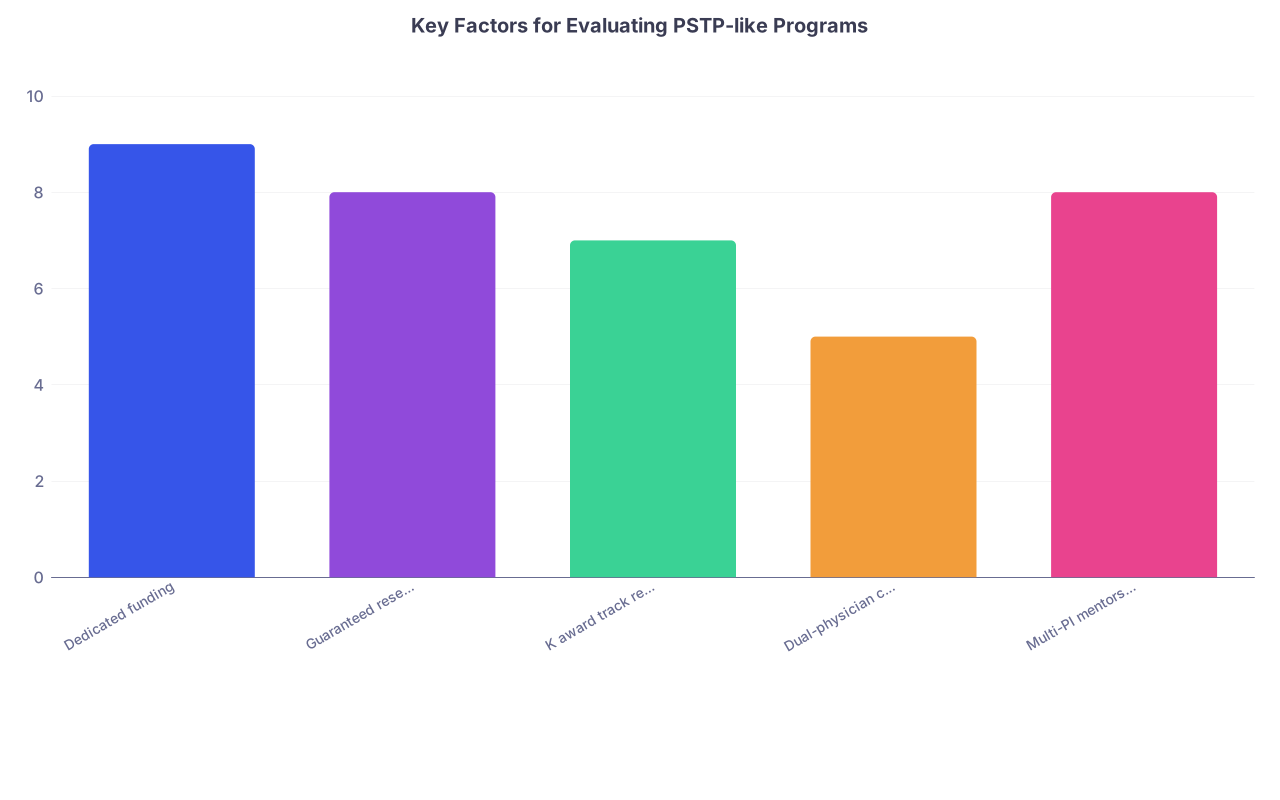
| Category | Value |
|---|---|
| Dedicated funding | 9 |
| Guaranteed research time | 8 |
| K award track record | 7 |
| Dual-physician couples experience | 5 |
| Multi-PI mentorship | 8 |
Let me translate that into actual questions you should be asking:
Dedicated funding
- “How are research years funded? Is it via T32, departmental funds, or soft money?”
- “Has any resident or fellow in the last 5 years lost their planned research time because of funding?”
Guaranteed vs ‘available’ research time
- “Is research time guaranteed in the contract, or ‘typically 6–12 months if service needs allow’?”
The latter means nothing. Absolutely nothing.
- “Is research time guaranteed in the contract, or ‘typically 6–12 months if service needs allow’?”
K‑award and R‑level outcomes
- “How many residents in the last 10 years have gone on to K‑level awards or equivalent?”
- “What proportion of PSTP graduates are now in full‑time research roles vs mostly clinical?”
Couples specifically
- “Have you had physician‑scientist couples in your program? Were both able to maintain meaningful research?”
If they hesitate or cannot name anyone, you are the experiment. Decide how comfortable you are with that.
- “Have you had physician‑scientist couples in your program? Were both able to maintain meaningful research?”
Multi‑PI mentorship across departments
Crucial when your fields differ. For example:- You: computational immunology
- Partner: solid tumor biology with heavy wet lab work
You want to hear about:
- cross‑appointments between departments
- joint seminars
- prior examples of multi‑PI K‑awards or R01s bridging your two areas
If they brag about “research electives” but cannot answer these specifically, adjust your expectations sharply downward.
8. Timeline and Process: How to Coordinate Without Losing Your Mind
Couples match is project management. You cannot just “sort it out later.”
You need a timeline and division of labor.
Here is a clean structure that works for physician‑scientist pairs:
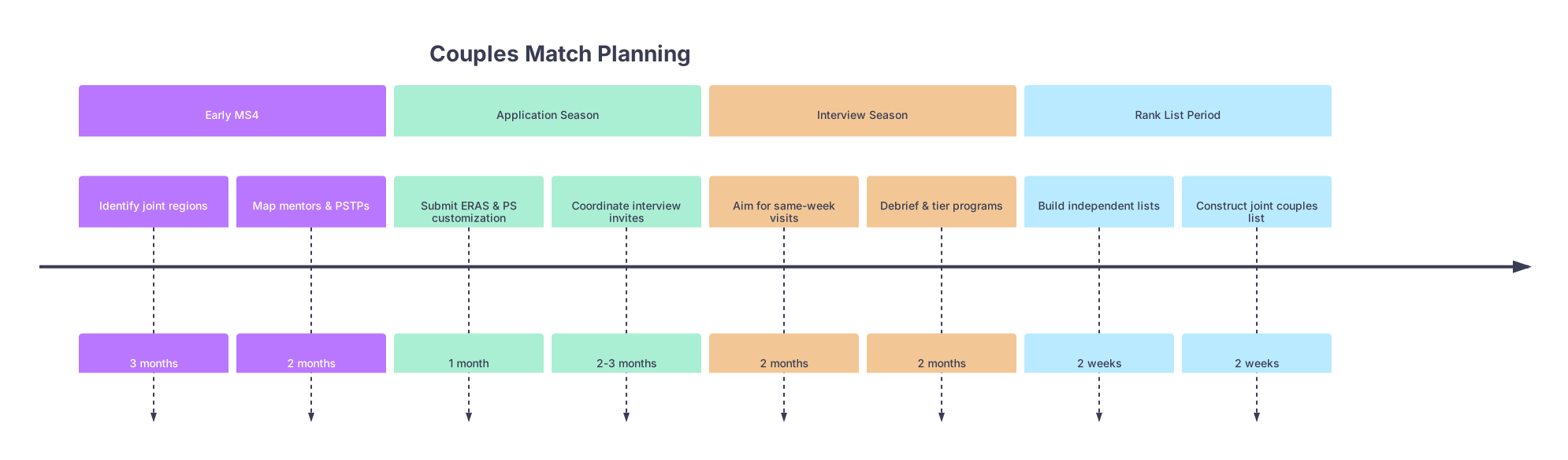
| Period | Event |
|---|---|
| Early MS4 - Identify joint regions | 3 months |
| Early MS4 - Map mentors & PSTPs | 2 months |
| Application Season - Submit ERAS & PS customization | 1 month |
| Application Season - Coordinate interview invites | 2-3 months |
| Interview Season - Aim for same-week visits | 2 months |
| Interview Season - Debrief & tier programs | 2 months |
| Rank List Period - Build independent lists | 2 weeks |
| Rank List Period - Construct joint couples list | 2 weeks |
A few non‑negotiables:
One shared master spreadsheet.
Columns for:- Program name
- City / region
- Your tier
- Partner’s tier
- Research environment notes
- Mentors contacted
- Interview dates / conflicts
- Post‑interview tier adjustment
Explicit weekly check‑ins during interview season.
Not just venting. 30–45 minutes where you update tiers, flag red‑flag programs, and update plan B/C options.Pre‑defined “kill switches.”
For example:- “If either of us gets no interviews in X metro area by Y date, we will broaden to region Z.”
- “If one partner’s interviews are skewed heavily toward mid‑tier programs in region A, we prioritize that region when choosing which interviews the other keeps vs cancels.”
Nothing ruins couples match faster than silently diverging strategies because you are both overwhelmed and not comparing the evolving picture.
9. Red Flags You Cannot Afford to Ignore (Especially as a Couple)
Research‑heavy CVs get you interviews in places that talk a gorgeous game. Many do not deliver.
Pay attention to these during interviews:
Hand‑wavy responses to specifics
You ask: “How is protected research time scheduled?”
They respond: “We really value research, our residents are so productive.”
You push: “Who was the last resident to get >6 months protected?”
They stall. Or name someone from 8 years ago.That is your answer.
Programs that subtly blame residents for lack of research
Phrases I have actually heard:- “Our residents could publish more if they prioritized better.”
- “We offer opportunities, but the interest just has not been there.”
Translation: schedules are brutal, mentorship is passive, and the culture is service‑driven. As a couple, you will both burn out.
No clear plan for dual‑scientist couples
If you say, “We are applying as a physician‑scientist couple; how have you supported such couples before?” and they give you blank stares, you are their pilot project.Being the first is not always bad, but it means you need:
- extra clarity on scheduling
- strong departmental champions
- realistic expectations about friction
Callousness about geography and relationships
If anyone says, “Residents work so much you won’t see each other anyway, haha,” you should mentally dock them a tier. That attitude bleeds into how they handle schedule requests, family emergencies, etc.
10. Special Cases: Competitive Specialties and Mismatched Competitiveness
The most brittle scenario is a dual research‑heavy couple where one or both are entering highly competitive specialties (derm, plastics, ortho, ENT, IR, radiation oncology) and/or one CV is significantly stronger in clinical metrics.
There are only three honest strategies here:
Anchor on the bottleneck specialty
For example:- Partner A: MD/PhD with 260s Step 2, multiple derm papers, aiming derm.
- Partner B: Solid but less competitive metrics, aiming IM with research.
You build your entire geography around where Partner A can realistically match in derm. Partner B then targets IM in those cities as widely as possible (university + strong community).
This is not “fair.” It is reality. The alternative is often:
- Partner A unmatched in derm
- Partner B matching IM somewhere that does not help either of you long term.
Use the research‑heavy CV to pivot slightly
Sometimes the “competitive” partner is actually more passionate about a less bottlenecked academic field where their PhD is highly valued (e.g., neuroimmunology in neurology vs derm).I have seen couples rescue their long‑term dual‑scientist goals by:
- Reframing specialty choice based on genuine research alignment, not just perceived prestige.
- Landing at institutions where both are valued as scientists instead of one person being a perpetual long‑shot.
Design an intentional staggered path
Occasionally, it makes sense for one partner to:- Do a preliminary or transitional year somewhere more flexible
- Re‑apply with additional research output or new mentors
But this requires brutal clarity:
- Who is taking that risk?
- How many re‑application cycles are you realistically willing to tolerate?
- What is the plan if the second attempt still fails?
If anyone tells you “it will probably work out” in competitive fields without this level of planning, ignore them. They are not the ones who will be unmatched in March.
11. How to Talk About Being a Research-Heavy Couple on the Trail
You do not need to hide that you are couples matching. In fact, in research‑driven departments, it often helps you.
You frame it like this:
- “We are both very serious about academic careers; our long‑term goal is dual‑physician‑scientist faculty roles.”
- “We are applying in [specialties] and have focused on programs where both of us can engage in substantial research.”
- “We are happy to discuss how we see ourselves integrating into your research community—both individually and as a pair with partly overlapping interests.”
Then you demonstrate you have done homework:
- Name one or two PIs for each of you at that institution
- Mention specific cores, centers, or T32 grants you have looked up
The subtext you want:
“We are not asking you to solve an impossible logistical problem. We have already identified how we fit here; you just need to agree.”
Do not:
- Beg for special treatment.
- Over‑promise joint projects (administrators roll their eyes when couples talk like they will publish everything together).
Focus instead on: two independent scientists who will both raise the program’s academic profile.
12. Final Calibration: What “Success” Really Looks Like
Let me reset expectations with how success actually looks for research‑heavy couples in the match:
It usually does not look like:
- Both of you at your #1 dream program
- Perfect PSTP slots with synchronized 80% research years
- Identical, glamorous biosketches by PGY4
More often, it looks like:
- Both of you matching in the same city, often same institution or tightly linked ones
- One partner with a somewhat “cleaner” research‑heavy training path, the other with more clinical load but still real research involvement
- Strategic use of fellowship and early faculty moves to “correct” any imbalance in protected time or mentorship
The key output is this: By the end of fellowship, both of you are legitimately on track for K‑level or equivalent funding, at institutions where you can stay or springboard.
That is the horizon you are planning for—not just the moment you open the envelope on Match Day.
Key Takeaways
- Treat the couples match as an engineering problem, not a vibe check: map research fit, geography, and program tiers explicitly and brutally.
- Use your research‑heavy CVs to secure real structure—protected time, mentors, funding pathways—not just prestige nameplates.
- Define, in writing, your compromise thresholds as a couple: whose path is more constrained, how far apart you will live, and how low you will go on combined tiers to protect both careers long term.


