

Most couples who match together discover the hard way that “we’re in the same city” does not mean “we ever see each other.”
If you are in dual-shift specialties—EM, anesthesia, OB/GYN, surgery, ICU-heavy medicine—the default system will chew up your relationship unless you learn how to manage the call schedules aggressively and strategically.
Let me break this down specifically.
1. Understand the Game You Just Entered
You are not just “two interns starting residency.” You are now:
- Two employees in different departments
- With different scheduling rules
- Reporting to people who do not talk to each other
- In services that depend on nights, weekends, and call to function
And you want… regular nights off together. Reasonable weekends. Some chance of seeing each other on holidays.
That does not happen by accident.
Dual-shift specialties: what you are really up against
Think of some common dual-shift pairs:
- EM + Anesthesia
- EM + OB/GYN
- EM + Surgery
- Anesthesia + OB/GYN
- EM + EM at different programs or sites
- OB/GYN + Surgery
These are not 9–5 services with predictable clinic schedules. They live on:
- 12‑hour shifts (EM, some ICU, some OB triage)
- 24‑hour calls (surgery, OB/GYN, anesthesia, some IM)
- Night floats covering 6–7 nights in a row
- Home call that is “home” in name only for some services
The overlap is brutal. I have seen couples go three straight weeks where one is always:
On call. On nights. Post-call and dead.
You need a framework before you ever send that first “schedule request” email.
2. Map the Constraints Before You Touch the Calendar
Do not start with “what we want.” Start with “what is non-negotiable.”
You each have three layers of constraints:
- Program rules
- Rotation-specific rules
- Personal / couple priorities
2.1 Program-level realities
Some programs are flexible. Many are not. A few are downright hostile to the idea of accommodating couples.
You need intel. Early.
Ask current residents (not chiefs, not PDs) questions that actually matter:
- “If you request a specific golden weekend, does it usually happen?”
- “Do they try to line up call schedules for couples or just shrug?”
- “How locked in is the yearly call template?”
- “Is there a rule about switching calls across months or services?”
You will usually hear phrases like:
- “The chiefs try, but the rotation templates are tight.”
- “EM is completely separate; they do their own thing.”
- “Surgery will not move calls between services, full stop.”
Translate that as: you will get some wins, but you cannot rely on global coordination.
2.2 Rotation-level constraints
This is where the real pain lives. A quick breakdown:
- EM: pre-defined block schedules, nights and weekends guaranteed; often fixed shift templates for the year.
- Anesthesia: variable; some places heavy 24‑hour call, others mostly day shifts with occasional nights. OB or cardiac months may be brutal.
- OB/GYN: 24‑hour L&D calls, night float blocks, some outpatient weeks with better control.
- Surgery: Q3–Q5 call on heavy services, night floats, trauma call.
- ICU months (any specialty): shift work with 7-on/7-off or 6–7 nights in a row.
For each rotation, you care about:
- Call/qX frequency
- Night float blocks
- Whether call is in-house vs home
- Whether the schedule is made monthly, quarterly, or yearly
If your EM partner’s schedule is built for the entire year in June and your OB/GYN schedule is handed out month-by-month, you have one shot at shaping EM and twelve small battles on your side.
2.3 Couple-level priorities
You cannot optimize everything. Decide your hierarchy before the chaos starts.
Common priorities:
- One full weekend off together per month
- One dinner together per week (not post-call, actual evening)
- Align vacations at least once a year
- Trade off major holidays every other year but be together for at least one
Write it down. Rank it. If you walk into the chief’s office with a vague “We just hope we see each other sometimes,” you will get nothing.
3. Build a Shared System Before July 1
If you try to manage this through text messages and screenshots, you will both lose.
You need a single shared calendar where everything lives.
| Layer | Tool Example | What Goes Here |
|---|---|---|
| Master Couple Calendar | Google Calendar | Both schedules, call, nights, weekends |
| Program Calendars | AMION/Intramural | Official rotation + call assignments |
| Personal Layer | Shared Google Cal | Dates, travel, family events, protected days |
3.1 Create three distinct views
Your schedule – labeled by rotation and call status
Partner’s schedule – same structure, different color
Couple overlay – combined view that shows:
- Days you are both free
- Nights you are both on
- Weekends where at least one is off
Color-code aggressively:
- Red – in-house 24‑hour call or night shift
- Orange – home call / jeopardy
- Yellow – post-call (dead to the world)
- Green – off
- Blue – conference / mandatory teaching (not usable free time)
Install this on both phones. No excuses.
3.2 Translate the templates
The worst mistake I see: one partner knows their own template by heart and mentally approximates the other person’s.
That does not work.
Example: EM partner has a template like:
- 4 weeks of shifts per block
- Pattern: D–E–N–Off–Off–D–E–N repeated
Anesthesia partner has:
- 24‑hour call Q4
- Post-call days “off” but half-destroyed
- Floating start times (6 a.m. to 7 p.m.)
You must literally build it into the calendar:
- For EM: exact shift time (e.g., 7a–5p, 3p–1a, 11p–7a)
- For anesthesia: call days tagged, post-call days flagged as “Low-function day”
Then zoom out. Look at a full 4–6 week spread. That’s your reality.
4. Strategy With Chiefs and Schedulers: How to Actually Ask
This is where most couples either win or crash.
You need to approach your chiefs/schedulers with:
- Specific requests
- Clear flexibility
- Documentation that you are not asking for privilege, just coordination
4.1 Your first email template (adapt this, do not copy-paste blindly)
Subject: Schedule coordination request – [Your Name], PGY‑1
Hi [Chief/Scheduler Name],
I wanted to touch base early as you start looking at [block/month] schedules. My partner is also a PGY‑1 in [Other Program/Department] and we are both in shift/call-heavy specialties.
I know service needs come first. Within those constraints, my top priorities for this block would be:
- Trying to line up one full weekend off together, ideally [dates or range].
- Avoiding both of us being on 24‑hour call the same day, if the template allows it.
I have attached their current schedule for that block so you can see what we are working with. I am also happy to take extra [nights/weekends] on other weeks if that helps coverage.
Thank you for anything you can do. I know this is extra work.
Best,
[Name]
Two key points:
- You show you understand service comes first.
- You offer a trade: “I will take more pain somewhere else.”
That is how adults negotiate in residency.
4.2 When to escalate and when to shut up
You can press a bit if:
- Your requests are modest and repeatedly ignored
- Other residents are getting specific weekend/holiday requests granted
- You are consistently assigned worse patterns without explanation
You do not press when:
- A rotation is clearly drowning in service
- You are on ICU, trauma, or a similar high-acuity service with rigid templates
- You have already been granted some scheduling favors this year
Pick your battles. You are playing a multi-year game.
5. Rotation-by-Rotation Tactics for Common Dual-Shift Pairs
Let us go through some specific combinations. This is where it gets real.
5.1 EM + Anesthesia
Classic dual-shift grind.
Common pattern:
- EM: 18–22 shifts/month, mix of days/evenings/nights, weekends guaranteed.
- Anesthesia: 24‑hour OR or OB call Q4–Q6, plus normal early starts.
Tactics:
Anchor weekends from the anesthesia side.
Anesthesia call schedules are often less flexible after publication. If you can negotiate 1–2 non-call weekends per block in advance, do it there. Then EM can request those days off or at least day shifts.Avoid back-to-back misery days.
“You on EM nights, partner on 24‑hr OB call the same day” = zero useful hours together. Ask chiefs to avoid direct overlap between EM night runs and anesthesia 24‑hour calls, even if that means trading a few evenings.Exploit EM weekdays.
If anesthesia has weekday post-call “off,” push EM to schedule the partner on day shifts that end before 7 p.m. You can actually get dinner together on those days.Vacation: schedule EM first.
Many EM programs lock vacations early and more rigidly. Once that is set, bring it to anesthesia and request matching weeks, even if it means anesthesia vacation is on a slightly less popular rotation.
5.2 EM + OB/GYN
This one can be absolutely brutal if unmanaged: lots of nights, lots of OB call, and different chiefs every few months.
Tactics:
Target L&D / night float months.
For OB months heavy on 24‑hr L&D call or night float, try to have EM shift distribution skew slightly more toward days. Your goal is to not always have one of you on nights.Golden weekends: one per month minimum.
OB is often more willing to plan golden weekends on some rotations (e.g., clinic-heavy months). Ask early. Then feed those dates to EM scheduling and politely request one of them as off days.Holiday years: pick a “together” holiday.
OB/GYN holiday coverage is non-negotiable. EM always covers something. Do not try to be off every major holiday. Instead: commit to “We will be together for at least X (e.g., New Year’s) this year,” and push both programs early to align that.
5.3 EM + Surgery
This pairing usually means:
- EM: fixed shift schedule with many weekends
- Surgery: long days, QX call, night floats
Tactics:
Protect post-night float weekends.
When the surgery partner finishes a night float block, ask EM to avoid stacking nights on that same “recovery” weekend if possible. You might salvage 36 real hours together.Align lighter EM weeks with heavy surgery weeks.
If EM has a lighter shift block (e.g., academic EM month, off-service rotation), try to line that up with the surgery trauma or ICU month. One of you will at least have some gas in the tank.Use EM shift swaps strategically.
EM programs usually allow more shift trading within a block. When a surgery call schedule is released, immediately comb through and front-load EM shift swaps around the worst surgery weeks.
5.4 OB/GYN + Anesthesia
This is a call-heavy, OB-heavy couple. I have watched this pair either thrive with structure or implode.
Tactics:
Avoid simultaneous OB-heavy months if possible.
If both of you are on OB at the same time—OB anesthesia and L&D—you may literally not see each other for days. Ask one program early: “If possible, could my OB month avoid [Partner]’s OB month?” Some will actually do this.Home call illusions.
OB anesthesia “home call” can function like in-house if the hospital is busy. Do not count home-call nights as meaningful couple time. Treat them as half-days at best.Stack truly off weekends.
On outpatient rotations (for OB) or non-call months (for anesthesia), push hard for at least one Friday–Sunday where neither of you has any call. Guard that like a hawk.
6. Micro-Level Maneuvers That Actually Save Your Sanity
This is where you can claw back 5–10 hours a week of real connection, even in the worst call months.
6.1 Use “partial overlaps” instead of waiting for perfect days off
Waiting for both of you to be 100% off at the same time is a trap.
Focus on:
- One of you on a shorter day, the other on a post-call “awake enough” day
- Overlapping evenings when one is on days and the other just waking up from post-call nap
- Breakfast dates after one partner’s night shift, before the other’s late-start day
If you see a day where:
- Partner A: 7a–5p
- Partner B: post-call but free after 3 p.m. and has napped
That is a potential 2–3 hour window. Put it in the calendar as “together time.” Treat it as a real commitment.
6.2 Pre-commit rituals around predictable pain
You both have predictable awful sequences:
- 5 nights in a row
- Two 24‑hr calls in 5 days
- Back-to-back weekend shifts
Build small rules:
- “Before my night run starts, we always have a real dinner together.”
- “After your 24‑hr call, I handle groceries and we do 1 easy meal + 1 show.”
- “On the last night of your night float, I meet you for breakfast if I am off.”
These sound trivial. They are not. They anchor the month.
6.3 Use group chats strategically for swaps
Most call swaps and shift trades happen in unstructured group chats.
Do three things:
- Be the couple that owes favors. Offer to pick up undesirable shifts when you can.
- Keep a running list of “IOUs” so you can cash them in later for high-value days (anniversary, travel days, etc.).
- Coordinate between yourselves before asking: do not accidentally both volunteer for the same terrible weekend.
7. Handling Vacations, Holidays, and Major Life Events
This is where couples either get very intentional or just hope the stars align. The stars rarely do.
7.1 Vacation strategy across two programs
You need to know:
- How early each program locks vacations
- Whether vacations are by block or by specific weeks
- Blackout periods (ICU, ED core months, holiday blocks)
Then construct like this:
- Identify the 1–2 highest-priority shared vacations (wedding, big trip, family event).
- Book the program with less flexibility after the stricter program locks dates.
- If necessary, accept that one yearly vacation will be suboptimal (e.g., you have a weekend call at the tail end and need to fly back early).
7.2 Holidays: stop trying to win them all
Dual-shift couples often expect:
- Christmas together
- Thanksgiving together
- New Year’s together
- And all with minimal call
That is fantasy.
Pick:
- One “anchor” holiday to prioritize together (for a given year).
- One backup (maybe just an evening or morning together, not the whole day).
Then be explicit with both programs early:
“Partner and I are both residents. We are totally fine working holidays. If there is any way to align us to both be off on [Holiday X] or at least the evening, we would really appreciate that. Happy to work [other holiday] in exchange.”
Schedulers tend to reward that attitude.
8. Coping Skills and Relationship Rules That Make This Sustainable
This is not just a scheduling puzzle. It is two exhausted people trying not to resent each other or their jobs.
8.1 The “no keeping score” rule
You must kill the instinct to track:
- Who had more calls this month
- Who has more weekends ruined
- Who is “working harder”
The second you start saying “You think your nights are bad…,” the relationship goes sideways.
Shift specialties are brutal in different ways. Respect that. You are on the same team against the schedules, not against each other.
8.2 Pre-plan “pressure release” conversations
Do not wait until one of you explodes.
Agree on:
- A weekly 15–20 minute check-in (even via FaceTime) about schedules and how you are each coping.
- A phrase that means: “I am overwhelmed, I need support not solutions right now.”
During those conversations, you focus on:
- What is non-negotiable the next week (exams, big cases, presentations)
- Where the other can give a little (chores, social commitments)
- Any specific schedule triggers to flag to chiefs early (back-to-back nights after a long stretch, etc.)
8.3 Boundaries with family and friends
Your parents will ask: “Why cannot you just request Christmas off?” Your non-medical friends will suggest trips during ICU month.
You need stock phrases.
Some examples:
- “Our call schedules are set months in advance and are hard to change. We will tell you as soon as we know when we are both free.”
- “We cannot both be off every holiday, but we are planning to be together for [X] this year.”
Defend your limited free time. That might mean saying no to things that are technically possible but will destroy your only 3‑day stretch off together.
9. Long-Game Adjustments: PGY‑2 and Beyond
You will not get this perfect in PGY‑1. The goal is to improve every year.
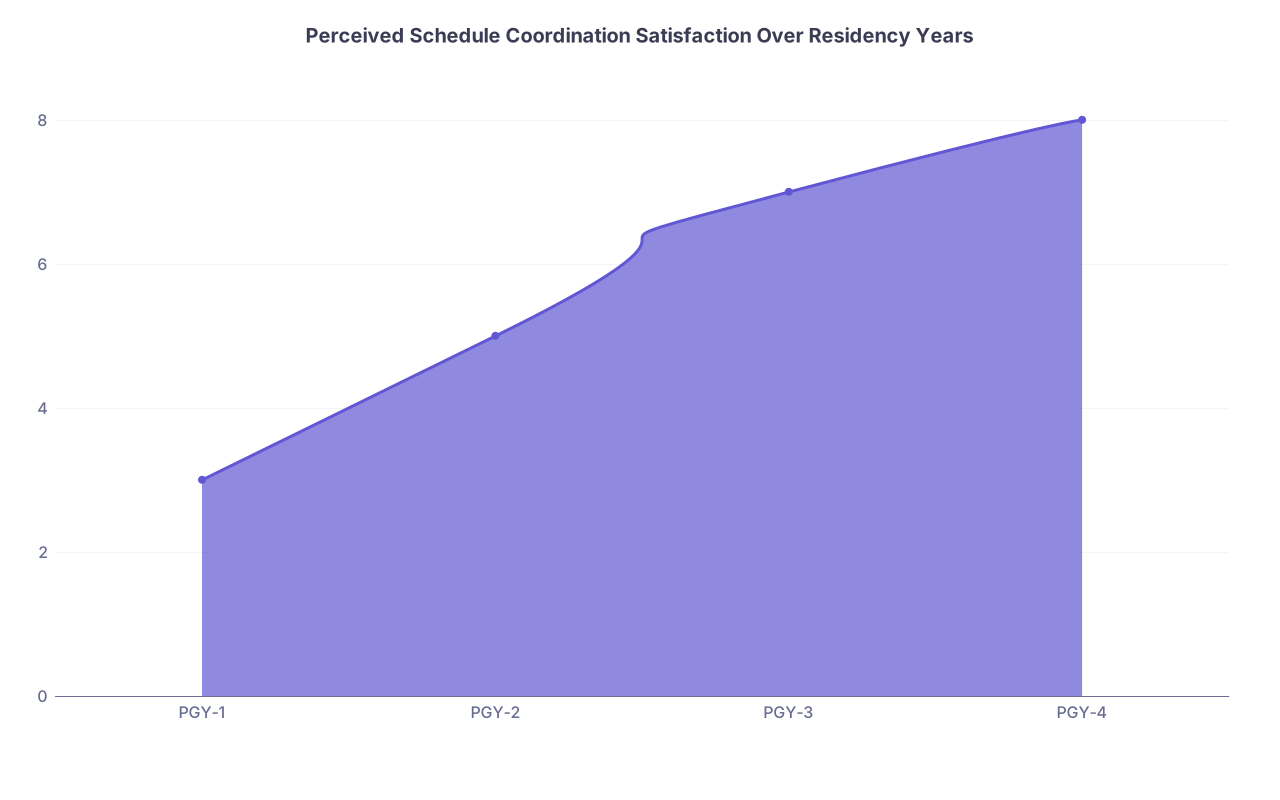
| Category | Value |
|---|---|
| PGY-1 | 3 |
| PGY-2 | 5 |
| PGY-3 | 7 |
| PGY-4 | 8 |
I have watched many couples move from “We never see each other” to “This is hard, but manageable” by PGY‑2 or 3. The difference is pattern recognition and preemptive strategy.
9.1 Debrief each year
At the end of the year, ask:
- Which rotations totally broke us, schedule-wise?
- Where did chiefs actually help, and where were we naive in our requests?
- What rituals or systems made things better, even a little?
Then use that to shape requests for the next year:
- Avoid stacking your brutal rotations simultaneously.
- Ask for lighter rotations to overlap when possible (e.g., research months, electives).
- Recalibrate which holidays or vacations matter most.
9.2 Use electives and selective rotations as buffers
When you get more autonomy:
- Try to schedule outpatient or elective blocks together.
- Use those months to recover some relationship capital: trips, family visits, actual weekends.
- Be the one who offers to cover colleagues’ calls during your easy months, and bank those favors.
10. A Quick Visual: How a Month Can Shift With Intentional Planning
Here is a very simplified schematic of how a single 4‑week block might look before and after intentional coordination for an EM + OB/GYN couple.

| Step | Description |
|---|---|
| Step 1 | Initial Schedules |
| Step 2 | Only 1 overlapping day off |
| Step 3 | 3 days both on nights/call |
| Step 4 | No shared weekends |
| Step 5 | Request 1 golden weekend OB |
| Step 6 | Shift trade EM nights to days |
| Step 7 | Align EM off with OB post-call |
| Step 8 | Revised Schedules |
| Step 9 | Result: 2 shared evenings/wk, 1 full weekend |
| Step 10 | Issues |
Is this perfect? No. But it is materially better than the default.
FAQ (Exactly 5 Questions)
1. How early should we start talking to chiefs about coordinating our schedules as a couple?
Start before you even begin residency. Once you have your block schedule previews (often sent out late spring or early summer), identify the heaviest months and send an initial, low-pressure email introducing yourselves as a couples match pair. For specific monthly call and shift schedules, give chiefs at least 4–6 weeks lead time for any requests. Last-minute asks will almost always be denied or irritate the people you need on your side.
2. Is it reasonable to ask programs to guarantee one weekend off together every month?
It is reasonable to ask for that as a preference, not as a guarantee. In call-heavy rotations (ICU, trauma, L&D, holiday blocks), it may be impossible. Where it works best is on outpatient or elective months and on services with more flexible coverage. Frame it as “If possible, we would really value one shared weekend in this block; we are happy to take less desirable shifts on other weeks.” That framing gets far more traction than “We need one weekend off together every month.”
3. What if one of our programs is very supportive and the other is rigid and unhelpful?
That is common. In that case, you push most of your flexibility through the supportive program. You treat the rigid schedule as the fixed variable and build the other partner’s shifts, weekends, and vacations around it as much as possible. You also keep careful score of favors and goodwill in the flexible program—be the resident who occasionally takes an extra night or covers a colleague in trouble—so that when you really need a major accommodation (wedding, major family event), you have social capital to spend.
4. Are shared nights or shared calls ever a good thing for couples?
Sometimes. If your hospital layout allows it and your services overlap (e.g., EM + anesthesia in the same building), a shared night can mean brief check-ins, shared meals, or driving home together post-call. However, for many couples it just means you are both destroyed at the same time with no one functional at home. I generally recommend avoiding simultaneous 24‑hour calls on the same calendar day, especially in PGY‑1, and selectively using shared nights once you understand your hospital’s pace and your own limits.
5. How do we protect our relationship when the schedules are objectively terrible and cannot be fixed?
You shift from macro-optimization (perfect weekends, aligned vacations) to micro-preservation. You commit to small, reliable rituals—10‑minute calls on post-call days, breakfast after night shifts, one short walk together before bed on days you overlap at home. You stop keeping score about who is more tired. You communicate in advance about especially bad stretches so resentment does not blindside either of you. And you treat this as a multi-year problem: some rotations and years will be awful, but if you consistently prioritize each other in the cracks between shifts, the pattern over time can still be one of connection rather than erosion.
With this level of deliberate, almost ruthless schedule management, you move from “We hope we see each other” to “We know when and how we will see each other, even in the worst months.” From there, the next challenge is different: using those limited shared hours well, building a life beyond just recovery sleep and shared exhaustion. That is the next phase of the journey—and it deserves its own playbook.


