

Most couples underestimate how hard it is to live in two different EMR and system cultures until it is already burning them out.
Let me be blunt: the medical part is rarely the real problem. The workflows, the charting, the paging culture, the IT quirks, the hidden politics between systems—that is where couples in separate residencies quietly get crushed.
You matched together. Great. Now you discover one of you is in an Epic-native, protocol-driven, closed-staff system while the other is in a Cerner or Meditech chaos-world with ancient paging and “we’ve always done it this way” energy. On top of that, the two hospitals may have totally different expectations about notes, messages, throughput, and “what counts” as being a good resident.
I am going to break down exactly what you are walking into, what usually goes wrong for couples, and how to adapt without one of you becoming the permanent emotional sponge for the other’s misery.
1. Understand: EMR and System Culture Are Not Side Details
Residents talk about EMRs like they are software choices. They are not. They are culture in code.
Epic vs Cerner vs Meditech vs home-grown. Academic vs community. County vs private. These combinations create very different daily lives.
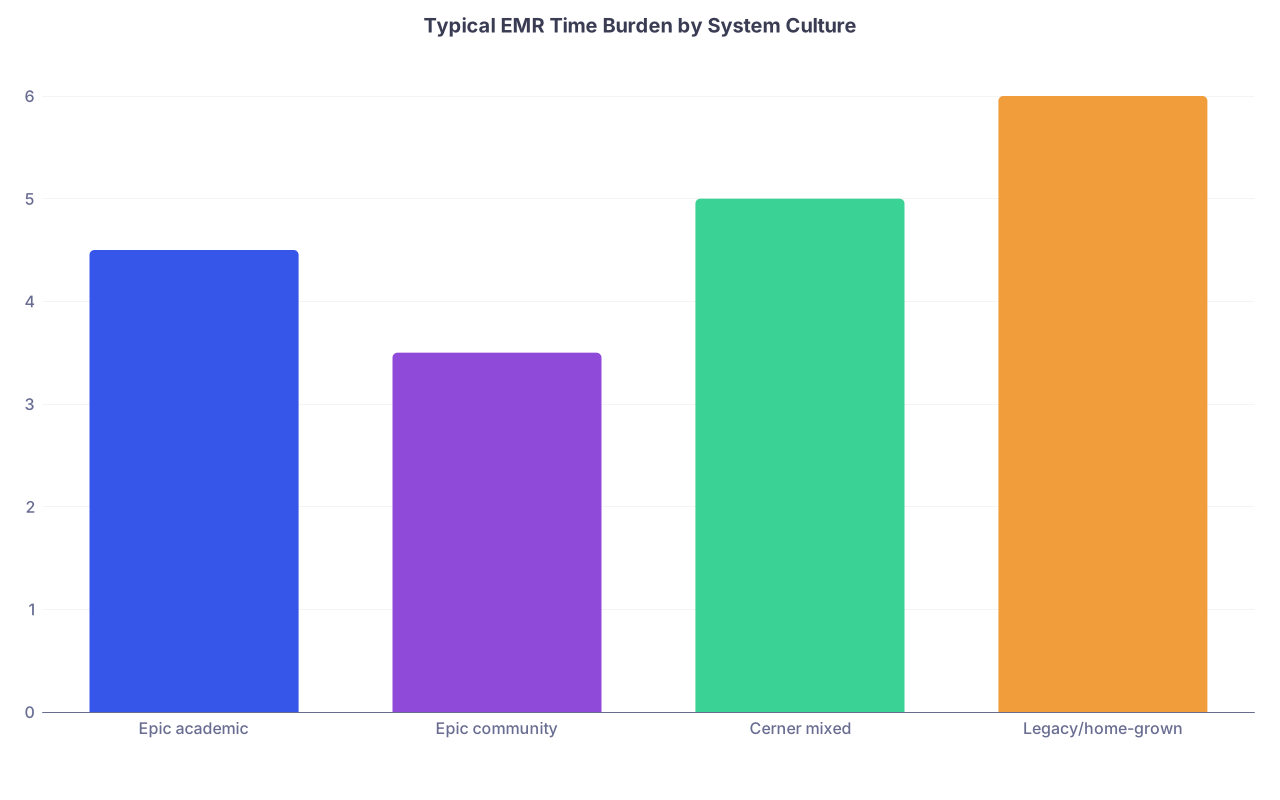
| Category | Value |
|---|---|
| Epic academic | 4.5 |
| Epic community | 3.5 |
| Cerner mixed | 5 |
| Legacy/home-grown | 6 |
Hours per day actually inside the EMR—this is what that chart is summarizing. I have seen residents in a legacy system spend 6+ hours of a 12–14 hour day doing pure documentation and order entry. That is not a learning environment; that is data entry with a stethoscope.
EMR differences that matter for couples
You do not need a full technical review. You need to know how these differences will affect your bandwidth and your relationship.
Key differences:
Documentation workload
Epic with smart tools vs bare-bones templates is night and day. One of you may do a full admission in 10–15 minutes. The other is still typing ROS manually at 01:30.Order entry friction
Some systems have excellent order sets, default dosing, best practice alerts that are actually helpful. Others make you search three different spellings of “ceftriaxone” to find the right order.Inbasket / messaging culture
At some Epic-heavy academic centers, residents are pseudo-primary care—Inbasket messages, MyChart messages, refill requests, lab follow-ups. At others, the EMR is used more like a basic chart. If one of you is drowning in patient messages off-service and the other is not, that disparity hits home pretty fast.Handoff tools
Built-in signout modules vs paper / Excel / random signout tools. This changes how long you stay after your “out” time and how safe you feel leaving.
System culture then layers on top:
Academic vs community
Academic may be more protocol, more QI, more tracking metrics (“discharge by 11:00,” “door-to-antibiotic time”), more layers of approval. Community may be more nimble but more variable and dependent on individual attendings.County / safety-net vs private
County: higher acuity, more social complexity, less resource reliability, often better training but higher emotional drain. Private: more “customer service” expectations, sometimes more admin pressure and “patient satisfaction” nonsense.Unionized vs non-union
This affects how often duty hours get blown, how easily you say no, and what happens when you push back.
If you and your partner are in significantly different boxes on these axes, your day-to-day emotional load will not be symmetric.
2. The Real Pain Points for Couples in Different Systems
Let me walk you through what I actually see couples struggle with. Not the theoretical stuff. The things that show up in real 22:30 kitchen conversations over cold food.
2.1 Asymmetric exhaustion and resentment
Scenario:
One partner at a large academic center on Epic.
- Good signout tools
- Strong ancillary support
- Efficiency-oriented workflows
The other at an older community system on Cerner or Meditech.
- Orders are slower
- Documentation is clunkier
- You are your own secretary
Both clocked out at 19:00 on paper. In reality:
- Epic partner left at 19:10
- Legacy partner left at 20:30 after catching up notes
When they both get home, they are not equally tired. One is “normal resident tired.” The other is “close to tears, borderline useless” tired. Repeat that 4–5 nights a week and you start to see where friction comes from.
And then this hits: the less exhausted partner—who genuinely had a hard day too—feels guilty for having any complaints at all. So they minimize. That is how you end up with one person emotionally stuffing everything to avoid seeming selfish.
2.2 Incompatible complaint languages
Each EMR / system culture has its own set of what “counts” as suffering.
In an over-messaged Epic environment:
3 straight days of endless Inbasket tasks and MyChart complaints absolutely counts as brutal.In an under-resourced safety-net environment:
Twelve patients in the ED waiting 10+ hours for admission with 2 nurses short on the floor absolutely counts as brutal.
Now cross them. The partner in the county system hears: “I had 18 Inbasket messages and 4 MyChart complaints after clinic.” They think (even if they do not say it): “At least your patients can even access MyChart.”
The partner in the academic health system hears: “Our EMR crashes twice a day and I have to handwrite orders until IT fixes it.” They think: “Our sepsis alerts fire every 20 minutes and if I do not respond, I get called into a meeting.”
You get competing miseries and very little mutual validation. That eats at couples.
2.3 Different definitions of “good resident”
This one is more subtle but it hits identity.
Some systems:
- Judge residents by throughput:
How fast you dispo ED patients, how many discharges before 11:00, how quickly you place orders.
Others:
- Judge by thoroughness and academic-ness:
Perfect documentation, detailed notes, long presentations, adherence to institutional pathways.
One partner hears daily: “You need to be faster.”
The other hears daily: “You need to be more comprehensive.”
If the EMRs reinforce those priorities—fast order sets vs thick templated notes—you end up developing two different internal barometers of success. That spills over when you give each other advice that does not translate.
3. Core Strategies for Adapting as a Couple
You do not solve this by pretending the systems are equivalent. They are not. You adapt by explicitly designing how you handle the mismatch.
3.1 Step 1: Map your two worlds together
Do this on purpose. Do it early—ideally PGY1 summer. Not in the middle of an ICU month when everything already hurts.
Sit down on a day off and literally answer these for each of you:
What EMR are you using?
- Are there smart phrases / templates?
- Are orders fast or slow?
- Is Inbasket a big part of your life?
How many hours per shift are you physically in the EMR?
Be honest: charting, messages, orders. Not just “shift length.”What is your system actually measuring you on?
- Throughput?
- RVUs?
- Note completeness?
- Patient satisfaction?
- Sepsis bundle / core measures?
Where does your system hurt you the most?
- Technically (slowness, crashes, clunky UI)
- Culturally (paging expectations, scut, “norms”)
Now compare. Not to figure out who has it worse. To name the asymmetries.
Then commit to this: “We are not going to use whose-system-is-worse as a weapon. We are going to use it as context.”
3.2 Step 2: Rules for post-call and post-shift interaction
Most couples wing this. That is dumb. Set explicit rules.
Example framework that works:
Post-call partner gets decision power on:
- Whether you talk about work at all
- Whether you order food vs cook
- Whether you watch something vs quiet
Non–post-call partner gets 10–15 protected minutes to debrief their day sometime later
Even if it is the next morning. The mistake residents make is: “You had it way worse, I will just shut up.” That builds silent resentment.
Write your version of:
- “When you are post-call, my job is to protect your recovery, not to compare suffering.”
- “When I am not post-call, my experiences still matter. We will find time to talk about them.”
The EMR / system mismatch matters here: the partner in the more chaotic or less supported system will have more post-shift emotional spillover. Cold fact. If that is you, own it and communicate it. If it is your partner, you need to adjust your expectations of emotional reciprocity on heavy rotations.

| Step | Description |
|---|---|
| Step 1 | Different EMR & cultures |
| Step 2 | Map both workflows |
| Step 3 | Name asymmetries explicitly |
| Step 4 | Post-call partner leads schedule & talk level |
| Step 5 | Both debrief with time limits |
| Step 6 | Non-post-call partner gets later debrief window |
| Step 7 | Plan weekly joint review & adjustments |
| Step 8 | Post-call day? |
4. EMR-Specific Adaptation Tactics (Both of You)
If you are in two different EMRs, you have an asset most couples do not: two sets of tricks.
Steal from each other aggressively. Efficiency is not optional; it is relationship protection.
4.1 Create a shared “cross-EMR efficiency” document
I have seen couples literally improve their relationship by 5–10 hours a week just by treating EMR mastery like boards studying.
Make a shared doc (Google Doc, Notion, whatever) with sections like:
- Smart phrases / templates
- Best admission note structure
- How to pre-chart faster
- How to batch orders
- How to avoid double documentation
- How to use .phrases / macros for consults and discharge summaries
Even if the exact syntax differs, the logic transfers. For example:
- One partner shows the other how they build a one-liner that pulls in key vitals/labs structurally.
- The other cannot use the exact code but can replicate the structure manually or with order sets.
You are not going to turn Cerner into Epic. But you can shave 10–15 minutes off multiple tasks.
4.2 Protect 1–2 “EMR lab” sessions early intern year
Sounds ridiculous until you do it. On a lighter rotation week:
- Sit down for 60–90 minutes each
- Screenshare or sit side by side (HIPAA-protected dummy charts / training environment if available)
- Walk through: “Show me how you admit a patient from start to finish. Timer on.”
- The observer’s job: ask “Why are you clicking that?” every 30–60 seconds.
What you often find:
- 4–5 steps that are pure habit and can be consolidated.
- Opportunities for phrase expansion, personal templates, keyboard shortcuts.
- Obvious “batching” opportunities (e.g., do admission orders and first progress note while you are already in there, instead of splitting across hours).
You are not just speeding up EMR use. You are reducing how much of your off-shift life gets eaten by charting. Which means you have more capacity for each other.
5. Relationship-Level Adaptation to Two Cultures
The EMR and system issues bleed into everything: days off, vacation planning, fights about “who is more tired,” career planning. You adapt by being brutally explicit together.
5.1 Preemptive communication about “blackout” periods
Every residency has rotations that destroy people. Night float, busy ICU, ED, trauma, months at the county site, etc. They are not the same months for each program.
You need a combined “blackout calendar” you both respect:
- Mark your highest-intensity rotations
- Mark your partner’s
- Assume: the person on a heavy rotation is at 50–60% relationship capacity
Then answer in advance:
- During your heavy block, what is the minimum we expect from you at home?
- What are non-negotiables: bills, pet care, family calls, etc.?
- What do we explicitly postpone: big decisions, travel planning, major money talks?
If one of you is in a system where “every month feels like a heavy month” because of a dysfunctional EMR + culture, you have to be honest about that too. That is not weakness. That is risk management.
5.2 One partner in a “nicer” system: how to not be a martyr
Somebody reading this is in a relatively well-run Epic system with good ancillary support and a residency that halfway respects duty hours. Their partner is in a more chaotic setting. Here is where people self-sabotage.
They start doing this:
- “My day was fine, yours was worse, let’s just focus on you.”
- “I should not complain. My EMR is better.”
- “I will just take on more at home because you are drowning.”
That works for 3–6 months. Then they quietly burn out. They start feeling invisible. They finally snap and the other partner is blindsided.
You need an explicit rule:
- System difficulty ≠ emotional priority.
- The person in the “nicer” system still gets to be tired, grumpy, human.
Concrete tactic: 1–2 nights a week, you reverse the usual pattern. Regardless of how bad the other person’s day was, you let the “easier system” partner go first in debrief. The other partner’s job is just to listen and not compare.
You are not scoring days by EMR misery index. You are maintaining both people’s humanity.
6. Long-Game: Career Planning and Exit Strategies
Some mismatches you can adapt to. Others you survive until graduation and then fix.
6.1 Year 1–2: Treat the mismatch like a design constraint
Ask together:
- Given my EMR and culture, what is realistic for:
- Research
- Moonlighting
- Leadership roles
- Fellowship prep
You cannot both do “maximum everything” if one of you is in a punishing system. You allocate ambition like you allocate money. One of you may take the research-heavy track. The other keeps their head above water and focuses on clinical competence and survival. That is not unfair. That is strategic.
| Scenario | Primary Risk | Primary Opportunity |
|---|---|---|
| Both in high-function Epic systems | Overcommitment, burnout | Strong joint productivity |
| One high-function Epic, one legacy EMR | Asymmetric exhaustion, resentment | Shared efficiency experimentation |
| Both in under-resourced systems | Dual burnout, no buffer | Intense shared resilience |
| One county/safety-net, one private/elite | Value clash, moral distress | Broader clinical perspective |
6.2 Year 3+: Plan the exit strategically
By PGY3 (earlier in shorter residencies), you should be having explicit conversations about:
- Do we both want to stay in these system cultures after training?
- Is one of these systems truly toxic?
- How do we position fellowship / job searches to move toward a more compatible environment?
If one of you has spent 3 years in a dysfunctional EMR and toxic culture, do not treat that as a badge you must keep wearing. Treat it as: “I got strong clinical training despite the system. Now I am choosing differently.”
Couples make a classic mistake: they choose post-residency jobs solely on geography or prestige and completely ignore EMR and system culture. Then they are shocked when the same misery repackages itself.
In job/fellowship interviews, both of you should be asking:
- Which EMR?
- How is Inbasket handled?
- How are RVUs and metrics tied to resident expectations?
- What is protected time, really?
- How often are duty hours actually violated?
You now know what these answers mean in real life. Use that.
7. A Few Things That Are Just Flat-Out Mistakes
Let me be very clear about a few patterns that almost always go badly for couples in different systems.
“We do not talk about work; it is too depressing.”
That does not create peace. It creates parallel isolation. You do not need to trauma-dump every night, but you need shared language for your worlds.“Whoever has the worse system always gets priority.”
Sounds generous. Ends in resentment and quiet scorekeeping.“I will fix my partner’s program from the outside by sending them articles / suggestions.”
No. Unless they explicitly asked you, you are just adding cognitive load and subtly judging their coping.“EMR efficiency is just individual; if I am slow, I am lazy.”
Completely wrong. There are structural limits, but there is also 10–20% gain sitting on the table for most residents. That 10–20% is the difference between having a relationship and living as two co-located zombies.
8. Concrete Weekly System for Not Letting This Consume You
If you want one “do this and you will be ahead of 90% of couples” plan, here it is.
Once a week, 30–45 minutes. Protected. No phones.
Run through:
Quick check-in (5–10 minutes each)
- How did the system/EMR treat you this week?
- One thing that felt awful. One thing that worked.
Asymmetry scan (5–10 minutes)
- Did one person carry more home load this week?
- Did one person’s program pile on extra (duty hour violations, unsafe staffing)?
Decide: does anything need to shift for next week?
Micro-adjustment (10–15 minutes)
- One practical change each of you will make next week.
Examples: “I will try batching notes before lunch.” “I will stop checking Inbasket after 20:00 unless on call.” “I will not schedule anything on your post-call day.”
- One practical change each of you will make next week.
Relationship anchor (5–10 minutes)
- Plan one thing that reminds you you are more than co-workers in different universes: breakfast date post-call, shared walk, 30 minutes of something non-medical.
This sounds structured and a bit rigid. It works. When the systems and EMRs are chaotic, your relationship needs to be the place where patterns are explicit and predictable.
FAQ (Exactly 4 Questions)
1. Should we actively avoid matching into different EMRs or system cultures as a couple?
If you have the choice, yes, you should strongly prefer landing in similar EMR and system cultures. It is not about software comfort; it is about having similar metrics, workloads, and definitions of “a hard day.” That said, couples often do not have enough leverage to optimize this perfectly. The real mistake is pretending EMR/system mismatch is trivial. If you end up mismatched, treat it as a serious shared problem to solve, not a background annoyance.
2. How do we tell the difference between a hard-but-good system and a truly toxic one?
Hard-but-good systems: you are tired, but you feel yourself learning, your attendings are mostly invested, duty hours are bent but not broken routinely, and concerns occasionally lead to change. Toxic systems: chronic duty hour violations with gaslighting, systemic safety issues that everyone shrugs about, EMR or workflow problems that staff have complained about for years with zero response, retaliatory behavior when residents raise concerns. If your partner’s system sounds consistently unsafe, do not normalize it just because “residency is hard.”
3. Is it reasonable for one of us to consider switching programs because of EMR or system culture?
It is rare, but it is not irrational. People do transfer for system-culture mismatch when it is severe enough to threaten their training or mental health. That said, transferring is disruptive, carries its own stigma in some circles, and is not guaranteed. I would frame EMR alone as almost never sufficient reason. EMR plus consistent toxicity, unsafe staffing, or blatant disregard for duty hours—then you at least have a conversation with mentors and your partner about whether a transfer is on the table.
4. How can we support each other without turning every evening into a venting session about our hospitals?
Set clear containers. Example: 15–20 minutes max of “hospital talk” when you first reconnect, with one person talking at a time, and then you actively change the subject. Use simple questions: “Do you want empathy, problem-solving, or distraction?” before responding. Rotate who goes first so the same person is not always “the listener.” And on at least one day off per week, explicitly declare a “no hospital talk” block for several hours and defend it. You are allowed to have a life that is not just processing what your EMRs did to you this week.
Key points: different EMRs and system cultures do not just change your screen—they reshape your daily exhaustion, your definition of success, and your capacity to show up as a partner. Map the asymmetries on purpose, treat EMR efficiency as relationship protection, and build explicit, structured ways to check in and rebalance. If you do that, you can survive very mismatched worlds without turning your relationship into collateral damage.


