
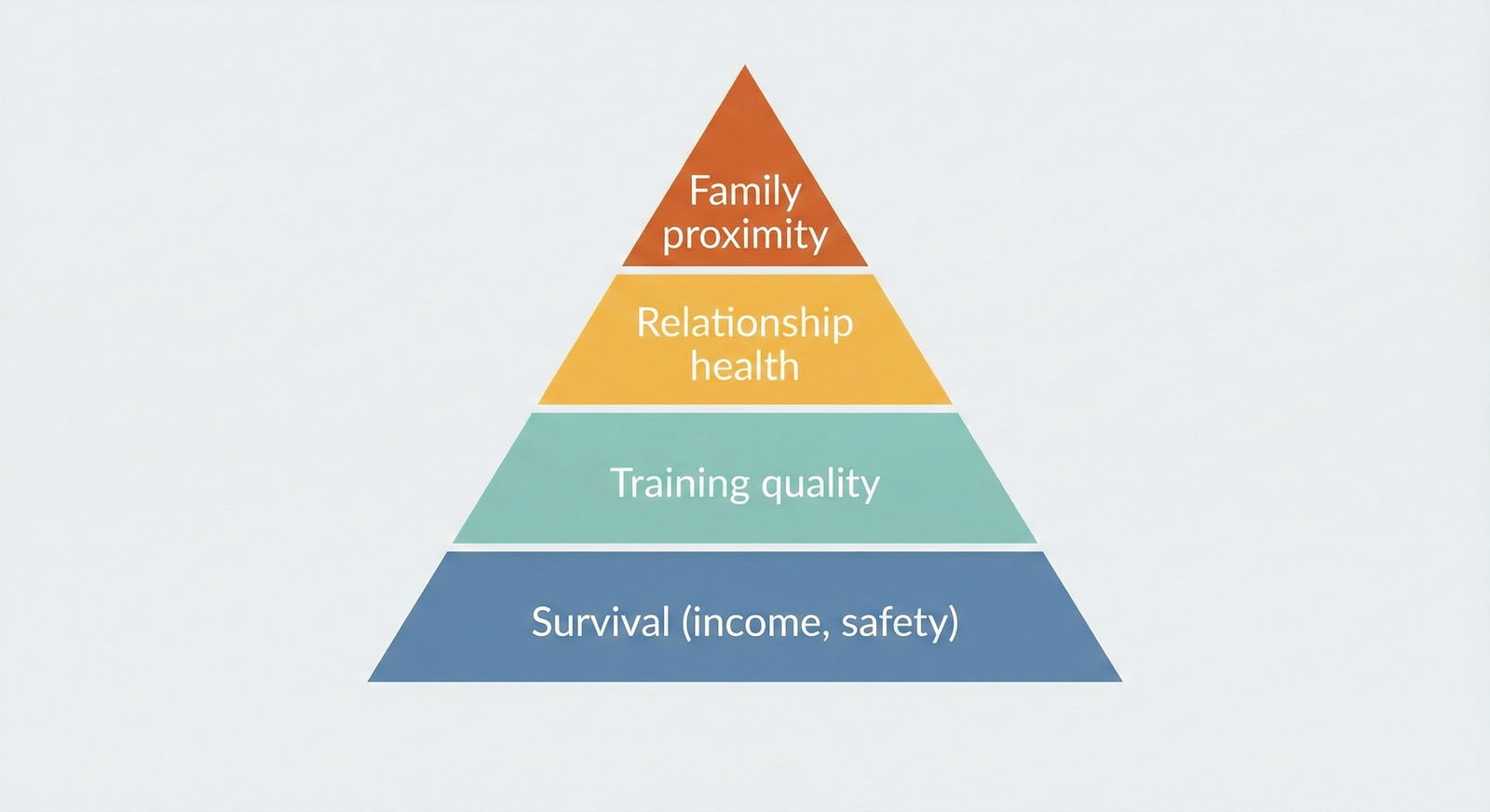
The biggest mistake couples make when one partner needs a J-1 or H-1B visa is pretending they’re a “normal” couples match. You are not. You’re running a visa-constraint logistics operation with a relationship attached.
Let me walk you through how to handle it like a grown-up instead of hoping it magically works out in February.
1. First, get brutally clear on your actual situation
You cannot plan this if you do not understand your constraints better than your advisors do. And most advisors will not understand your visa situation well enough.
Here’s what you need on paper before you touch ERAS:
- Which partner needs the visa?
- J-1 only? H-1B possible? Both possible?
- Specialty choices and competitiveness for each of you
- USMLE scores and red flags
- Year of graduation (fresh grad vs older)
- Geographic flexibility (true flexibility, not what you wish)
Write it out like this, not in your head:
| Item | Partner A | Partner B |
|---|---|---|
| Visa status needed | None (US citizen/GC) | Needs J-1 or H-1B |
| Specialty | Internal Medicine | Pediatrics |
| Step 2 CK | 245 | 231 |
| YOG | 2025 | 2021 |
| Research/USCE | 1 year US research | 3 months observerships |
Now, reality check:
- If the visa-needing partner is in a competitive specialty (derm, ortho, ophtho, rad onc, plastics, neurosurg): couples match is dramatically harder, sometimes suicidal. You may need to rethink either specialty, visa path, or the couples match itself.
- If both are in moderately or less competitive specialties (IM, peds, psych, FM, neuro, path, anesthesia in many regions): it’s tight but doable with planning.
- If one is super strong (260+ scores, research, US grad) and the other is an IMG with visa needs + average scores: the strong partner’s job is to create geographic leverage.
Be honest now so you do not end up unmatched and resentful in March.
2. Understand what visa reality does to your couples strategy
Visa needs change everything about how you build your list and talk to programs.
J-1 vs H-1B in the couples context
Short version: J-1 is easier to get, harder later. H-1B is harder to get, easier later.
- J-1: Most academic programs are comfortable with J-1. ECFMG sponsors it. Easier to find spots. But you owe a 2-year home-country rule after training unless you get a waiver later. For couples, that future waiver/job search can be a mess if you’re in different specialties.
- H-1B: Fewer programs offer it (some explicitly do not). Typically requires Step 3 before residency starts. Often more IMG-friendly community programs that sponsor H-1B. For couples, coordinating two H-1Bs in one city is possible but tight.
If your partner “prefers” H-1B but could do J-1, decide early: is this preference or necessity?
You must decide which of these three camps you’re in:
- “J-1 is totally fine; long-term we’ll work out the waiver.”
- “We’d prefer H-1B, but we will accept J-1 if that’s what it takes to match together.”
- “We will ONLY do H-1B.”
Camp 3 drastically shrinks your couples match options. If you’re in that camp, admit it and build a plan that assumes very large rank lists and potentially different cities.
3. Build your program list like a logistics problem, not a dream board
Most couples just slap programs into ERAS and hope overlap appears.
Wrong approach. You start with visa filters and institutional behavior.
Step 1: Map visa policies before you apply
Do not trust outdated spreadsheets or random forums alone. You do this:
- Check official program websites for:
- “We sponsor J-1 only”
- “We sponsor J-1 and H-1B”
- “We do not sponsor visas”
- Cross-check last 2–3 years of residents on their website
- Names + med schools. You can usually spot IMGs and whether they’ve historically had visa holders.
- Email coordinators for unclear programs with a tight question:
- “Dear [Name], I'm an IMG applying this cycle who will require [J-1/H-1B] sponsorship. Does your program sponsor this visa category for incoming PGY-1 residents? Thank you for your time.”
Track answers. Spreadsheet. Not in your head.
Now, filter your options.
Step 2: Combine visa + couples geography
You need overlapping cities where:
- Programs exist for both specialties
- Visa-needing partner’s specialty has viable visa-sponsoring programs
- At least some of those programs are couples-match friendly (they don’t have to say it; you infer from size and past patterns)
Cities where couples with one visa partner often have the best shot:
- Large metro areas with many hospitals: NYC, Chicago, Houston, Philadelphia, Boston, Dallas, LA, Miami
- States that are IMG-heavy and visa-friendly: NY, NJ, PA, MI, OH, TX, FL, IL
Smaller cities with 1–2 programs per specialty are risky unless you’re very competitive. If your spreadsheet shows only one H-1B-sponsoring IM program and one psych program in a city, that’s not a “hub,” that’s a lottery ticket.
Drop the romance about “we love Seattle” if Seattle has exactly one program that sponsors H-1B and they take one IMG every 3 years. That’s not a strategy.
4. Decide your couples “risk level” together
You and your partner need one hard conversation before ERAS goes out:
What’s worse:
- Matching apart but both matching
- One of you going unmatched so you can be in the same place
People pretend they’ll “figure it out later.” Then the Match gives them a brutal combination and they realize they never aligned on this.
You need a hierarchy. Example:
- Both match in same city, both have a visa (J-1 or H-1B).
- Both match in same region (1–3 hours apart), visa as above.
- Both match anywhere, even if separate states.
- One matches, one goes unmatched (decide which of you is the anchor if it comes to that).
If you cannot agree on that order, you’re not ready to couples match with a visa on the line. Fix that first.
5. Structure your rank list for visa reality, not fantasy
This is where people blow it. They use couples matching like it’s just “ranking our dream pairs.” No. You are ranking probability-weighted, visa-screened outcome pairs.
Internal rules you should follow
- Rule 1: The visa-needing partner’s list is the limiting reagent. You build around them.
- Rule 2: You prioritize cities with multiple realistic visa-sponsoring programs for the visa partner rather than your favorite city with one unicorn program.
- Rule 3: Your early ranks should be “good + realistic,” not “perfect but unlikely.”
Example structure for an IM (needs visa) + psych (US citizen) couple:
1–10: Major cities with multiple IM visa-sponsoring programs + multiple psych programs (e.g., Houston, NYC, Chicago). Mostly bigger academic or IMG-heavy community programs. 11–25: Slight compromise cities with at least 1–2 IM visa options and 1–2 psych programs, some weaker reputation. 26–40: “Safety” combos: strong likelihood match for IM at lower-tier, IMG-heavy, J-1-only programs, psych partner ranks whatever is nearby, even if community or less ideal.
And you absolutely include some “distance” pairs:
- Partner A in City 1, Partner B in City 2, 2–4 hours apart. You do not put these first. But you do rank them before “unmatched.”
Because being unmatched “together” is not romantic in real life. It’s just financially and psychologically brutal.
6. How to talk to programs about your couples + visa situation
Programs hate surprises. They hate feeling like you used them for a couples list stunt. But many will work with you if you’re smart about how you communicate.
Timing and phrasing
You do not open your personal statement with “I need a visa and I’m couples matching.” That screams: “I’m a logistical headache.”
You use three routes:
ERAS application fields
- Visa requirement is obvious there.
- Couples code is entered in NRMP, programs see that status but not your partner’s name or specialty.
Interview day (late in the day or during PD meeting)
- “I want to mention I am couples matching with my partner who’s applying in [specialty] in this region. I’ll be ranking [this city/this area] very highly. Your program is a top choice for me because [specific reasons]. I also wanted to be transparent that I will require [J-1/H-1B] sponsorship.”
Post-interview emails to priority programs
- If you truly love a program and they’re visa-sponsoring, you can send something like: “I remain very enthusiastic about your program. My partner is applying in [specialty] and is interviewing at [X, Y, Z] programs in [city/region]. We’re committed to this area and will be ranking it highly as a couple. If accepted, I’d be very happy to train at your institution and plan our life here.”
Do not constantly hammer them about visas. Once they confirm sponsorship and you know their pattern (they have IMGs on J-1/H-1B in the current residents), let it go. Be the candidate they want. Let the visa be logistics, not your identity.
7. Specific scenarios and what to actually do
Let’s get concrete. A few common patterns I’ve seen blow up — or succeed — depending on planning.
Scenario A: One partner is US grad, one is IMG needing J-1
US grad in a moderately competitive specialty (say EM) + IMG needing J-1 in IM.
What to do:
- IMG’s priority: apply very broad to IM programs that sponsor J-1. 150–200 programs is not crazy for IMGs in this situation.
- US grad’s priority: pick regions with many J-1-friendly IM programs (NY, NJ, PA, TX, IL) even if their dream coastal academic program is elsewhere.
- Couples list: overweight cities with 4–10 IM J-1 spots and at least 2–3 EM programs. The US grad sacrifices geographic prestige for the relationship and the visa reality.
- Hard truth: If the US grad insists on “top-10 academic in the West Coast only,” either you should not couples match, or you should accept high risk of separation or IMG partner going unmatched.
Scenario B: Both are IMGs, one needs H-1B only
This is one of the hardest.
H-1B-only partner must:
- Take Step 3 early (ideally before application season or at least before rank lists are due).
- Apply absurdly broadly to all H-1B-sponsoring programs in their specialty.
- Be ready to consider less desirable locations.
The other partner (regardless of visa status) needs to:
- Align specialty and geography around those H-1B hubs.
- Be willing to take weaker programs in the same city or region.
Often, this couple needs a Plan B: “If we do not both match on H-1B this cycle, are we willing to let one do a research year on a different visa while the other starts residency?”
If the answer is no, you’re placing a huge bet on a small number of programs.
8. Strategy for distance vs same-hospital vs same-city
Too many couples think their only success outcome is “same hospital, same city.”
You should think in tiers:
Tier 1: Same hospital or same system
Tier 2: Same city, different hospitals
Tier 3: Same region (1–3 hours)
Tier 4: Different states but both matched
Tier 5: One unmatched
Your rank list should reflect all viable Tier 1 and 2 options, some Tier 3 combos, and only move to Tier 4 if you both decide it’s better than Tier 5.
Do not be too proud to rank “Tier 3” combinations. I’ve seen couples 2 hours apart who visit weekly and then both later transfer or coordinate fellowship in the same city. That’s survivable. Being unmatched another year? Much harder to recover from.
9. Backups, transfers, and “if it goes sideways” planning
You also plan for things not going perfectly.
If one matches and the visa-needing partner does not
If the unmatched one is the visa-needing partner:
- Look for:
- Research positions, observerships, or prelim spots that keep them in the US and clinically adjacent.
- Re-apply next cycle focusing on the region of the matched partner if possible.
If the unmatched one is the US citizen/green card holder:
- They generally have more flexibility:
- They can work, do research, or seek SOAP/prelim positions in the matched partner’s city.
- They can re-apply with a strong geographic focus on the partner’s region.
Transfers
Transfers are rare but not impossible. Visa complicates, but does not kill, the option.
For a transfer to realistically happen:
- Good performance (strong reviews, no professionalism issues).
- Open PGY-2 or PGY-3 slot in the target city.
- Program willing to take over visa sponsorship (for J-1, ECFMG stays the sponsor; for H-1B, it’s a paperwork move).
You do not plan on transfer as your main strategy. You treat it as a bonus if things go okay-but-not-ideal initially.
10. Timeline: what to do, and when
Here’s how your timeline should look if one partner needs J-1 or H-1B:
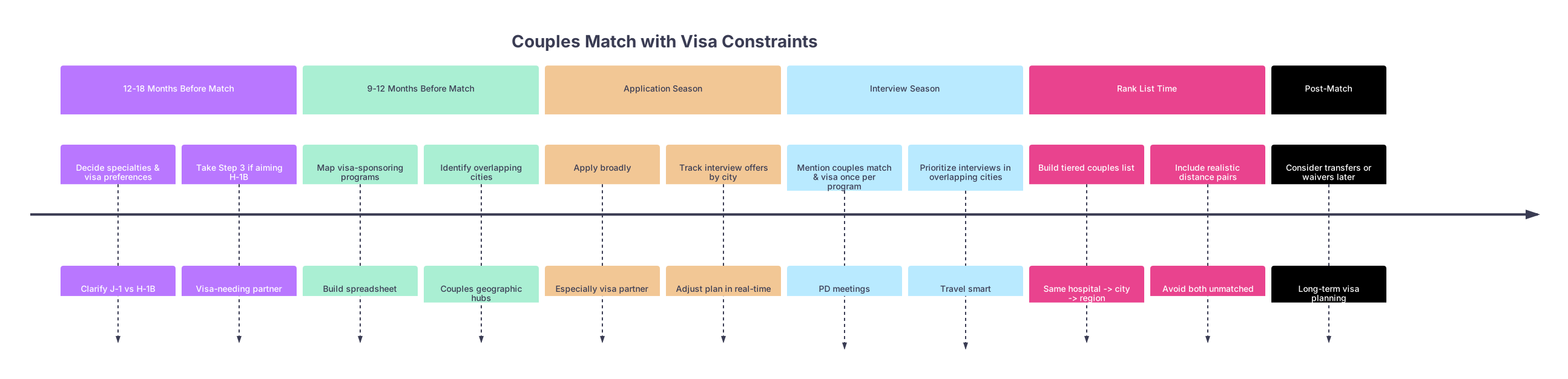
| Period | Event |
|---|---|
| 12-18 Months Before Match - Decide specialties & visa preferences | Clarify J-1 vs H-1B |
| 12-18 Months Before Match - Take Step 3 if aiming H-1B | Visa-needing partner |
| 9-12 Months Before Match - Map visa-sponsoring programs | Build spreadsheet |
| 9-12 Months Before Match - Identify overlapping cities | Couples geographic hubs |
| Application Season - Apply broadly | Especially visa partner |
| Application Season - Track interview offers by city | Adjust plan in real-time |
| Interview Season - Mention couples match & visa once per program | PD meetings |
| Interview Season - Prioritize interviews in overlapping cities | Travel smart |
| Rank List Time - Build tiered couples list | Same hospital -> city -> region |
| Rank List Time - Include realistic distance pairs | Avoid both unmatched |
| Post-Match - Consider transfers or waivers later | Long-term visa planning |
If you’re already in interview season and haven’t done any of this, you can still salvage some structure by re-mapping your invites by city and visa flexibility, then weighting those heavily in your couples ranks.
11. Mental game: how not to implode your relationship in the process
Last thing. People underestimate the psychological strain of combining couples match with a visa constraint. You’re not just stressed. You’re on different levels of existential risk.
A few ground rules that help:
- No weaponizing visas: Don’t say things like “Well, if you didn’t need a visa, this would be easier.” It’s not productive and they already know.
- Shared spreadsheet, shared decisions: One unified reality. If only one of you tracks visa-friendly programs, resentment builds when the other “feels” like you’re not trying hard enough.
- Scheduled decisions, not constant fighting: Sit down once a week, review new interview invites, adjust city priorities. The rest of the time, agree not to re-litigate everything over dinner.
- No secret rank lists: In a couples match, secret solo ranking is betrayal. If you’re at that point, don’t couples match.
12. The bottom line
A couples match with one partner needing a J-1 or H-1B visa is not impossible. It’s just unforgiving of magical thinking.
Three things to remember:
- The visa-needing partner’s situation drives your geography and your risk profile. Accept that early and plan around it.
- Build your lists and your communication around probability, not fantasy: visa sponsorship, number of programs per city, and realistic tiers of “togetherness.”
- Decide together what you fear more: distance or being unmatched. Then let that decision, not vague hope, shape your rank list.
Handle those three well and you stop being at the mercy of the Match. You still might not get a perfect outcome. But you’ll almost certainly avoid the worst ones.


