

The biggest mistake couples make in the Match is pretending you’re “both flexible” when one of you is clearly not.
If you’re in a couples match where one partner strongly wants to stay near family and the other is genuinely flexible, you have leverage and risk at the same time. Handled well, you get a list that feels fair and protects your relationship. Handled badly, you end up with silent resentment, a shaky rank list, and an ugly March.
Let’s do this like you’re sitting at my desk with coffee and a Google Sheet open. I’ll walk you through how to actually handle this situation step by step.
Step 1: Get Uncomfortably Specific About “Near Family”
“Near family” is vague. Vague kills good strategy.
You need to turn “near family” into something you can rank programs around. That means numbers and limits, not vibes and hope.
Ask the partner who wants to be near family:
- “What’s the maximum commute you’d actually be okay with? In minutes, not ‘oh, like an hour-ish.’”
- “Are we talking same city, same metro area, or drivable for a weekend?”
- “What family events matter most? Weekly dinners? Holidays? Having help with future kids?”
Then get concrete:
- Is “near family”:
- Within 30 minutes of parents’ house?
- Within 60–90 minutes?
- Within a 3–4 hour drive?
- Or just “same state”?
Do not accept, “I don’t know, just…close.” That’s how you end up matching 3 hours away and hearing, “Well I didn’t think this far counted as close.”
Write it down. Literally. Something like:
- “I want to be within 45 minutes of my parents at least 4 days a week” → that’s “same metro.”
- “I want to easily go for a weekend once a month” → that’s “within 4-hour drive.”
- “I want to be in the same state so it’s easier long term” → that’s geographic, not time-based.
Then translate that into an actual radius around the family address and which cities/regions qualify.
This feels overly rigid. Good. You are not negotiating with vibes; you are building a rank list.
Step 2: Decide What “Flexible” Actually Means for the Other Partner
The “flexible” partner is usually lying to themselves a little.
They say things like:
- “I’m happy anywhere.”
- “Whatever works best for your family, we’ll figure it out.”
- “I don’t have strong geographic preferences.”
Then Match Day rolls around, they end up at a malignant program in a city they hate, and you hear, “I did this for you.”
If you are the flexible partner, you need to answer three questions honestly:
What are your hard stops?
Not preferences. Dealbreakers.
For example:- “I will not go to a program with a reputation for 90+ hour weeks every month.”
- “I will not live somewhere with no real airport because my family is cross-country.”
- “I will not rank community-only programs if I want fellowship X.”
What are your minimums?
Things like:- At least X type of training environment (academic/community mix).
- Reasonable fellowship match history if you’re fellowship-bound.
- Program size you can tolerate (some people hate tiny programs).
What kind of city do you absolutely not want to live in?
Yes, you need to say it out loud:- “Absolutely no cities with brutal winters.”
- “Absolutely no truly rural areas.”
- “I refuse to live in a city smaller than [X population].”
You’re not being selfish by doing this. You’re preventing a future blowup.
Once both of you have your “near family” constraints and “flexible but not a martyr” constraints on paper, you can actually make a strategy.
Step 3: Map Out Your Realistic Geography
Now you combine those constraints into an actual geographic footprint.
Take a blank map (or Google Maps):
- Put a pin where the family is.
- Draw rough circles/areas for:
- Ideal radius (e.g., 0–45 minutes from family).
- Acceptable radius (e.g., 45–120 minutes).
- Stretch radius (e.g., 2–4 hours, or short flight with direct routes).
Then list programs by radius zone.
| Zone | Commute/Distance | Priority Level |
|---|---|---|
| Core Zone | 0–45 mins from family | Highest |
| Near Zone | 45–120 mins | High |
| Drive Zone | 2–4 hour drive | Medium |
| Flight Zone | Short direct flight | Lower |
You’re going to treat those zones differently when you:
- Decide where to apply broadly vs. apply selectively.
- Decide where to visit if interviews are limited.
- Decide which programs get ranked higher as a couple vs. backup safeties.
This is better than “We’re willing to go anywhere but prefer to be near family,” which is utterly useless when you’re trying to decide between a mid-tier program 30 minutes from family and a strong academic one 3 hours away.
Step 4: Inventory the Programs for Both of You
Now you stop talking about theory and look at the actual program list.
You’re going to build a shared spreadsheet. If you hate spreadsheets, do it anyway.
Suggested columns:
- Program name
- Specialty (for partner A / partner B)
- City
- Distance from family house (actual minutes or drive time)
- Zone (Core / Near / Drive / Flight)
- Program “tier” or strength for each partner (High / Medium / Safety based on your stats and competitiveness)
- Vibe fit (Green / Yellow / Red based on interviews, resident feedback, etc.)
- Dealbreakers (Y/N)
- Notes
Then you code programs like this:
- Core zone + good fit for both → gold.
- Near zone + great program for flexible partner → also strong.
- Drive/Flight zone but much stronger career fit → might outrank closer-but-mediocre options.
You are trying to see visually:
- Where proximity to family and training quality align.
- Where they’re in tension.
- Where you are deluding yourselves (e.g., “We’ll be near family” but it’s a 3-hour drive and both of you will do q4 call).
Step 5: Set Shared Priorities Before Interview Season Ends
Couples screw this up by waiting until February to decide what matters most. By then you’re exhausted, anxious, and way too emotionally attached to certain programs.
You should have this talk before Rank List Certification week:
Here’s the conversation structure:
Each partner lists their top 3 non-negotiables.
Example:- Partner A (wants family):
- Within 1 hour of parents if possible.
- Reasonable call schedule in PGY-1.
- A city where family can actually help (safe neighborhood, realistic commute).
- Partner B (flexible):
- Strong enough training to not close doors for fellowship.
- No toxic or malignant vibe.
- City I can see myself living in for 3–5 years.
- Partner A (wants family):
Agree on system-level tiebreakers.
For example:- If distance-to-family is similar, career fit wins.
- If career fit is similar, closer-to-family wins.
- If one program clearly helps both of you long term (e.g., academic main campus with both your specialties) vs. one that’s mostly good for family proximity, pick the one that doesn’t screw your careers.
Set a line where “family priority stops” and “career preservation begins.”
For instance:- “We’ll rank all programs within 1–1.5 hours from family that are at least ‘medium’ fit for both of us above any drive/flight zone programs. But we will not rank a malignant or very weak program above a clearly much better one just because it’s 30 minutes closer.”
Write this down. Yes, again. Because when you get emotionally attached to that one interview where they gave you free Patagonia, you will forget every rational thought you had in November.
Step 6: Build the Couples Rank List in Layers, Not Emotions
Couples matching near family is basically playing 4D chess while sleep deprived. So simplify it.
You’re not trying to handcraft each possible pairing in the order they “feel right.” You’re going to build in layers.
Layer 1: Best-case near-family outcomes
These are combinations where:
- Both get solid or strong programs.
- You’re in the Core or Near zone.
- No one is sacrificing their whole career.
Rank all of these at the top, ordered by your shared tiebreakers (program quality, city preference, vibe).
Layer 2: Stretch but still near-ish family outcomes
These might include:
- One of you at a slightly weaker program but still decent.
- Slightly longer commute or Drive zone, but still realistically involved with family.
Layer 3: Career-preserving outcomes farther from family
This is where the flexible partner matters. You list combinations where:
- Programs are clearly better training environments.
- You’re in Drive/Flight or totally unrelated geography.
- But this protects long-term career options.
These should not be below absolutely terrible options near family. I’ve watched couples match into two weak, miserable programs an hour from family, then not get fellowships they wanted, then move away anyway 4 years later. They lost both family proximity and career options.
Layer 4: True disaster avoidance
Bottom part of your list:
- Combinations where at least you both match somewhere that isn’t malignant, even if far from family.
- This is your “we don’t want to go unmatched over this” layer.
This structure keeps you from ranking chaos like:
- Amazing academic combo 3 hours away
- Mediocre + malignant 30 minutes from family
- Good + good 1.5 hours from family
Which I’ve seen. That’s how you realize too late you valued a car ride over one of your careers.
Step 7: Handle the Emotional Politics Directly, Not Passive-Aggressively
This situation has a power imbalance: the “near family” partner has a clear geographic agenda; the “flexible” partner is tempted to be the hero and then quietly resent it.
You want none of that.
Couple of rules:
The flexible partner must be allowed to say no.
If you’re the flexible one and you look at a program and think, “I will hate my life there,” you say that. You don’t swallow it because, “Well, it’s close to your parents.”The near-family partner must own the tradeoffs.
If you’re the one who cares about staying close, you have to explicitly say:- “I understand this may mean you take a slightly weaker program than you could otherwise get.”
- “I’m not going to weaponize gratitude later (‘I did this for you’).”
Money and logistics matter more than people admit.
Ask:- Will family actually help with childcare or is this nostalgia?
- Can your parents reasonably drive to help when you’re on nights?
- Are you counting on “free childcare” that your retired-but-actually-exhausted parents will not actually provide?
If the real situation is “my parents want to see us more” but they’re not going to do school pickups or night-call coverage, be honest: that’s emotional support, not practical support. That still matters—but it’s not magic.
Step 8: Plan the Worst-Case Scenarios Before Match Day
Couples like to pretend the worst case won’t happen. Then March hits.
You need to ask yourselves, now:
What if:
- You both match, but not near family?
Are you going to: - Accept and commit?
- Or talk about reapplying / future fellowships closer to them?
- You both match, but not near family?
What if:
- One of you matches near family and the other farther away (e.g., satellite vs main campus, separate cities)?
Are you willing to: - Do long distance for a year?
- Drive every weekend?
- Or is that a “we’ll suck it up and live apart” situation?
- One of you matches near family and the other farther away (e.g., satellite vs main campus, separate cities)?
What if:
- Your best mutual outcome is 3 hours from family, but there’s a 45-min away combo that is clearly worse for one person’s training?
Together, decide now: - “Are we okay choosing the 3-hour option because it protects training, or would we actually choose the 45-min option and accept weaker training?”
- Your best mutual outcome is 3 hours from family, but there’s a 45-min away combo that is clearly worse for one person’s training?
Do that thinking now, before there’s an NRMP clock ticking and anxiety brain running the show.
Step 9: Keep an Eye on Long-Term Strategy Beyond Residency
Staying near family doesn’t have to be a residency-or-never decision.
If you’re both early in training, you actually have multiple chances:
- Med school location
- Residency
- Fellowship
- First attending job
If you can’t make near-family work in a way that preserves both of your careers during residency, you can explicitly agree:
- “We’ll go where training is best fit now and put serious weight on family location for fellowship or attending jobs.”
Sometimes the smartest play is:
- Take a strong program that’s within Drive/Flight distance now.
- Use that leverage to get good fellowships with more geographic choice later.
- Then go all-in on being near family as attendings when schedules and money are better.
That’s not “giving up on being near family.” That’s sequencing your priorities so you don’t tank your training permanently for a few years of slightly easier drives.
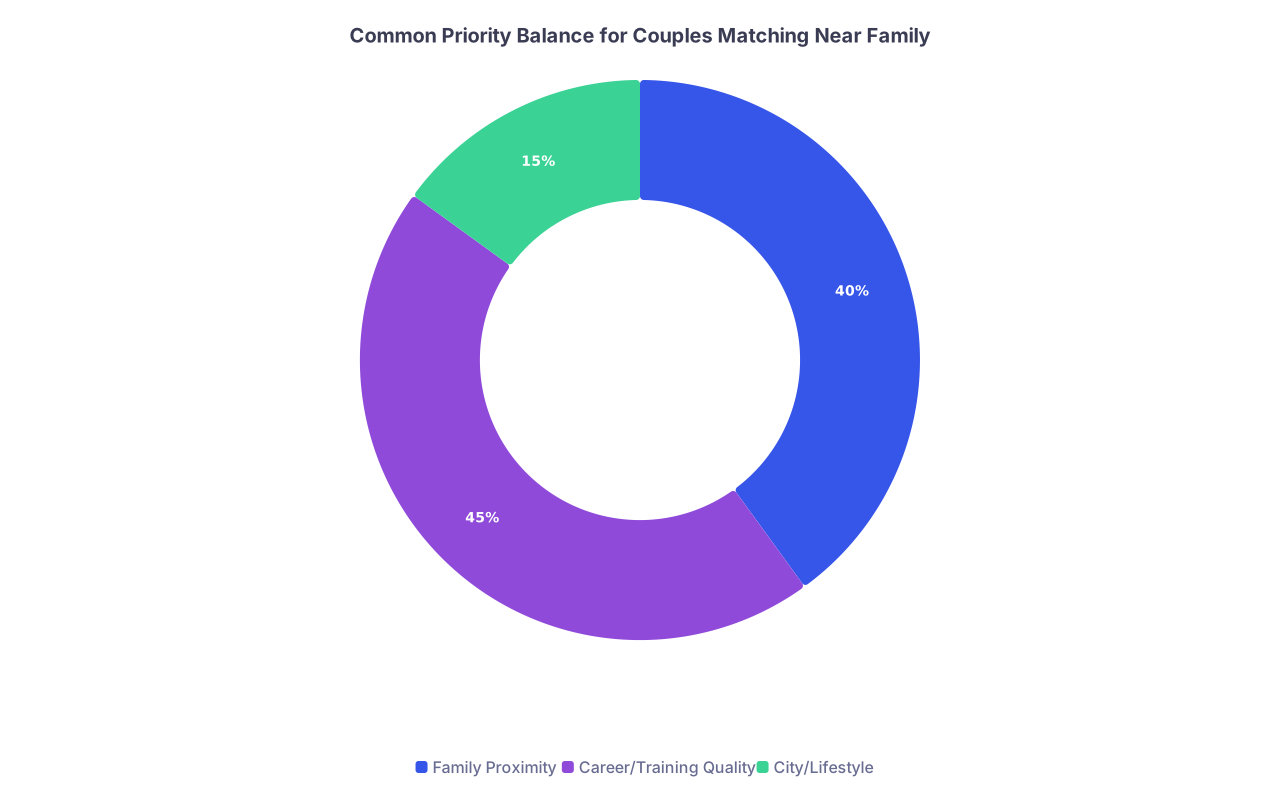
| Category | Value |
|---|---|
| Family Proximity | 40 |
| Career/Training Quality | 45 |
| City/Lifestyle | 15 |
Step 10: Have One Final, Blunt Check-In Before Certifying Your List
Right before you hit “Certify,” sit down, open your couples rank list, and ask each other three things out loud:
“Point to any combination on this list where you would secretly feel resentful if we matched there.”
If either of you points to one ranked high, you either:- Move it down.
- Or have a real conversation and decide if it stays.
“Do you understand what you’re giving up for the top 3 options?”
For each of your top 3:- What is the family upside?
- What is the career cost, if any?
- Say it out loud. Own it.
“If we match at #1, 2, or 3, can both of us say, ‘I chose this’ instead of ‘I let you pick this’?”
If the answer is no, your list is not honest.
This last check isn’t about data. It is about making sure neither of you is silently taking a hit you’ll resent.

| Step | Description |
|---|---|
| Step 1 | Define Near Family Radius |
| Step 2 | Identify Programs by Zone |
| Step 3 | Assess Program Fit for Each Partner |
| Step 4 | Set Shared Priorities and Tiebreakers |
| Step 5 | Build Layered Rank List |
| Step 6 | Worst-Case Scenario Check |
| Step 7 | Final Emotional/Resentment Check |
| Step 8 | Certify Rank List |
The Core Takeaways
- Vague preferences like “near family” and “I’m flexible” are useless. Turn them into hard distances, zones, and dealbreakers you can rank around.
- Do not sacrifice a partner’s entire career or sanity just to shave 90 minutes off a drive to Sunday dinner. Protect both careers first, then optimize family proximity within that.
- Your couples rank list should be structured, layered, and discussed openly. If either of you looks at a top-ranked outcome and feels, “I’m doing this for them,” fix that before you hit Certify.


