

The usual Couples Match advice breaks down the second a mortgage or prior career enters the picture.
Most guidance assumes you’re two flexible 20‑somethings with no real roots. That is not your situation. You’ve got a house. Or a partner locked into a career they actually like. Maybe equity vesting, maybe kids in schools. Now you’re trying to bolt the NRMP Couples Match—one of the least forgiving systems in medicine—onto a life that is already in motion.
This is manageable. But only if you stop pretending you’re a standard couple and start making decisions like people with assets and constraints.
Here is how.
Step 1: Get Brutally Clear on Your Non‑Negotiables
You cannot plan the Couples Match around vibes. You plan it around constraints.
Sit down—phones away, both of you—and answer these separately first, then compare:
For the partner with the prior career or mortgage:
- Are you willing to move at all? If yes, how far: same city only, same state, or broader region?
- If there’s a mortgage: can you rent the place out? Sell without losing money? Carry the payment on one income if needed?
- If career-based: can the job be done remotely or hybrid? Are there branches/offices in other cities with relevant residency programs?
- Any hard geographic lines? (e.g., “We must be within 30 minutes of [Company HQ]” or “We cannot move out of state due to custody.”)
For the partner entering residency:
- Which specialties are you applying to (and are they realistic given your scores, letters, performance)?
- Are you willing to do a less competitive specialty or a community program to stay geographically constrained?
- Are you open to a transitional/preliminary year locally, then reapply?
You’re looking for the red lines—things you refuse to bend on.
Once those are written down, sort them into three buckets:
- Non‑negotiable
- Strong preference
- Nice to have
If everything is “non‑negotiable,” you’re not being honest. Something will give: program prestige, specialty, distance, or finances. Better to choose consciously now than be crushed on Match Day.
Step 2: Map Your Geography to Reality, Not Hope
Now you translate your constraints into an actual map.
There are three main realities I see in these couples:
- Mortgage locked in one city
- Career anchored to one metro/region
- Both: house + anchored job in one place
Case A: Mortgage in One City, Career Flexible
This is the “we bought early but my partner can move or go remote” group.
Your questions:
- How negative is the equity if you sell now versus rent?
- Is your monthly PITI (principal, interest, taxes, insurance) coverable by realistic rent numbers?
- Are there at least 3–5 residency programs in commuting distance of that house for your specialty?
If your specialty is something like internal medicine, family med, peds, psych—you’ve got options in most metros. If you’re trying for derm, ortho, plastics, ENT, rad onc—you do not get to be as picky with geography.
I’ve seen couples sink themselves by deciding, “We have to keep the house” in a city with 1 tiny categorical surgery program and a Step 1 of 220. That’s not planning. That’s denial.
Case B: Career Anchored, Housing Flexible
Classic scenario: one partner is a software engineer, consultant, nurse, teacher, or has a stable non‑medicine role in a specific city. Mortgage maybe, maybe not.
Here, the real constraint is the job market:
- Does this city have enough programs across multiple specialties?
- Would the non‑med partner consider switching companies locally if needed?
- Can you realistically live off the resident salary alone for a year or two if the other job falls apart?
You build your Couples Rank List focused tightly around that metro and a suburban radius you’re actually willing to commute.
Case C: House + Career Both Anchored
This is the hardest combination.
If you own a house, equity is modest, and your partner’s job is tied to a physical HQ, you have a simple but painful question:
Are we willing to:
- Delay graduation or do research / extra time so we can reapply more strategically?
- Change specialty targets for better match odds locally?
- Accept the possibility of matching separately and living apart temporarily?
You don’t solve this with optimism. You solve it with contingency planning.
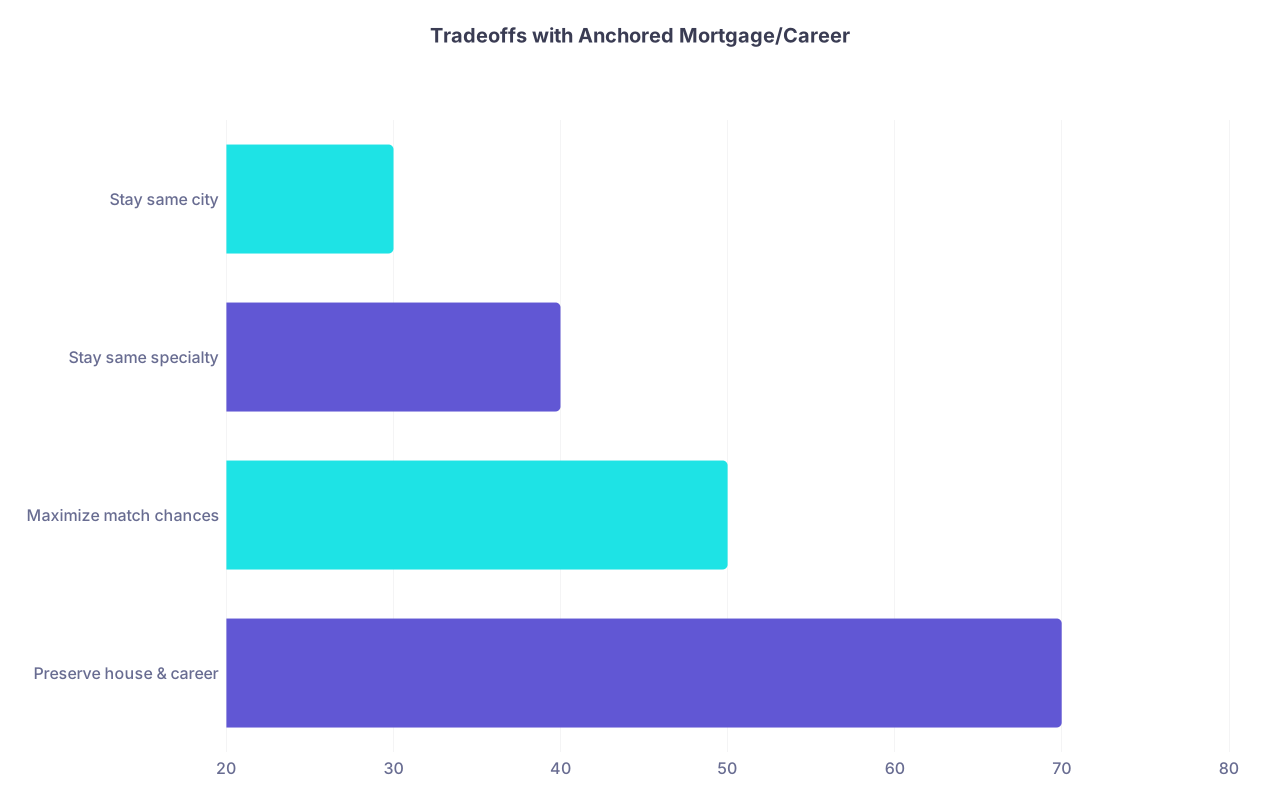
| Category | Value |
|---|---|
| Preserve house & career | 70 |
| Maximize match chances | 50 |
| Stay same specialty | 40 |
| Stay same city | 30 |
Step 3: Decide Your Strategy: Anchor vs Flex
In a standard Couples Match, both people are “flex.” You pick a few regions, rank like crazy, hope the algorithm is kind.
Your situation is different. You essentially choose one of two strategies:
- Anchor Strategy – You anchor around the prior career or mortgage.
- Flex Strategy with Contingency – You treat career/house as important but not absolute.
Anchor Strategy: “We Are Not Leaving This Metro”
This looks like:
- You define a tight geographic circle: e.g., “must be within 45 minutes of our house or partner’s job.”
- You list every program in that radius. Academic + community. Big name + tiny community program you’ve never heard of.
- You reality check it: number of programs, competitiveness, your stats, and specialty.
If you’re IM-bound with average scores in a large metro (Boston, Philly, Chicago, Houston), anchoring can absolutely work.
If you’re aiming for neurosurgery in a mid-size city with a single program that likes 260+ Step 2 scores and AOA? Anchoring is fantasy.
When the anchor strategy is viable, your job is:
- Apply broadly to every program in that radius.
- Over‑communicate geographic commitment in your application and interviews.
- Use your partner’s local career/housing as a positive: “We have deep roots here; I’m committed to training and staying in this community.”
Anchor strategy works best if:
- The specialty is mid‑ to low‑competitiveness.
- The region/city has multiple institutions.
- You’re willing to rank community programs ahead of shiny places farther away.
Flex Strategy: “The House/Career Matters, But Match Comes First”
Here, you:
Include your current city/region as a priority zone.
Add 1–3 additional regions where your partner could plausibly transfer, work remotely, or where you could rent/sell the house without imploding your finances.
Build your rank list across multiple zones with tiers:
Tier 1: Same city, ideal programs
Tier 2: Same city, acceptable but not dream programs
Tier 3: Other cities where partner could plausibly land a job or manage mortgage remotely
Tier 4: Safety options even if it means temporary long‑distance or renting at a loss
This is more emotionally uncomfortable—because it accepts that you might move. But it significantly improves your odds of matching together somewhere, not just “at home or unmatched.”
Step 4: Build a Realistic Program List Around Your Constraints
Look at your partner’s career or house like a third member of the couple. It gets a vote, but not a veto.
Here is how I would actually build the list with you.
Start with your medical reality:
- Step 2 score, clerkship grades, letters, research.
- Specialty competitiveness.
Pull programs within:
- 45–60 minutes of your house or partner’s job.
- Any other city where your partner has a clear career pivot option (company office, family help, strong job market).
Classify each program:
- Reach
- Realistic
- Safety
Force yourself to confront the numbers:
- If you have 2 realistic and 1 safety program in your home city for a competitive specialty, that’s a red flag.
- You need more “realistic/safety” programs somewhere else, or you need to adjust specialty or expectations.
| Program Type | Count | Risk Level |
|---|---|---|
| Academic, Reach | 3 | High |
| Academic, Realistic | 2 | Medium |
| Community, Realistic | 4 | Low-Medium |
| Community, Safety | 3 | Low |
If your table doesn’t look something like this—if it’s “1 academic reach, 1 realistic, 0 community”—anchoring only is dangerous.
Step 5: Decide How Much You’re Willing to Sacrifice on Specialty
This is where a lot of people get stuck.
Scenario I’ve seen more than once:
- Partner A: Mortgage + 5‑year career at regional firm in City X, strong trajectory.
- Partner B: Wants ortho, Step 2 is 240, no home ortho program, City X has 1 hyper‑competitive ortho program.
You have a few actual choices:
- Partner B broadens to gen surg, IM, or another less competitive specialty to stay local.
- Partner B applies to ortho but uses Couples Match with a “split” list heavily weighted to gen surgery locally + ortho more broadly.
- You accept high risk of unmatched or SOAP + turmoil, all to protect prestige.
If the prior career is high‑earning and stable, and the house is in a good long‑term market, blowing all that up for a shaky shot at a competitive specialty in one city often does not make sense.
There are exceptions. But as a pattern, couples underestimate how punishing an unmatched year is and overestimate how punishing a specialty pivot is.
You can have a great life in IM, anesthesia, EM, psych, OB. You cannot have a great life easily if you’re unmatched, unemployed, paying a mortgage, and your partner suddenly has to cover everything.
Step 6: Constructing the Couples Rank List with a Mortgage/Career in Play
Now the annoying technical part: the actual Couples Match list.
You’re not just ranking “Program A / Program B.” You’re ranking PAIRS.
You want your pair list to reflect:
- Both match near the house / career (ideal)
- Both match in a secondary acceptable region
- One matches near house, the other acceptable nearby alternative
- Backup options where one or both get something, even if not perfect
Example Structure (simplified)
Let’s say:
- Partner 1 (resident applicant) – Internal Medicine
- Partner 2 (career/mortgage) – anchored job in City X, can maybe move to City Y where same company has an office
Your rank pairs might look like:
- (IM Program X1 in City X, “Job in City X”)
- (IM Program X2 in City X, “Job in City X”)
- (IM Program X3 in City X, “Job in City X”)
If you agree City Y is acceptable:
- (IM Program Y1 in City Y, “Job transfer to City Y”)
- (IM Program Y2 in City Y, “Job transfer to City Y”)
Then come the “less ideal but still better than unmatched”:
- (IM Program X4 in City X, “Job in City X – accept tough commute”)
- (IM Program Y3 in City Y, “Job change/new employer in City Y”)
- (IM Program Z1 far away, “Remote job or short‑term long distance”)
That “job status” is not literally in NRMP, of course. But you and your partner should explicitly label what each pair means for your finances and life.

| Step | Description |
|---|---|
| Step 1 | Define constraints |
| Step 2 | Anchor or Flex? |
| Step 3 | Limit to home region |
| Step 4 | Add secondary regions |
| Step 5 | Identify all local programs |
| Step 6 | Classify reach/realistic/safety |
| Step 7 | Build ranked pairs around house/career |
| Step 8 | Add contingency pairs for non-ideal options |
What you do not do is:
- Rank only the “perfect” pairs (same city, top‑tier programs) and then stop because it feels depressing to consider worse options.
- Ignore the possibility that you might rather match somewhere non‑ideal than not at all.
The algorithm is literal. If you do not rank it, you cannot get it.
Step 7: Financial Reality Check: Can You Actually Carry This Life?
A mortgage plus residency salary plus job uncertainty can get ugly fast.
Sit down with:
- Current mortgage (PITI)
- Student loan payments (or projected after grace)
- Estimated resident salary in your city
- Partner’s current or potential income in each geographic scenario
Run 3–4 scenarios:
- Best case: Both in home city, partner keeps same job, rent out a room or not.
- Acceptable: You move to City Y, partner transfers at slightly lower pay, mortgage rented out at break-even.
- Hard mode: You move, house rents at a $300–$500 monthly loss, partner takes a temporary pay cut or job gap.
- Nightmare: You move, house sits vacant 3 months, partner’s job falls through.
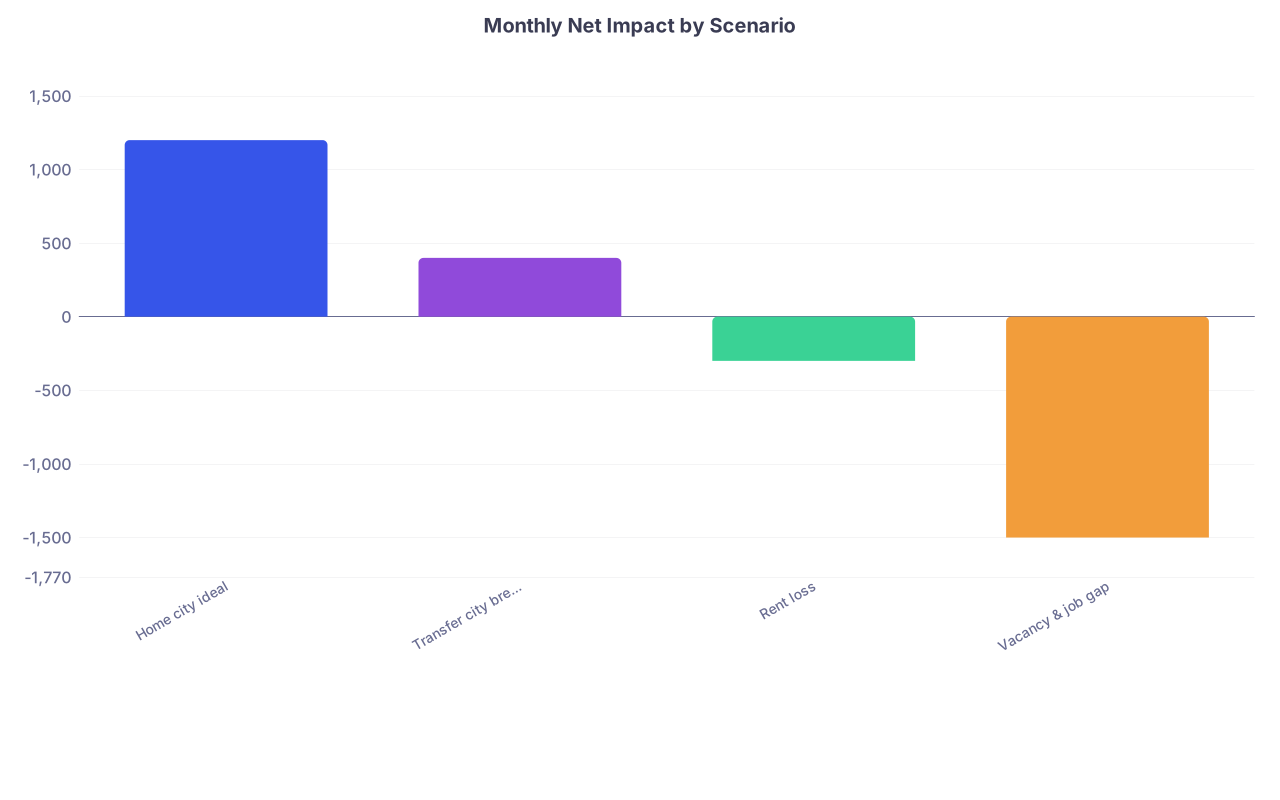
| Category | Value |
|---|---|
| Home city ideal | 1200 |
| Transfer city break-even | 400 |
| Rent loss | -300 |
| Vacancy & job gap | -1500 |
If scenario 3 or 4 would literally break you financially, that needs to feed back into your rank list. You may:
- Prefer lower cost‑of‑living cities.
- Prefer regions where the partner’s career prospects are stronger.
- Decide to be more aggressive about staying put—even if it means switching specialty or reapplying.
Do not do this math after Match Day. Do it now.
Step 8: Communication with Programs (Without Over‑sharing)
You do not need to announce your mortgage on every interview day. But you should absolutely leverage geographic ties and your partner’s career when it helps.
You can say in interviews and in your PS or supplemental:
- “My partner’s career is based in this region and we’ve purchased a home here; we’re committed long term.”
- “We have strong family and professional roots in [City], and it’s our clear first choice location to train and practice.”
Programs like residents who will stay. It’s a plus.
What you do not do:
- Threaten: “If I don’t match here, my life falls apart.”
- Sound inflexible to learning opportunities: “I’m only ranking programs in this one zip code.”
Just show that you’re not using them as a backup and that you have a realistic plan.
Step 9: Have a Plan if Things Go Sideways
You need a pre‑agreed “if this, then that” set of decisions. Otherwise you’ll try to improvise during the worst stress of your life.
Things to decide now:
If you both match in another city:
- Are you selling or renting the house?
- Is your partner quitting or transferring jobs? On what timeline?
- Will you live on one income temporarily? For how long?
If only the med partner matches somewhere else:
- Are you doing long distance? For a year? For the whole residency?
- Are you okay refinancing or moving tenants in quickly?
- Is the partner with the job willing to leave it if a PGY‑2 transfer becomes available back home?
If you do not match:
- Are you open to SOAP in any location just to secure a position?
- Would you rather go unmatched and reapply locally next year to protect the house/career?
- Are you willing to change specialties to increase odds locally?
Write this down. Two pages. Call it “Contingency Document.” You’ll still adjust when reality hits, but at least you have a starting point.

Step 10: Emotional Reality: You Can’t Optimize Everything
The hardest part for couples in your situation is accepting that you cannot win on every axis at once:
- Keep the house
- Keep the career
- Get the dream specialty
- Get the dream program
- Stay in the same city
- Avoid financial strain
You might get 3 of those. Maybe 4 if you’re lucky and strategic.
But trying to cling to all 6 is how people end up:
- Unmatched
- Broke
- In long‑distance marriages they didn’t plan for
Better path: deliberately choose which ones matter most. Example tradeoffs I’ve seen work:
- “We protect the career and house; I accept community IM instead of academic neuro.”
- “We prioritize matching together in same city; my partner is willing to leave current job but we keep the house as a rental.”
- “We let go of the house, keep the career path, and open our geographic range so I can still pursue a more competitive specialty.”
There is no morally correct answer. There is only the answer that lets both of you live with yourselves five years from now.
Quick Example: How This Looks in Real Life
Let me sketch a composite case I’ve seen some version of multiple times.
- Alex: MS4, wants internal medicine, Step 2 = 238, average clinical performance.
- Jordan: 31, mid‑level project manager at a manufacturing firm in Cleveland, making $95k, bought a townhouse 3 years ago, $40k equity.
Constraints:
- Jordan’s job is in‑person, but the company has a big facility in Pittsburgh.
- Mortgage: $1,650 PITI, likely rental income ~ $1,700–$1,800 if they move.
- They’d like to stay within driving distance of family in Ohio/PA.
Plan they built:
- Non‑negotiables:
- Do not destroy credit or go into foreclosure.
- Stay within half‑day drive of family.
- Specialty:
- Alex sticks with IM; competitiveness appropriate.
- Geography:
- Tier 1: Cleveland/Akron (anchor around the house and job).
- Tier 2: Pittsburgh (Jordan could request internal transfer).
- Tier 3: Columbus/Toledo/Erie/Buffalo (rent the house out, Jordan job‑hunt).
- Program list:
- Applied to every single IM program in these metros (academic + community).
- Rank pairs:
- First 10–12: Cleveland/Akron programs + “Jordan stays in current job.”
- Next 8–10: Pittsburgh programs + “Jordan transfers internally.”
- Last 8–10: Columbus/Toledo/others + “Jordan job‑hunts, house rented.”
Outcome:
- Matched to a solid, not‑fancy community program in Pittsburgh.
- Jordan transferred to the Pittsburgh facility at slightly lower pay, townhouse rented at +$50/month.
- Not the original “perfect plan,” but financially stable, together, within 2.5 hours of family.
That’s what a real win looks like with a mortgage and prior career in the mix.

FAQ (Exactly 5 Questions)
1. Should we delay graduation or take a research year so we can better align with my partner’s career or housing situation?
If your current options locally are extremely limited (e.g., one hyper‑competitive program in your specialty), a delay or research year can be rational. It gives you time to strengthen your application, possibly add programs (new residency openings, new affiliations), and align better with your partner’s career transitions. But don’t take a year off just to “wait for something to change” without a concrete plan: you need clear goals (Step 2 improvement, publications, networking with local programs) and a specific payoff in mind.
2. We own a house but are underwater on the mortgage. Should we still prioritize staying in this city?
Being underwater is a financial hit, not always a permanent anchor. If leaving the city opens up many more realistic programs and both of you can work elsewhere, it may be better to accept a controlled loss (short sale, renting at a modest negative, or aggressive savings to cover a move) rather than risking an unmatched year. Talk to a financial planner or housing counselor early; do not let shame about a “bad financial decision” dictate your entire residency trajectory.
3. Is it ever smart to not couples match and just try to match independently in the same region?
Yes, in certain cases. If your partner’s career is fully remote or extremely flexible and the main constraint is the mortgage (which doesn’t care which exact city you’re in as long as you can pay it), you might not need to couples match. Also, if your specialties and competitiveness levels are wildly mismatched, coupling can reduce flexibility. But if co‑location in the same metro is crucial and both of you are relatively constrained, couples matching with a carefully built list usually gives you more control over how far apart you might end up.
4. How much should I tell programs about my partner’s job or our mortgage?
Use it as evidence of geographic commitment, not as emotional leverage. You can mention that your partner works in the area and that you own a home there to show roots and long‑term plans. Do not imply that your life will fall apart if you don’t match there or that you aren’t open to the demands of training. Programs want residents who will show up, work hard, and likely stay; they do not want people who seem fragile or desperate.
5. What if we disagree on priorities—one of us cares more about the career/house, the other about specialty or prestige?
You need a structured conversation, not a series of late‑night arguments. Each of you should write down, separately, your top three priorities and your red lines. Compare lists. If there’s serious misalignment, consider a neutral third party: couples therapist, faculty advisor, or mentor who understands both medicine and real life. The decision is not “Who wins?” It’s “What scenario can both of us accept, five years from now, without resentment?” If you can’t find that, you may need to reconsider either the relationship dynamic or the rigidity of your career expectations—before the Match forces a choice for you.
With your constraints on the table, your finances modeled, and a rank list that reflects reality instead of fantasy, you’re no longer just hoping the algorithm is kind. You’re steering it. The next piece in your journey is how you actually present yourselves—to programs, in interviews, as a couple with roots and a plan. But that’s a story for another day.


