

The couples match will not magically fix a shaky long‑distance relationship. It will magnify whatever is already there.
If you’re already long-distance as med students and staring down the Couples Match, you’re in one of the most logistically brutal but manageable scenarios in medical training. The good news: you actually have some advantages over couples who’ve always been in the same city. The bad news: if you approach this like two solo applicants stapled together, you will get burned.
Let me walk you through how to handle this like adults who want jobs, not like two panicked M4s hitting “couples” at the last minute and hoping geography will be kind.
1. Start With a Hard Reality Check (Together, Not in Your Heads)
You do not start with ERAS. You start with a brutally honest conversation.
Not a 10‑minute “we’ll figure it out.” I mean a 60–90 minute call where you both treat this like a major life planning meeting.
You need answers to three categories: relationship, geography, and competitiveness.
Relationship reality
Ask and answer out loud:
- “Are we 100% committed to training in the same city if at all possible?”
- “If the only way to be together is one or both of us going to a less desirable program, are we okay with that?”
- “If we don’t match in the same place, what’s our plan? Stay together long-distance again? Re-evaluate?”
If one of you is quietly thinking, “If I got my dream program and they didn’t, I’d probably just take it,” you either need to say that now or not couples match. Silent fantasies destroy rank lists.
Geographic reality
You’re long‑distance already. That changes the game.
You both need to answer:
- “Are we okay limiting ourselves to specific regions?”
- “Is one of us willing to move across the country to the other’s ‘home base’?”
- “Is there a true ‘must‑be-near-family’ constraint for either of us?”
Then define 3–5 clear regions where there are densities of programs for both of you. A single city with one program for one of you and one extremely competitive program for the other? That’s not a “target region.” That’s a fantasy.
Competitiveness reality
This part requires numbers, not vibes.
Each of you write down:
- Step 1 (if numeric), Step 2 CK score
- Class rank/quartile or AOA status
- Publications / meaningful research
- Red flags: leaves, failures, professionalism issues
- Target specialties + backup(s) if applicable
Then compare, bluntly.
If one of you is applying anesthesia with a 255 and strong research and the other is applying derm with a 270 and 8 pubs, your strategies are totally different than if you’re both mid‑tier applicants in primary care.
Couples match punishes delusion. If you’re the weaker applicant in a more competitive specialty in a saturated city, you may have to be the one who flexes most.
2. Understand How the Couples Match Actually Works (And Why It’s Ruthless)
The couples match doesn’t “give preference” to couples. It just lets the algorithm treat you as a unit.
You submit pairings of ranks, like:
- (Program A – You, Program X – Partner)
- (Program B – You, Program Y – Partner)
- (Program C – You, Program X – Partner)
…
N. (Program Z – You, No Match – Partner)
N+1. (No Match – You, Program W – Partner)
If the algorithm can’t place you both in one of your paired options, it keeps going down. That’s it. No romance. No mercy.
Here’s what that means in practice:
- You will likely rank fewer “dream” combinations than each of you would solo.
- You should assume more risk of going unmatched if you only create an aspirational list.
- You must be okay with “one matches, one doesn’t” pairings if you want to avoid both going unmatched.
Most couples wildly underestimate how long their list needs to be. Especially when they already live apart and are trying to converge.
3. Map Out Your Realistic Geography (Not Your Fantasy Map)
This is where being long‑distance actually helps you: you’re already used to thinking in airports and highways, not just zip codes.
You’re trying to solve three questions:
- Where can you both get enough interviews?
- Where are there multiple programs for at least one of you?
- Where would you actually live happily, not just tolerate?
Make a simple table. Yes, an actual table.
| Region/City | Your Specialty: # of Programs | Partner Specialty: # of Programs | Both Reasonably Competitive? |
|---|---|---|---|
| Boston | 4 | 3 | Yes |
| Chicago | 6 | 5 | Yes |
| Denver | 1 | 1 | Maybe |
| Rural Midwest | 3 | 2 | Yes |
| West Coast (SoCal) | 5 | 1 | No |
Your top regions should look like Chicago and Boston in that example. Multiple programs for each of you. Redundancy.
That single‑program city that you “both love”? That goes down the priority list unless you’re both extremely strong applicants in not‑insanely‑competitive fields.
4. Specialties, Competitiveness, and Who Bends
The harsh part: one of you almost always has to bend more.
If both of you are applying to moderately competitive specialties (EM, anesthesia, gen surg) or one very competitive + one less competitive (derm + IM, ortho + FM), you can’t both behave like solo top‑choice applicants.
If one of you is in a highly competitive specialty
Derm, ortho, plastics, neurosurg, some ROAD specialties. You know who you are.
If that partner is solid on paper (top scores, strong research, good letters), the other partner usually has more flexibility:
- Broader geographic spread
- Willingness to rank solid but non‑fancy programs higher
- Considering prelim years or backup specialties if necessary
If the competitive‑specialty partner is average or has red flags? Now the whole couple has to be conservative:
- Apply very broadly (think 60–100+ programs for the competitive partner)
- Strongly consider a “safety” specialty or transitional year plan
- Have a clear line where you will not couples match and will instead do separate matches to avoid both going unmatched
If both of you are in less competitive specialties
Think IM + FM, peds + psych, IM + peds, etc.
You have more room to:
- Target fewer but denser regions
- Put quality of fit higher on the list
- Aim for most of your pairings being “same city, different hospital” before expanding outward
But don’t get cocky. The couples penalty still exists: two average applicants tied together are less flexible than two average solo applicants.
5. Application Strategy When You’re in Different Cities
Being long-distance means your “home program advantage” is split. You’re “local” in two separate places. Use that.
How many programs to apply to?
Here’s a rough, not‑sugar‑coated guideline for couples already long‑distance:
- Stable/strong applicants in non‑competitive fields:
20–40 each if you have 2–3 dense regions where both are viable. - Average applicants or mildly competitive fields:
40–60 each. - Competitive specialty + anything:
Competitive partner: 60–100+ programs.
Less competitive partner: 30–50, but broad and aligned with the competitive partner’s regions.
When in doubt, apply broadly and sort it out later with interviews. Application fees hurt less than a SOAP nightmare.
Coordinating program lists
Do not build your program lists in isolation and then try to overlap them. That’s how you end up with 12 shared programs and a meltdown.
Instead:
- Each of you makes your full “if I were solo” list.
- Put them side-by-side and highlight:
- Same city, same hospital
- Same city, different hospitals
- Nearby cities within commutable distance (e.g., Philly–Camden, Dallas–Fort Worth)
- Add extra programs in your partner’s key cities where you’d be willing to train.
Your goal: create as many overlap zones as possible before interview season starts.
6. Interviews: How to Coordinate Without Losing Your Minds
Interview coordination is where already being long‑distance can either destroy you or save you.
You’re used to planning visits and flights. Now you’re adding interview dates and program politics.
Communicating with programs
You are allowed to mention that you’re couples matching. You just have to do it like a professional, not a manipulative mess.
Good email after one of you receives an invite:
Dear Dr. Smith,
Thank you very much for the interview invitation to your Internal Medicine residency program. I’m very excited about the opportunity to learn more.
I also wanted to mention that I am participating in the NRMP Couples Match with my partner, [Name], who has applied to your [Specialty] program. We are both very interested in training in the same institution and region.
If possible, we would appreciate consideration for interview dates that overlap or are close together to allow us to travel more efficiently.
Thank you again for your time and consideration.
Sincerely,
[Your Name]
You’re not asking for a favor in ranking. You’re asking for logistical help. Programs are usually receptive.
Deciding where to actually interview
You’ll both get interviews in places that only one of you is excited about. You cannot go to every single one without burning money and sanity.
Priority should usually go to:
- Cities where you both have interviews
- Cities with multiple programs for one or both of you
- Your agreed “anchor” regions (near family, great support, etc.)
Low‑priority interviews:
- Single isolated programs in cities the other person has zero chances
- Prestige programs in solo locations that would completely break the rest of the strategy
Sometimes one of you goes to a “selfish” interview (dream solo program) as a backup plan in case you later decide not to couples match or you both would rather match separately than go unmatched. That’s a valid strategy. You just need to say that explicitly.
7. Building the Rank List Without Killing Your Relationship
Ranking is where couples lose their minds.
You have to accept three truths:
- Nobody gets everything they want.
- There will be at least 2–3 pairings one of you hates more than the other.
- Someone will feel like they compromised more. They probably did.
The actual process
Do this in stages, not in one drunken call the night before the deadline.
Stage 1: Individual rankings
Each of you ranks your programs as if you were solo. Honest list. Don’t pre-adjust for your partner.
Stage 2: Combine lists by city
Create a shared document with combinations:
- Same hospital, same program (if applicable)
- Same city, different hospitals
- Neighboring cities that are a realistic commute or life (not 2‑hour drives each way)
Stage 3: Color code combinations
Use simple categories:
- Green: Both would be genuinely happy
- Yellow: One happy, one “fine with it”
- Orange: One pretty unhappy, but still better than not matching
- Red: Deal-breakers / would rather not match than end up here
If more than 30–40% of your realistic combinations are “orange” or “red,” your expectations are off. You’re trying to have it both ways: perfect programs and perfect geography.
Stage 4: Decide on your “drop-off” point
You must agree on where you switch from “same city or nearby” pairings to “one matches, one doesn’t” or “both in different cities.”
There are couples who absolutely refuse “one matches, one doesn’t.” That’s fine. Then you must live with the increased risk of both going unmatched.
There are couples who say, “Past rank #30, we’re willing to put in combinations where one of us doesn’t match before we consider both going unmatched.” That’s also fine. Just be intentional.
This is where you say out loud:
- “Are we willing to live apart again for 3–4 more years if it means better programs?”
- “Would we rather both match somewhere less ideal than have one of us unmatched?”
The couples who don’t ask these questions end up screaming at each other on match day. Or quietly resentful.
8. Contingency Planning: If One or Both of You Don’t Match
You’re already long‑distance. You know what it’s like to not have the relationship be easy. That’s actually an advantage here. You’ve done hard.
But you still need clear contingency plans.
If one of you doesn’t match (and the other does)
This is where that early conversation matters.
Your options:
- SOAP in the same city/region as the matched partner if possible
- Prelim or transitional year near the matched partner, then reapply
- The unmatched partner moves to the matched partner’s city and does research or a master’s year if residency options are awful
Write this down in advance, in plain language:
“If one of us doesn’t match and the other does, our default plan is:
- Try to SOAP near the matched partner,
- If that fails, unmatched partner moves to matched partner’s city for a research or prelim year,
- We reassess together after that year.”
You can change it later. But having a default prevents panicked, impulsive decisions in March.
If both of you don’t match
It happens. Less often than people fear, but it does.
You regroup with:
- SOAP options that keep you in the same city if at all possible
- Willingness to consider prelim/TY + reapplication
- A bigger, broader, much more realistic list the next cycle
The relationship question becomes: are we still a “we” in all of this, or did we just staplegun ourselves together and hope? The work you do now answers that.
9. Protect the Relationship While You’re Doing All This
You’re not just coordinating databases. You’re two extremely stressed people in different places.
Some simple guardrails:
- Schedule “application meetings” and keep the rest of your calls non‑application focused. Don’t let every conversation become “so what about that Chicago program?”
- Be explicit about appreciation. “Thanks for being willing to consider those smaller programs near my family” goes a long way.
- Don’t weaponize sacrifice. If you’re compromising more this year, you talk about it calmly–you don’t throw it back in fights.
- Decide on at least one non‑negotiable joy thing you’ll do together after rank submission, no matter what. A trip, a weekend, something to mark the end of this grind.
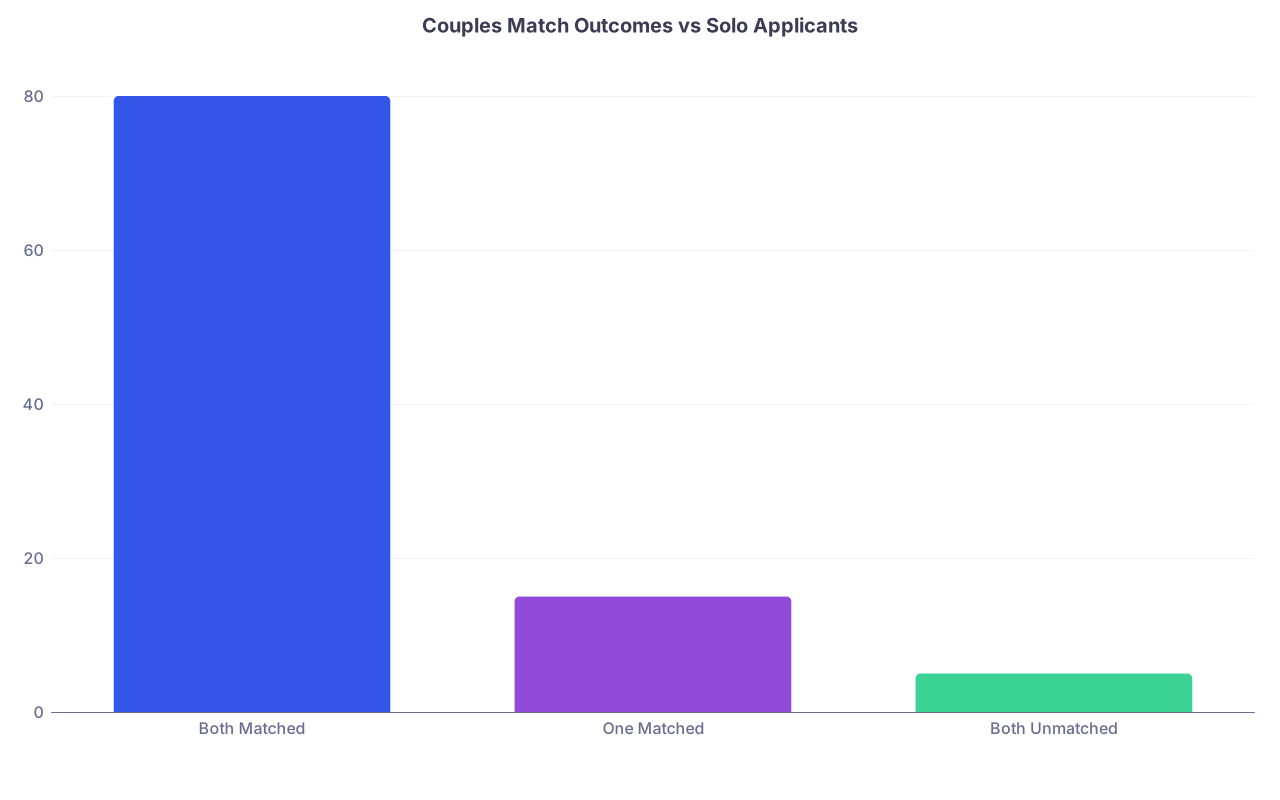
| Category | Value |
|---|---|
| Both Matched | 80 |
| One Matched | 15 |
| Both Unmatched | 5 |
(Those aren’t exact NRMP numbers, but directionally: most couples match both. The real question is where and how happy you are with those “where”s.)

| Step | Description |
|---|---|
| Step 1 | Start: Already Long-Distance |
| Step 2 | Hard Reality Talk |
| Step 3 | Define Regions & Competitiveness |
| Step 4 | Build Overlapping Program Lists |
| Step 5 | Apply Broadly in Key Regions |
| Step 6 | Coordinate Interviews & Communicate Couples Match |
| Step 7 | Construct Joint Rank List |
| Step 8 | Submit Rank List |
| Step 9 | Prepare Contingency Plans |
| Step 10 | Match Day & Next Steps |
| Step 11 | Agree on Drop-Off Rules |
FAQ (Exactly 5 Questions)
1. We’re not 100% sure we want to stay together long-term. Should we still do the couples match?
If you’re not at least 90% sure you’re in this for the next several years, I’d lean strongly against couples matching. It ties your professional futures together in a way that’s very hard to undo cleanly. Consider matching separately but prioritizing the same regions, so you have flexibility if the relationship ends or deepens.
2. One of us has a red flag (leave of absence, Step failure). Does that mean we shouldn’t couples match?
Not automatically. But it does mean you both need to be more conservative: more applications, more geographic breadth, and very careful backup planning. The partner without the red flag usually needs to accept more compromise—aiming for solid but not hyper‑selective programs, especially in the regions where the flagged partner has the best shot.
3. We’re at different schools across the country. Should we try to both “home‑in” on one person’s region?
Often, yes. It’s usually smarter to pick one person’s “home base” (stronger connections, more PDs who know them, or a region with higher program density) and let that anchor your geography. But you still apply in both regions initially; then let interview offers guide you. If one region clearly has more overlap and interest, you shift your rank list weight there.
4. How many overlapping programs do we need for a reasonable couples match?
There’s no magic number, but if you end up with fewer than ~15–20 genuine overlap combinations (same city or reasonable commuting distance), you’re in risky territory unless you’re both very strong applicants in less competitive fields. The more limited your overlap, the more you should consider including “one matches, one doesn’t” pairs lower on the list to avoid both going unmatched.
5. When should we decide our “deal-breakers” for rank list pairings?
Before interview season ends, ideally. Once you’ve seen your options, schedule a real conversation where you define: cities you absolutely will not live in, program types you refuse to rank, and whether “one matches, one doesn’t” is ever acceptable. If you try to set deal-breakers the night before rank submission, you’ll fight instead of think, and one of you will feel cornered.
Key points to keep: treat the couples match as a professional logistics problem and a relationship stress test, not a fairy tale. Use your long‑distance experience to be brutally realistic about geography, compromise, and contingency plans. And have the hard conversations early, on purpose, while you still like each other—not late, when you’re both exhausted and terrified.


