

The couples match is a terrible place to test a shaky relationship.
If your couples match just fell apart—or is clearly about to—you are not “dramatic,” you are not “overreacting,” and you are absolutely not the first person to be stuck in this mess. But if you handle the next 7–14 days badly, you can wreck your training options for years.
I’m going to walk you through exactly what to do, step by step, if your couples match falls apart before, during, or right after Match season.
1. First: Figure Out Exactly Where You Are in the Match Timeline
The options you have depend brutally on timing. Feelings matter, but the calendar is king here.
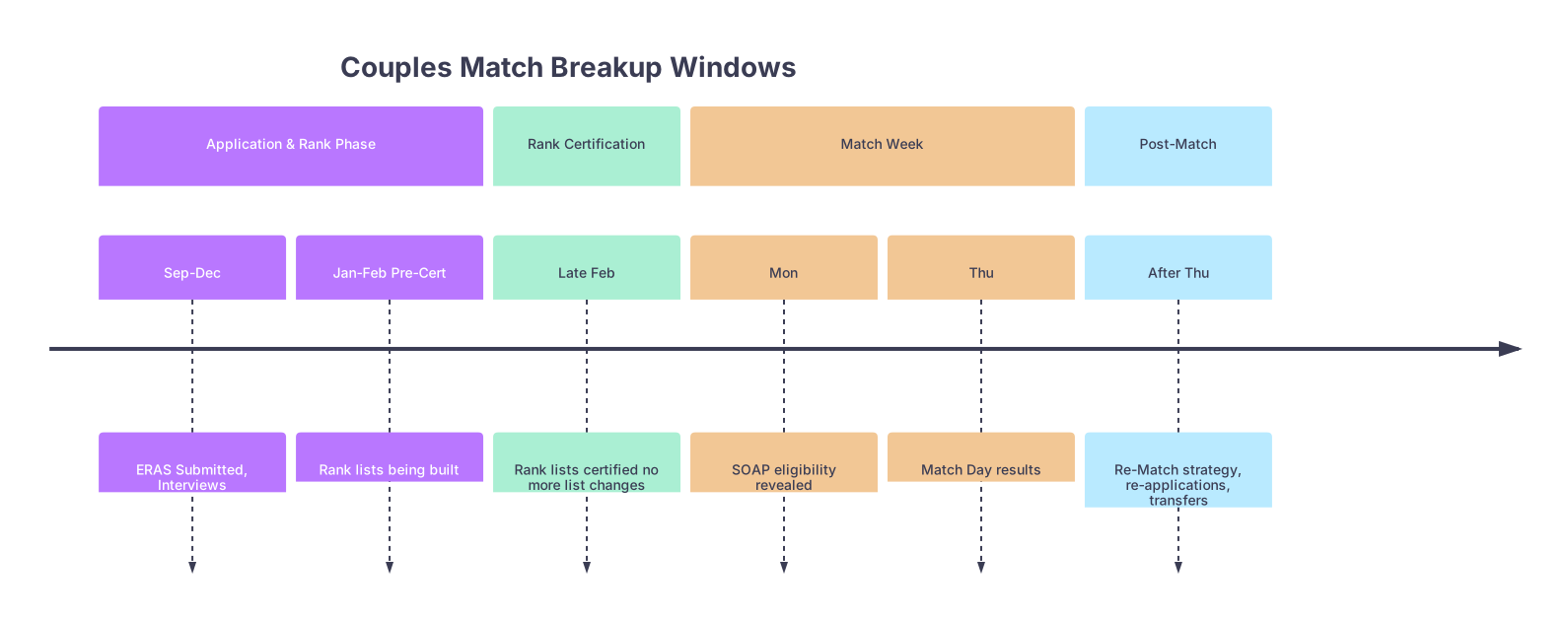
| Period | Event |
|---|---|
| Application & Rank Phase - Sep-Dec | ERAS Submitted, Interviews |
| Application & Rank Phase - Jan-Feb Pre-Cert | Rank lists being built |
| Rank Certification - Late Feb | Rank lists certified no more list changes |
| Match Week - Mon | SOAP eligibility revealed |
| Match Week - Thu | Match Day results |
| Post-Match - After Thu | Re-Match strategy, re-applications, transfers |
You’re in one of these buckets:
- Before rank lists are certified
- After rank lists are certified but before Match Day
- During Match Week (SOAP)
- After Match Day, pre-residency start
- In residency already, considering transfer/re-match
Different rules. Different landmines.
Let’s break it down.
2. If the Breakup Happens Before Rank Lists Are Certified
This is the best terrible scenario. Painful emotionally, but fixable on paper.
Step 1: Decide if you’re actually uncoupling in NRMP
There’s a difference between:
- “We had a big fight”
- “We’re not sure where this is going”
- “We are not doing couples match anymore”
You only need to act if it’s that last one.
Be blunt with each other:
- Are we staying coupled in NRMP no matter what?
- If yes: we adjust ranks but keep the couple.
- If no: we each need our own individual rank list. Period.
If one of you wants to uncouple and the other doesn’t, the one who wants to uncouple wins, practically speaking. You can’t force someone to be in a formal match pair with you.
Step 2: Contact NRMP (and know what’s actually allowed)
Don’t rely on Reddit rumors. NRMP has specific rules about breaking a couples match before rank lists are certified.
You need to:
- Log into NRMP and change from couples to individual (there is a process; sometimes both parties must confirm)
- Confirm that:
- You both still have valid registrations
- You both can see your individual rank order lists
If you’re confused, email NRMP support that day. Use clear language:
- “We are currently registered as a couple for Match 202X. We have decided to break our couple status and submit separate rank lists. What steps must we take to do this before the rank list certification deadline?”
Then do exactly what they say.
Step 3: Rebuild your rank list for you, not “us”
This is where people screw up badly because they’re still half-planning for the relationship that just died.
You need to answer:
- What’s my priority now? Prestige? Location? Family support? Lifestyle?
- Am I geographically flexible now that I’m not tied to another specialty/location?
- Which programs did I only rank because they worked for the couple, not for me?
Be ruthless. Delete combos/programs that were only good for the pair.
If you originally over-weighted “same city” over program quality, you may actually have better options once you’re solo.

Step 4: Decide what to tell programs (if anything)
You are not required to tell programs your personal life story.
Situations where I’d consider contacting programs:
- You told a PD or faculty, in writing or in an interview, “I’m couples matching to the X city area with my partner.”
- Your application explicitly mentioned the couples match in your personal statement or during the interview.
In that case you can send a short, clinical update:
- “I wanted to update you that I am no longer participating in the couples match and will be submitting an individual rank list. My interest in your program remains strong, particularly because of X/Y/Z.”
No drama. No details. No “we broke up and I’m devastated.”
3. If the Breakup Happens After Rank Lists Are Certified but Before Match Day
This is the nightmare timing. You cannot change your list. You cannot uncouple for this cycle.
You’re stuck with the couples rank list. But you still have moves.
First: Stop trying to game “where we might match”
Once lists are certified, the match algorithm does not care about your current relationship. It will place you as a couple according to the combined list you submitted.
You can’t:
- Secretly back out
- Tell programs “please don’t rank me” (and expect the system to honor that cleanly)
- Call NRMP and say “we broke up, undo it”
You ride it out.
What you can do right now
Emotionally detach from outcomes that involve the other person.
You might both match in the same city and never speak again. You might end up across the country. Assume any combination is possible.Start planning for worst reasonable case:
- What if you match to a city where you now have zero support system?
- What if you’re near them and it’s toxic?
- What if you don’t match and they do?
Quietly line up contingency support:
- Where would you live if you end up near them? Don’t live in the same building.
- Who do you know in each likely city?
- Where are you going to get therapy or counseling coverage?
You’re preparing your life logistics, not your match outcome. The outcome’s already locked.
4. If the Breakup Collides with Match Week / SOAP
This is where people really melt down. Don’t. You do not have time.
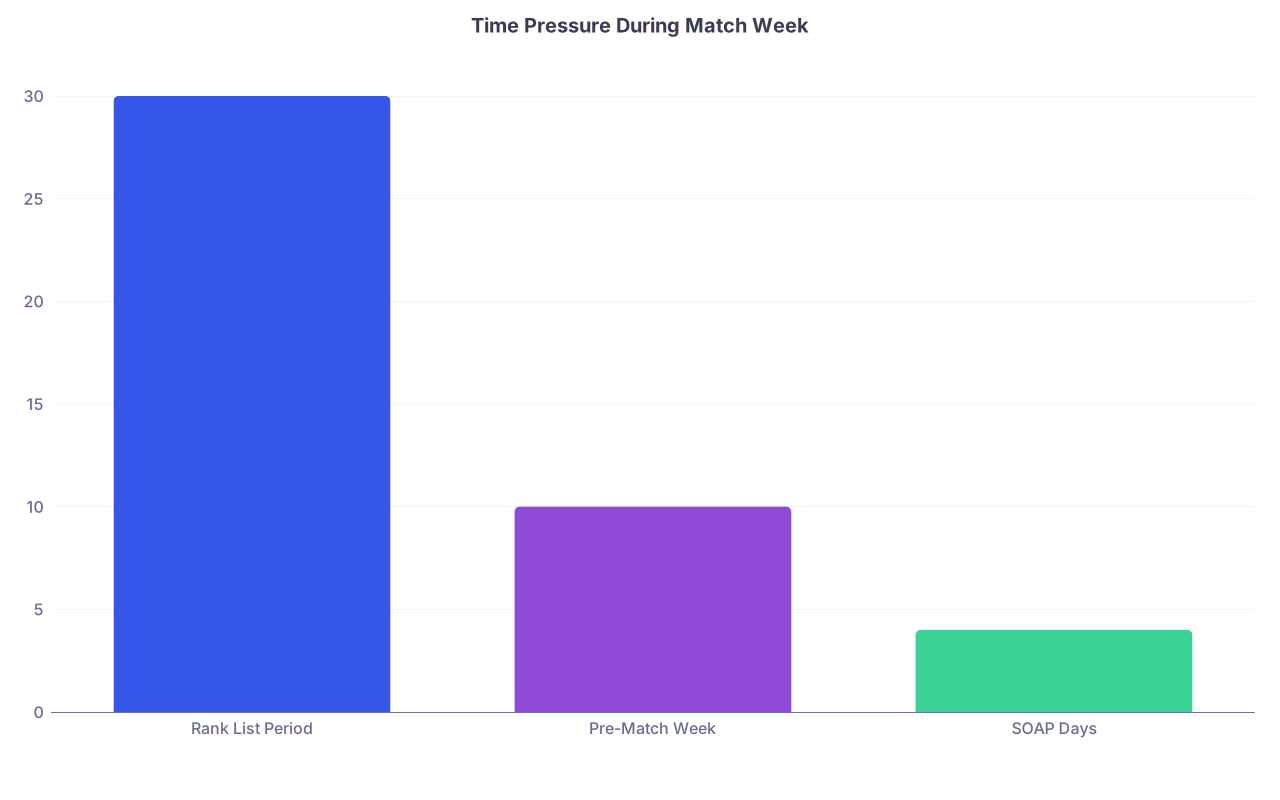
| Category | Value |
|---|---|
| Rank List Period | 30 |
| Pre-Match Week | 10 |
| SOAP Days | 4 |
SOAP is four days of controlled chaos. If you’re broken up, here’s the rule:
You are now an independent applicant, even if the algorithm still sees you as a couple for the initial match result.
If you find out Monday that you did not match
On Monday:
- You learn “Matched” or “Did not match”.
- Couples can end up in any combo:
- Both matched
- One matched, one not
- Both unmatched
If you’re unmatched:
- SOAP is not couples-based. It’s just you vs the list of unfilled positions.
- Your ex’s situation is now irrelevant to your SOAP planning.
Do this:
Sit with your advisor / dean that day
Tell them:- “We couples matched. The relationship ended. I need to approach SOAP as an individual and I may not want to be in [same city/region] as them if possible.”
They don’t need gossip. They need constraints.
- “We couples matched. The relationship ended. I need to approach SOAP as an individual and I may not want to be in [same city/region] as them if possible.”
Re-prioritize SOAP programs as if the couple never existed
Forget geography for the relationship. Think:- Where can I function with minimal support?
- Where do I have family / friends?
- Which specialties am I realistically willing to do if my original one is scarce?
Coordinate zero with your ex Do not try to “SOAP together” or “see where the other’s going.” That just adds drama with no benefit.
If you matched but hate where you landed because of the ex
If the breakup happened late and the algorithm placed you based on couples preferences, you might end up:
- In a city you only chose for them
- In a weaker program because it paired nicely with theirs
You still have options, but not during Match Week. You’ll be thinking:
- How do I survive PGY-1 here?
- Do I plan to transfer after intern year?
- Do I re-apply next cycle?
More on that in a bit.
5. After Match Day: You Matched, But the Couple Is Over
So you matched as a couple, but the relationship is dead. Same city. Maybe same hospital system. Maybe same program.
You have two jobs: protect your training and protect your sanity.
Step 1: Decide how “disaster-level” this is
There’s a spectrum:
- Civil breakup, can be polite, no safety concerns
- Messy, emotional, but not dangerous
- Toxic, controlling, stalking, or safety issues
The more serious it is, the sooner you loop in someone on the residency side.
If there are any safety concerns:
- You treat this like any other workplace/school safety issue.
- You may need to talk to GME, program leadership, or even campus security.
If it’s just messy and painful:
- You aim to keep it out of the formal system if you can, but you still plan boundaries.
Step 2: Think through living and working boundaries
Do not double down on bad decisions out of embarrassment.
- If you planned to live together: cancel it.
- If you put your name on a joint lease: talk to the landlord now about getting off, subletting, or splitting responsibility.
- If you’re at the same program:
- Different call schedules when possible
- Avoid same research projects initially
- Don’t sign up for the same social things reflexively

Step 3: Decide if you’re going to disclose to your program
If you’re in the same institution, they’ll figure out you used to be a couple. These environments are small and gossipy.
What you control is the framing.
You can choose one of these routes:
Say nothing until/unless there’s a problem
- Works if breakup is civil and both of you intend to be professional.
Quiet, short disclosure to chief(s) or PD
- “I want to give you a heads up: we entered the match as a couple but are no longer together. We’re both committed to being professional. I’m letting you know in case you see anything odd or scheduling issues come up.”
Formal, documented disclosure if it’s volatile
- “I am concerned about potential conflict that could affect the work environment. I’d like this documented and would appreciate help separating schedules/rotations where feasible.”
What you do not do:
- Give them your emotional play-by-play
- Ask them to take sides
- Use this to punish the other person
Residency leadership wants stability. Show them you’re stable.
6. When the Breakup + Match Outcome Is So Bad You Consider Re-Matching
Sometimes the combination is just awful:
- You hate the location
- The program is a poor fit
- You’re near an ex who’s unhealthy for you
And you start thinking: “Should I just re-apply next year?”
Here’s the blunt truth: that’s a high-cost move.
| Option | Pros | Cons |
|---|---|---|
| Stay in current program | Stability, salary, training | Location/relationship stress |
| Try to transfer after PGY-1 | Keep credit for year | No guarantee, limited spots |
| Re-apply from scratch (no start) | Choose fresh location/program | Gap year, financial strain |
Option A: Stay, survive, and grow
If:
- The program is decent
- You’re not in physical/psych danger
- You can reasonably separate your life from the ex
Then the most rational move is often:
- Do your intern year
- Build strong evals
- Reassess after 6–12 months whether you truly need to transfer or re-match.
Medicine careers are long. One painful location is not your whole story.
Option B: Try to transfer after PGY-1
This is more realistic than starting over sometimes.
Path:
- Do well in your first year. No professionalism issues. Solid evaluations.
- Quietly talk with your PD: “Long-term, for personal reasons, I may need to be in [different region]. If opportunities arise for PGY-2 positions closer to that area, would you be open to supporting a transfer?”
- Watch for open PGY-2 spots on clearinghouses and specialty listservs.
Transfers are easier:
- In IM, peds, psych, FM
Harder: - In very competitive or small specialties (derm, ophtho, some surgical fields)
Option C: Full re-match / re-apply
Usually only makes sense if:
- You’re in a specialty you never truly wanted and only ranked high for the couple, and
- The mismatch is so profound you’d be miserable long term, and
- You can financially and emotionally afford a “gap year” outcome if it doesn’t work.
If you do this:
- Get honest advising from someone who is not invested in protecting your feelings.
- Be prepared to explain the gap and previous match in a mature, non-dramatic way:
- “I originally matched into X in Y city as part of a couples match. After starting, it became clear the specialty wasn’t aligned with my strengths or long-term goals. I stepped away, and have spent the past year doing Z (research, clinical work, etc.) while preparing to re-apply in a field that fits better: A, B, C.”
You own your choice. You don’t blame the ex or the relationship in official conversations.
7. Protect Your Reputation While Your Personal Life Is Burning
Residency and the Match world are tiny. People talk. You can’t stop that.
You can control:
- What you put in writing
- Who you vent to
- How you show up professionally
Some non-negotiables:
- Don’t email PDs or faculty in the heat of emotion. Ever.
- Don’t trash your ex to attendings, chiefs, or coordinators. They will remember you as “the messy one,” not “the wronged one.”
- Don’t ask mentors to “take your side.” Ask for advice, not advocacy against the other person.
Use:
- Friends outside medicine
- Therapist
- Family
Leave:
- PDs, faculty, coordinators
for neutral, professional communication only.
8. Conversation Scripts You Can Actually Use
You’re probably dreading what to say. So here’s the cheat sheet.
To your ex, when deciding whether to uncouple in NRMP (pre-certification)
“I need clarity on the Match part separate from our relationship. Are you planning to stay in the couples match with me, or do you want us to submit individual rank lists? I’m okay either way, but we have to decide so we can adjust before the deadline.”
To your dean / advisor (if things blow up before or during Match Week)
“We entered the couples match together, but the relationship has ended. I want to plan my next steps purely as an individual and make decisions that are best for my training and wellbeing. I’d really appreciate your help thinking through options.”
To a PD after you’ve broken up but matched to the same institution
“I wanted to briefly share something that may be relevant. I matched here as part of the couples match, but the relationship ended recently. I’m committed to professionalism and keeping any personal matters separate from work. I’m telling you only so that if any scheduling or team issues arise, you have context. I don’t need anything specific right now—just wanted you to be aware.”
To friends/colleagues when rumors start
“Yeah, we’re not together anymore. We’re keeping it professional at work. I’d rather not get into the details, but I appreciate you asking.”
Short. Clean. Dead-end for gossip.
9. Where SOAP and Re-Match Strategy Actually Change After a Breakup
Let’s be concrete.
If you’re now solo, you should re-prioritize:
Geography:
Before: “We need to be in the same city.”
Now: “Where can I function and be supported?”Specialty flexibility in SOAP:
Before: Maybe you limited SOAP options to avoid separating from them.
Now: You consider a broader range of programs/specialties that align with your long-term goals—even if that’s across the country.Long-term story:
You’re now crafting your narrative as an individual. Programs care about:- Stability
- Insight
- Commitment to the specialty
They do not care about:
- The blow-by-blow of your breakup
- “Who hurt who”
Focus on: What did you learn? How did you handle adversity? How does this experience make you a stronger, more grounded resident?
FAQ (Exactly 5)
1. Do programs find out that we couples matched if we break up before Rank Day?
Not automatically. Many programs will never know you were a couple unless you told them during interviews or put it in your application materials. If you uncouple before lists are certified and you never mentioned it, they’ll just see you as two separate applicants.
2. Can I ask NRMP to undo my couples match after rank lists are certified because of a breakup?
No. Once rank lists are certified, the system treats you as a couple for that cycle. NRMP doesn’t make exceptions for relationship status changes. Your only options are planning your life around that outcome and making downstream moves (SOAP, transfer, or future re-match).
3. If I matched into a program just for the relationship, is it “unprofessional” to try to transfer later?
Not inherently. What matters is how you perform where you are and how you frame the transfer. You don’t say “I only came here for my ex.” You say: “For personal and family reasons, I need to relocate closer to [region], and I’m hoping to continue my training in the same specialty.” Strong performance and a mature explanation make transfers very normal.
4. Should I warn my PD about my ex if we’re in the same residency class?
If you can both be civil and keep it together, you don’t have to. If there’s any chance of conflict spilling into the workplace—or any safety concern—yes, quietly let them know in a short, factual way. Your goal isn’t to trash the other person. It’s to give leadership the context they need to protect the work environment.
5. Does a failed couples match hurt my chances if I re-apply in a future cycle?
Not by itself. What will matter is: your performance since then, the strength of your application, and how you explain your path. If your story is “I was in a couples match, things changed, I reassessed, and here’s the specialty and training path that actually fits me now,” that can come across as mature and thoughtful. If you sound bitter, blame-heavy, or chaotic, that will hurt you far more than the fact that you once couples matched.
Key points:
- Your options depend entirely on timing—pre-certification, post-certification, SOAP, or post-Match all have different rules.
- Stop planning for “us” the minute the relationship is clearly over; all your rank, SOAP, and transfer decisions must be built around you.
- Protect your professional reputation: keep the drama out of emails and out of your program, and use transfers or re-match only when the training misfit—not the heartbreak—is truly severe.


