

It’s late November. You’re on a Zoom interview, you just admitted you’re couples matching, and the program director pauses, looks down at their spreadsheet, and says, “Oh, interesting – who are you couples matching with and what specialty?”
You answer. They nod. They say something bland like, “We’re very supportive of couples match.”
The call ends.
Then they open a different Excel tab labeled something like “Couples / Special Cases” and that’s where the real conversation about you happens.
Let me tell you what really goes on in those rooms.
The First Reaction: Asset, Problem, or Neutral?
Every PD I know has an immediate, gut-level categorization when they see “Couples Match” on ERAS or hear it in an interview. They won’t say this out loud, but they think it:
- “This might help us get both of them.” (Asset)
- “This is going to complicate our list.” (Problem)
- “Okay, doesn’t change much.” (Neutral)
Which bucket you land in depends on four things that nobody explains clearly to you:
- Your individual strength as an applicant
- Your partner’s strength as an applicant
- The competitiveness of each specialty
- The geography you’re insisting on (whether you admit it or not)
Here’s the dirty secret: programs don’t primarily care about your relationship. They care about whether your couple status makes their ranking work easier or harder.
If you’re both strong, both in moderately competitive or less competitive specialties, and open to a few nearby cities? You’re an asset. You can anchor into two programs in the same hospital system and both are happy.
If one of you is substantially weaker, in a choke-point specialty (like derm, plastics, ortho) in a crowded metro where everyone wants to go? That’s when the internal conversations get tense.
How PDs Actually Discuss Couples Behind Closed Doors
I’ve sat in rooms where this plays out. The public party line is always, “We value couples and try to accommodate them.” The private line is more like:
- “I really want her, but I’m not sure I want to burn a spot on him to make it happen.”
- “If we rank them together, what does that do to our list if his partner doesn’t rank us high?”
- “Their partner is in a different institution across town. Are we okay being ‘the backup program’ in this city?”
Here’s how the thought process usually unfolds:
First pass: Evaluate each of you individually
They’ll look at board scores, letters, rotation performance, interview, fit. They don’t start by asking “Are they a nice couple?” They start with: “Would I rank this person if they were single?”If the answer is “no” on either side, your leverage drops dramatically.
Second pass: Evaluate you as a package
If both of you clear the “we’d rank them anyway” bar, that’s when you move into a different column: “Possible couples rank strategy.”Third pass: Rank list logistics
This is where it gets messy. PDs and coordinators start asking:- “Can we live with ranking them higher together than we normally would rank each separately?”
- “Do we need to create a ‘pairing zone’ around a certain rank range?”
- “What if we only like one of them much more than the other?”
What no one tells you: couples create extra work. Extra emails with other programs. Extra scenarios to game out. Extra risk that a spot gets “wasted” in their eyes if one partner doesn’t end up matching there.
Some programs embrace that work. Others quietly avoid it by screening couples more harshly or just ranking them low and calling it “the algorithm.”
The Single Biggest Factor: Are You Both Strong?
If you remember nothing else, remember this: couples match amplifies your partner’s profile on your application and your profile on theirs.
Program directors informally think of couples in a few archetypes:
| Archetype | How PDs Quietly View It |
|---|---|
| Power Couple (both strong) | Opportunity to snag two top residents |
| Balanced Mid-pack | Low-risk, manageable, often accommodated |
| One Star / One Struggling | Internal debate, often major headache |
| Both Weak | Low priority, often pushed down the list |
Let’s be blunt.
If you’re both solid – good Step 2, decent letters, no professionalism issues, no catastrophic red flags – many programs will lean in and try to make it work. Especially IM + peds, IM + FM, IM + neuro, etc. Program directors know stable residents with life partners are often happier and more likely to stay for fellowship or faculty. That’s a plus.
But if one of you has:
- Very low score with no redemption
- Failed Step/COMLEX without a strong comeback story
- Bad letters floating around the region
- Multiple professionalism whispers
…then you’ll hear a lot of programs say things like, “We’re supportive of couples match, but we advocate for each of you independently.” That’s PD-speak for: “We’re not tying ourselves to the weaker partner unless we’re forced to.”
At ranking meetings, I’ve heard lines like:
- “I’ll rank him where he belongs, but I’m not bumping him up just to land her.”
- “If we take both, that means we’re not taking that stellar solo applicant. Is that worth it?”
So if one of you is clearly weaker, you cannot pretend the couple label magically neutralizes that. It magnifies it.
Specialty Combinations: Who Gets Nervous, Who Doesn’t
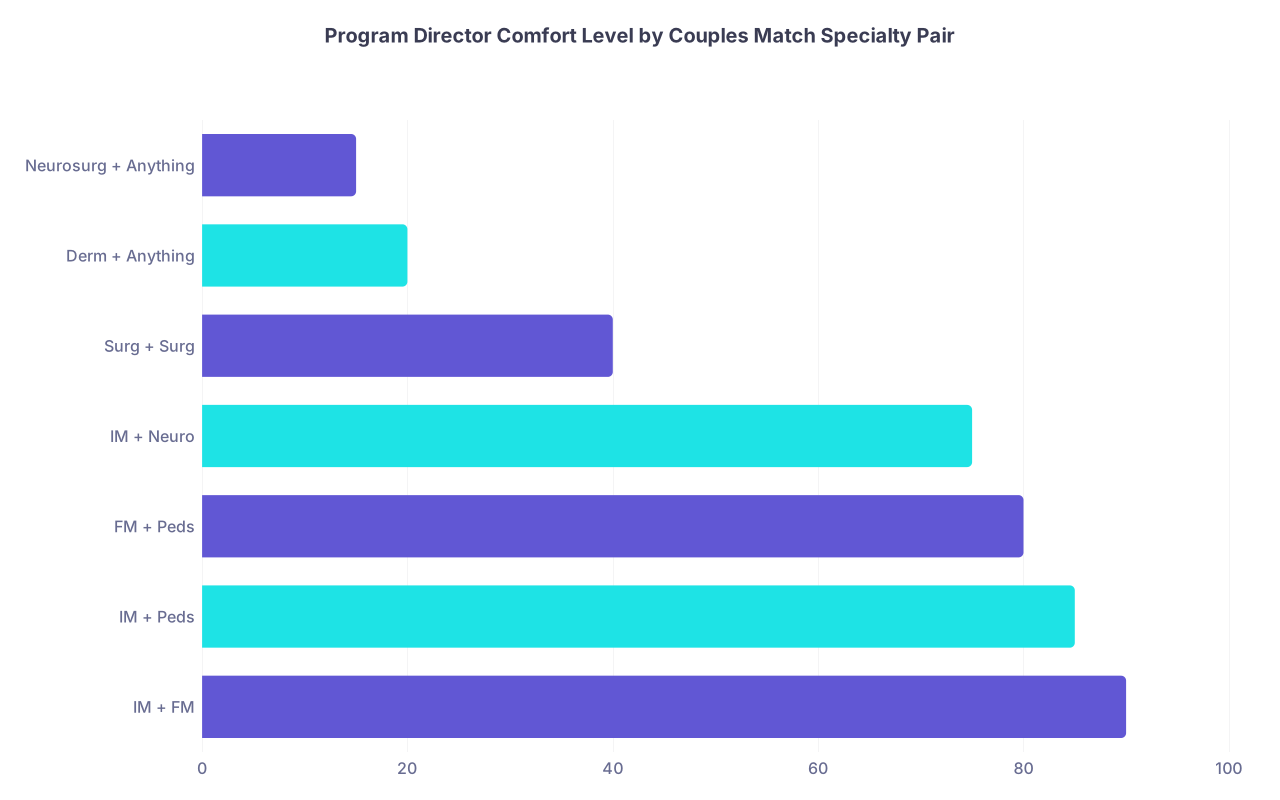
Couples match is not viewed equally in every specialty. Some PDs shrug. Some get anxious the moment they see “couple.”
Here’s how they often see it, whether they admit it or not:
| Category | Value |
|---|---|
| IM + FM | 90 |
| IM + Peds | 85 |
| FM + Peds | 80 |
| IM + Neuro | 75 |
| Surg + Surg | 40 |
| Derm + Anything | 20 |
| Neurosurg + Anything | 15 |
Roughly how the comfort levels feel in the real world (not an official survey, but it tracks with what people actually say):
IM + FM / IM + Peds / FM + Peds
These are “easy mode” couples from the PD perspective. Lots of programs, lots of spots per program, often multiple hospitals in the same system. The main issue is geography, not spot availability.IM + Neuro / IM + Psych / IM + EM
Still workable, but more coordination is needed if the neuro/psych/EM programs are smaller or more competitive within the city. PDs start sending quiet emails: “We like your candidate; if you take theirs, we’ll look favorably on yours.”Surgery + Surgery (especially ortho / ENT / plastics)
This is where PDs start twitching. Surgical programs have fewer spots, tighter politics, and often more ego in the mix. They’re calculating: “Do we want to lock ourselves into two of the same year? What if one flames out?”Anything + Derm / Neurosurgery / Plastics
These are the landmine couples. Nobody is going to say “we won’t rank couples,” but here’s the truth: if one of you is in a tiny, ultra-competitive field and fixated on one or two cities, your odds of both being happy plummet. PDs know this. They will quietly assume your couple constraints might self-destruct your match.
Bottom line: programs in flexible, high-volume specialties are much more comfortable bending for couples. Niche and competitive fields are less so. You’re asking them to twist a smaller, stiffer system.
Geography: Your Real Constraint (Not Your Scores)
Most couples underestimate how much geography is the real choke point, not the competitiveness of the individual programs.
Here’s what PDs run through in their heads when you say, “We really want to be in Boston / NYC / SF / Chicago”:
- “Of course you do. So does everyone else.”
- “How many pairs will be trying to land together here?”
- “Do we really want to commit a spot to someone who might rank us low because their partner can’t land nearby?”
And behind closed doors, when reviewing a couple that is clearly location-locked, the conversation sounds like:
- “They’ll rank MGH/BWH first. We’re in their desperation zone. Rank them where we normally would and let the algorithm sort it out.”
- “If we rank her high and his program doesn’t rank him, we end up with a disgruntled resident whose partner is across the country.”
Couples who come in with a rigid, high-demand metro in mind are often labeled as “high maintenance” mentally, even if you’re perfectly nice people. Programs have been burned by this: residents trying to transfer, PGY-2s suddenly applying out, morale problems because the partner ended up far away.
You have more power as a couple if you can say, convincingly, “We’re open to several regions, not just one zip code.” PDs hear that and relax a bit. It signals flexibility, which makes them more willing to take a risk on you.
How Much Do Programs Actually Coordinate With Each Other?
Here’s where the mythology and the reality really diverge.
You probably imagine PDs from different specialties getting together like some benevolent council, saying, “Let’s figure out how to get this lovely couple together.” Sometimes that happens. More often, it’s a loose, informal, and occasionally self-interested process.
The real pattern:
In-house coordination (same hospital, different specialties)
This is where meaningful coordination can happen. IM PD texts the peds PD: “We like her a lot. Thoughts on him?” They might intentionally rank both of you a bit higher in a certain band to improve the odds you land together. Not guaranteed, but very possible.Across-institution coordination (different hospitals, same city)
Much weaker. Sometimes PDs in friendly institutions will trade quick impressions: “We like your guy; you like ours?” But nobody’s restructuring their entire rank list for you. At best, they nudge things slightly.Across cities or systems
Basically non-existent. No one is calling another city to engineer your match.
What actually surprises students is this: programs sometimes don’t coordinate even when they could, simply because they’re busy, their own list is political enough, or they just don’t see that couple as strategic enough to justify the effort.
I’ve seen couples PDs would’ve liked to help… just get steamrolled by the sheer inertia of the ranking process.
What PDs Want to Hear From Couples (And What Makes Them Nervous)
Your couples status can either reassure a PD or set off quiet alarms. It all depends on how you talk about it.
The reassuring version sounds like this:
- You both clearly understand that you will need to be flexible.
- You can name multiple cities or regions you’d be genuinely okay with.
- You emphasize commitment to training quality and fit, not just “same city or bust.”
- You show insight into your relative competitiveness and have a realistic plan.
The alarming version:
- “We have to be in Boston because of family.”
- “We’re only ranking places where we can both be at the same hospital.”
- “We’re both aiming for top 10 programs.” (From mid-tier applicants.)
- “We just really love this city and can’t see ourselves anywhere else.”
You might think you’re just being honest. A PD hears: “Their list is going to be brittle, and we might waste a rank slot on them.”
I’ve also watched applicants sabotage themselves by over-dramatizing the relationship angle. Crying in an interview about how you can’t imagine being apart does not increase your match chances. It makes PDs think: “If they end up separated, are we going to have a meltdown PGY-1?”
You’re not auditioning your romance. You’re auditioning your resilience.
The Hidden Advantage: Couples as Retention and Stability
Let me pull back the curtain on something positive: many PDs quietly like couples for one big reason—retention.
A couple that lands in the same city, both happy enough with their programs, is more likely to:
- Stay for fellowship at the same institution
- Put down roots in the area
- Become junior faculty
- Not blow up their life to chase something three states away
That’s gold to a department trying to build long-term workforce stability.
So if you present yourselves as:
- Mature
- Grounded
- Realistic about geography and competitiveness
- Committed to building a life somewhere, not just chasing a brand-name
…then a PD sees your couple status not as a liability, but as a potential long-term win.
Strategy: How to Present Yourselves So PDs Take You Seriously
Here’s what actually plays well in those meetings.
1. Be very clear, very early, and very consistent
Programs hate surprises. If you’re couples matching:
- Put it in your application.
- Mention it in your interview when asked about location or rank list thinking.
- Make sure both of your stories match. Same regions, same flexibility, same basic narrative.
I’ve watched PDs roll their eyes when one partner says, “We’re open to the Midwest,” and the other has told a different PD, “Honestly, we’re aiming for the coasts.”
They compare notes. They notice.
2. Have a believable hierarchy of preferences
When a PD asks, “How are you thinking about your rank list as a couple?” you need a coherent, non-fantasy answer. Something like:
- “We’ve identified 3–4 cities where we both have a decent number of programs, and we’ll prioritize those. After that, we’d rather be in nearby cities than across the country. We’ve talked through the risk and we’re prepared for some distance if needed, but we’ll structure the list to maximize us being close.”
That tells them you’re adults. Not idealists trying to bend the Match to your will.
3. Don’t ask programs to ‘help coordinate’ your match
PDs already know how the couples algorithm works. Asking them, “Can you coordinate with X program so we can be together?” sounds naïve and entitled.
The correct play is more like:
- “We both really liked this city and this institution. We each interviewed at X and Y here. We’ll be ranking you highly. We wanted you to know we’re couples matching so if coordination is possible within the system, that would mean a lot to us.”
Then stop talking. Let them decide whether you’re worth the effort.
The Truth About Risk: Couples Match Increases Volatility
Behind the scenes, PDs do see your couple status as a risk multiplier. Not necessarily bad risk, but variability.
From the PD’s side:
- A strong single candidate has a high probability of matching if ranked high.
- A strong coupled candidate has a more complex probability. Their match depends on how their partner’s list and both sets of program lists line up.
So some PDs become more conservative. They’ll say:
- “I like her, but if I rank her at 5 and they’re only ranking us as a backup, that’s a wasted high spot. Let’s put her at 12 instead.”
- “We’ve been burned by couples over-ranking other cities and leaving our top slots empty.”
Which is why you’ll hear PDs harp on the same line: “Rank us where you actually want to come.” Because when couples play “we’ll just list them high, but we’ll probably get our dream city,” programs notice the fallout on their end.
You can’t fully control this, but you can:
- Avoid obviously unrealistic rank strategies.
- Communicate genuine interest clearly when a program is truly a top choice.
- Not play games with programs you’d never actually attend “just to pad the list.”
Visualizing How Couples Complicate Match Outcomes

| Step | Description |
|---|---|
| Step 1 | Review Individual Applicant |
| Step 2 | Low/No Rank |
| Step 3 | Check Partner Application |
| Step 4 | Rank Individually, No Boost |
| Step 5 | Consider Couples Strategy |
| Step 6 | Conservative Rank |
| Step 7 | Moderate/Optimistic Rank |
| Step 8 | Rank If Single? |
| Step 9 | Partner Rankable? |
| Step 10 | Geography Flexible? |
That little flowchart is what’s essentially happening in someone’s head when they hear the words “we’re couples matching.”
A Quick Reality Check: Match Rates for Couples
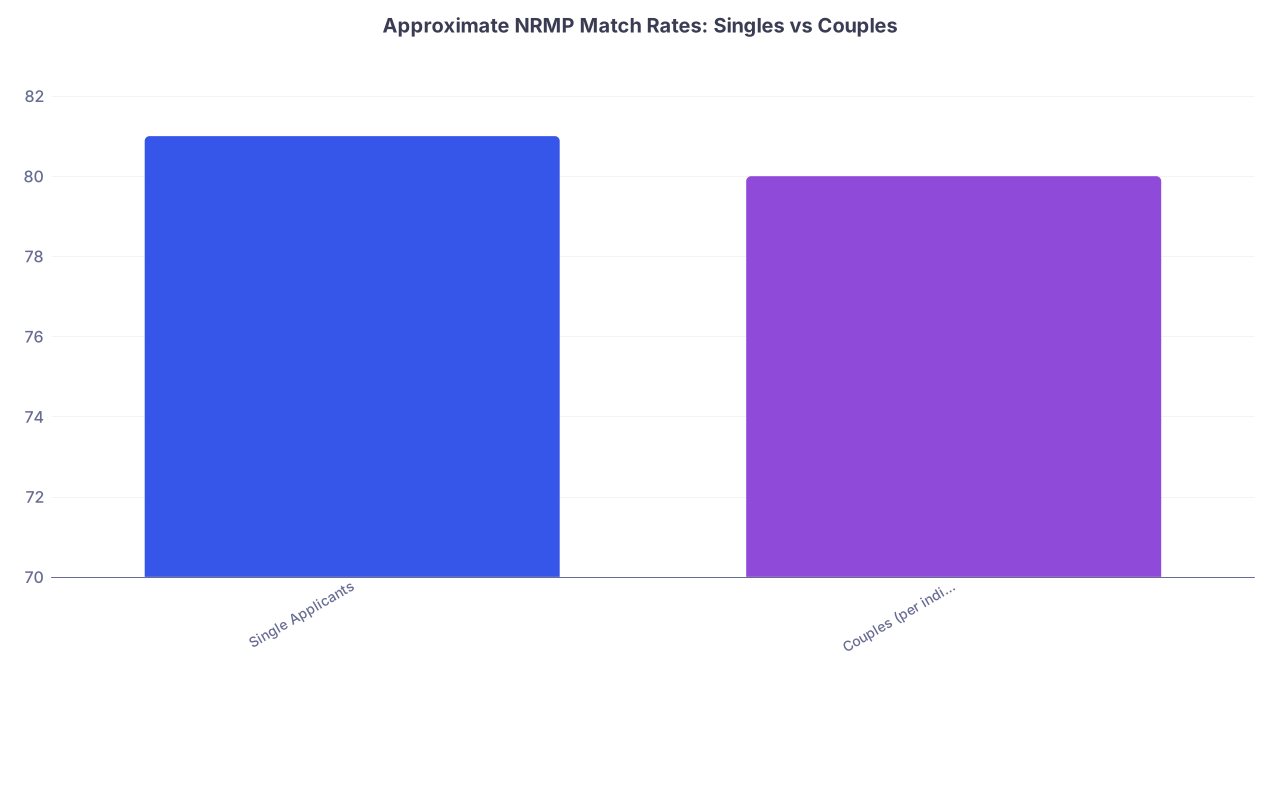
One more thing students wildly misjudge: they assume couples matching craters their odds. Program directors, on the other hand, know the data.
| Category | Value |
|---|---|
| Single Applicants | 81 |
| Couples (per individual) | 80 |
The difference in overall match rate per individual isn’t catastrophic. What changes is how close you get to your ideal combination of program + city.
From PD conversations, what actually fails more often is satisfaction, not pure matching:
- “They both matched, but in different cities.”
- “She matched her dream program; he ended up somewhere he clearly ranked way lower.”
- “They both matched in the same city but at programs one of them obviously didn’t want.”
PDs are aware of that. It’s why cautious ones are reluctant to bend their list too much for couples—they’ve seen the aftermath.
FAQs: What You’re Too Nervous to Ask PDs Directly
1. Should we ever hide that we’re couples matching?
No. That’s how you end up with disaster scenarios where one PD feels misled and you get quietly blacklisted when transfers come up. Programs sometimes really do try to help couples when they know early. If you spring it on them late, it looks disorganized or manipulative.
The only nuance: you don’t need to open every interview with “We’re couples matching!” But it should be in your application, and you should confirm it when discussing geography, rank list thinking, or “anything else you want us to know.”
2. If one of us is much weaker, should we still couples match?
Here’s the ugly truth: couples matching won’t hide a weak file. PDs will see it. If the gap is huge (failures, massive score difference, no interview invites at most places), couples matching can drag the stronger partner into worse outcomes.
That said, if you’d be devastated to be separated, couples matching might still be worth it. You just have to recalibrate expectations. The stronger partner may need to be okay landing at a mid-tier or lower-tier program so that both of you have jobs in the same region. PDs respect couples who are realistic about that trade-off. They roll their eyes at couples who want top 10 prestige and ironclad geographic unity despite big performance gaps.
3. Does telling a program they’re our “number one” help more as a couple?
It can. If – and this is key – you mean it and you both say it consistently to the same programs. PDs are more willing to take a risk nudging couples up if they believe:
- You’ll actually come if you match there.
- Both of you are genuinely prioritizing that city/institution.
But if they catch wind that you told three programs you’re “definitely ranking them first,” word gets around. PDs talk. Especially within the same region. Then your credibility is gone, and so is any extra effort on your behalf.
Strip it down, here are the real takeaways:
- PDs judge you first as individual applicants; couples status only helps if you both clear that bar.
- Flexibility—in geography, prestige, and exact program type—is the single biggest thing that turns couples from “problem” to “asset” in directors’ minds.
- Programs will sometimes help coordinate, but only for couples who are strong, realistic, and honest; you’re not entitled to that effort, you have to earn it with your file and your attitude.


