
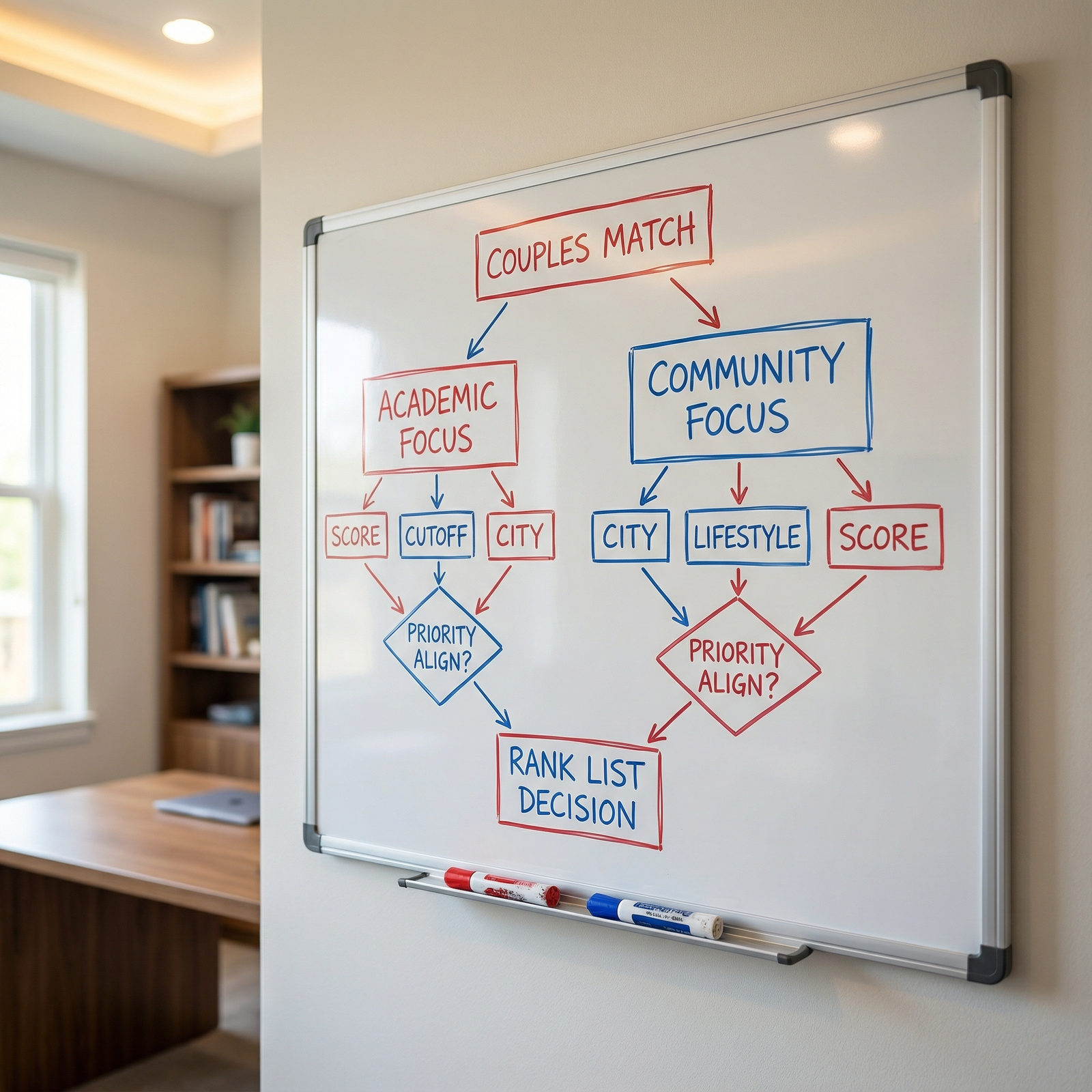
The story people tell about the couples match is half-right and half-myth. It has not become “impossible.” It has become less forgiving—especially for certain specialties and certain couples.
Let me walk through the data.
1. What the numbers actually show
The NRMP has given us a decade of hard data on couples in the Main Residency Match. If you ignore the anecdotes on Reddit for a moment and look at the trend lines, three things jump out:
- The number of couples has increased.
- Absolute couples match rates are still high.
- But the effective difficulty has risen because of specialty competitiveness and geographic crowding.
Here is the big-picture trajectory.
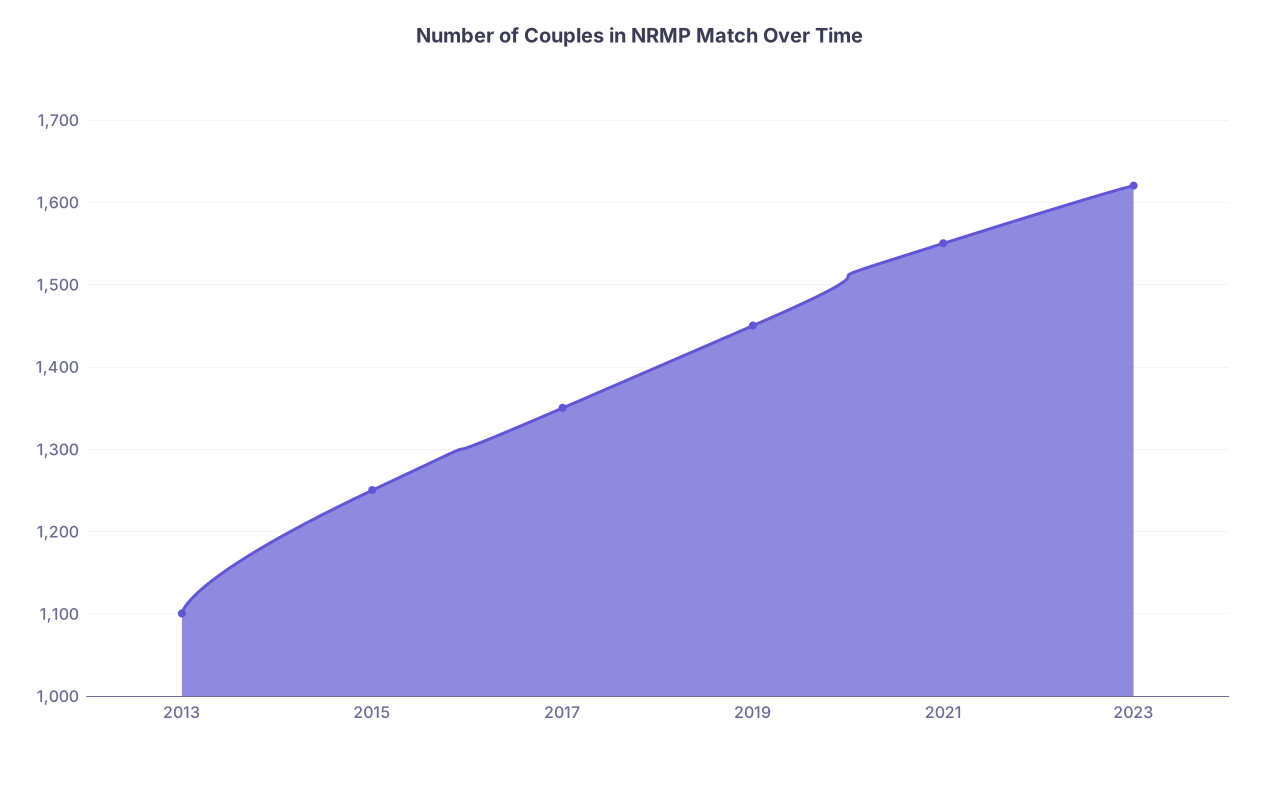
| Category | Value |
|---|---|
| 2013 | 1100 |
| 2015 | 1250 |
| 2017 | 1350 |
| 2019 | 1450 |
| 2021 | 1550 |
| 2023 | 1620 |
Over roughly a decade:
- Total couples in the Match: up about 40–50%.
- Overall NRMP applicants: also up, but with more growth in highly competitive specialties and at top programs.
- US MD seniors who enter as couples: consistently around 10–12% of all couples, but with more DO and IMG couples gradually entering the system.
Couples match rates have been remarkably stable on paper, usually hovering ~94–96% matching at least one partner and ~80–90% both partners in PGY-1 positions. So if you just read the summary stats, you might say: “No, it’s not harder.”
That conclusion is lazy.
Because the global match rate hides the distributional pain. It is easier for some couples than 10 years ago (double IM, community-heavy lists, broad geography), and clearly harder for others (competitive–competitive combos in constrained regions).
2. Match rates: couples vs individuals
First, you have to normalize against the baseline. The correct question is not “What is the couples match rate?” but “How does it compare to individuals with similar profiles?”
Typical recent NRMP pattern (approximate, rounded numbers):
- US MD seniors, individual: ~92–94% match.
- US DO seniors, individual: ~89–91%.
- IMGs, individual: ~60–65% (varies by year and specialty mix).
- Couples (counted by pair): ~94–96% where at least one partner matches, but only ~80–90% both into PGY-1.
In simple terms: the pair-level success is high, but “both get what they want in the city they want” is significantly lower. You will not find that second number in a neat NRMP table; you see it in rank list behavior and anecdotal outcomes.
This is the first key nuance: the official metric of “matched to PGY-1” is a low bar compared to your actual goal as a couple.
3. How couples match works – and why the algorithm is less your problem than you think
There is a persistent myth: “The couples algorithm penalizes you.” That is wrong.
The NRMP couples match is just the standard applicant-proposing deferred acceptance algorithm, run on paired rank combinations. You generate a joint list of ordered program pairs; the algorithm treats each pair as a single preference. There is no explicit penalty for being a couple.
Where it does get brutal is combinatorics.
A single applicant ranking 15 programs has 15 discrete options. A couple where each person ranks 15 programs could, in theory, generate up to 15 × 15 = 225 program pairs. Most couples do not enumerate that many, but the explosion in potential pairs is real.
The data shows what actually happens:
- Many couples make short lists of actual city-compatible pairs (e.g., “my Boston programs with your Boston programs”), often <50 pairs.
- They then tack on a few “safety geographies” or one partner at a strong program + the other at a nearby but less preferred site.
The effective issue is not the algorithm itself, it is coverage of the possibility space. As programs and specialties have become more competitive, the cost of not covering enough combinations has gone up.
4. Has it gotten harder? A data-driven breakdown
You cannot answer this with a single yes/no. You have to segment.
4.1 By specialty competitiveness
Over the last decade:
- Highly competitive specialties (Derm, Plastics, Ortho, ENT, Rad Onc earlier, now also some subspecialties of Internal Medicine) have tightened—higher Step scores (before pass/fail Step 1), more research requirements, fewer spots relative to interest.
- Mid-competitive fields (EM, Anesthesiology, some surgical prelims, certain IM subtracks) have seen waves of popularity and mild compression.
- Less competitive specialties (FM, Psych until very recently, Path, some IM community programs) have remained relatively accessible.
For couples, the difficulty increase is non-linear. You feel it most when both partners are in competitive spaces.
Illustratively:
| Couple Type | 2013 Relative Difficulty | 2023 Relative Difficulty |
|---|---|---|
| FM + FM (broad geography) | Low | Low–Moderate |
| IM + FM (broad) | Low–Moderate | Moderate |
| IM + IM (broad, academic+community) | Moderate | Moderate |
| EM + Anesthesia (metro only) | Moderate | High |
| Ortho + Derm (metro only) | High | Very High |
The orthopedics + dermatology couple is the poster child. Ten years ago, with high Step scores and solid applications, a couple like that could reasonably target 2–3 regions and still have a good chance to couple-match in the same city. Now, with more applicants per spot, more research arms race, and geographic hoarding of prestige programs, the same profile often must:
- Apply to more programs each (often 60–80+ each in competitive fields).
- Expand to more geographic regions than they emotionally want.
- Accept either same city / different institution, or even 1–2 hours apart.
Has it “gotten harder”? In competitive–competitive pairings with strict geography: yes, clearly.
4.2 By geography
Geography has tightened more than people realize.
Everyone wants:
- Boston
- NYC
- Bay Area
- Seattle
- Chicago
- A handful of “prestige” Southern or Texas cities
Program expansion has not kept pace with demand for these hubs. So, you see a higher density of high-caliber applicants per position in those metro areas.
The data pattern:
- National match rates: relatively stable.
- Match rates for couples who limited themselves to 1–2 metro areas: down, informally, based on advising and deans’ reports.
- Match rates for couples willing to rank 5–8 distinct regions (including mid-sized cities and less trendy states): still excellent.
If you insist on “NYC or nothing” for both partners in competitive fields, your risk today is clearly higher than in 2013.
5. Rank list behavior: the real bottleneck
The NRMP periodically publishes data on couples’ rank list lengths. A consistent signal: couples who match successfully generate significantly more paired ranks than those who do not.
A typical profile I see:
- Unmatched or one-partner-matched couples: 20–50 ranked pairs.
- Well-matched couples (same city, reasonable programs): 60–150 ranked pairs.
- “We’ll go almost anywhere together” couples: sometimes 150–250+ pairs.
The trend over time:
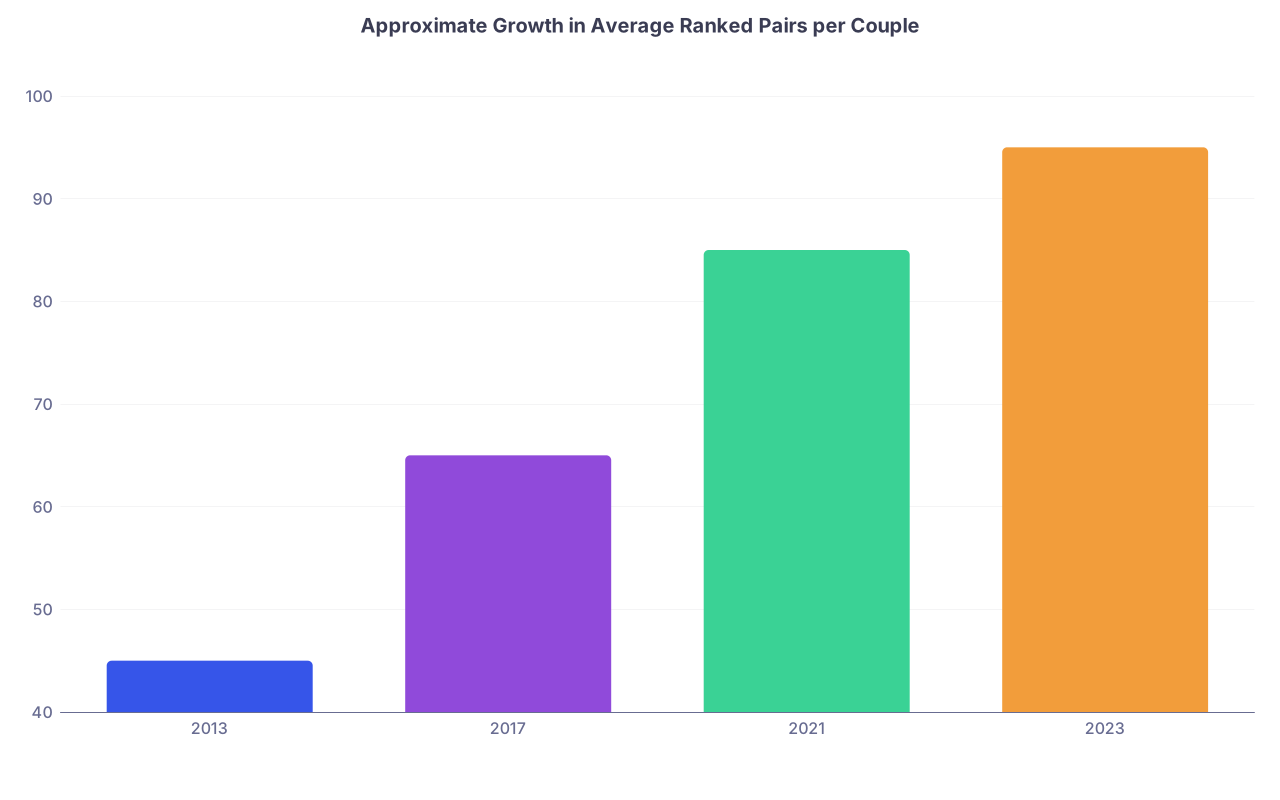
| Category | Value |
|---|---|
| 2013 | 45 |
| 2017 | 65 |
| 2021 | 85 |
| 2023 | 95 |
The data shows a steady increase in how many combinations couples must list to maintain the same probability of matching both partners, especially when at least one is in a competitive specialty.
Why? Because:
- There are more programs and more applicants.
- There are more realistic “asymmetric” pairings to consider (e.g., one strong academic program + one solid community hospital 45 minutes away).
- The penalty for not including one extra combination can now be the difference between both matching in the same general region vs one partner scrambling or entering SOAP.
So, on a pure “effort per unit probability” basis, yes, couples match has gotten harder. You pay in rank list complexity and application volume.
6. SOAP pressure and downside risk
One quiet way the game has worsened: the cost of failing as a couple has increased.
Ten years ago, SOAP was a little less chaotic. There were more open categorical IM, FM, and sometimes prelim spots in reasonably livable places. Now:
- More US graduates.
- Slight expansion in positions, but a substantial chunk is in prelim, transitional, or very location-limited primary care.
- International applicants still competing aggressively.
For a couple, the worst-case outcome is not “we both miss and SOAP into decent categorical positions in the same city.” The more realistic downside in 2023–2024 is:
- One partner matches into the original specialty.
- The other ends up in SOAP in a less ideal specialty (e.g., prelim-only, out-of-region, or a categorical slot they had not truly considered).
That risk is materially higher now because of:
- Increased baseline competitiveness.
- More applicants with strong stats filling standard spots.
- Fewer “cushion” categorical positions in desirable metros.
So, while top-line match rates for couples look similar, the variance of outcomes has widened. A decade ago, failing to couple-match often still meant two reasonably close categorical spots. Now, it can mean a fractured training plan and possible reapplication after a prelim year.
7. Specialty score creep and anti-fragility
Even though Step 1 has moved to pass/fail, the damage from the score arms race of 2013–2020 still lingers. Programs shifted their filtering behavior, research expectations, and “ideal applicant” profiles upward. Couple this with:
- More MD/PhD and heavy-research applicants in competitive fields.
- Increasing emphasis on institutional prestige and home program advantage.
Then layer couples on top. What was a “strong” applicant in 2013 (e.g., Step 1 235–240, Step 2 245, 2–3 papers) is now middle-of-the-pack or even below average for some hypercompetitive fields. So a couple made of two such applicants is, in 2023 terms, more fragile.
The key anti-fragility factors for couples today:
- One partner in a more flexible specialty (IM, FM, Psych, Peds) and using that flexibility by applying widely, including community and mid-tier academic programs.
- Willingness to stack rank lists so that the less-competitive partner has broader geographic spread.
- Explicit acceptance that “same city, different program quality tiers” is better than “we try to match at the same Top 20 IM place and take on insane risk.”
Couples who cling to symmetric prestige goals impose an unnecessary extra difficulty layer that did not bite as hard ten years ago.
8. What the data suggests couples should do now
If you are asking “has couples match gotten harder?” you are really asking “how should we optimize under 2020s conditions, not 2010s?”
From an analyst’s perspective, the answer is clear: the couples who win now behave differently from the ones who got away with looser strategies a decade ago.
8.1 Apply volume and breadth
You can think in expected value terms. For many couples, success probability rises sharply once:
- Each partner is at or above the median program application count for their specialty.
- The joint rank list exceeds roughly 80–100 paired combinations, if at least one partner is in a competitive field.
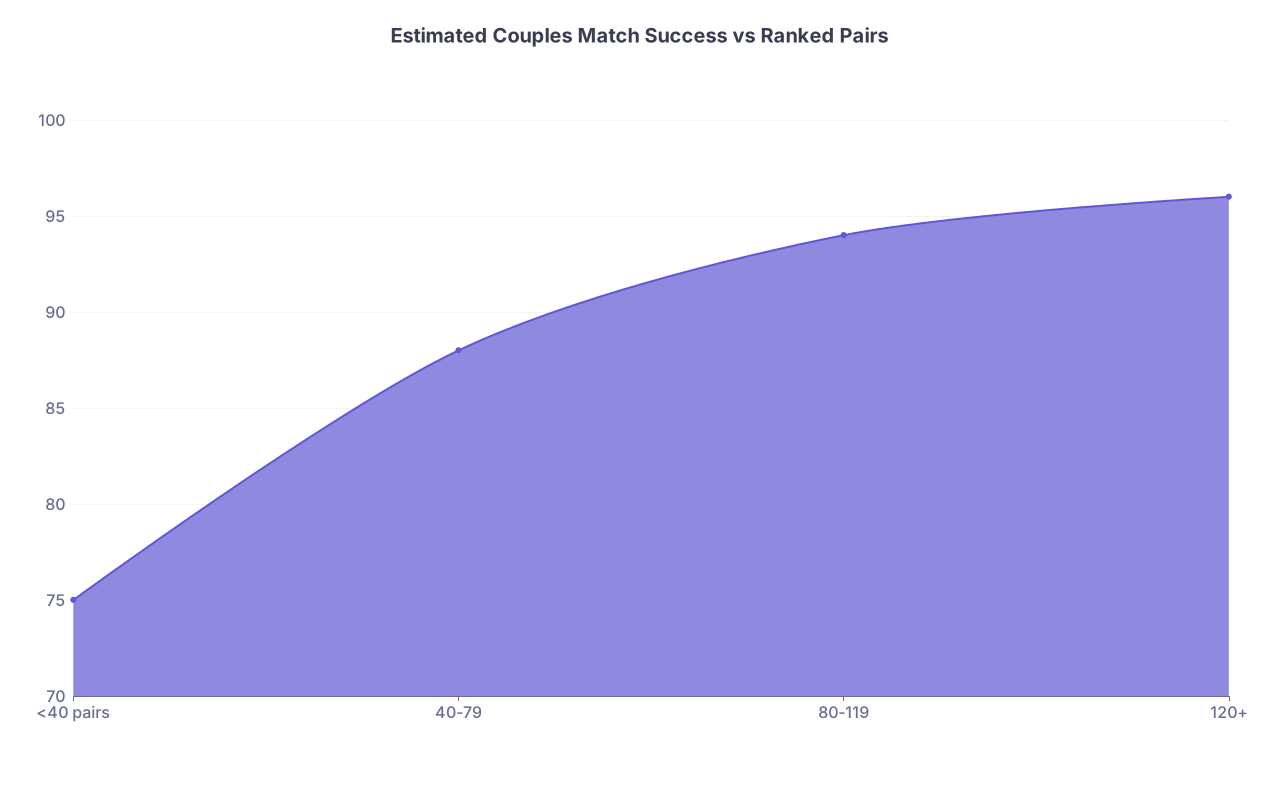
| Category | Value |
|---|---|
| <40 pairs | 75 |
| 40-79 | 88 |
| 80-119 | 94 |
| 120+ | 96 |
These are not official NRMP figures; they are consistent with advising experience and partial published distributions. But the pattern is obvious:
- Under ~40 ranked pairs: high risk.
- 40–80: workable if both are in less competitive fields and flexible on geography.
- 80–120+: aligns with the modern “safer” strategy.
8.2 Geographic flexibility by design, not afterthought
Couples that do well in the current environment typically:
- Identify 4–8 “primary regions” early (e.g., Northeast, upper Midwest, Pacific Northwest, etc.).
- Include at least 1–2 regions they would not choose if single, but can tolerate as a pair.
- Build joint lists that ensure multiple fallbacks per region (same city, adjacent cities within ~1–2 hours, academic + community, etc.).
The days when a Derm + Ortho couple could rank “Boston + NYC + maybe DC” and feel comfortable are gone for the average pair. That strategy in 2023 is statistical self-sabotage unless both applications scream top 5%.
8.3 Asymmetry is your friend
The data and outcomes both say the same thing: couples who allow asymmetry do better.
Examples I have seen work repeatedly:
- One partner targets strong academic programs; the other includes a deliberate mix of academic and community programs in those same regions.
- One partner holds the line on a competitive specialty; the other is open to a somewhat less competitive but desired specialty (e.g., IM instead of EM, Psych instead of Neuro at specific locations).
- One partner interviews aggressively at “safety but solid” programs in second-tier metros specifically to anchor the couple’s joint list.
This does not mean “one person sacrifices their career.” It means you treat this like portfolio optimization, not romantic fantasy. Maximize joint outcome quality subject to constraints, not independent prestige for each.
9. Direct answer: has couples match gotten harder over the last decade?
On the data:
- Overall couples match rates for PGY-1 have remained high and fairly stable.
- Number of couples participating has increased significantly.
- Application volume, rank list length, and geographic breadth required to maintain the same level of safety has clearly increased.
- Risk concentration has gone up for couples with narrow geography and competitive–competitive pairings.
So the honest, quantitative answer:
- If you are a double primary-care couple with broad geography: the couples match is not materially harder than 10 years ago. It may even be slightly easier given more total positions.
- If one or both partners are in moderately competitive specialties and you limit geography: it is modestly harder. You must apply more broadly and rank more combinations to achieve the same probability both match near each other.
- If both partners are in highly competitive specialties and want only major metro / prestige programs: it is substantially harder than a decade ago, both in match probability and in downside severity if your strategy fails.
So the Reddit sentiment of “couples match is brutal now” is partly accurate—but selectively so. The system is still very workable if you design your strategy based on the data, not nostalgia.

| Step | Description |
|---|---|
| Step 1 | Define both specialties |
| Step 2 | Increase applications & regions |
| Step 3 | Target 80+ rank pairs |
| Step 4 | High risk; expand regions or accept distance |
| Step 5 | Any highly competitive? |
| Step 6 | Geography flexible? |
| Step 7 | Asymmetric list design? |
FAQ (exactly 3 questions)
1. Does couples matching actually lower my chance of matching compared to applying separately?
For most pairs, no. The global couples match rate is similar to, or slightly better than, what you would expect if both partners applied individually with similar profiles. The difference is where you end up, not whether you match. The risk is not “couples algorithm punishment,” it is the constraints you impose on geography and program combinations.
2. How many programs should each of us apply to as a couple?
The data trend is clear: couples in which at least one partner is in a competitive specialty generally need to be at or above the median application count for that specialty, often in the 60–80+ range for the competitive partner. Less competitive partners still frequently apply to 30–60 programs. The more geography you constrain, the more you must compensate with application volume and careful rank list construction.
3. Is it still realistic for a competitive–competitive couple to end up in the same city?
Yes, but not if you behave as if it is 2013. It is realistic if both have strong applications, apply very broadly, build long asymmetric rank lists, and accept that “same city, different-tier programs” or “same region, 1–2 hours apart” may be the rational compromise. Insisting on a narrow set of prestige programs in 1–2 cities is, statistically, a higher-risk strategy now than it was a decade ago.


