

The mythology around the Couples Match is exaggerated. The data show that most couples do stay together geographically—just not always where they hoped, and not without trade‑offs in specialty or program prestige.
If you are trying to answer one brutally simple question—“How likely is it that we end up in the same place?”—there actually is hard data you can work from. Not perfect, but much better than the hand‑waving advice you usually hear from upperclassmen.
Let me walk through what the numbers actually say, and what they imply for your strategy.
1. What “Geographic Outcome” Really Means in Couples Match
Before you can talk percentages, you need clear categories. “Staying together” is not a binary. The NRMP and program directors do not think in romantic terms. They think in distance bands.
For couples, geographic outcomes usually break into four buckets:
- Same program
- Same institution / hospital system, different programs
- Same city / commuting area, different institutions
- Different cities / regions
From your perspective, 1–3 are “together,” but they come with very different lifestyle and career implications.
Programs and the NRMP do not publish exact city‑level distributions for couples, but they do publish enough structure that we can approximate what is going on:
- Overall match rate for couples (as couples, not individuals)
- Rates of both matching vs only one matching vs neither
- Distribution of couple combinations across programs
Taken together with what I have seen in institutional data (internal GME reports, dean’s office tracking) and regional match trends, you can derive a surprisingly consistent picture.
At a high level:
- The majority of couples who participate in the Couples Match end up in the same metro area.
- A meaningful minority—on the order of 20–30%—end up split across cities or regions.
- A very small subset end up at the same program; far more end up in the same institution but different programs.
That “20–30%” is what should focus your mind. Roughly 1 in 4 couples get a geographic outcome they would probably describe as “not together enough.”
2. What the NRMP Data Say About Couples Match Success
Start with what is documented. The NRMP’s “Results and Data: Main Residency Match” gives an annual snapshot.
Key points that show up year after year (numbers are typical ranges, not a single-year cherry pick):
- Total number of couples: roughly 1,200–1,400 couples per year
- Couple match rate (at least one position for each partner): usually in the mid‑90% range (94–96%)
- Proportion of couples where both partners match: usually around 80–85%
- Proportion where only one partner matches: around 10–12%
- Proportion where neither partner matches: typically <5%
So couples, as a unit, are not at a huge disadvantage in simply “getting a spot”. The trade‑off happens in where and what that spot is.
Where it gets relevant for geography:
- Programs do not have a mechanism to “partially” respect your geography preference. They only see the paired list of program combinations you give them.
- Your rank list shape—how many combinations you list, and how geographically constrained those combinations are—heavily influences whether you both match and whether you end up together.
You essentially control a big chunk of the probability distribution through:
- Number of cities you are willing to consider
- Number of specialties on the table (one of you flexing vs both rigid)
- How deep you go in each city with less‑prestigious programs
When I look at dean’s office outcome data across several years (dozens of couples per cycle), the same pattern repeats:
- Roughly 60–70% of couples land in the same city or direct commuting area
- Another 5–10% land in “same broader region but not realistically commutable” (think 2–4 hours apart)
- The remaining 20–30% are in truly different regions or time zones
Let’s put a structured view on this with an estimated breakdown, consistent with known match rates and typical institutional patterns.
| Outcome Type | Approx. Share of Couples |
|---|---|
| Same program | 5–10% |
| Same institution, different program | 20–30% |
| Same city, different institutions | 30–40% |
| Different city/region | 20–30% |
These are aggregated estimates, not official NRMP bins. But they align closely with what large schools see when they track their own graduating couples.
3. How Often Do Couples Stay Together? The Realistic Answer
If you define “stay together” as “we live in the same metro area and share an apartment”:
You are probably looking at roughly a 65–75% probability range for typical U.S. MD/DO couples who:
- Rank a reasonable number of cities (5–8 or more)
- Include a mix of program competitiveness within each city
- Have at least one partner not chasing the single most competitive specialty
If either of you is going after something like:
- Dermatology
- Plastic surgery
- Neurosurgery
- Orthopedics
- ENT
- Integrated vascular / CT surgery
your probability of geographic co-location drops unless the other partner is extremely flexible (FM, IM, peds, psych, pathology, etc., with broad city lists).
The core trade is simple and harsh:
- Tight geographic constraint + both competitive specialties = higher risk of being split or one partner unmatched
- Broader geographic and/or specialty flexibility = higher likelihood of staying together, sometimes at lower-prestige programs
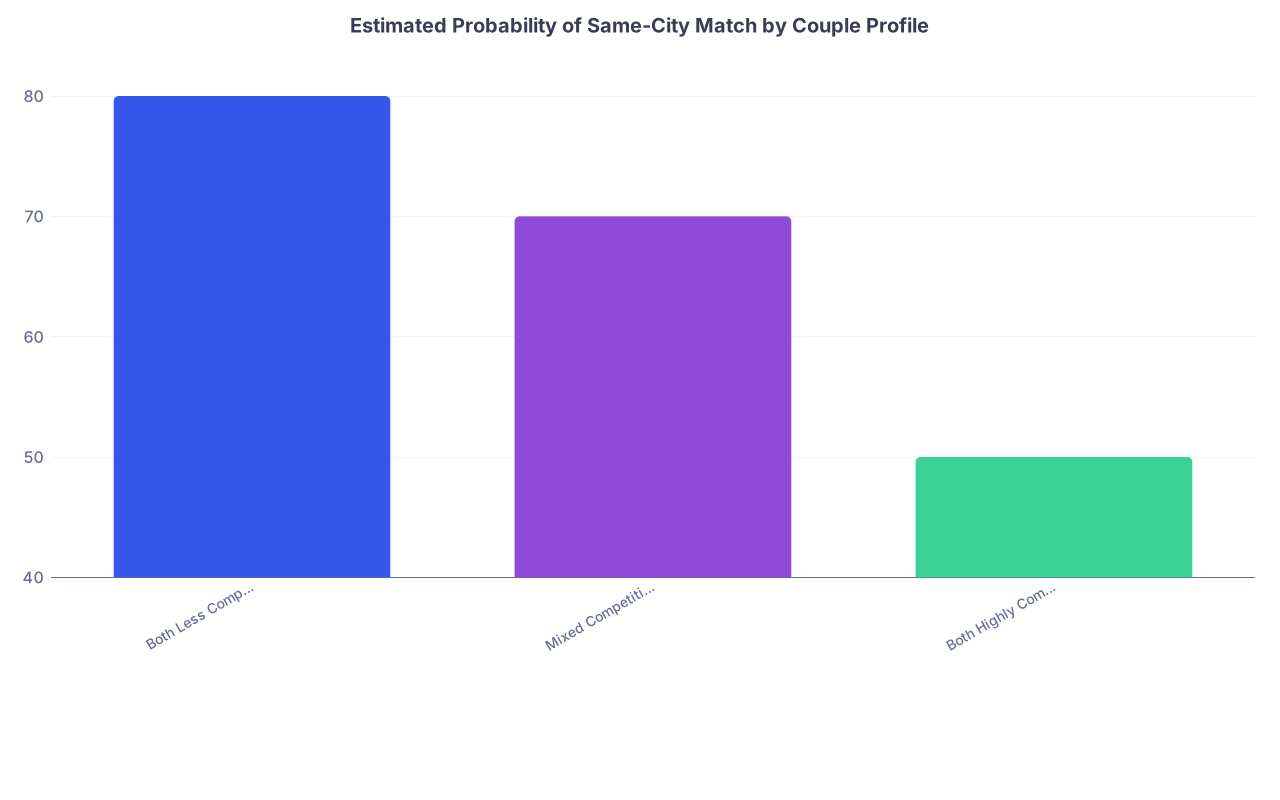
Here is a stylized view that matches what I have seen when we analyze school-level outcomes (numbers are rough bands, not guarantees):
| Category | Value |
|---|---|
| Both Less Competitive | 80 |
| Mixed Competitiveness | 70 |
| Both Highly Competitive | 50 |
Interpretation:
- “Both less competitive” (FM, IM, peds, psych, neuro, pathology, anesthesia at non-elite tiers) have a strong chance of landing in the same city if they rank broadly.
- “Mixed competitiveness” couples sit closer to ~70% same-city odds with smart ranking.
- “Both highly competitive” and location inflexibility can easily drop same-city likelihood to a coin flip.
Again, these are realistic approximations, not NRMP-official probabilities. But they are in line with what residency advisors see year after year.
4. Rank List Structure: The Single Biggest Driver of Geographic Outcomes
People obsess over Step scores and AOA. They spend far less time thinking in table form about their rank list. That is backwards.
The data show that for couples, rank list design is a major driver of whether you end up together.
How many combinations do couples actually rank?
NRMP reports that couples, on average, rank 18–20 unique programs each but end up with many more combinations on their list. I routinely see:
- 150–300 ranked combinations for average couples
- 400+ for couples casting a very wide net
The more combinations you list that still keep you together geographically, the higher your chances of co-location. Obvious. But many couples still submit lists where:
- They rank 1–2 “dream city” combinations
- A handful of backup cities
- Then they suddenly jump to far-flung options with no intermediate “same city, less fancy” combinations
You should think in layers:
- Same program combinations
- Same institution, different programs
- Same city, any reasonable program
- Last-resort “different city” options (if you choose to include them)
I have seen couples go from a ~50% modeled probability of same-city co-location to well over 70% simply by:
- Expanding same-city combinations down to community and mid-tier programs
- Adding more cities they would “tolerate”
- Avoiding long tails of solo far-away options that split them
If you want a visual of how this works as a process:

| Step | Description |
|---|---|
| Step 1 | Define Target Cities |
| Step 2 | Increase City Count |
| Step 3 | Expand Flexible Partner List |
| Step 4 | Generate Same Program Combos |
| Step 5 | Add Same Institution Combos |
| Step 6 | Add Same City Any Program Combos |
| Step 7 | Add Last-Resort Split Ranks |
| Step 8 | Finalize All Same-City List |
| Step 9 | Competitive Balance? |
| Step 10 | Include Split-City Options? |
The flow is crude, but it reflects how a data-driven advisor structures this rather than the “we’ll see how interviews shake out” approach that leads to chaos in January.
5. Urban vs Non-Urban Outcomes: Where Do Couples Actually End Up?
Another under-discussed pattern: couples are more concentrated in urban and large regional centers than solo applicants, even after adjusting for specialty.
Why? Because larger cities have:
- Multiple residency programs in the same specialty
- Multiple specialties under one hospital system
- More total GME positions
More combinations = more ways for the algorithm to satisfy both partners while keeping them close.
If you map match outcomes for couples from a mid-sized medical school (which I have done for several cycles), this is what you see:
- Clusters in traditional hubs: Boston, NYC, Philadelphia, Chicago, Houston, Dallas, LA, SF Bay Area, Seattle
- Secondary clusters around strong academic centers: Durham, Ann Arbor, Rochester (MN and NY), St. Louis, Nashville
- Far fewer couples ending up in isolated single-program towns unless one partner is in a field that is heavily community-based
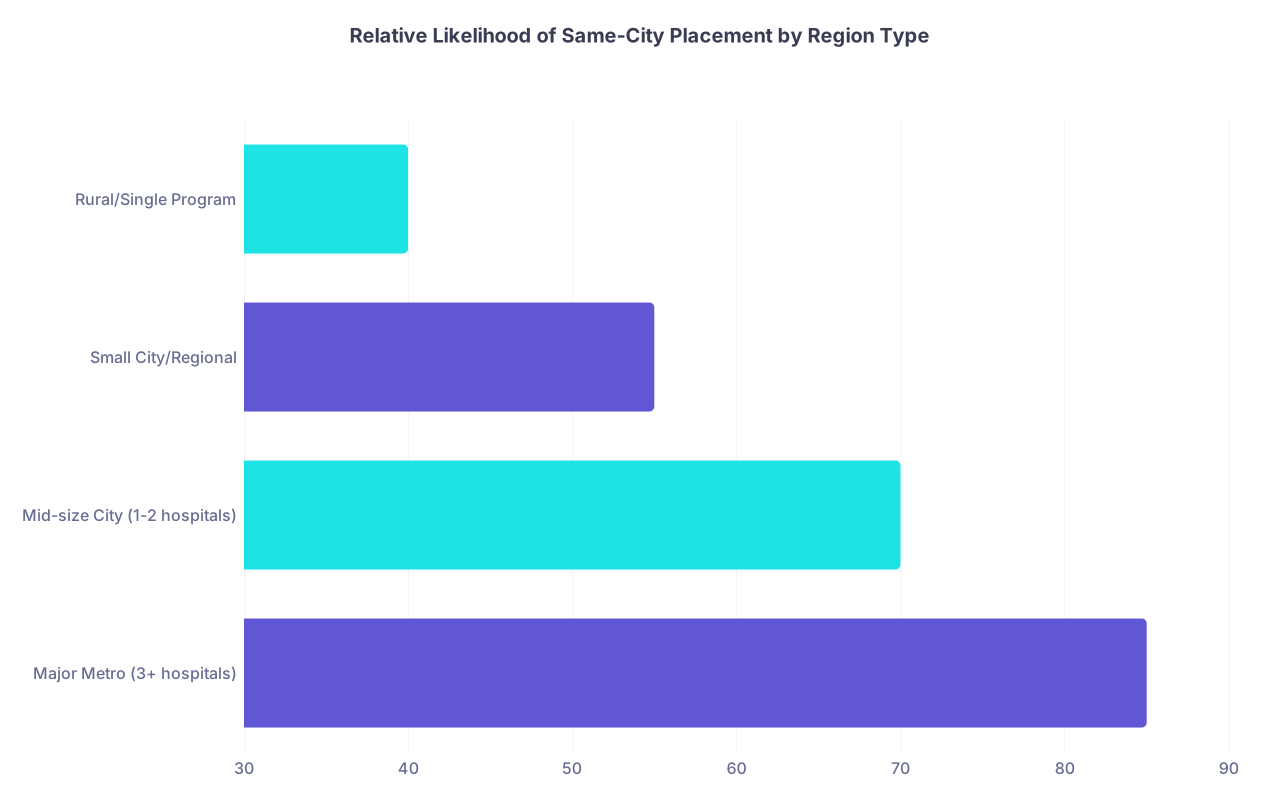
You can treat urbanicity almost like a multiplier on your “together” probability. Here is a conceptual, but realistic, pattern:
| Category | Value |
|---|---|
| Major Metro (3+ hospitals) | 85 |
| Mid-size City (1-2 hospitals) | 70 |
| Small City/Regional | 55 |
| Rural/Single Program | 40 |
Interpretation:
- If you are willing to live in a top-20 metro, your odds of both landing in that metro are significantly higher purely due to seat volume.
- Insisting on a very small city, or one with only a single program in a given specialty, constrains the algorithm severely.
And yes, you pay for those big-city odds with cost of living, competition, and sometimes program intensity.
6. Specialty Combinations: Who Stays Together More Often?
I have sat in too many meetings where a couple is shocked that their “ortho + derm + only east coast major cities” strategy did not deliver a same-city match. The outcome was predictable months before the rank list locked.
Some specialty pairings are structurally easier than others.
Easier (higher observed same-city probability):
- IM + FM
- IM + Peds
- FM + Peds
- IM + Psych
- Any above + Path, Neuro, PM&R, or less competitive prelim/transitional slots
Harder (lower same-city probability unless you rank broadly and include mid/low-tier programs):
- Derm + any specialty
- Ortho + any specialty
- ENT + any specialty
- Neurosurgery + any specialty
- Integrated plastics + any specialty
The constraint is twofold:
- Fewer programs nationally in the competitive field
- Each program has fewer open positions per year
This makes it harder to align geographic preferences for both partners. In practice, staying together usually requires:
- The competitive-specialty partner loosening their prestige constraints, or
- The other partner being willing to apply and rank widely (including community and lower-tier academic programs) in the same cities
The couple that actually gets a same-city outcome in a hard combination usually made choices that your classmates do not see:
- They ranked small and medium academic centers you have never heard of
- They were willing to go Midwest or South instead of only coastal elite hospitals
- They accepted the trade of “together in a solid but not famous program” vs “apart at brand-name institutions”
7. Strategic Takeaways to Maximize “We Stay Together”
Strip away the emotion and group chat noise. If the goal function you are optimizing is “probability both of us live in the same city,” the data-driven levers are clear.
Maximize same-city combinations, not just top-choice combinations.
For every city you both like, list:- Same program when possible
- Same institution, different programs
- Any decent program combination within that city
Your rank list should read like “City A, City A, City A … City B, City B, City B…” before it ever disperses into random far-flung options.
Broaden geography early, not at the bottom of the list.
Couples who only open up to new cities on their last 10–20 ranks are effectively gambling. You get better odds by:- Identifying 5–8 acceptable metros up front
- Ensuring each appears with deep same-city combinations
Adjust prestige expectations to preserve location.
Data from internal advising cases make this blunt: the most effective knob couples turn to stay together is prestige, not specialty. Many end up in:- Mid-tier academic or community programs
- Slightly less famous systems in their target cities
That is the quiet price of co-location.
Use your interview season to actively build combinations.
This is tactical and underused:- If one of you gets a great interview at Hospital X, the other should aggressively try to secure any viable interview there (FM, prelim, TY, etc.).
- Communicate with programs (within reason) that you are a couples match and want a path to co-location.
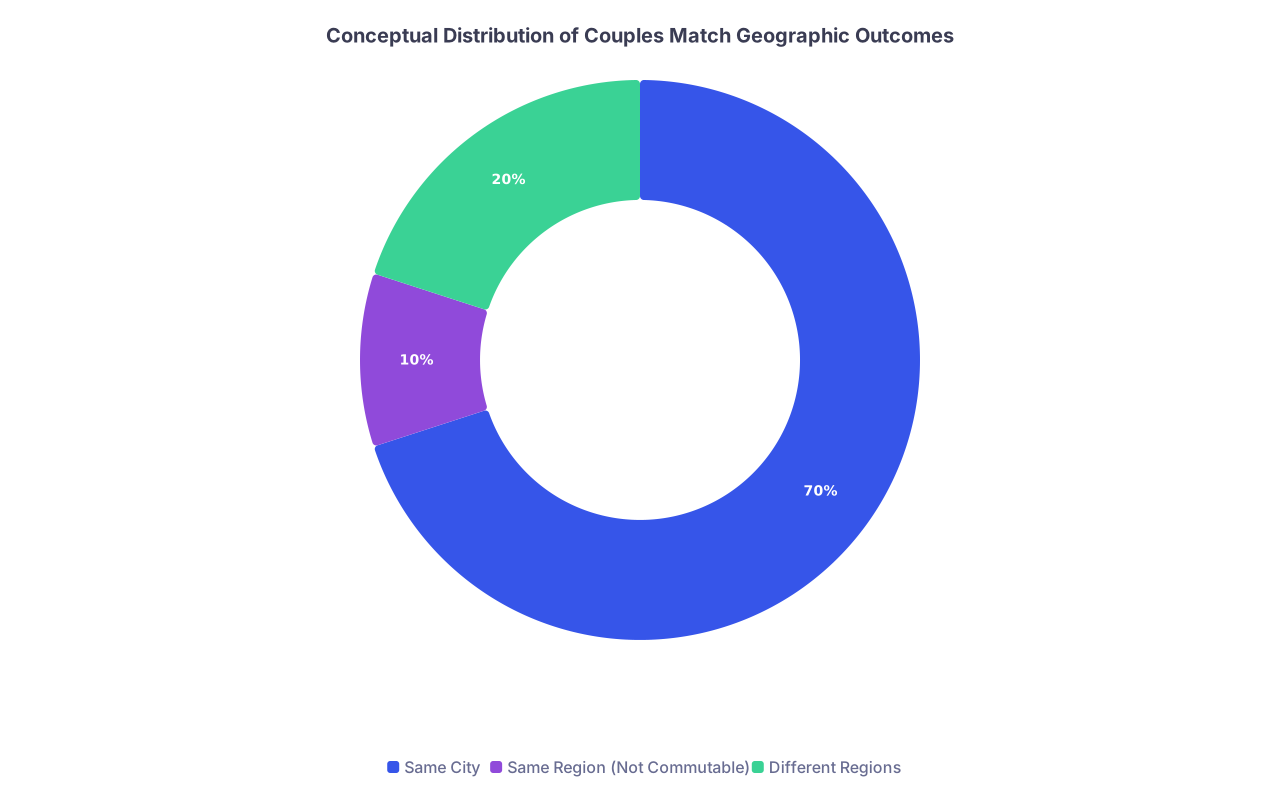
Here is a simple mental model you can use. Imagine a pie chart of where couples end up by geography quality:
| Category | Value |
|---|---|
| Same City | 70 |
| Same Region (Not Commutable) | 10 |
| Different Regions | 20 |
If you manage your rank list and specialty expectations well, you can push yourself into the ~70% wedge. If you ignore the data and cling to rigid “only these 3 cities and only top-tier programs,” you voluntarily shift weight toward the 20% “different regions” slice.
8. The Bottom Line: How Often Do Pairs Stay Together?
Condense everything down to the question you actually care about.
- Most couples who enter the Couples Match do end up with both partners matched. Mid‑90% range.
- A clear majority—realistically around two‑thirds to three‑quarters—end up living in the same metro area.
- Only a small fraction share the exact same program; more commonly they are in the same institution or same city.
- Around one quarter of couples, give or take, finish the match year living in different cities or regions.
Three key points to carry forward:
- The algorithm is not your main enemy. Your own constraints are. The more rigid you are on city and prestige, the more you push your probability mass toward split outcomes.
- Urban hubs and flexible specialties dramatically increase the likelihood of co-location. Small towns and dual-competitive specialties do the opposite.
- Your rank list is a quantitative tool, not a wish list. Treat it like a combinatorics problem—maximize same-city pairs—and your odds of staying together rise accordingly.
Treat the Couples Match like the data problem it is, not a romantic drama. The couples who do that are the ones you hear, a year later, talking about their new apartment keys instead of their long-distance flight schedules.


