

The mythology around the couples match is wrong. Most people overestimate the “penalty” and underestimate where the real risk actually is.
For couples, the data shows two things very clearly:
- Your individual competitiveness still matters more than the couple status itself.
- The combination of specialties you choose changes your probabilities far more than most advisors acknowledge.
Let’s walk through what the numbers actually show and which specialty pairings are structurally higher- or lower-risk for couples.
1. Baseline: How the Couples Match Actually Performs
NRMP releases couples match data every year. Strip out the noise and the pattern is stable.
Across recent cycles:
- Roughly 8–10% of all applicants participate as couples.
- About 95% of couples match at least one partner.
- Around 80–85% of couples match both partners into PGY‑1 positions in the same year.
- A smaller but important subset do not match in the same geographic area, or one partner “trades down” specialty or program prestige.
The critical nuance: “Matched” in pairs data does not necessarily mean “matched to your target specialty at your ideal program in the same city.” The high success statistics hide a lot of compromise. The couple algorithm is designed to maximize pair utility (matching both) rather than individual fit at top choices.
How couples compare to solo applicants
Single applicants in the NRMP match have PGY‑1 match rates around 92–94% in recent years (US MDs higher, DOs and IMGs lower). Couples, viewed as units, have high rates of both matching somewhere, but a nontrivial fraction land lower on their list or in backup specialties.
The matchmaking cost of being in the couples algorithm is not catastrophic. But it is real, especially in certain combinations.
To understand where the risk is concentrated, you need to combine three numbers:
- Specialty competitiveness (fill rate, unmatched rate, typical Step 2 scores).
- Program supply (number of positions and geographic distribution).
- Alignment between the two specialties (how often both have programs in the same hospitals/cities).
That is where specialty pairing matters.
2. Quantifying Specialty Risk for Couples
Let me be concrete. You are not “in the couples match.” You are in one of several risk tiers defined by your pairing.
You can think of pairings in four broad bands:
- Competitive + Competitive (e.g., Derm + Ortho, ENT + Optho)
- Competitive + Moderate (e.g., Ortho + IM, Derm + Peds)
- Moderate + Moderate (e.g., IM + EM, Peds + Anesthesia)
- Moderate/Competitive + Primary Care “Anchor” (e.g., Ortho + FM, IM + FM)
These are not official NRMP labels. They are how someone who reads the data every year actually thinks about it.
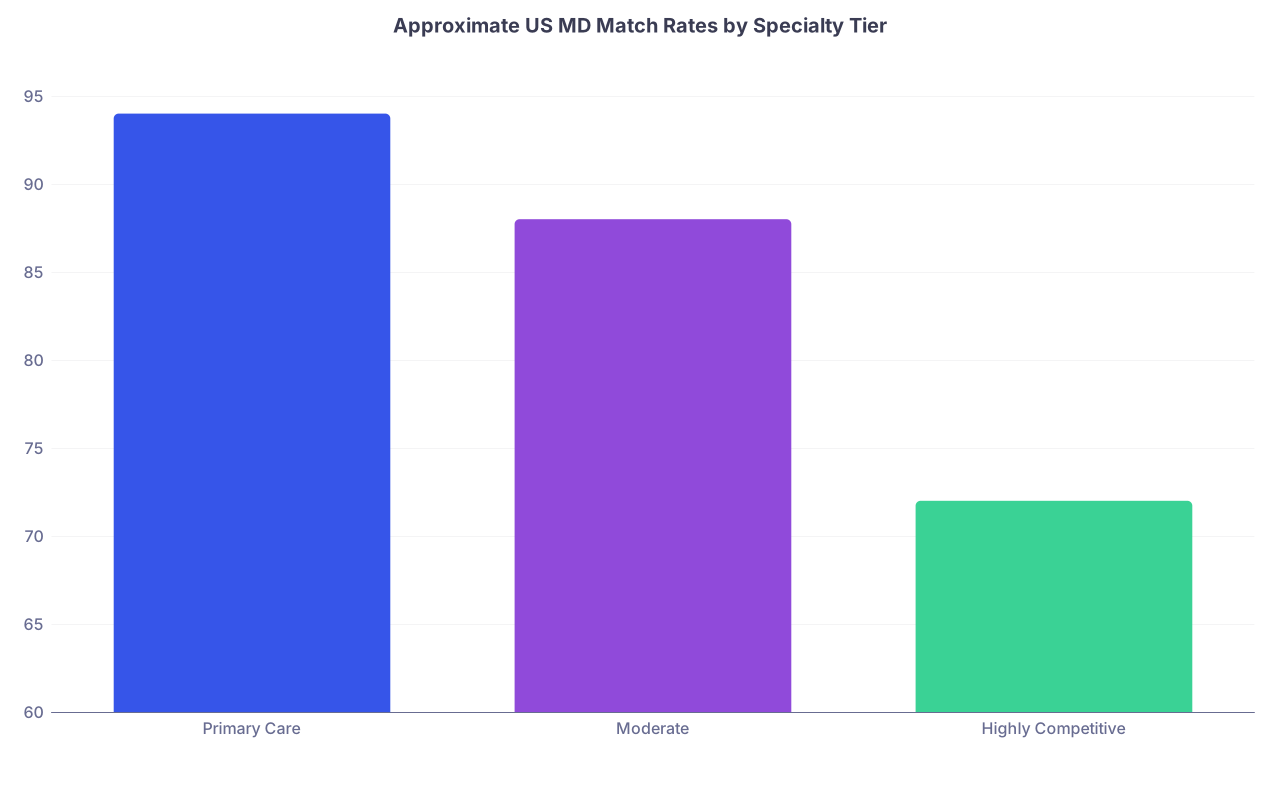
To anchor that, look at how specialties differ in match difficulty.
| Category | Value |
|---|---|
| Primary Care | 94 |
| Moderate | 88 |
| Highly Competitive | 72 |
These are rounded, illustrative values combining several years of NRMP data:
- Primary Care (FM, IM categorical, Peds): very high match rates for US MDs.
- Moderate (EM, Anesthesia, OB/GYN, Psychiatry, General Surgery): mid‑80s to high‑80s.
- Highly Competitive (Dermatology, Plastic Surgery, Ortho, ENT, Ophthalmology, Neurosurgery, Radiation Oncology, some ROAD specialties): much lower for all comers.
Now map that onto pairings.
3. High-Risk Pairings: Competitive + Competitive
If you and your partner both aim for highly competitive specialties, the data is not subtle. Your failure modes multiply.
Think about independent probabilities. If a single Derm applicant with your profile has, say, a 70–75% chance of matching Derm somewhere, and a single Ortho applicant has a 70–75% chance of matching Ortho somewhere, then the chance that both clear their bar independently is 0.75 × 0.75 ≈ 56%. That is before you impose the geographic coupling constraint.
That calculation is simplistic but directionally correct. The couples algorithm can improve on this somewhat, because it optimizes pairs together across rank lists. But it cannot create positions where none exist, and it cannot make two programs in the same city take two marginal applicants just to keep a couple happy.
Examples of particularly fragile pairings:
- Derm + Ortho
- Derm + ENT
- Ortho + Neurosurgery
- ENT + Ophthalmology
- Plastics + anything else competitive
You are asking for:
- Two distinct program directors in often different departments
- Both in specialties with limited positions (often 1–4 per year per program)
- Both in cities that might have only 1–2 programs in each field
The bottleneck is program supply and geographic clustering. Plenty of cities have strong Ortho but no Derm. Or Derm but no ENT. Or ENT but no Ophtho.

What I see in these couples:
- Very long rank lists with many “mismatched” entries (one matches, the other in a prelim, research year, or backup specialty).
- Heavy use of backup specialties, often decided late, which reduces quality of those backup applications.
- A clear trade‑off: if both insist on no backup and same specialty competitiveness, they are accepting a real probability that one or both go unmatched or take a non‑categorical position.
From a data analyst perspective: Competitive + Competitive couples should behave as if their true match probability in both intended specialties, same city is well below what each would have as a solo applicant. Not half. But meaningfully lower.
4. Medium-High Risk: Competitive + Moderate
This is where most “ambitious but not reckless” couples land. One partner chases a competitive field; the other is in a moderate one. Think Ortho + Internal Medicine, Derm + Peds, ENT + Anesthesia, Ophtho + OB/GYN.
The data story here is more nuanced.
- The competitive partner’s probability of matching their dream specialty somewhere is roughly similar to solo applicants with the same stats.
- The moderate partner’s probability of matching somewhere is still high.
- The real constraint is geographic overlap: how many cities have both fields with enough positions to absorb a couple without one being clearly weaker?
| City Tier | Ortho Programs | Ortho Positions/Year | IM Programs | IM Positions/Year |
|---|---|---|---|---|
| Top metro A | 3 | 10 | 4 | 80 |
| Metro B | 2 | 6 | 3 | 60 |
| Regional C | 1 | 3 | 2 | 40 |
| Smaller D | 0 | 0 | 1 | 20 |
In a structure like this (common in the US):
- The Ortho partner has only 3+2+1 = 6 realistic program sites within the areas they want.
- The IM partner effectively has slots almost everywhere.
For the couple, the binding constraint is the Ortho positions in cities that also have IM. So the pair’s chance of both matching in the same city is dominated by the competitive specialty’s options, not the moderate one.
The big mistake I see:
Couples overestimate how much “being a package” will help the competitive partner at individual programs.
Reality: Many PDs do not care that much that your partner is in IM down the hall. They care about your board scores, letters, case logs, and perceived fit. Unless your partner is also joining their department or call pool, most PDs will not massively stretch their rank order list just to complete your couple. A slight nudge, maybe. Not a 30‑point Step 2 deficit.
Statistically, these couples usually:
- Match somewhere together at relatively high rates.
- Match the competitive partner to their dream specialty with decent rates, but often not at top‑tier programs.
- Force the moderate partner to be extremely flexible on program prestige, region, and maybe even preliminary versus categorical structure.
Still, this tier is workable if both have reasonable profiles.
5. Medium Risk: Moderate + Moderate Pairings
Moderate + Moderate couples are where the algorithm starts to look friendly. You have more supply, more geographic overlap, and less brutal score cutoffs.
Think
- IM + EM
- Peds + Anesthesia
- OB/GYN + EM
- Psychiatry + General Surgery
- Anesthesia + EM
Here the math changes. Many mid‑sized to large hospitals run several of these programs under the same institutional umbrella. That means:
- Multiple programs at the same site you can realistically rank as “same city, same institution” pairs.
- Dozens of cities and programs where both partners are individually competitive.
| Category | Value |
|---|---|
| Competitive+Competitive | 55 |
| Competitive+Moderate | 70 |
| Moderate+Moderate | 80 |
| Competitive+Primary Care Anchor | 85 |
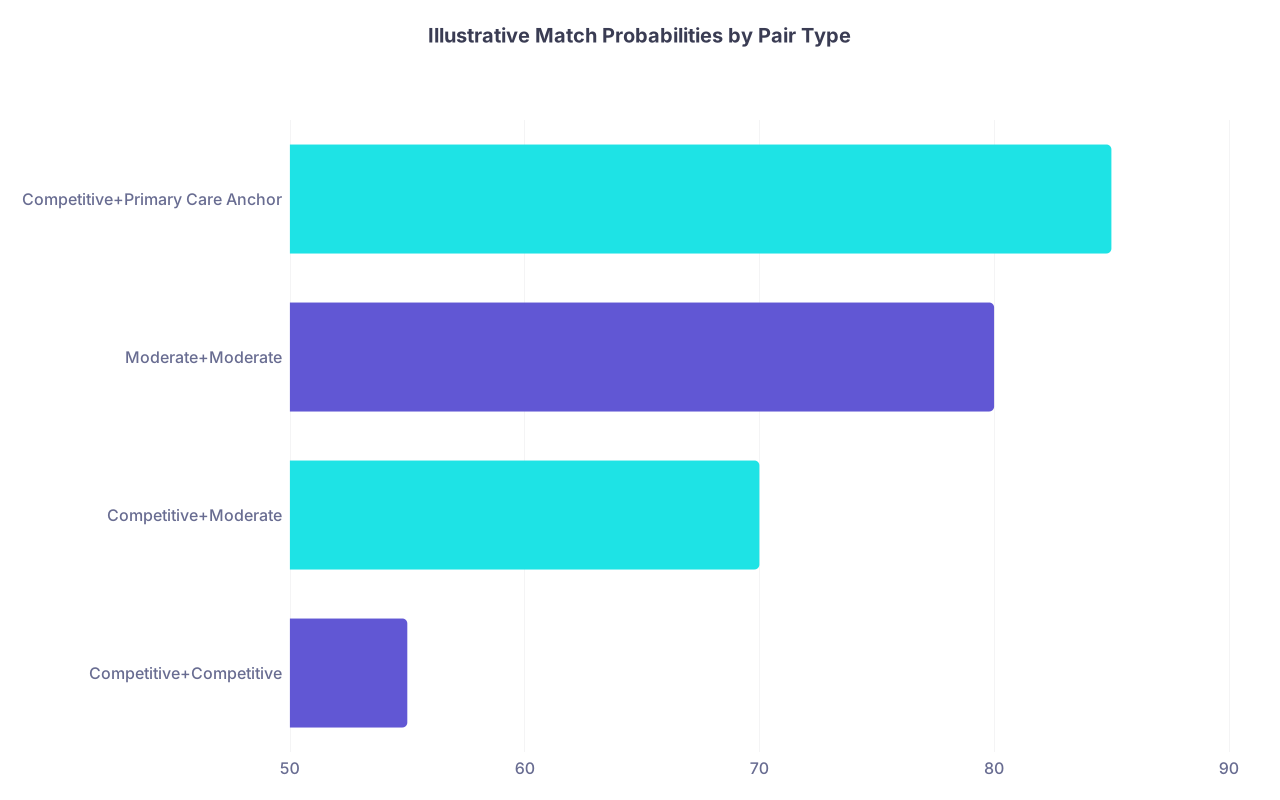
These numbers are not official NRMP values; they are reasonable approximations for “probability both partners match their intended specialties in the same region” for reasonably competitive US MDs.
The key here is variability. I have seen:
- IM + EM couples with solid Step 2 scores (mid‑240s USMD) match at top‑20 academic centers in the same city.
- Psychiatry + OB/GYN couples with average stats fill their top 3 paired choices.
- Anesthesia + EM couples absorb a wide geographic net and almost always land both in their densities of interest.
The limiting factor in this tier is often not raw match probability. It is alignment of lifestyle goals and schedule tolerances once in training. EM + Surgery both on nights is not exactly a family‑friendly pairing. But that is a different problem than match probability.
Numerically, as long as:
- Both partners are above roughly the 50th percentile for their specialty (boards, grades, letters), and
- You build a long, well‑coordinated rank list spanning a mix of institution types and regions,
your couples match statistics look reasonably strong.
6. Lower-Risk Strategy: Pairing with a Primary Care “Anchor”
If you want to tilt the statistics heavily in your favor as a couple, you make one simple, unromantic strategic choice:
One partner anchors the couple with a high‑supply, high‑match‑rate specialty in which they are clearly competitive.
That usually means:
- Family Medicine
- Internal Medicine categorical
- Pediatrics
- Sometimes Psychiatry, depending on the region (psychiatry slots have expanded meaningfully)
Pairings like:
- Ortho + FM
- Derm + IM
- ENT + Peds
- Neurosurgery + FM
- EM + IM
have a fundamentally different risk profile than Competitive + Competitive.
Because the anchor partner can:
- Apply very broadly (40–60+ programs) without raising eyebrows.
- Rank aggressively in the cities most favorable to the competitive partner.
- Absorb some downgrade in program prestige without losing training quality.
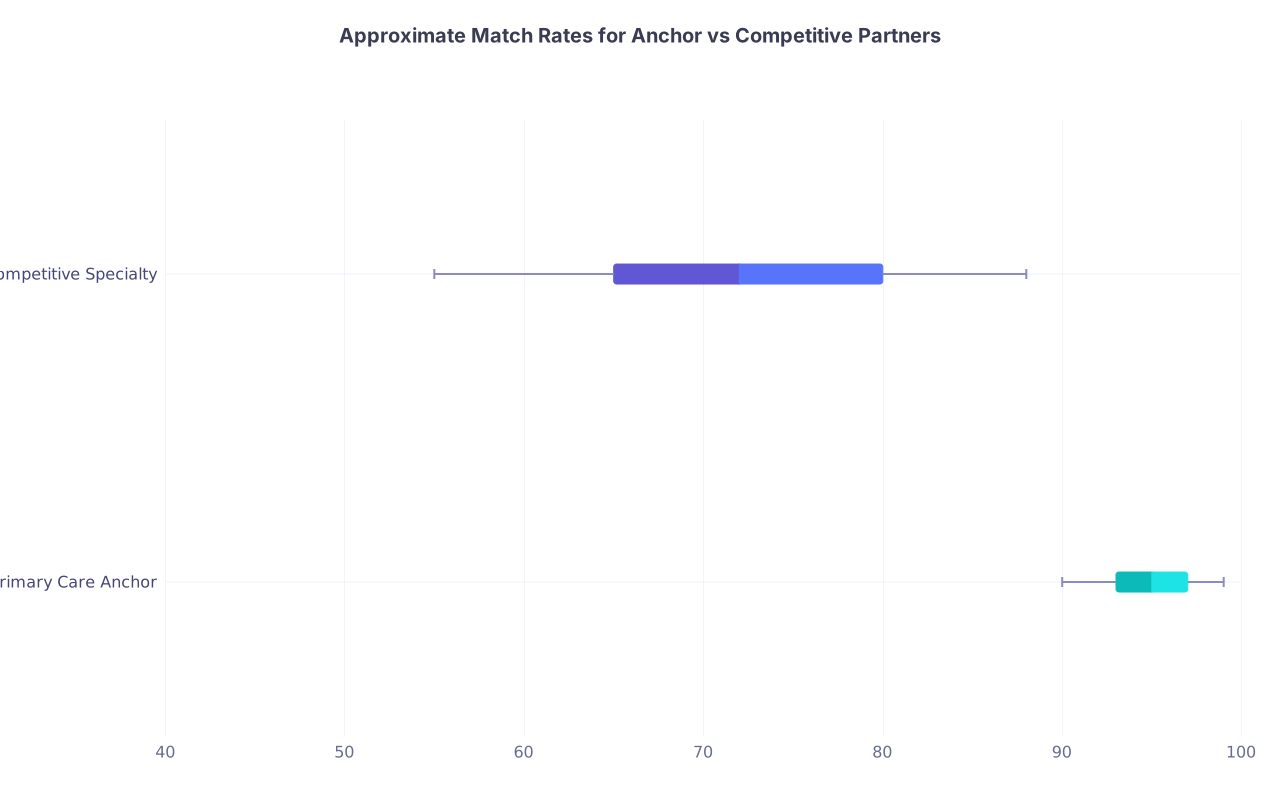
The anchor’s personal match probability in that field is often 90–95%+ as a solo applicant. You are effectively using that capacity to “absorb” the uncertainty of the competitive partner.
| Category | Min | Q1 | Median | Q3 | Max |
|---|---|---|---|---|---|
| Primary Care Anchor | 90 | 93 | 95 | 97 | 99 |
| Competitive Specialty | 55 | 65 | 72 | 80 | 88 |
Again, illustrative ranges from NRMP trends, not exact numbers.
I have seen:
- Derm + IM couples where the IM partner simply blanketed every city with a Derm program and comfortably matched at a strong but not ivy‑league internal medicine residency.
- Neurosurgery + FM couples who targeted a narrow set of regions, built 30–40 rank pairs in those, and matched within their top 5 pairs.
- Ortho + Peds couples that essentially optimized for the Ortho partner’s institutional preferences, with the Peds partner still landing at excellent children’s hospitals.
Is this fair? That depends who you ask. Statistically, it works.
7. How Rank List Strategy Changes the Numbers
The couples algorithm is powerful, but it is dumb in one way: it only sees the combinatorial structure you give it.
If your rank lists are shallow, misaligned, or sloppily built, you waste a lot of “latent” probability you actually had. I have seen couples with strong applications sabotage themselves with poor rank design.
There are three levers that matter most for the data:
- Number of paired ranks
- Proportion of “desirable” vs “safety” pairs
- Willingness to rank asymmetric outcomes (one matches, the other does prelim or backup)
Let me show a simplified scenario. Imagine a Moderate + Moderate couple, each with roughly 80% chance of matching somewhere individually given their interview set, if they ranked independently.
Scenario A: Shallow, aspirational lists
- 10 paired choices, all big coastal academic centers.
- Very few midsize or community programs ranked.
- No asymmetric options.
Scenario B: Deep, diversified lists
- 30+ paired choices, including a mix of academic, community, and different regions.
- Thoughtful inclusion of cities where one program is slightly weaker but the other is strong.
- Some asymmetric “one in prelim or TY year” options.
You can think of Scenario B as tripling the number of “states” where the couple could find a consistent and mutually acceptable match.

| Step | Description |
|---|---|
| Step 1 | Individual Interviews |
| Step 2 | High chance of no mutually acceptable combo |
| Step 3 | Higher chance of at least one feasible pair |
| Step 4 | Short Paired List |
| Step 5 | Deep Paired List |
From a data perspective, Scenario B pushes the couple’s effective probability of landing an acceptable pair much closer to the product of their individual match potentials. Scenario A wastes that potential and makes geographic coincidence your enemy.
A rule of thumb I use when advising:
- If each partner has 12–15 interviews, you should usually end up with at least 20–25 paired ranks.
- If you are in a higher‑risk pairing (Competitive + Competitive or Competitive + Moderate) you want more—30–40+ if feasible.
8. Specialty Pairing Profiles: Who Has Structural Advantages?
You probably want some concrete pair examples. Here is a simplified comparison of how different pairings tend to behave, assuming similar applicant strength (average‑to‑above‑average US MDs, no major red flags).
| Pairing Example | Risk Level for Both Matching Intended Specialty Same Region | Main Bottleneck |
|---|---|---|
| Derm + Ortho | Very High | Limited slots + geography |
| ENT + Ophtho | Very High | Program supply + scores |
| Ortho + IM | High | Ortho positions by city |
| Derm + Peds | High | Derm positions + scores |
| EM + Anesthesia | Medium | Both moderately selective |
| IM + EM | Medium | Location/fit, not supply |
| Peds + Anesthesia | Medium | Fewer joint programs |
| Ortho + FM | Low‑Medium | Ortho only |
| Derm + IM | Low‑Medium | Derm only |
| IM + FM | Low | Both high supply |
“Risk level” here means: relative risk that one partner fails to match their intended specialty in the same region, not the generic NRMP unmatched rate.
The pattern is obvious:
- When both sides are battling for limited slots at high thresholds, tiny shifts in applicant strength matter.
- When one side has 90–95%+ baseline match probability and broad geographic options, the couple can absorb a lot of randomness.
9. What the Numbers Mean for Your Strategy
The data is not sentimental. It does not care how long you have been together or how perfectly your lifestyle goals sync. It cares about positions, probabilities, and constraints.
If I strip this down for you as a couple:
Your specialty combination defines your risk band. Competitive + Competitive is structurally risky. Moderate + Moderate is workable. Competitive + Anchor is statistically favored.
Geography interacts with that. Want to be in one specific city or region only? You have effectively made every pairing more like Competitive + Competitive. I have watched strong couples torpedo their match by insisting on “Boston or bust” when only one partner had Boston‑caliber stats.
Depth and structure of rank lists convert probability into reality. If you refuse to rank enough reasonable backup configurations, you are choosing a brittle outcome even if your raw odds were decent.
Someone will probably compromise. That compromise shows up in prestige, location, or specialty. The data does not support the fantasy of two marginal applicants both landing in hyper‑competitive fields, top‑10 programs, and their #1 city as a couple. It happens, but only when they were already outliers on paper.
The numbers on the couples match are not a horror story. They are a constraints problem.
Three key points to take with you:
- Specialty pairing is not all‑or‑nothing, but some combinations are objectively riskier. Plan like the data, not like the anecdotes.
- An anchor specialty with broad program supply dramatically raises the couple’s odds of matching together without blowing up one partner’s career.
- Long, well‑aligned rank lists are not optional for couples—they are the main tool you have to convert individual competitiveness into joint success.


