

The standard advice about rank lists for couples is dangerously vague. “Rank as many programs as possible” is not a strategy. The data shows that the optimal list length for couples is not infinite—it is specific, year-dependent, and very different from solo applicants.
Below I am going to treat this the way it should be treated: as a probability and capacity problem, not a vibes-based decision.
1. The Core Numbers: Solo vs Couples Match Probabilities
Let me start with what the data actually says.
NRMP’s Charting Outcomes and data supplements (2018–2023) consistently show:
For solo US MD seniors:
- Match rate if they rank only 1 program: ~50–55%
- By 5 ranks: ~80–85%
- By 10–12 ranks: ~90–95%
- Incremental benefit after ~12–15 programs is small for most core specialties.
For couples:
- Match rate is lower at each comparable list length.
- Safe numbers are roughly 1.5–2.5 times longer than solo applicants for a similar probability of matching somewhere.
Couples are not just „two solo lists stuck together.“ The algorithm tries to place both partners together using pairs of ranks. That creates combinatorial scarcity: fewer acceptable pairings exist, and many of those are effectively “competing” for the same limited spots.
So the rule of thumb I use when advising couples:
To get approximately solo-level security, each partner usually needs 1.5–2× the individual rank list length a similar solo applicant would need.
Let’s put that into more concrete numbers by year.
2. Optimal Rank List Length by Year (Solo vs Couples)
Think about rank length in tiers:
- “Very risky”: You are flirting with not matching.
- “Reasonable but not maximized”: Acceptable if you can tolerate some risk.
- “Aggressive safety”: Optimizing for matching somewhere, not just dream programs.
I will break this down by application year and then translate it into a simple table.
PGY‑1 / Categorical Match (Standard US MD Senior, Non‑Couples)
Assuming a moderately competitive specialty (IM, Peds, FM, Psych, OB/GYN, Anesthesia) and a reasonably aligned applicant (Step 1 pass, solid Step 2, typical number of interviews):
- 5 ranks: Match probability often >80%, but specialty and competitiveness matter.
- 8–10 ranks: Frequently in the >90% zone.
- 12–15 ranks: Diminishing marginal returns; above this, each additional rank adds small incremental probability.
For very competitive specialties (Derm, Ortho, Plastics, ENT, NSGY), the entire distribution shifts; 10 ranks in ortho is not the same as 10 ranks in FM. But the shape of the curve is similar.
PGY‑1 / Categorical Match (Couples)
The couples data are sparse in public reports, but pattern is clear:
- With short lists (≤5 programs each), couples match rates drop sharply compared to solos.
- Successful couples nearly always have longer lists, more geographic flexibility, or both.
For many couples, this is the practical translation:
- 6–8 programs each: Very risky. You are gambling, especially if either specialty is competitive or locations are limited.
- 10–12 programs each: Reasonable middle ground if both specialties are mid‑range competitiveness and you accept a non‑trivial chance of SOAP.
- 14–20 programs each: Aggressive safety zone for most couples in non-ultra-competitive specialties.
The constraint is not just count; it is the size of the overlap set—the number of programs where meaningful couples combinations exist (same hospital, same city, drivable distance).
To make this concrete, here is a summary comparison.
| Applicant Type | Year / Context | Conservative Safe Range | Risky Short Range |
|---|---|---|---|
| Solo | PGY-1, mid-competitiveness | 10–15 programs | ≤7 |
| Couple | PGY-1, both mid-competitiveness | 14–20 programs each | ≤9 each |
| Solo | PGY-2 Advanced (e.g., Radiology) | 8–12 programs | ≤6 |
| Couple | PGY-2 Advanced + prelim/TY needed | 14–22 programs each | ≤10 each |
| Solo | Re-applicant / weaker portfolio | 15–20+ programs | ≤10 |
| Couple | One or both weaker candidates | 18–25+ programs each | ≤14 each |
These are not perfect for every specialty, but they are directionally correct. And yes, for couples, 18–22 ranked programs each is not excessive. It is normal.
3. Why Couples Need Longer Lists: The Math, Not the Myth
Let’s do the part people usually hand‑wave: the combinatorics.
3.1 Basic Probability Model
Assume (for a simplified mental model):
- Solo applicant has an approximate chance ( p ) of matching at some ranked program based on list length.
- A couple succeeds only if both match into an acceptable pairing.
If each partner matching was independent (it is not, but this sets the floor), then:
- Probability both match ≈ ( p_A \times p_B )
If each solo has 90% chance (0.90), then:
- Both match ≈ 0.90 × 0.90 = 0.81 (81%)
So even if each of you is a “90% chance of matching solo” applicant, the chance of both matching at all (ignoring geography) is already down around ~80%. And that is the optimistic case.
Now layer in geography constraints:
- Many “matches” that work for A do not have a paired option for B in the right radius.
- Some programs are acceptable only as “same-institution” pairs, not “same city.”
- Some specialties are only present in a few sites per metro area.
So the effective number of viable pairs is often far smaller than the raw number of individual programs each of you ranks.
3.2 Overlap Set Size: The Hidden Variable
What really determines your required length is not just “how many total programs” but:
- The size of the overlap set: Where there exists at least one acceptable (Program A_x, Program B_y) combination.
- The rank depth within those overlap programs: Are you both realistically competitive at those places?
I have seen couples come in with:
- Partner A: 20 IM programs nationwide
- Partner B: 15 Pediatrics programs
- Overlap where both interviewed: only 6 cities, with maybe 2–3 hospitals each.
So even though they had 35 combined interviews, the actual number of distinct geographic pair options they could stomach was more like 8–12. That is low. That pushes you into needing to list very deeply within each overlap region.
4. Year‑Specific Considerations: PGY‑1 vs Advanced / PGY‑2
The year of entry changes the risk landscape. PGY‑1 couples and advanced‑year couples are not playing the same game.
4.1 PGY‑1 Couples (Categorical or TY/Prelim + Categorical Same Year)
For couples entering PGY‑1 together (e.g., IM + Peds, EM + Anesthesia, FM + Psych):
- The algorithm treats you as a couple for that year only.
- Complexity is mostly driven by:
- Number of geographic markets you are willing to rank.
- Whether you require same‑hospital vs same‑city vs “commutable region.”
- Competitiveness mismatch between partners.
Data‑driven guidelines here:
If both are in moderate specialties and have average or better profiles:
- Aim for ≥14–16 ranks each as a baseline.
- If you are location-flexible (5+ metro areas): you can sometimes get away with 12–14 each.
- If you are location-restricted (≤3 metro areas): 18–22 each is safer if available.
If one partner is in a clearly more competitive specialty (e.g., Ortho + IM, Derm + Peds):
- The less competitive partner should often rank more programs, not fewer.
- Why? Because they may need more geographic flexibility to „follow“ the competitive partner’s matches.
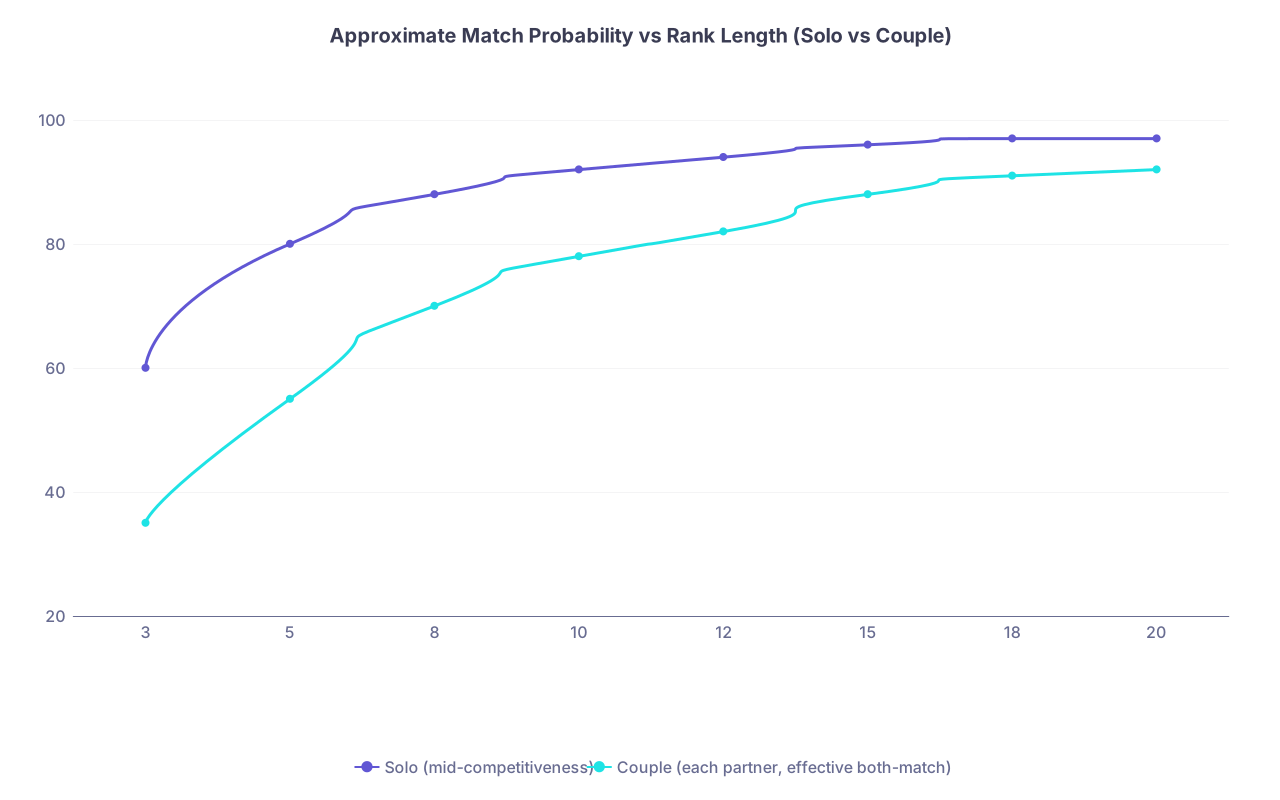
| Category | Solo (mid-competitiveness) | Couple (each partner, effective both-match) |
|---|---|---|
| 3 | 60 | 35 |
| 5 | 80 | 55 |
| 8 | 88 | 70 |
| 10 | 92 | 78 |
| 12 | 94 | 82 |
| 15 | 96 | 88 |
| 18 | 97 | 91 |
| 20 | 97 | 92 |
Read this chart directionally, not literally. The key pattern: couples need to move farther to the right on the x‑axis to get similar y‑axis security.
4.2 Advanced Positions (PGY‑2 Start, e.g., Radiology, Anesthesiology, Neuro, Derm)
For advanced specialties, couples usually deal with two rank lists per person:
- A PGY‑1 list (prelim or TY year).
- A PGY‑2+ list (categorical advanced program).
Sometimes only one partner is advanced. Sometimes both are.
This multiplies the complexity:
- You must ensure your PGY‑1 year locations align with where your PGY‑2+ positions are.
- The algorithm allows couples to build multi‑year linked ranks, but the bottleneck is often the PGY‑1 level (limited prelim spots, heavy competition in desirable cities).
Practical implication for couples where at least one partner is in an advanced field:
- PGY‑2 lists:
- Each partner: 10–15 advanced programs at minimum if possible.
- PGY‑1 lists:
- Each partner: 12–18 prelim/TY programs, more if you are geographically constrained.
And yes, that means a real world example I have seen more than once:
- Radiology applicant:
- 15 advanced rads programs
- 18 prelim/TY programs
- IM applicant partner:
- 20 categorical IM programs (covering the same cities)
- Possibly some prelims/TYs as backup configurations
This is not overkill. This is how you get your risk profile closer to “solo-like.”
5. Strategy by Scenario: How Many Ranks Do You Actually Need?
Let’s look at concrete couple scenarios.
5.1 Average Couple, Average Competitiveness, Moderate Flexibility
Scenario:
- Partner A: Categorical IM, ~12 interviews.
- Partner B: Categorical Peds, ~10 interviews.
- Geography: Open to 4–5 major regions, prefer same city, will accept same metro, no long‑distance.
Recommendations:
Target 14–18 ranks each:
- Rank all reasonable pairings in each city/region.
- Use same‑hospital as top priorities where it makes sense.
- Accept some “same city, different hospital” options lower in list.
If they stop at 9–10 ranks each:
- They are probably cutting their joint match probability by 10–15 percentage points compared to ranking deeply.
5.2 One Competitive, One Less Competitive
Scenario:
- Partner A: Ortho, ~10 interviews.
- Partner B: IM, ~16 interviews.
- Geography: Prefer 2 regions, acceptable 4 regions.
Reality check: A’s list is the limiting reagent.
- Ortho partner:
- Must rank essentially all places where they interviewed (likely 10–12 total).
- IM partner:
- Should build out all IM programs in those cities/metro areas: easily 18–22 programs.
Why more for B? Because you can create multiple viable pairings per city based on A’s fixed options. Each ortho program city may have several IM options. That is how you expand the overlap set without “inventing” new ortho interviews.
5.3 Both Competitive, Narrow Geography
Scenario:
- Partner A: Derm, ~7 interviews.
- Partner B: ENT, ~8 interviews.
- Geography: Want only 2 metro areas for life reasons.
This combination is mathematically brutal. The problem is not rank length; it is low combinatorial overlap.
For couples like this:
- Even with 20 ranks each, your ceiling may be well below solo match probabilities.
- You should:
- Extend geography if at all feasible.
- Consider realistic backup specialties (yes, seriously).
- Talk with mentors about single‑applicant matching and trying to rejoin later if absolutely necessary.
No amount of rank length can fully rescue a situation where the overlap set is tiny and ultra‑competitive.
6. How to Actually Build a Longer Couples Rank List (Without Losing Your Mind)
“Rank more programs” is useless advice if you do not know how to structure them. The goal is to maximize your probability mass early in the list but maintain depth so the tail can still catch you a match.
6.1 Priority Tiers
I usually see couples build tiers like this:
- Tier 1: Same‑hospital, top‑choice cities, both strong fits.
- Tier 2: Same‑city, different hospitals in preferred cities.
- Tier 3: Same‑city/same‑region in “backup” cities that are still acceptable.
- Tier 4: Long‑commute or less ideal city combinations (for those who are risk‑averse and want to avoid SOAP).
You build the rank order by enumerating all Tier 1 pairs, then Tiers 2–4 in descending preference. That is how you end up with 15–25 pairs that are still genuinely acceptable.
6.2 Avoiding Fake Length
Some couples pad lists with options they would never actually take. That is a statistical error.
If there is a pair you would rather go unmatched than accept, it should not be on the list. Full stop. A long list of fake options is not depth; it is noise.
Instead, focus on:
- Enumerating all realistic combinations in each city where you both interviewed.
- Considering “adjacent” programs in a metro area you neglected when scheduling interviews (if it is not too late).
- Creating clear rules about commute limits (for example, ≤1 hour each way max).

| Step | Description |
|---|---|
| Step 1 | List all interviews each partner has |
| Step 2 | Identify overlap cities/regions |
| Step 3 | Define acceptability rules: same-hospital, same-city, commute limits |
| Step 4 | Generate all acceptable program pairs per city |
| Step 5 | Assign preference tiers 1-4 |
| Step 6 | Order pairs within tiers |
| Step 7 | Check for any pairs you would rather go unmatched than accept |
| Step 8 | Remove unacceptable pairs and finalize list |
7. Year‑Over‑Year Trends: Why “Rank More” Matters Slightly More Each Cycle
The Match is not static. Over the last decade we have seen:
- Rising number of applications per applicant.
- Stable or slightly increasing residency positions, but demand still high in certain fields.
- More couples matching each year.
This pressures popular metro areas and amplifies the risk for couples who insist on:
- High‑demand cities (NYC, Boston, SF, Seattle, Denver, etc.).
- Competitive specialties.
- Short lists.
So the “old chiefs” saying “we matched fine with 8 ranks each” may not be living in your reality. The equilibrium has shifted.
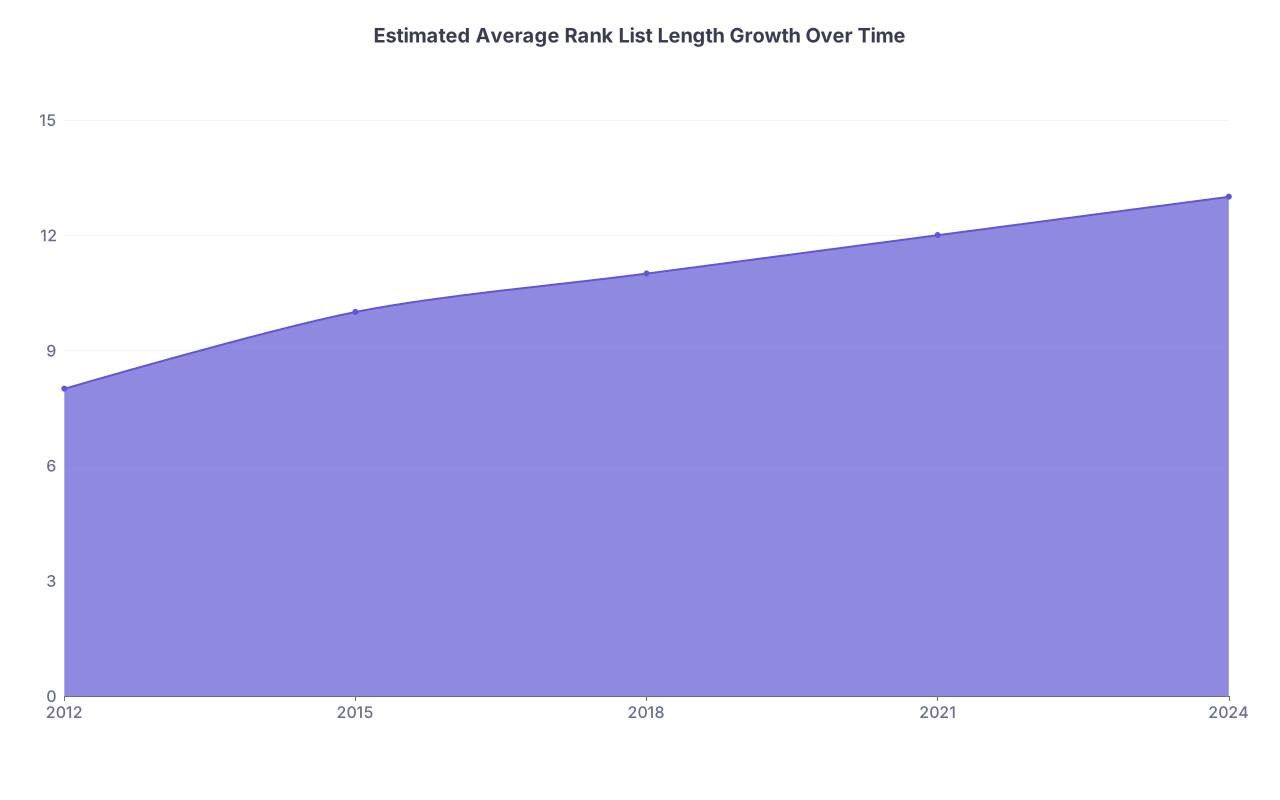
| Category | Value |
|---|---|
| 2012 | 8 |
| 2015 | 10 |
| 2018 | 11 |
| 2021 | 12 |
| 2024 | 13 |
This chart is illustrative, not official NRMP data, but it matches the visible trend: applicants, especially couples, are ranking more programs now than a decade ago.
8. Practical Benchmarks: What You Should Aim For
Here is where I put a stake in the ground, based on the data patterns and what I have seen.
For couples:
- If each of you has fewer than 10 ranks:
- You are in the danger zone unless both are highly competitive in very non‑competitive specialties with broad geography.
- 10–13 ranks each:
- Acceptable if both are mid‑strength, specialties are not hypercompetitive, and you have ≥4 metro areas in play.
- 14–18 ranks each:
- The “normal” target for most couples who care about minimizing SOAP risk.
- 19–25 ranks each:
- Sensible for:
- One or both weaker applicants.
- Heavily constrained geography (≤3 cities).
- One or both in more competitive specialties.
- Sensible for:
For solo applicants with average risk tolerance in mid‑range specialties:
- 8–12 ranks is often adequate.
- Above 15 is usually overkill unless you are weaker or the field is competitive.
Couples are playing a different game. The list length needs to reflect that.
FAQ (Exactly 5 Questions)
1. Is there such a thing as “too long” a rank list for couples?
Functionally, almost never. The algorithm can handle long lists. The real constraint is your willingness to accept the lower‑tier pairs. If every pair on the list is truly acceptable, an extra 10–15 ranks only helps. “Too long” is when you start including combinations you would rather not match into.
2. If we only have 7–8 interviews each, are we doomed as a couple?
Not doomed, but you are high‑risk. With 7–8 each, your strategy should be: create as many pairings as possible within that set (same‑hospital, same‑city, broader commute), be extremely honest about geographical flexibility, and seriously discuss backup plans, including the possibility of an unpaired match for one partner and rematching later.
3. Does couples matching always reduce our chances compared with going solo?
Yes, mathematically. You are solving a harder optimization problem—two matches, linked by location constraints. The data show lower match rates for couples than for comparable solo applicants, especially when lists are short. However, longer, well‑constructed lists can shrink that gap substantially.
4. Should the stronger partner “limit” their rank list to match the weaker partner’s options?
Not usually. The smarter move is: the weaker partner expands their list aggressively in cities where the stronger partner is viable. The stronger partner’s most competitive options should stay on the list, especially early; removing them just compresses your probability space and can paradoxically increase non‑match risk for both.
5. How do we know when to stop adding more programs to rank?
You stop when additional programs are either:
- Locations you would seriously not move to, or
- Programs so misaligned with your goals or wellbeing that SOAP or reapplying would be preferable.
If you are still adding combinations that you would genuinely accept—and you care about minimizing risk—you probably are not “too long” yet, especially as a couple.
Key points, without padding:
- Couples need roughly 1.5–2× the rank length of similar solo applicants to get comparable match security.
- “Optimal” rank length for most couples in mid‑range specialties is 14–20 programs each, adjusted upward with tighter geography or weaker applications.
- The enemy is a small overlap set, not just a short list—build depth around your real overlapping cities and programs, and your probability of matching together climbs dramatically.


