

15% of couples in the NRMP Match include one partner who is applying to a “highly competitive” specialty while the other is not—yet most of them still plan as if they both have the same odds.
That asymmetry is exactly where people get burned. The data shows that a score gap between partners—especially when only one is truly competitive—changes your match probabilities far more than most couples realize. Not just for the weaker partner. For the stronger one too.
Let me walk through what the numbers actually suggest, instead of the optimistic “we’ll just rank the same places and see what happens” approach that tanks couples every year.
1. What the data actually says about couples match risk
The NRMP’s Couples Match data is not as flashy as the specialty competitiveness charts, but it is much more brutal.
Across multiple NRMP Outcomes and Data reports, one pattern is consistent: couples have a higher overall match rate than individuals, but only because they’re more self-selected and often stronger on average. Once you condition on one competitive and one non-competitive partner, the picture changes fast.
Several key data points:
- Solo U.S. MD seniors have ~92–94% match rates overall.
- Couples together match at ~95–96% to something if they are both reasonably competitive.
- But when you adjust for score gaps and specialty competitiveness, the “95–96%” doesn’t apply. At all.
The closest proxy we have is combining:
- Match rate by Step 2 CK score band.
- Match rate by specialty competitiveness.
- The mechanical rule of couples matching: both must match in the same geographic pair (or one unmatched).
Here is a simplified translation into something usable.
| Step 2 CK Band | Competitive Specialty* | Non-Competitive Specialty** |
|---|---|---|
| ≤ 220 | 30–40% | 60–70% |
| 221–240 | 55–65% | 80–88% |
| 241–255 | 75–85% | 92–95% |
| ≥ 256 | 85–95% | 95–98% |
* Competitive: derm, plastics, ortho, ENT, urology, ophtho (separate match but similar pattern), integrated IR, neurosurgery.
** Non-competitive: FM, psych, peds, pathology, most community internal medicine.
These are broad ranges, but the relative pattern is stable year after year.
The multiplicative trap
Couples matching is essentially multiplicative risk under constraints.
If Partner A has a 90% chance to match solo and Partner B has a 90% chance solo, naïve expectation is “We’re 90% likely to be fine.” That is wrong. The relevant probability is:
- Probability that they both match in acceptable paired locations.
Which is considerably less than “0.9 × 0.9” because they are not applying everywhere independently. They are coupling their rank lists, cutting down the number of viable combinations.
Now add a score gap and a competitiveness gap. Then the problem is not symmetric anymore.
2. Defining “competitive” vs “non-competitive” partner—numerically
People overcomplicate this with subjective labels: “I think I’m competitive for ENT” or “FM always matches.” The data cuts cleaner.
Use two axes:
- Specialty category
- Step 2 CK score relative to that specialty’s applicant pool
Here’s a simple operational framework.
| Partner Type | Specialty Tier | Step 2 CK vs National Mean for That Specialty |
|---|---|---|
| Strong-competitive | Top-tier competitive | +10 or more |
| Mid-competitive | Mid-tier or competitive border | 0 to +9 |
| Non-competitive | Any specialty | -5 or below |
Examples from actual application seasons I’ve seen:
- A 255 applying ortho = strong-competitive.
- A 230 applying ortho = non-competitive.
- A 245 applying IM = mid-competitive to strong, depending on research and letters.
- A 225 applying FM = often fine, but not “strong.”
Couples must stop labeling specialties as “competitive vs non-competitive” and start labeling partner profiles that way.
The critical situation for couples is:
Partner A: competitive profile in a competitive specialty
Partner B: non-competitive profile (usually in ANY specialty)
That is the “competitive vs non-competitive partner” configuration that destroys match probability if handled poorly.
3. How the score gap and specialty gap change match probability
Let’s put numbers on an example. Say:
- Partner A: 255, ortho. Solo match probability ~80–88% at a reasonable application spread.
- Partner B: 225, internal medicine. Solo match probability ~80–85% if they apply broadly, including community and lower-tier academic programs.
On paper, both look “around 80–85%”. But as a couple, that is fantasy unless they act like analysts instead of optimists.
Scenario 1: They both aim high, limited geographies
They only rank:
- Academic ortho programs in big cities for A, and
- Academic IM at the same hospitals or in the same cities for B.
Realistic solo match odds in those specific institutional/geographic buckets:
- A in big-city academic ortho with 255: maybe 70–75%.
- B in the same big-city academic IM environments with a 225: maybe 55–65%.
Even if we naïvely multiply: 0.75 × 0.60 = 45% for a “both matched in a target area” outcome—before we account for the fact that some of the geographic/institutional pairs may not exist or be rankable.
That is how couples end up shocked on Match Day. The individual stats looked fine. The overlap window did not.
Now widen the score gap: say B has a 215.
- A still ~70–75% at those programs.
- B maybe ~30–40% at those same IM programs.
0.75 × 0.35 = 26%. And that is generous.
Scenario 2: They plan for “A anchored, B flexible”
Same couple, but now:
- A applies very broadly in ortho: academic + community, wider geography.
- B applies to IM programs at:
- Same hospitals,
- Same cities with multiple programs,
- Neighboring cities within commutable range.
And their rank list is not 10–20 combinations. It is 70–100+ combinations, including a lot of “A at community ortho / B at community IM” pairings that they would not have considered at first.
Their probability that:
- A matches somewhere in that broad net: maybe 90% (downshifting on prestige to increase raw probability).
- B matches somewhere in that same net: maybe 95% (IM is forgiving if you go wide).
Now you are in a regime where joint probability can easily clear 80%, because the denominator is large. Not because the scores changed, but because the couple stopped pretending they were both aiming at the same level.
The score gap did not disappear. They just stopped ignoring it.
4. Quantifying match probability by score gap size
Let me put this in a more structured way. Assume:
- Partner A: competitive specialty (ortho, derm, ENT, etc.).
- Partner B: less competitive specialty (IM, peds, FM, psych).
We will categorize the Step 2 CK score gap (A minus B):
- Small gap: ≤ 5 points
- Moderate gap: 6–15 points
- Large gap: > 15 points
And combine that with planning strategy. Because probability is not just about scores; it is about how rationally you build the joint rank list.
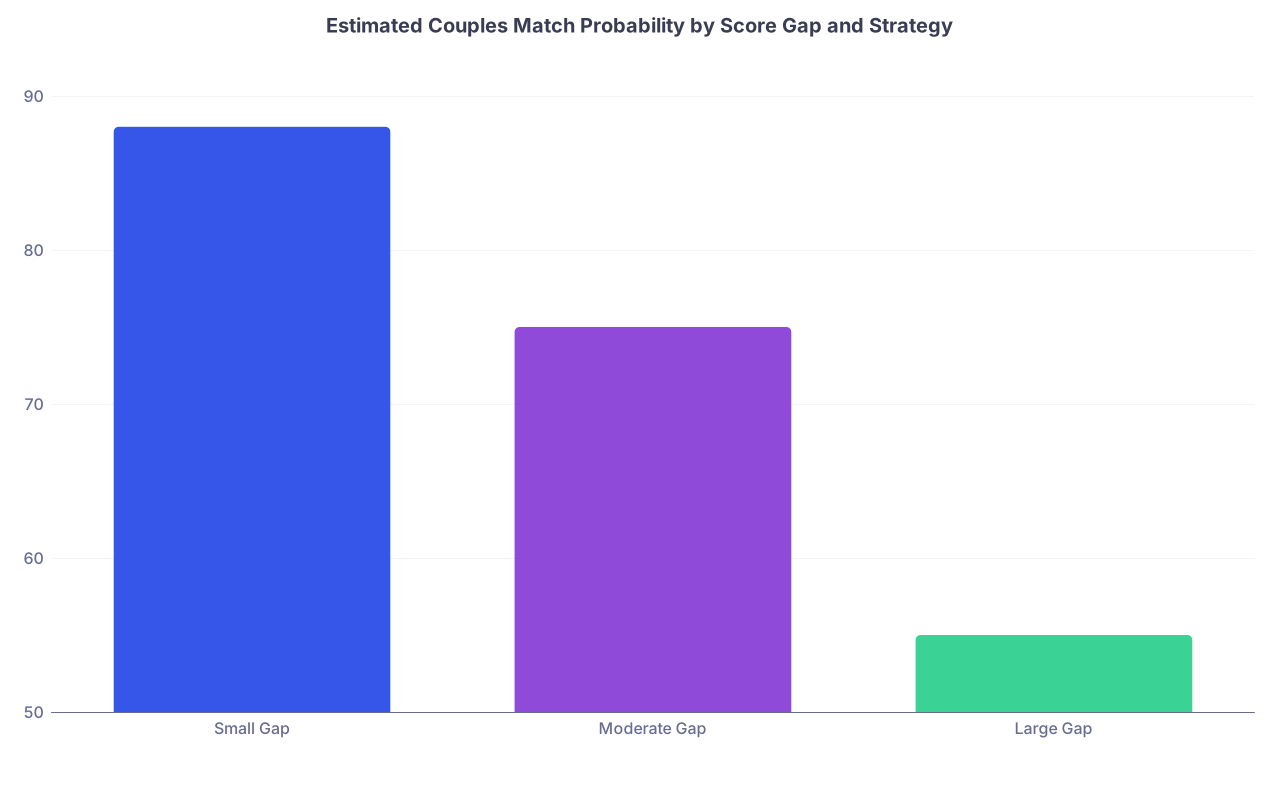
| Category | Value |
|---|---|
| Small Gap | 88 |
| Moderate Gap | 75 |
| Large Gap | 55 |
Those “values” assume rational, flexible planning (broad, tiered rank lists, multiple geography tiers, realistic anchor). Here is a more segmented view:
| Score Gap (A − B) | Strategy Type | Estimated Couple Match Probability* |
|---|---|---|
| ≤ 5 | Both shoot same tier, moderate breadth | 85–92% |
| ≤ 5 | Both broad, tiered, realistic backstops | 90–95% |
| 6–15 | Both shoot high, narrow geography | 55–75% |
| 6–15 | A anchored high, B very broad/flexible | 75–88% |
| > 15 | Both shoot high, prestige-focused | 30–55% |
| > 15 | A anchored, B maximally flexible | 55–75% |
*These are analytic estimates from combining solo probabilities under realistic geographic/tier patterns, not official NRMP numbers.
The pattern is straightforward:
- Small score gap: You can behave almost like equal partners.
- Moderate gap: You must start distorting one partner’s plan toward the other.
- Large gap: You are no longer doing “two parallel individual strategies.” You are optimizing a joint probability function, which often means sacrificing prestige and sometimes even specialty choice.
5. Concrete couple archetypes: what the numbers imply
Let me give you actual archetypes I see over and over. This is where the “competitive vs non-competitive partner” framing becomes concrete.
Archetype 1: Strong ortho + average IM
- Partner A: Ortho, 255, strong research, AOA.
- Partner B: IM, 225, okay research, decent letters.
If they both behaved like solo applicants:
- A might match at mid–high tier academic ortho: 80–85% likelihood.
- B might match at a mix of mid-tier academic and community IM: 80–90% likelihood.
As a couple:
If they only target cities where both can land at solid academic centers: joint probability collapses into the 40–60% range.
If they build a rank list that includes:
- A at community ortho programs in smaller cities,
- B at community IM in those same cities or within 1-hour drive,
- A slight downgrade in prestige expectations for A,
you can reasonably push the couple’s probability up to ~80–85%.
The harsh reality: the non-competitive partner has more leverage on risk. B’s ceiling is not high enough to match A’s ambition without cost.
Archetype 2: Derm + FM, big score gap
- Partner A: Derm, 260, strong CV.
- Partner B: FM, 220, no red flags but weaker metrics.
If they both aim only at “cool” cities and academic hospitals:
- A’s probability in derm in those cities: 70–80%.
- B’s probability in FM in those exact systems: maybe 50–65%, because even FM in very desirable cities fills up with decent applicants.
Joint probability? Likely under 50% for a truly restricted list.
If instead:
- A applies derm broadly: including smaller markets, university affiliates, and community-focused programs.
- B applies FM to:
- The same systems,
- Independent FM programs in the same cities,
- Neighboring-town FM programs.
And they rank a lot of combinations that would make an Instagram influencer cry but are statistically safe:
Then the joint probability can climb into the 65–75% range.
Again: the gap did not vanish. They simply stopped pretending that Partner B’s FM options mirror Partner A’s derm options in competitiveness and geography.
Archetype 3: Competitive + Non-competitive in the same specialty
This is messy but important.
- Partner A: EM, 245, strong SLOEs.
- Partner B: EM, 220, average SLOEs.
Same specialty, different competitiveness. Programs must decide what they think about taking both.
Solo:
- A: 80–90% at desirable EM programs.
- B: 50–65% at those same programs, many of which will be wary.
As a couple:
- Programs that like A may hesitate on B.
- The more “elite” the program, the more likely they are to view B as a liability.
The data implication: for same-specialty couples where one partner is clearly weaker, your joint probability is highly constrained by institutional willingness to “take the pair.” Some programs simply will not.
This scenario frequently ends with:
- One partner switching specialties (e.g., B to IM),
- Or the couple accepting a mid-tier or community program that will take them both.
The true competitive partner has to decide: prestige or probability. The numbers almost never give you both.
6. Geographic strategy: the hidden multiplier
Scores drive baseline probabilities. Geography multiplies them up or down.
Couples who pretend geography is fixed (“We will only live in Boston or NYC”) are doing the equivalent of taking a solid 80–85% chance and voluntarily compressing it into a 40–60% gamble.
There is a clear pattern:
- Single-city focus with one competitive + one non-competitive partner → very high volatility, wide range of outcomes, high unmatched risk.
- Multi-region, tiered strategy with realistic trade-offs → far more stable probabilities.
Here is a stylized comparison.
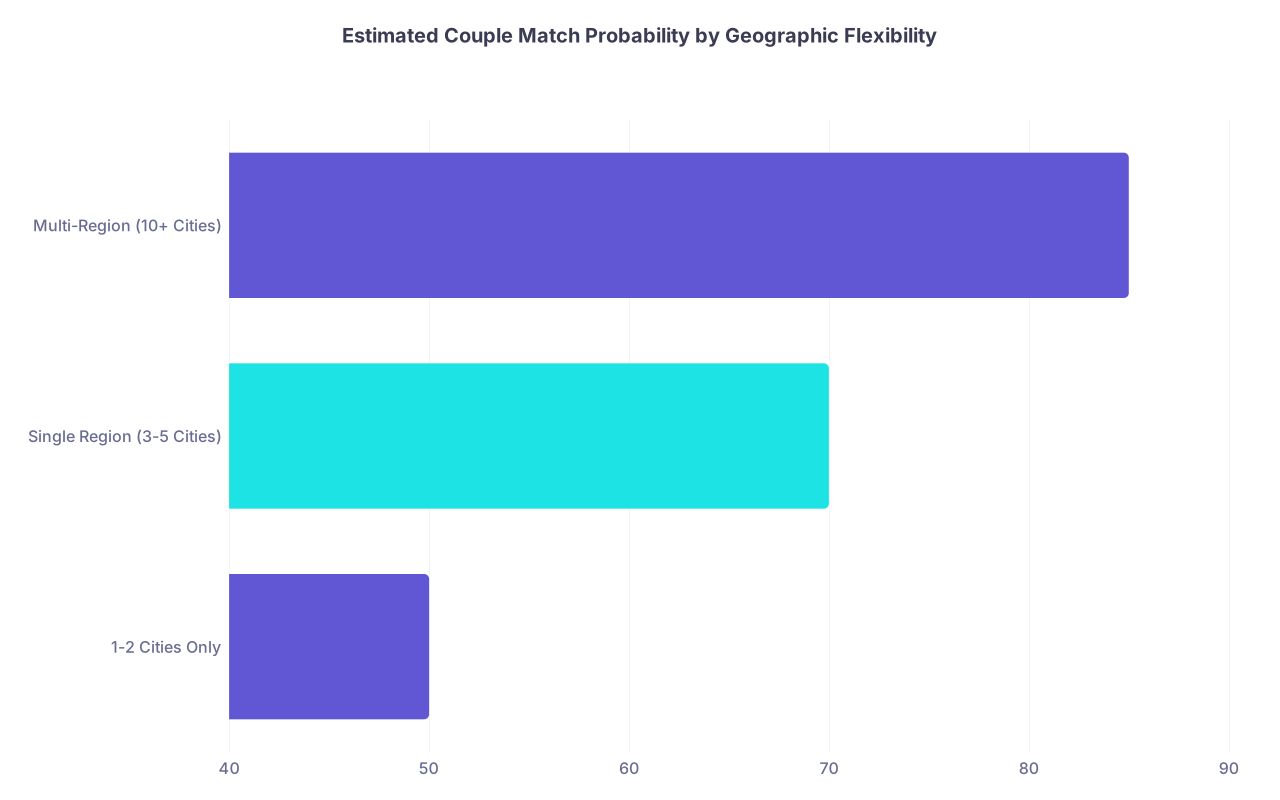
| Category | Value |
|---|---|
| 1-2 Cities Only | 50 |
| Single Region (3-5 Cities) | 70 |
| Multi-Region (10+ Cities) | 85 |
Assumptions: moderate score gap, A competitive specialty, B non-competitive specialty, both building rational rank lists within their geographic constraints.
If you remember nothing else, remember this: geographic rigidity is often more dangerous than the score gap itself.
I have seen couples with a small score gap destroy their odds by chasing one coastal metropolis. And I have seen couples with a massive score gap match comfortably because they accepted a wide geographic radius and tiered their expectations.
7. Tactics to rebalance odds when partners are mismatched
Now the practical part. How do you manipulate the system in your favor when one partner is clearly more competitive?
The data points to four levers you can actually pull:
Program list breadth (for both partners).
- A: apply much more broadly than your solo ego would want.
- B: apply absurdly broadly, especially in the lower tiers and less saturated cities.
Intentional tiering of prestige and geography.
Design the rank list so that:- Top ranks: both in good cities, higher-tier programs where A’s competitiveness matters.
- Middle ranks: still decent cities, more community or lower-tier academic for both.
- Lower ranks: less desirable locations but very high probability of joint match.
One partner anchoring, one absorbing the variance.
One partner—often the competitive one—accepts:- Lower prestige,
- Smaller academic footprint,
- Less “brand name.”
The weaker partner accepts:
- Maximum application breadth,
- Willingness to follow A’s anchor to that tier.
Early reality checks.
Program directors are not shy. If A is getting interview invites at a level that B is not, you must update your internal probability estimates in real time and adapt:- B might need to add more programs mid-season.
- You might need to mentally downgrade the top half of your rank list and focus on where you both are actually getting interest.
A simple sanity check I recommend:
- Count the number of institutions or cities where both of you have interviews.
- If that number is < 8–10, your joint probability is fragile, even if your individual invite counts look fine.
8. When the gap is so large that the probabilities are ugly
There is a category nobody wants to talk about, but the data essentially screams it:
- Partner A: clearly competitive applicant in a highly competitive specialty.
- Partner B: at or near the margins of matching even in a non-competitive specialty (significant red flags, low scores, failed attempts).
If B’s solo probability is already down in the 40–60% range, joining as a couple with a competitive A can produce three very bad equilibria:
They optimize for B’s success:
- A sacrifices prestige heavily, maybe even switches specialties.
- Couple’s joint match probability might climb, but A’s individual trajectory is derailed.
They optimize for A’s success:
- B applies widely but is still at high risk of not matching.
- There is a substantial probability that A matches and B does not.
They try to split the difference:
- Both under-optimize.
- They end up with roughly 40–60% couple match probability and high emotional risk.
The data-based conclusion is not romantic, but it is honest: with a very large gap and a marginal partner, the rational strategies include:
- The less competitive partner pursuing a true backup plan (research year, SOAP plan, even switching away from Match that year).
- The couple having a serious conversation about whether to couples match at all.
Couples Match is not an obligation. When the baseline probabilities are bad, coupling them can make both partners worse off.
Key takeaways
A competitive vs non-competitive partner setup is not just a narrative problem; it is a probability compression problem. The stronger partner’s odds are dragged downward by the overlap constraint, especially in narrow geographies or prestige-only lists.
Score gap size matters less than how you respond to it. Small gaps can be treated almost symmetrically. Moderate and large gaps demand asymmetric strategies: one partner anchors, the other maximizes flexibility. Geography and program tiering are your main levers.
The data consistently punishes couples who pretend they are equally competitive and chase only top-tier programs in a few cities. If you want high match probability as a mismatched couple, you trade prestige and geography for volume and overlap. The couples who accept that early are the ones who match.


