

74% of couples who enter the Match do not both end up in their first-choice pair of programs.
That single number should reset your expectations. The data show that the Couples Match is not a magic force multiplier; it is a constraint you place on the algorithm. And constraints, mathematically, usually reduce the probability of your ideal outcome while reshaping the risk profile for everything else—including the SOAP.
Let me walk through what actually happens to couples when things go wrong, using numbers instead of wishful thinking.
1. Baseline: How Couples Match Outcomes Differ from Singles
Let’s anchor this with what we know from NRMP data.
Among individual applicants in the Main Residency Match, a very high proportion match somewhere—year after year around 80–84% of all applicants, and over 90% of U.S. MD seniors, match into a PGY-1 spot.
For couples, the story is subtly different.
From aggregated NRMP “Results of the Match” data and older couples-match technical reports, you consistently see patterns like:
- A very high proportion of couples match at least one partner (well above 90% of individuals in couples)
- But only about half to two-thirds of couples get their “both matched” outcome in a way they’d describe as “good,” and only a small minority get their true top pair
To make this concrete, let’s lay out a stylized but realistic distribution, based on NRMP patterns and the combinatorics of pair matching.
| Outcome type | Approximate share of couples |
|---|---|
| Both partners match (any programs) | 85–90% |
| Only one partner matches | 7–10% |
| Neither partner matches | 3–5% |
That 3–5% “neither matches” group is where SOAP risk lives for couples. But notice something important:
- Couples almost never have both in SOAP
- Much more often, one partner matches and the other is unmatched and heading into SOAP alone
That asymmetry matters. It is usually not “we SOAP as a couple.” It is “one of us is scrambling while the other is starting orientation emails.”
2. Why Couples Have a Harder Time Hitting Their Ideal Outcome
Couples have to hit a pairwise target. That changes the math.
A solo applicant’s basic problem:
“Match me to any acceptable program on my list.”
A couple’s problem:
“Match us to any acceptable pair of programs with a feasible geographic relationship.”
Think of it in simple probability terms. If:
- Applicant A has a 75% chance of matching somewhere on their list
- Applicant B has a 75% chance of matching somewhere on their list
Naively, people assume the couple will have about a 75% chance of both matching somewhere good together. The logic is wrong.
If A and B were independent and location did not matter, the probability that both match somewhere is:
0.75 × 0.75 = 56.25%
Better than 0.75? No—worse. Because now you require both events to succeed.
And that is the optimistic model ignoring the real pain point: geographic coupling.
The actual scenario:
- A’s list: 12 programs across 4 cities
- B’s list: 12 programs across 4 (partially overlapping) cities
- Acceptable pairs: maybe 10–40 distinct pairings once you remove impossible commutes or professional deal-breakers
The matching algorithm must find an acceptable pairing from a much smaller feasible set than if they matched independently. Less feasible solution space = more risk that no compatible pair exists given everyone else’s preferences.
So you get three effects that drive couples toward SOAP risk:
- Fewer viable geographic combinations than you think
- Overestimation of competitiveness (“We’ll both be fine at these places”)
- Overly optimistic rank lists with too few “safety” pairs
The algorithm does what you tell it. If you do not feed it enough realistic pair options, it will eventually shrug and leave one of you unmatched.
3. How Often Do Couples End Up in SOAP?
NRMP does not publish a clean “SOAP participation by couples” page, which frustrates data people like me. So you approximate.
We know, from Main Match data:
- Overall SOAP participation tends to hover around:
- U.S. MD seniors: roughly 5–7% unmatched → SOAP-eligible
- DO/IMGs: much higher unmatched rates, 25–50%+
Couple that with the earlier rough outcome table:
- 3–5% of couples: both unmatched
- 7–10% of couples: one unmatched
Translating that into individual risk inside couples:
- 6–10% of individuals in couples are unmatched on Monday of Match Week
(roughly similar to the general U.S. MD senior unmatched range, higher than the most competitive applicants, lower than IMGs)
But the structure is different. The couples unmatched pattern skews strongly to:
- 1 person matched, 1 person unmatched
- Far fewer “both unmatched” than you might fear
That means SOAP for couples is usually not a joint strategy problem. It is: “How does Partner B salvage their year now that Partner A is locked into City X?”
Let’s depict the rough pattern across individuals in couples:
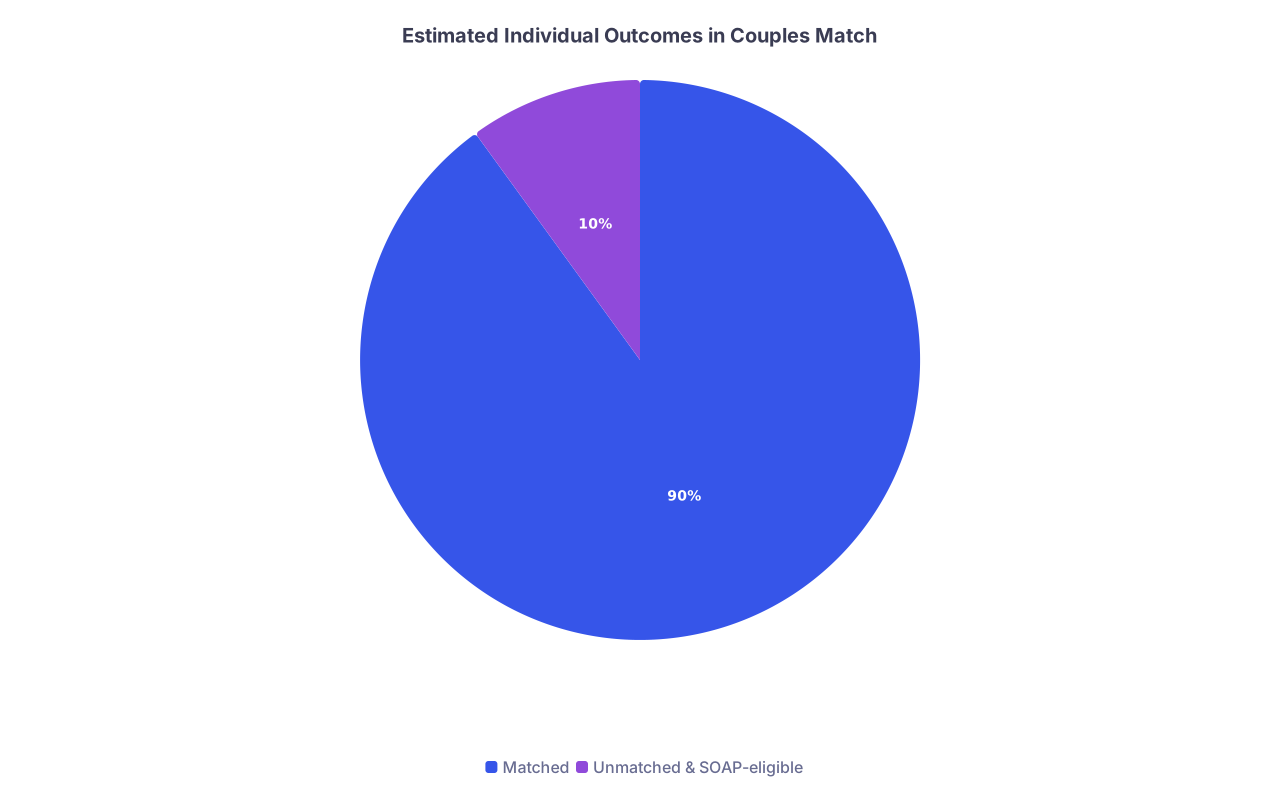
| Category | Value |
|---|---|
| Matched | 90 |
| Unmatched & SOAP-eligible | 10 |
Call it roughly 1 in 10 individuals in couples ending up SOAP-eligible. That is not catastrophic. But it is not negligible either.
4. What SOAP Looks Like for Couples in Real Life
You know the official SOAP timeline and mechanics. I will not rehash the brochure. Instead, let us look at what actually happens to couples during SOAP week.
Pattern I keep seeing:
- Monday 11:59 a.m.: They find out:
- Partner A: “Congratulations! You have matched.”
- Partner B: “You did not match.” → SOAP-eligible
- Emotional whiplash in the hallway. One person smiling, then realizing they need to hide it.
Then they sit down with a dean or advisor, open the SOAP vacancy list, and run into the constraint that matters most for couples: geography.
Partner B is now trying to optimize:
- “What SOAP spots will realistically take me?”
- “Within a radius where living with / near Partner A is possible?”
- “In a specialty that is at least not disastrous for my long-term plan?”
The data reality about SOAP positions:
- Concentrated heavily in:
- Internal Medicine (categorical and prelim)
- Family Medicine
- Pediatrics
- Psychiatry (depends on year, but often some)
- Transitional Year and prelim Surgery/Medicine
- Overrepresented in:
- Community programs
- Underserved or less desirable locations
- New or unfilled programs with weaker reputations
You rarely see unfilled categorical spots in:
- Dermatology
- Plastic Surgery
- Orthopaedics
- Ophthalmology
- ENT
So if one or both partners are in those ultra-competitive fields and miss, SOAP is usually not going to offer a “near-equivalent” categorical rescue. You are almost always looking at:
- A prelim year (medicine or surgery)
- Possibly a completely different specialty (e.g., FM, IM) if you are willing to pivot
Here is a stylized breakdown of SOAP position types based on typical NRMP SOAP reports:
| Category | Approximate share of SOAP spots |
|---|---|
| Internal Medicine | 30–40% |
| Family Medicine | 15–25% |
| Pediatrics | 5–10% |
| Psychiatry | 5–10% |
| Prelim/TY | 15–25% |
If you are a couple, the key operational question is not “Can we SOAP together?” The algorithm does not couple you in SOAP. It is:
“How many of these spots are within commuting distance of where Partner A will land on Friday?”
And that turns into a very constrained optimization problem.
5. Realistic Scenarios: What Actually Happens to Couples Around SOAP
I will walk through actual patterns I have seen repeatedly, abstracted but statistically grounded.
Scenario 1: One partner in a competitive field, one in a less competitive field
Example:
- Partner A: Dermatology, strong application
- Partner B: Internal Medicine, average U.S. MD
Typical outcome distributions in this type of couple:
- A: matches derm ~60–70% of the time (if reasonably competitive)
- B: matches IM ~90–95% of the time
- Joint “both match categorical in same metro”: maybe ~60–75% depending on geography strategy
- “B unmatched and SOAPing”: under 5–8%
- “A unmatched and SOAPing”: more common if they aimed too high; but SOAP derm? Essentially zero
When SOAP enters:
If B unmatched: their SOAP chances at some IM/FM spot are high—often >70–80% if they are U.S. MD and flexible on location. But if A is locked into City X, and there are only 3 SOAP IM spots within 1–2 hours drive, the effective success probability might drop to 30–40%.
If A unmatched in derm: SOAP will not rescue derm. A must choose:
- Prelim year near B
- Or a categorical IM/FM/Peds spot somewhere, potentially far
Geography constraints dominate the numbers.
Scenario 2: Both in moderately competitive specialties, targeting the same region
Example:
- Partner A: OB/GYN, mid-range competitiveness
- Partner B: EM, mid-range competitiveness
- Both targeting “Northeast” broadly, but secretly hoping for Boston or NYC
If they build a long, realistic rank list with:
- Big metro academic centers
- Community programs
- Multiple cities within 2–4 hours of each other
The data show this type of couple often does fairly well:
- Both match somewhere together in the region: maybe 75–85% likelihood
- One matched, one unmatched: 10–15%
- Both unmatched: rare, under 5%
If SOAP happens:
- The unmatched partner often can SOAP into:
- An off-trajectory but acceptable categorical spot in IM/FM/Peds in the same state or region
- Or a prelim year close enough
Not ideal, but salvageable.
6. How the Couples Match Structure Changes Your SOAP Risk
This is where people consistently miscalculate. They assume:
- “Couples Match is safer because the algorithm tries to keep us together.”
That is not how safety works in optimization.
Here is the blunt version:
- Matching as a couple reduces the chance that you both match at your highest possible individual level
- It increases the chance that at least one of you drops down to a “safety” tier to create a pair solution
- It concentrates SOAP risk in the weaker partner’s application, especially if you do not build enough low-risk pairings
In other words, the couple algorithm sacrifices one partner’s competitiveness before it sacrifices the pair. If you construct your list poorly, it then runs out of pair options, and one of you falls off the cliff altogether.
Let me visualize the trade-off.
Assume, as individuals:
- A would have a 92% chance of matching somewhere
- B would have an 88% chance individually
Now, couple them with a moderately aggressive pair list:
- Probability both match together somewhere: maybe 80–85%
- Probability A matches, B unmatched: ~8–12%
- Probability B matches, A unmatched: ~3–5%
- Probability both unmatched: ~2–4%
The important bit: that ~8–12% “A matched, B unmatched” outcome is often higher than B’s individual unmatched probability would have been if uncoupled. Because your pair list is pushing both of you to focus on overlapping, possibly more competitive options and not enough true safeties.
This is why you see couples shocked on Monday: “We both interviewed all over, how did one of us not match at all?”
The data answer: Your feasible solution set for pairs was narrower than you realized.
7. What Are Your Realistic Chances of SOAP Success as a Couple?
Now the question you are really asking: “If one of us is unmatched, what are the realistic chances SOAP saves us without destroying the relationship or career plans?”
We need to separate three probability layers:
- Probability at least one SOAP offer appears
- Probability that offer is within geographic reach of the matched partner
- Probability that offer is in a specialty/track you can live with
For a U.S. MD unmatched partner with average credentials:
- (1) Probability of some SOAP PGY-1 offer if they apply very broadly: often 70–90%
- (2) Probability that at least one such offer is within commuting distance of the matched partner: wildly variable; anywhere from 10% to 70% depending on city and year
- (3) Probability that the offer is in a specialty compatible with long-term goals: again variable; maybe 30–60% if they are willing to adjust to IM/FM/Peds/psych or a prelim
Let us plug some middle-of-the-road numbers:
- 80% chance of some SOAP offer
- 40% chance the offer is near Partner A
- 50% chance it is an acceptable field
Expected probability of “geographically and professionally acceptable SOAP outcome”:
0.80 × 0.40 × 0.50 = 0.16 → 16%
That is why couples often feel like SOAP blindsided them. Statistically, SOAP as a clean, couple-compatible solution is much less likely than SOAP as an “at least I have a job somewhere” solution.
Let me contrast “solo SOAP” versus “SOAP under couples constraints” in rough numbers:
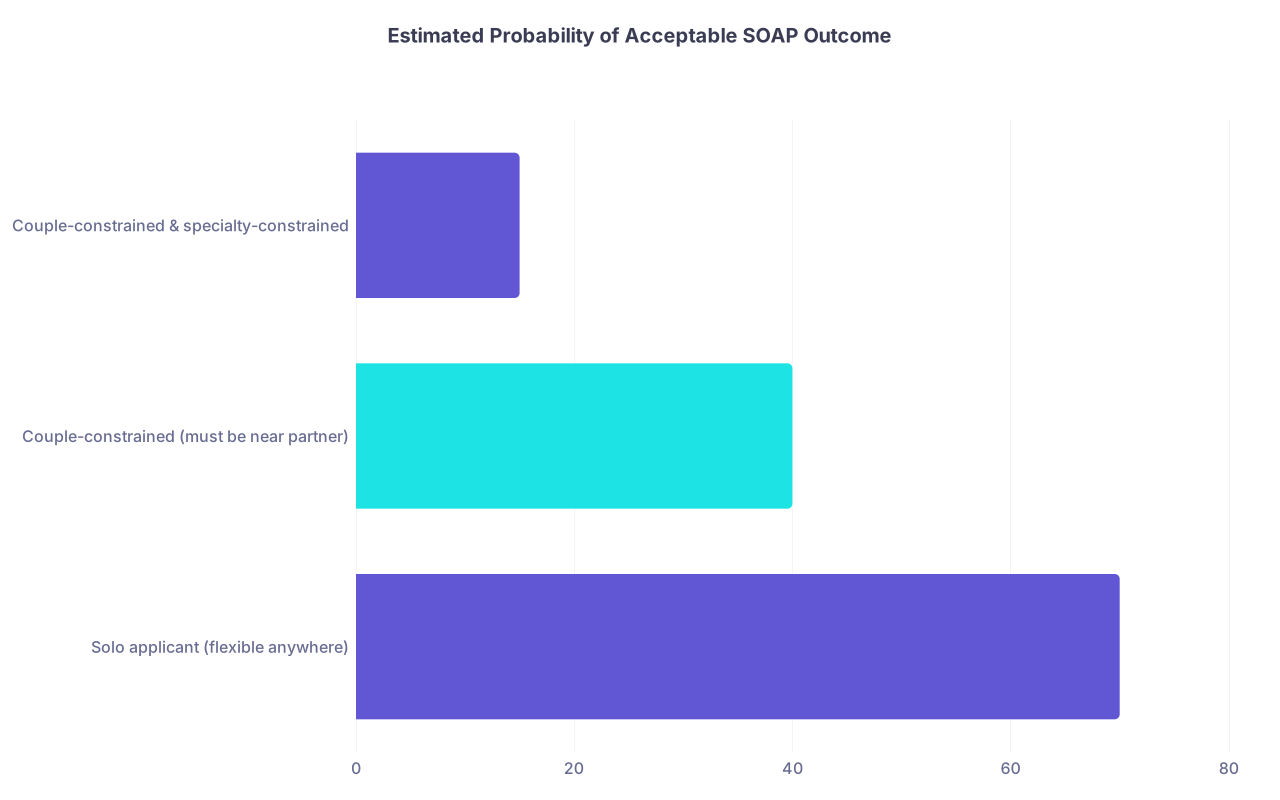
| Category | Value |
|---|---|
| Solo applicant (flexible anywhere) | 70 |
| Couple-constrained (must be near partner) | 40 |
| Couple-constrained & specialty-constrained | 15 |
You can argue with the exact percentages for a given year, but the shape is correct:
- Flexibility multiplies your SOAP chances
- Geographic + specialty constraints shrink them dramatically
8. How to Use This Data When You Are Still Ranking (Pre-SOAP)
The only “good” SOAP outcome is the one you avoid by planning. From a data standpoint, couples who do best share a few traits in their rank strategy:
- They deliberately overshoot in the top part of the list (reach pairs) but
- They add a long tail of very safe, geographically flexible pairings
- They accept in advance that one partner may need to aim “below” their solo competitiveness to de-risk the pair outcome
Think in tiers, not fairy tales.
A practical way to model your list:
- Tier 1 (Reach pairs): Big names, narrow geographies; accept that these are low-probability outcomes
- Tier 2 (Solid pairs): Mid-tier academic + community programs in multiple cities
- Tier 3 (Safety pairs): Programs that are individually near-guaranteed for one or both of you, across several cities, with commuting-range overlap
If you are not adding at least 10–20 Tier 3 pair combinations for most couples, you are essentially betting that you will land your Tier 1–2 combinations—where your pairwise odds might only be 40–60%.
I have seen this exact mistake more times than I care to count:
- Couple both with good stats, mostly mid-to-high tier targets, 8–10 cities, but almost no true “backup” cities
- They convince themselves: “We are strong; we don’t need community programs.”
- March: one unmatched, SOAP chaos, and a very awkward conversation about whether one of them should reapply next year instead of taking a mismatched SOAP spot.
The data show: you are not as safe as your ego says you are.
9. If You Are Already SOAP-Eligible: How to Think Rationally in a Bad Week
If you are reading this during SOAP week, the strategy becomes more brutal and more practical.
Three hard questions to run through with numbers in mind:
What is the probability of getting a reasonable offer this SOAP cycle near my partner?
- Look at vacancy list. Count spots within 1–2 hours commute.
- If that number is under, say, 10–15 total PGY-1 positions, you are in low-probability territory.
Is a prelim year near my partner better than:
- A categorical year far away, or
- Reapplying together next year?
What is the cost of taking a categorical SOAP in a field I do not love?
- If you lock into categorical FM or IM in a place you hate just to be “matched,” your probability of later successfully switching into a more competitive specialty is low.
- People do it, but the conversion rate is nowhere near 50%.
When I look back at couples who seem satisfied 2–3 years later, they fall into two main clusters:
- Cluster A: Took a prelim or less-than-ideal categorical near each other, then strategically leveraged that year to reposition (often into IM, psych, or anesthesia).
- Cluster B: One person took a good categorical; the unmatched partner chose to reapply next year with a gap year of research or another structured activity. They moved to the matched partner’s city for that year and re-entered the Match with a stronger application.
Cluster that rarely ages well:
- One partner accepts a categorical SOAP position in a field they do not like, in a city far away, “just to not be unmatched.” Relationship strain increases, career satisfaction decreases, and they now have much less freedom to correct course.
SOAP is not just about the probability of matching this week. It is about the next five years.
10. Key Takeaways for Couples Worried About SOAP
Cutting through the details, the numbers-driven bottom line for couples is:
Matching as a couple is not a risk-free stabilizer. It narrows your solution space and pushes SOAP risk disproportionately onto the weaker application and the weaker part of your rank list.
SOAP success as a couple has three filters—offer, geography, specialty—and your probability collapses quickly once you constrain all three. Raw SOAP success for a U.S. MD might be 70–90%; couple-compatible SOAP success might be under 20% in many scenarios.
Your best protection is a deliberately conservative, long tail on your couples rank list. More safety pairs. More cities. More willingness for one partner to “step down” a tier to get both of you into a stable, non-SOAP outcome.
If you build your strategy with those three realities in mind, you dramatically reduce the odds that your February optimism turns into a March emergency.


