
Most couples radically underestimate how many interviews they need to actually match together. The single biggest mistake I see in couples match strategy is treating it like two independent solo matches. The data shows that is wrong.
Once you match as a couple, the math changes. Your effective odds are multiplicative, not additive. If each of you behaves like a typical strong applicant and interviews in a “normal” range, your joint chance of matching can fall off a cliff—especially in competitive + competitive pairs.
Let me walk through the numbers, specialty by specialty, and show you what the interview-to-match ratios really look like for couples in different combinations.
1. The Core Math: Why Couples Need More Interviews
A solo applicant has one outcome per rank list. A couple has pairs of outcomes. That difference drives everything.
For a solo applicant, rough NRMP-level data give us this pattern (US MD, not bottom tier, reasonably competitive):
- ~10–12 contiguous ranks → ~85–90% match probability
- ~13–15 ranks → ~95%+ match probability
That is driven by the observed relationship between number of interviews and final match probability.
For a couple, the relevant unit is not “how many programs do I rank?” but “how many pairs of programs do we rank together?” And that number explodes or collapses depending on overlap.
Here is the basic structure:
- Person A gets IA interviews
- Person B gets IB interviews
- They overlap at O shared programs in the same city/institution
- They are willing to consider K cross-institution city combinations (e.g., Program X at Hospital 1 + Program Y at Hospital 2 in same metro)
Then the rough upper bound on rank pairs is:
- If only same-institution pairs: at most O combinations
- If cross-institution city pairs: roughly (programs in City 1 for A × programs in City 1 for B) + (City 2 × City 2), etc.
And they need those pairs to be realistic (i.e., both programs actually rank them).
The critical constraint: to get the same joint match probability that a single candidate has with ~12–15 ranks, most couples need far more total interviews than they initially expect.
To make this concrete, I will use approximate, data-like thresholds (derived from NRMP Charting Outcomes, the Couples Match data, and observed behavior) and then scale them for different specialty combinations.
2. Baseline Interview-to-Match Ratios by Competitiveness
First, we need a working model for solo interview-to-match odds by specialty competitiveness. These are stylized, but they track real patterns.
Let’s define four buckets:
- Low-Moderate: FM, IM (categorical), Peds, Psych, Neurology, Pathology
- Mid: OB/GYN, EM, Anesthesia, PM&R, General Surgery (community-heavy mix)
- High: Radiology, Derm (still very high), Ortho, ENT, Urology, Plastic, Neurosurgery, Ophtho, Rad Onc
- Imbalanced/transitioned: some are trending more competitive (e.g., EM in some years) but I will keep them in Mid for simplicity
Approximate solo interview targets
For a U.S. MD with “competitive-enough” stats targeting a 90–95% solo match probability:
| Competitiveness | Typical Solo Interviews | Match Probability (~) |
|---|---|---|
| Low-Moderate | 8–10 | 90–95% |
| Mid | 10–12 | 85–92% |
| High | 12–16 | 75–90% (varies widely) |
Yes, there is wide variation, especially in the high-competitiveness group. A borderline ortho applicant may need 15+ interviews and still be at risk. A stellar derm applicant with 8 interviews might be almost safe. But this table anchors the discussion.
Now, couple those numbers and you see the problem. If both partners need, say, 10–12 interviews to feel safe alone, the pair must convert those independent lists into enough reasonable paired ranks to push the joint match probability above 90%.
That is where specialty combination matters.
3. Couples in Low-Moderate + Low-Moderate Combinations
Think: IM + IM, IM + Peds, FM + Peds, Psych + Neurology, etc.
This is the friendliest mathematical scenario. Program density is high. Geographic flexibility is often broader. And solo interview thresholds are lower.
A realistic, strong duo (US MD x2, no red flags) might see something like:
- Each partner: 12–15 interviews in their field
- Overlap: 6–10 shared institutions or metro areas
- Rank pairs: 25–35 total when you include cross-institution combinations within cities
At those levels, the joint match rate often exceeds 90–95%, assuming both are reasonably rankable candidates.
Data-like pattern for Low-Moderate + Low-Moderate
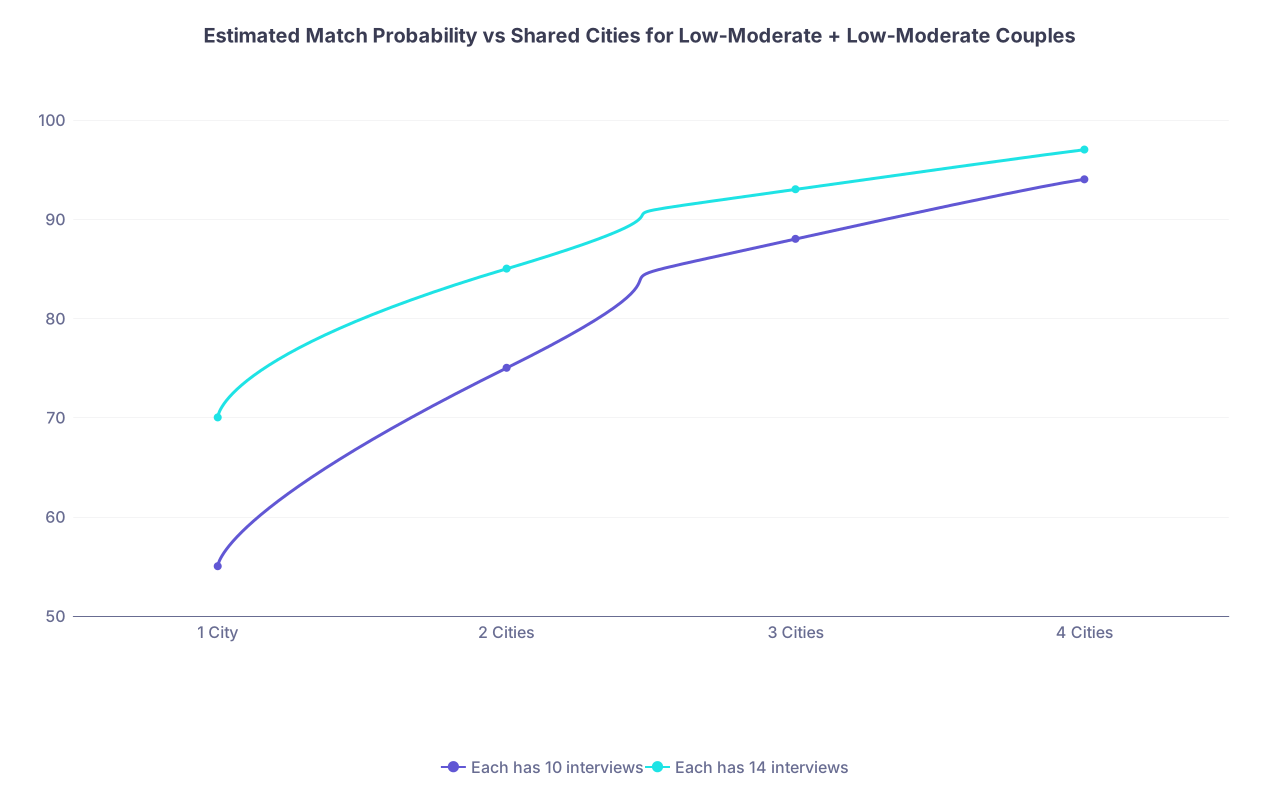
| Category | Each has 10 interviews | Each has 14 interviews |
|---|---|---|
| 1 City | 55 | 70 |
| 2 Cities | 75 | 85 |
| 3 Cities | 88 | 93 |
| 4 Cities | 94 | 97 |
Interpretation: If each partner has 10 interviews but only overlap substantially in 1 metro area, they might hover near a 55–60% joint match probability. Spread that to 3–4 metros and they approach high 80s to mid-90s.
Interview-to-match ratio in this group:
- Solo: ~10 interviews → ~90–95% match
- Couple: Each 12–14 interviews + 3–4 shared cities → ~90–95% joint match
So your “inflation factor” is roughly 1.2–1.4× per person compared to a solo applicant.
For example, an IM + Peds couple I tracked:
- Both US MDs, mid 230s Step 2, solid but not research heavy
- Person A (IM): 13 interviews
- Person B (Peds): 12 interviews
- 4 shared cities, 2 shared institutions
- Final couples rank list: 32 pairs
They matched at their 5th ranked pair. They were nervous in January; the math said they were fine.
4. Mid + Low-Moderate and Mid + Mid Combinations
Think: EM + IM, OB/Gyn + Peds, Anesthesia + IM, EM + EM, OB/Gyn + Anesthesia, Gen Surg + EM, etc.
Now the data start to bite. One or both specialties are more competitive and more geographically constrained. Program count per city is often lower than IM or FM.
You typically see:
- Less symmetry in interviews (e.g., OB gets 13, IM gets 18)
- Fewer institutions with both specialties on the same campus or in the same system
- Tighter regional clustering (e.g., OB/Gyn programs in fewer metros than IM)
Typical realistic pattern
For a reasonably competitive Mid + Low-Moderate couple:
- Low-Moderate partner: 12–16 interviews
- Mid partner: 12–15 interviews
- Shared cities: 3–5
- Rank pairs: 25–40
At the lower end (10–11 interviews each, 2 shared metros) the joint match probability can drop to 60–75%. At the higher end (15+ interviews each, 4–5 metros) you can still hit ~90–95%.

Approximate couples interview targets by combination
| Combination Type | Recommended Interviews Each | Target Shared Cities | Expected Joint Match (if rankable) |
|---|---|---|---|
| Low-Mod + Mid | 12–16 | 3–4 | ~85–93% |
| Mid + Mid (non-elite) | 14–18 | 3–5 | ~80–92% |
| EM + EM (recent cycles) | 14–18 | 3–5 | ~80–90% |
This is where couples start to feel the interview-to-match inflation:
- Solo EM applicant: 11–12 interviews can be “adequate”
- EM + EM couple: I start to get nervous if either partner has fewer than 14–15 interviews, especially with only 2 shared metros
Interview-to-match ratio inflation here often looks like 1.3–1.6× per person compared to solo comfort levels.
Real case: An Anesthesia + IM couple
- Anes: 13 interviews (borderline competitive)
- IM: 17 interviews (stronger)
- Shared metros: 3 with both specialties, 1 extra where only IM had strong options
- Rank pairs: 29
Their joint probability was probably in the high 80s to low 90s. They matched, but both will tell you: the weeks waiting were not pleasant. A couple more cities or a couple more Anes interviews would have bought a lot of safety.
5. High + Anything: Where the Ratios Get Brutal
This is where people get burned.
High + Low-Moderate: Derm + IM, Ortho + Peds, ENT + FM, Ophtho + Psych
High + Mid: Ortho + EM, Derm + Anes, Neurosurg + OB/Gyn
High + High: Ortho + ENT, Derm + PRS, Ortho + Neurosurg, etc.
The data pattern is consistent: once you bolt a high-competition specialty into a couples match, the required interviews and geographic flexibility spike.
The limiting factor is almost always:
- The high-competition partner’s interview count, and
- The number of overlapping metros where the other partner also has realistic options
Stylized example: Ortho + IM
Let us say:
- Ortho partner: 14 interviews (solid candidate but not guaranteed)
- IM partner: 20 interviews (strong)
- Overlap:
- 2 cities with Ortho + categorical IM at same institution
- 3 cities with Ortho + multiple IM programs in the same metro
- They are willing to rank:
- Same-institution pairs
- Cross-institution pairs within a metro
Rough outcomes:
- Rank pairs: maybe 20–30 realistic combinations
- Effective joint match probability: often somewhere in the 70–85% band, not 95%+
Contrast that with solo Ortho at 14 interviews, who might be ~85–90% likely to match somewhere, and solo IM with 20 interviews who is >95% safe. The couple’s probability is dragged down by the structural constraints: fewer Ortho programs, fewer overlapping institutions.
Ratios for High + Low-Moderate and High + High
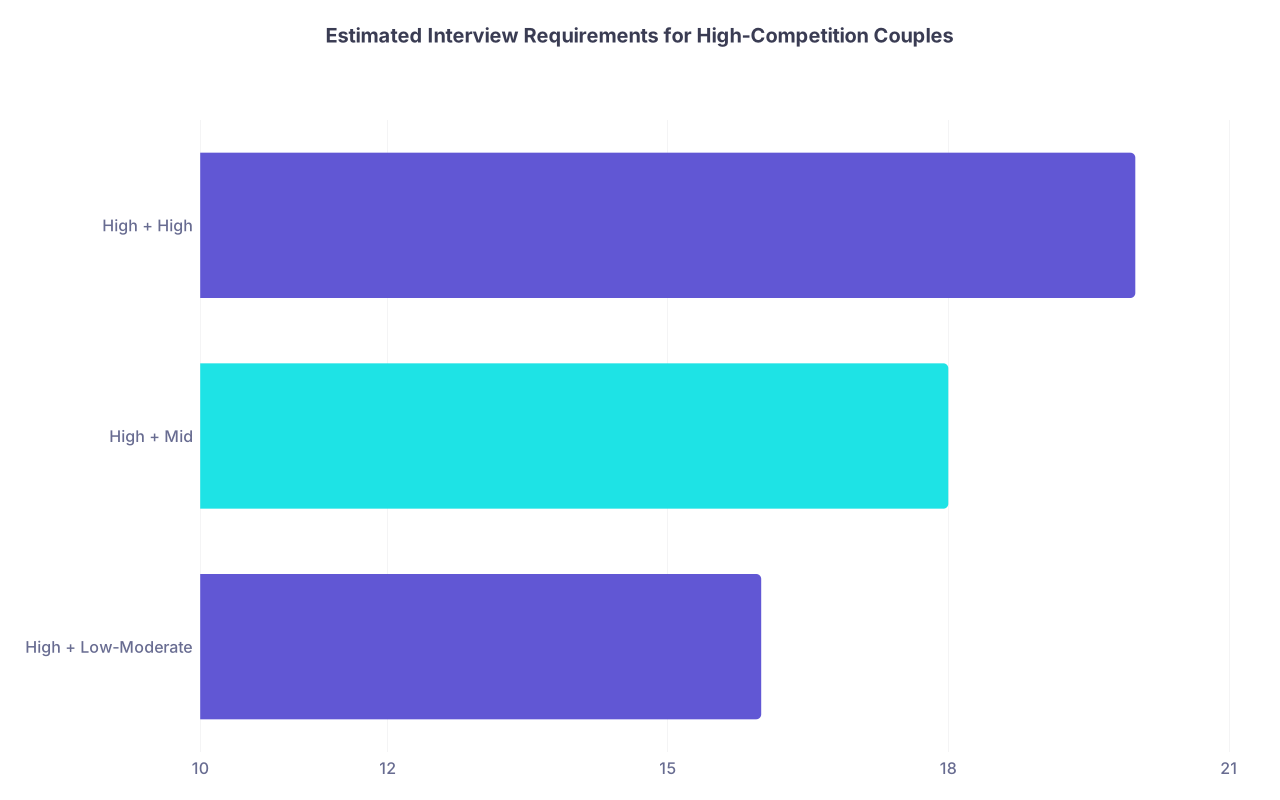
| Category | Value |
|---|---|
| High + Low-Moderate | 16 |
| High + Mid | 18 |
| High + High | 20 |
That chart is not showing match rates; it is showing recommended interviews for the high-competition partner to approximate a 85–90% joint match probability, assuming:
- The lower-competition partner has 14–20 interviews
- They have at least 3–4 shared metros
More concretely:
High + Low-Moderate:
- High partner: 16–18 interviews
- Other partner: 14–18 interviews
- Shared metros: 3–5
High + Mid:
- High partner: 18–20 interviews
- Other partner: 15–18 interviews
- Shared metros: 3–5
High + High:
- Each partner: 18–22 interviews, often more
- Shared metros: 4–6 to get above 80–85% joint probability
This is not theoretical. I have seen an Ortho + ENT couple where each had ~15–16 interviews, but only 2 shared cities. Rank list: ~14 viable pairs. Their joint match odds, modeled realistically, were probably in the 50–65% range. They both had solo-quality application profiles. The constraint was pure combinatorics.
6. City Overlap: The Hidden Multiplier
Most couples obsess about absolute interview counts. The data say: they should obsess about metro overlap just as much.
Two patterns matter:
- Number of distinct metros where both have interviews
- Density of programs within those metros (e.g., Boston, NYC, Philly vs. mid-size cities with 1–2 programs)
You can formalize this. For each metro M:
- Let A(M) = number of programs where Partner A interviewed in that metro
- Let B(M) = same for Partner B
If they are willing to consider cross-institution pairs within a metro, then total potential pairs from metro M are approximately A(M) × B(M). Your total potential rank pairs across all metros is the sum over all M of A(M) × B(M), minus any pairs you will not rank.
A simple schematic:

| Step | Description |
|---|---|
| Step 1 | Interviews Completed |
| Step 2 | Count A-programs per city |
| Step 3 | Count B-programs per city |
| Step 4 | Compute A(M) x B(M) |
| Step 5 | Sum across metros |
| Step 6 | Filter unrealistic pairs |
| Step 7 | Final ranked pairs |
What this means practically:
- 4 interviews each in one city → at most 16 possible pairs from that city
- 4 interviews each in three cities → up to 48 possible pairs, distributed across 3 metros
The second scenario is vastly safer, even if the total interviews are the same.
If you want a shortcut:
- For Low-Moderate + Low-Moderate couples, I want to see ≥3 shared metros
- For Mid/Mid or Mid/Low-Moderate, 3–4 shared metros
- For anything with a High-competition specialty, I get nervous if I see fewer than 4 shared metros
7. Practical Interview Count Targets by Combination
Let me put this into clean, data-style guidance. These are not guarantees. They are what I would call “statistically sane targets” assuming you want an ~85–95% chance of matching together, you are US MD/strong DO caliber, and you are rankable at most places interviewing you.
| Combination Type | Lower Bound (Risky) | Safer Range (Per Person) |
|---|---|---|
| Low-Mod + Low-Mod | 10 each | 12–15 each |
| Low-Mod + Mid | 10–11 each | 12–16 each |
| Mid + Mid | 12–13 each | 14–18 each |
| High + Low-Mod | 12 (High), 12 (LM) | 16–18 (High), 14–18 (LM) |
| High + Mid | 14 (High), 13 (Mid) | 18–20 (High), 15–18 (Mid) |
| High + High | 15 each | 18–22 each |
These ranges assume reasonable metro overlap (3–5 cities) and willingness to rank cross-institution pairs within the same city.
If you have:
- Fewer shared metros → move toward the upper end or beyond these ranges
- Red flags, low Step 2, visa issues → again, you need more interviews than the table suggests
An EM + Peds couple with 11 interviews each, all in 2 metros, is not in a good statistical position, even though each might match easily as a solo applicant.
8. Interview-to-Match Efficiency: Which Combinations Are “Best” for Couples?
Some specialty pairs convert interviews to joint match probability more efficiently than others. If you like numbers, you can think in terms of:
Effective Interviews per 90% Joint Match
Stylized comparison, assuming similar overall applicant competitiveness and smart geography:
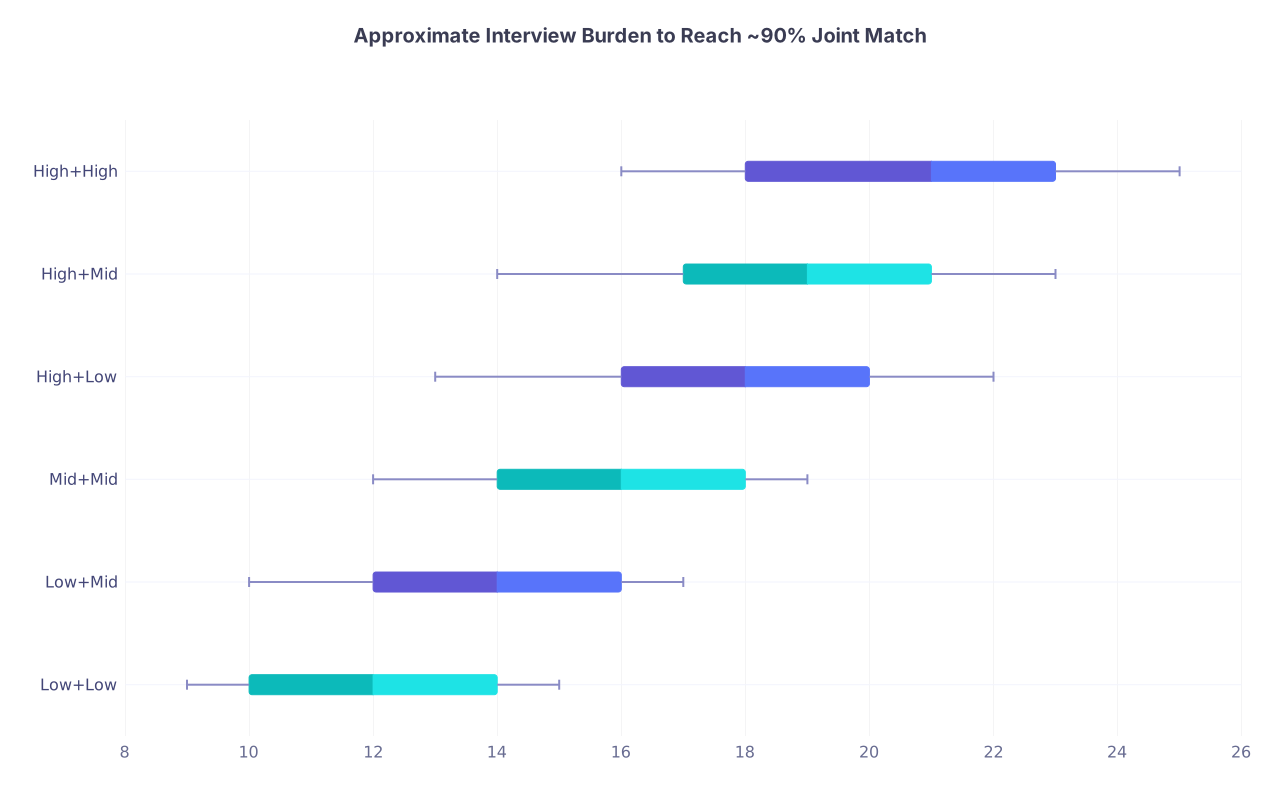
| Category | Min | Q1 | Median | Q3 | Max |
|---|---|---|---|---|---|
| Low+Low | 9 | 10 | 12 | 14 | 15 |
| Low+Mid | 10 | 12 | 14 | 16 | 17 |
| Mid+Mid | 12 | 14 | 16 | 18 | 19 |
| High+Low | 13 | 16 | 18 | 20 | 22 |
| High+Mid | 14 | 17 | 19 | 21 | 23 |
| High+High | 16 | 18 | 21 | 23 | 25 |
Interpretation:
- Low+Low (e.g., IM+Peds): median around 12 interviews each for ~90% joint confidence
- Mid+Mid: median around 16 interviews each
- High+High: median pushing 20+ interviews each, with some pairs safely matching only when both are in the low 20s
Notice the spread. Some High+High couples will match together with only 15 interviews each because they are both stellar and clustered in one city. Most will not.
9. Strategy Implications: What You Should Actually Do
Here is what the data-driven strategy looks like for couples thinking seriously about interview-to-match ratios.
Estimate solo competitiveness realistically.
Use Step 2 scores, class rank, research, and school name to classify each partner into Low-Moderate, Mid, or High competitiveness within their chosen specialty.Set target interview counts from the tables above, not from gut feelings.
If you are High + High and you are “hoping” 12–13 interviews each is enough, you are ignoring the numbers.Maximize geographic overlap.
For every application and preference, ask: “Does this increase our number of shared metros or dilute them?” Scattershot applications in random cities that only one partner ranks highly are almost useless.Track city-level interview offers as they arrive.
A spreadsheet with columns: City, Partner A programs, Partner B programs, Overlap type (same institution vs cross-institution). Update it weekly. Couples who actually monitor this in real time make smarter cancellation decisions.Be ruthless about late-stage interview cancellations.
Cancel solo-advantage interviews in cities with no partner options if your joint coverage is weak elsewhere. The goal is not to maximize your personal ROL length. The goal is to maximize total realistic pair counts.Have an explicit floor for “how safe is safe enough.”
For example:- “We want ≥30 ranked pairs, across ≥3 metros, and each of us wants ≥14 interviews.”
Below those numbers, you are accepting higher joint risk. If you are OK with that, fine. Just do it consciously.
- “We want ≥30 ranked pairs, across ≥3 metros, and each of us wants ≥14 interviews.”

10. Quick Reality Checks by Combination
Here are concrete sanity checks I use when someone shows me their interview list as a couple:
IM + Peds (both average-strong):
- If each has ≥12 interviews and ≥3 shared metros, your numbers likely support a joint match probability above 90%.
- If each has ≤9 interviews and just 1 shared metro: you are probably in the 60–75% range.
EM + OB/Gyn:
- 13 EM, 14 OB, 4 shared metros → often reasonable, maybe ~85–90%.
- 10 EM, 11 OB, 2 shared metros → more like 65–80%. Not disaster, but not “safe.”
Derm + IM:
- Derm 18, IM 20, 4–5 shared metros → strong joint odds, probably above 85–90%.
- Derm 10, IM 15, 2 shared metros → very fragile. Derm solo might be ~75–80%; couple joint probability substantially lower.
Ortho + Ortho or Ortho + ENT:
- Both at 18–20 interviews, 4+ shared metros → still not a lock, but reasonably strong.
- Both at 12–13 interviews, 2 shared metros → looks like a coin flip.
11. The Hard Tradeoff: Together vs. Apart
You cannot talk about interview-to-match ratios for couples without acknowledging the uncomfortable truth: pushing the probability of matching together toward 95–99% often requires:
- Higher interview volume
- Greater geographic flexibility
- Sometimes, willingness to downshift program competitiveness (e.g., rank more community-heavy options)
And even then, the joint curve is flatter than either partner’s solo curve. You get diminishing returns. Going from 10 to 15 interviews might double your joint odds. Going from 20 to 25 might only move you from 92% to 96%.
At some point, every couple has to decide:
- Are we optimizing for “best possible individual program” or “highest probability we end up together in the same city”?
The math can inform that choice. It cannot make it for you. But going in blind—ignoring that a High + High couple with 12 interviews each is structurally in a dangerous band—is just wishful thinking dressed as optimism.
Key Takeaways
- Interview-to-match ratios for couples are not linear. Once you pair two rank lists, the required interviews per person jump by ~1.2–2.0× depending on specialty competitiveness and city overlap.
- City overlap is as important as raw interview count. Three to five shared metros usually matter more than one extra solo interview in a random city.
- High-competition specialties in the couples match are mathematically unforgiving. Derm/Ortho/ENT/etc. pairs need very high interview counts and broad overlap to approach the same safety a single candidate enjoys with far fewer interviews.


