

It’s mid-January. You and your partner are staring at a terrifyingly complex Excel sheet that looks like air traffic control for relationships. Columns of programs, specialties, cities. Rows of “if you match here, I rank there.”
You keep hearing the same line from advisors and forums:
“Couples match is harder. Don’t expect it to help you. Just rank honestly.”
Let me tell you what actually happens in the rooms you are not in.
Program directors will never go on record saying this, but the couples match can give you real leverage if you understand how they think and how the algorithm behaves. The problem is most couples use it like a handcuff instead of a lever.
Let’s fix that.
What Program Directors Actually See When You Apply as a Couple
First thing: yes, programs see that you’re in the couples match. Not just in some vague way. On their side of ERAS/NRMP, there are flags and fields. It’s not subtle.
Some systems literally show something like:
“Applicant is participating in couples match with: [Partner Name], Specialty: [X].”
I’ve sat in meetings where the PD points at the screen and says:
“He’s strong. She’s okay. But they’re a couple. Do we want both? Can we use that?”
Notice that last sentence.
Can we use that.
Couples match applicants are not just “two applicants.” On the back end you become:
- A package that modifies fill risks
- A bargaining chip with other departments
- A way to secure a high-value recruit by “tolerating” a less shiny partner
Publicly, PDs talk like this:
“We rank each candidate on their own merits and do not change our lists for couples.”
Privately, here’s how the conversation really sounds:
“If we want her badly, let’s at least consider him in the mid-list band. Med-Peds might be able to take him. I’ll call their PD.”
Or:
“We like him. We don’t care that much about her specialty. If OB/GYN can use her, we probably land both. Let’s ask.”
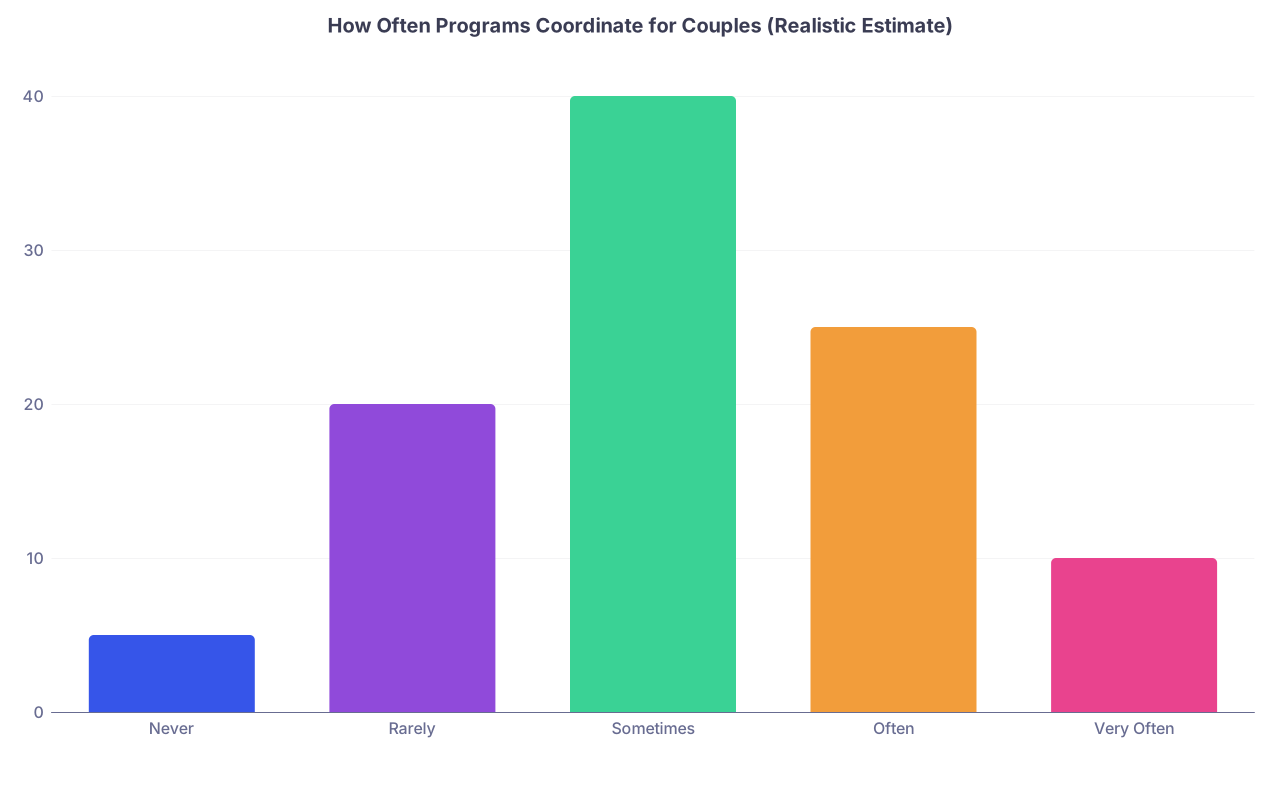
And yes, they email each other. They walk down the hall. They text. Especially at mid-size university programs where 4–8 different residencies share the same hospitals.
| Category | Value |
|---|---|
| Never | 5 |
| Rarely | 20 |
| Sometimes | 40 |
| Often | 25 |
| Very Often | 10 |
No, nobody publishes these numbers. But “sometimes” and “often” are far more common than you’d guess from the sanitized NRMP language.
The Algorithm: Why Couples Are Not Just “Two Applicants”
Residents and med students love to repeat:
“The algorithm favors programs, not applicants.”
In individual matching, yes, that’s structurally true. For couples, the story changes.
The couples match is essentially running a search for pairwise outcomes:
- It looks for the highest possible pair ranking where both of you can reasonably fit into your respective programs’ rank lists.
- It will happily match you “lower” individually if it creates a valid pair that is still high on your joint list.
This gives PDs a weird kind of fear and a weird kind of opportunity.
The fear:
“If we rank this person too low and another program ranks their partner higher, we might lose them both.”
The opportunity:
“If we coordinate with the other department and both of us are willing to go a bit deeper on our lists for these two, we’ve now increased the chance of filling two slots with decent people without exposing ourselves much.”
What no one tells you: once you’re in the couples pool, the system actively searches for ways to place you together if it can. You’re not a normal applicant anymore. You’re labeled as a constraint that the algorithm tries hard to satisfy, within program list boundaries.
That constraint alone gives you leverage—if you build your rank list and your communication in a way that makes it easy for programs to say yes.
The Three Hidden Forms of Leverage You Actually Get
Let’s dissect the kinds of leverage you get as a couple. These are the maneuvers PDs won’t admit to externally but use all the time.
1. Cross-Department Negotiation
Programs talk. More than you think.
At a typical academic center, the IM, Surgery, Peds, EM, OB/GYN PDs share:
- GME meetings
- Teaching conferences
- Office hallways
- The same chiefs complaining about ED boarding
Couples provide something they can trade on: coordination.
Scenario I’ve seen multiple times:
- Your partner is a stellar EM candidate, top 10% on paper.
- You’re a solid but not spectacular IM candidate—maybe middle third of their pool.
- EM wants your partner badly. IM is lukewarm on you.
In a closed committee room:
EM PD: “We really want her. Her partner’s in IM. Can you guys use him?”
IM PD: “He’s fine; not our top tier. Where would you rank him to help?”
EM PD: “If you can put him mid-list, we’ll bump her up a few spots. Better chance we land both.”
No one changes their whole rank philosophy. But one or both of you gets nudged favorably. This doesn’t happen for solo applicants.
Sometimes the leverage goes the other way. A strong IM applicant pulls up a weaker partner in another field. It’s a quiet cross-subsidy.
2. Risk Reduction for Programs
From a PD’s perspective, unfilled spots are the nightmare. Scramble/SOAP is embarrassing and dangerous. You get weaker applicants, more work, and sometimes angry faculty who suddenly realize they’re short a resident.
You, as a couple, represent:
- Two spots likely to be stable long term
- Lower attrition risk (people transfer less when their partner is also happy-ish)
- Less drama about “partner in another city” crises
So when a program is worried they might slightly over- or under-rank someone, couples can tilt their decision.
I’ve heard surgeons say this explicitly:
“He’s borderline. But his partner’s Peds and they’re both ranking us high. We’ll push him up a bit—once they’re here, they’re not going anywhere.”
They don’t do that for a lone, borderline applicant with no anchor.
3. Political Capital With GME
If you think PDs don’t have to justify their rank decisions upstream, you’re naive.
GME offices track fill rates, board pass rates, resident complaints, etc. A PD who can say:
“We landed a strong EM–IM couple that will be solid for both programs and probably stay here for fellowship.”
has more political capital than a PD who comes back from Match Day with: “We filled 90%, SOAPed three spots, and our top gem went to another city because we low-balled their partner’s program.”
Couples allow PDs to “sell” a story:
We are a place where serious, stable, long-term doctors come together.
Again—no one says this on a webinar. But this is the hallway conversation.
How You Accidentally Throw Away That Leverage
Most couples neutralize their own leverage in three predictable ways.
Mistake 1: Rank Lists Built on Emotion, Not Strategy
I’ve watched couples build joint lists like this:
“We love Boston. So we’ll rank all Boston pairs first. Then maybe the programs where we both interviewed, then whatever.”
Terrible idea.
Programs can’t respond intelligently to chaos. When you scatter your rank pairs across dozens of cities with no clear signal, no department can confidently say:
“These two are really committed to us and our partner department.”
What PDs want to see (and feel) is:
- Clear clustering of your rank pairs around a few anchor institutions
- Evidence from your emails/communication that they are a priority region or program
- Reasonable, not insane, geographic spread
If your list tells them: “We kind of want you if it works, but we’ve also ranked 30 other random combos,” they’re not going to move you up for “loyalty.” You’ve shown them you don’t have any.
Mistake 2: Silence When Communication Would Help
I’m not talking about begging or manipulating. I’m talking about strategic, honest communication.
The number of couples who never once explicitly tell a program:
“We are couples matching with [specialty] at your institution and your program is our top realistic choice in [region].”
is staggering.
Then they’re shocked when no coordination happens.
If a PD doesn’t know:
- That you both interviewed there
- That you’re ranking them high as a pair
- That you have realistic ranges at other places
they’re not going to go out on a limb or call the other PD. Too many unknowns.
Mistake 3: Sloppy, Overlong Rank Lists
There’s this myth that longer rank lists are always better. For solos, usually yes. For couples, there’s a breaking point.
Very long, completely unfiltered couples lists often contain:
- Pairs where one of you has an almost zero chance
- Cities one of you openly hates but left on “just in case”
- Random combinations that make no sense with your stated preferences
Programs sniff that out. It screams “we’re desperate” rather than “we’re committed to making this specific location work.”
Your leverage comes from being believable and targeted, not from ranking 300 insane pairings.
How to Use Your Couples Status as Real Leverage
Let’s switch to what you should actually do to use the couples match like an insider.
1. Decide Your “Anchor” Institutions Before Rank Day
Behind closed doors, PDs are most willing to move for couples who make them feel like “the anchor.”
An anchor institution is where:
- Both of you interviewed
- Both of you could realistically land (not pie-in-the-sky)
- You’d actually be willing to commit if they reciprocate
Identify 3–6 of these at most. More than that and you look noncommittal.
Your list should reflect clear priority tiers. Programs don’t see your whole rank list, but the ones who talk with you and with each other can infer how serious you are based on your behavior and what you actually tell them.

2. Use Targeted, Honest Preference Communication
You’re allowed to communicate preferences. You’re not allowed to lie about rank order. There’s a line. Stay on the right side of it but walk right up to it.
Examples of calibrated, useful communication:
To a high-priority anchor program for Partner A (say IM):
“Dear Dr. ___,
Thank you again for the opportunity to interview at [Program]. My partner and I are participating in the couples match. She is applying in [Specialty] and interviewed at your [Specialty] program as well.[Institution] is our top choice in [region/state] and, if possible, we hope to train together here. We will be ranking [IM Program] and [Specialty Program] very highly as a pair.
Sincerely,
[Your Name]”
Notice what this does:
- Signals real commitment to the institution
- Clearly states that a coordination opportunity exists
- Avoids the specific “I will rank you #1” language that crosses into forbidden territory unless it’s true
What usually happens next internally?
If the PD is at all interested, this triggers one of two actions:
- They remember you and nudge you up a few slots, especially if they like you and your partner is plausible for their colleague’s program.
- They forward your email (yes, literally forward) to the other PD: “FYI, this couple seems serious about us. Any interest in her on your end?”
You never see that thread. But it happens all the time.
3. Align Your Story Across Both Specialties
The worst thing that can happen is misaligned messaging.
I’ve seen this blow up:
- Partner A emails IM: “You’re our top choice in the Midwest.”
- Partner B emails EM at the same institution: “We are ranking your program first overall.”
Then EM PD and IM PD talk. They both think they’re the “true #1.” Someone realizes that can’t be right. Now your credibility is suspect.
Coordinated couples are careful. They:
- Agree on how they’ll talk about regions (“Pacific Northwest,” “Northeast”)
- Use consistent language about priority (“top choice in X,” “one of our highest ranked”)
- Don’t spray conflicting promises across six cities
You’re trying to look like a unified, competent unit. Programs notice when your communication is precise instead of messy.

| Step | Description |
|---|---|
| Step 1 | Identify Anchor Institutions |
| Step 2 | Align Priorities as a Couple |
| Step 3 | Draft Consistent Preference Emails |
| Step 4 | Send Targeted Messages to Anchor PDs |
| Step 5 | PDs Coordinate Internally |
| Step 6 | Couple Gains Rank List Leverage |
4. Build a Rank List That’s Aggressive but Plausible
There’s a balance here.
If you both are mid-range applicants trying to couples match into MGH/Brigham/Stanford pairings as your top 20, you’re in fantasy land. The algorithm can’t leverage anything real there.
But if your list is:
- A realistic top band where both of you are competitive
- Followed by a mid band of slightly safer but still desirable places
- Then a smaller tail of “safety” pairs that you could actually tolerate
you give the algorithm room to work, and you give PDs confidence that if they stretch a bit for you, it won’t be wasted effort.
Too many couples put almost no realistic overlap in their “high” band then are surprised when they drop into ugly back-up cities.
Here’s the part PDs will never say out loud: they like couples whose rank lists they can understand. If you build plausible, overlapping tiers, you’re easier to coordinate around.
Specialty Mismatch: Where the Leverage Is Strongest
Certain combinations generate more behind-the-scenes movement than others.
| Couple Type | Leverage Potential | Why |
|---|---|---|
| IM + Peds | High | Many overlapping institutions |
| IM + EM | High | ED + wards rely on each other |
| IM + Psych | Moderate | Common academic combos |
| Surgery + Derm | Low–Moderate | Very different ecosystems |
| Ortho + Rad Onc | Low | Hyper-competitive, siloed |
The best leverage situations:
- One partner is highly desirable in a high-need specialty (EM, IM, FM, Peds, Psych).
- The other is at least solid in a moderately competitive but flexible specialty.
What PDs say quietly:
“If I can grab this star EM resident by taking their decent IM partner, I’ll do it.”
The worst leverage situations:
- Both in ultra-competitive, small cohort specialties (Derm, Ortho, Rad Onc, ENT).
- Or one in a hyper-competitive niche and the other in something the institution barely has.
Those couples have very little room to maneuver. The departments simply don’t have enough slots or flexibility to horse-trade.
One Hard Truth: Couples Leverage Cuts Both Ways
You need to understand one more thing. Sometimes your couples status hurts you. On purpose.
A PD might think:
“We like her a lot. But her partner’s in a specialty we don’t love working with, and I don’t want the political headache of being asked to coordinate. Easier to avoid them both.”
Or:
“He’s great but they’re only willing to be in 3 cities. Too restrictive. Too risky for us.”
That’s the darker side nobody mentions. By signaling you’re a couple, you also signal:
- You may be harder to place if only one department wants you
- You might reject them entirely if your partner doesn’t land there
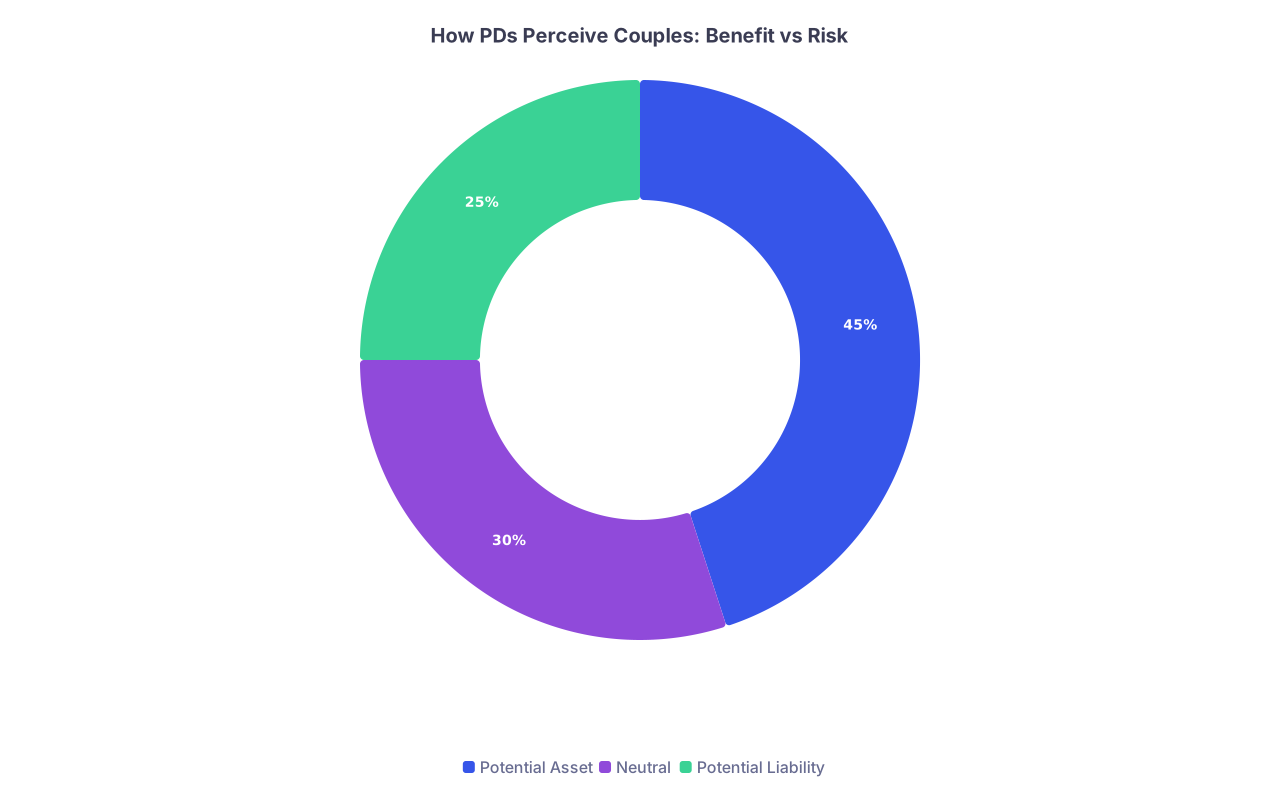
This is exactly why you have to lean into the right kind of communication. You’re trying to make yourself a low-risk couple, not a high-maintenance one.
| Category | Value |
|---|---|
| Potential Asset | 45 |
| Neutral | 30 |
| Potential Liability | 25 |
Asset if you’re stable, realistic, and anchor-friendly. Liability if you’re demanding and incoherent.
FAQs
1. Should we ever tell a program they’re our “#1” as a couple?
Only if it’s 100% true and both of you are saying the same thing, and you’re prepared to back that up on your rank list. Programs do compare notes. If you lie or hedge and get caught, your credibility tanks and any leverage you had evaporates. It’s safer—and often just as effective—to say: “You are one of the highest programs on our joint rank list” unless you’re absolutely certain.
2. Is it worth reaching out if only one of us interviewed at that institution?
Usually no. If only one of you interviewed there, the other PD has already made a silent decision: they’re not in the game for you. Sending an email that says “my partner would love to be there too” won’t override their interview filter. Focus your strategic communication on places where both of you interviewed or where there’s at least some prior interaction or waitlist-like ambiguity.
3. How many program pairs should we realistically rank as a couple?
For most couples, 60–100 pairs is a reasonable ceiling. Above that, you’re usually padding with garbage combinations you don’t truly want or where one partner has almost zero shot. I’ve seen couples match very well with 30–50 smart, tightly constructed pairs. Depth helps, but targeted depth beats a bloated, incoherent list every time.
Key points, without sugarcoating:
- Programs do coordinate for couples behind closed doors when it’s politically and logistically worth it.
- Your real leverage comes from being a believable, low-risk, high-commitment pair for a small number of anchor institutions—not from ranking everywhere.
- Clear, honest, aligned communication as a couple makes it much easier for PDs to justify nudging you up and calling their colleagues on your behalf.


