

The way programs talk about couples match in public is not how they talk about it behind closed doors.
On the website and at interview dinners, you’ll hear: “We’re very supportive of couples” and “We’ve had many successful couples matches.” Then the door closes, the rank list screen comes up, and the tone changes to: “Are we really going to burn two spots on them?” or “If one of them bails, we just wasted a rank.”
Let me walk you through what actually happens in those rooms — why some programs quietly avoid couples match pairs, and why others actively try to recruit you.
Because this part no one explains honestly.
The First Truth: Programs Don’t Think in Individuals, They Think in Slots
You think of yourself as an applicant. Programs think of you as FTE. A slot. A warm body to cover nights and clinics and call.
Now add a couple into that mental model.
A couples match pair is not “two applicants.” In the program director’s head, it’s one linked decision with double the risk. Two contracts, one failure point.
Here’s how the thinking actually goes:
- If we match Applicant A, we’re heavily incentivized (or forced) to match Applicant B.
- If Applicant B is clearly weaker, we’re effectively dragging them in above where we’d normally rank them.
- If they break up, transfer, or implode, we’ve burned a precious spot for three to seven years.
Programs do not say it this bluntly to you. But in the rank meeting, this is exactly how it’s framed.
And that’s why some places instinctively shy away from couples match even while publicly smiling and nodding.
What Programs Secretly Worry About With Couples Match
Let me be direct. These are the real concerns that come up in PD meetings and faculty rank discussions, usually starting with, “I know we support couples, but…”
1. The “Two-for-One” Risk Calculation
If you’re an above-average applicant and your partner is borderline for that program, the PD sees a trade:
- Take you and carry your partner.
- Or pass on both of you and use those two spots for two solid, independent applicants.
In a tight program — strong reputation, too many qualified applicants, limited spots — that trade often loses. Quietly. Nobody emails you saying, “We loved you but not your partner.” You just don’t get ranked as high as you thought.
This is especially brutal in competitive fields: dermatology, plastic surgery, ortho, ENT, some gas and rads programs. They’ll absolutely consider the couple, but the threshold for “we’re willing to burn two slots on this pair” gets very high.
2. Fear of Transfers and Breakups
Every PD has at least one story like this:
Couple came in together. Year two, they split loudly. One wants to transfer. The other becomes toxic on nights. PD spends months doing damage control. Clinic staff complains. Co-residents complain. Faculty complain. The program regrets the whole thing.
You won’t see this posted on the website, but it lives in institutional memory. And once a program has lived through a messy couples-breakup-transfer disaster, they become much more skeptical about couples match. Sometimes permanently.
I’ve literally heard: “We got burned last time we ranked a couple high. I’d rather not deal with that again.”
3. Scheduling and Coverage Headaches
Programs don’t like variables they can’t control. Couples are a variable.
You will hear PDs say:
- “They’ll want the same vacation weeks.”
- “They’ll ask for the same elective blocks.”
- “If we deny them, we’re ‘anti-family.’ If we grant it, everyone else wants special treatment.”
Are these problems insurmountable? No. But when a program is understaffed, running two residents short, and trying to survive the year, they’re not looking to add any avoidable complexity.
Smaller programs feel this more acutely. A four-person per class program can’t absorb the same disruptions that a 25-person internal medicine program can.
4. The Hidden Power Problem: Who Really Has Leverage?
A single resident threatening to leave is annoying. A couple threatening to leave together is a coverage crisis.
Multiple PDs have said some version of: “If they’re unhappy, that’s potentially two empty spots. That’s an ACGME and service issue, not just a ‘we’ll survive somehow’ issue.”
So programs that already feel vulnerable — marginal reputation, high service burden, hard-to-recruit location — sometimes see couples as a future hostage situation: if both feel miserable halfway through PGY-2, leadership gets stuck.
Is this rational? Not always. But it’s how they think.
Why Some Programs Actively Like Couples Match
Now, the flip side. Not everyone is quietly trying to avoid you.
There are programs that love couples match. They try to recruit couples. They see you as a stabilizing force, not just a logistical problem.
Let’s sort out who those programs are and why they think differently.
1. Resident Stability = Less Drama, Fewer Losses
Some PDs — especially in solid but not top-10 programs — see couples as stickier.
The internal logic:
- Couples often have deeper roots in the city (family, joint leases, long-term plans).
- They’re less likely to bolt to another program on a whim.
- They build a social core — they host, they integrate, they bring other residents together.
One PD literally told his chiefs: “Couples are retention gold. They don’t leave as easily.”
Programs that have been burned by high resident turnover, or are in cities where residents frequently try to transfer “up,” often welcome couples.
They want people who will commit to the program and the location in a long-term way. A couple planning to stay near each other for fellowship, jobs, or family sounds great to them.
2. Two Birds, One Recruitment Cycle
Some programs — especially in mid-competitive or less geographically desirable locations — see couples as a recruitment multiplier.
Think rural or Rust Belt or “good program, meh city.”
Their logic goes like this:
- One strong applicant might be willing to come.
- But they’d be much more willing if their partner can land nearby.
- If we lean in and coordinate with the partner’s specialty, we can attract both.
So you’ll see internal medicine and pediatrics, or FM and EM, or psychiatry and IM, quietly coordinating to land couples.
They know if they support your relationship and actively help, you’re more likely to rank them higher than a similar program in a slightly nicer city that shrugs and says, “Yeah, couples are fine.”
3. Family-Friendly Branding
Some programs actively want the “we support families, partners, and human beings” reputation.
Usually these are programs with:
- Leadership who remember how hard training was on their own marriages.
- A more humane, education-first culture.
- Institutional pressure to present as “supportive and progressive.”
For them, a couple who thrives, talks about being supported, and posts about the program online is priceless PR. Especially in smaller specialties or community-heavy programs that need a positive reputation boost.
They’ll bend over backwards to coordinate rotations, clinic schedules, or at least vacations. Not because they’re saints, but because they understand the ROI of being known as the “we treat you like a person” program.
Where Programs Quietly Avoid Couples (Patterns You Don’t See on ERAS)
There’s a pattern in which programs tend to be skeptical about couples match — they’re not all the same, but I’ve seen the same categories come up again and again.
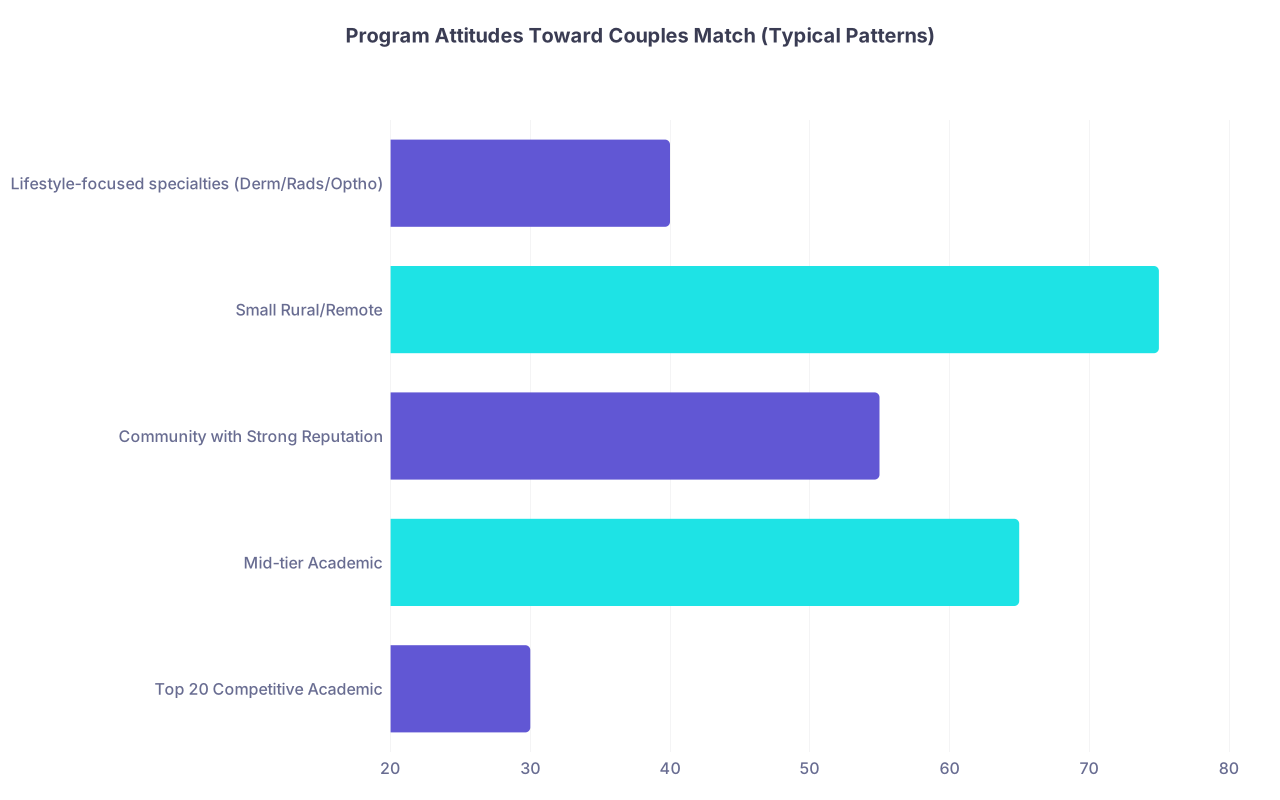
| Category | Value |
|---|---|
| Top 20 Competitive Academic | 30 |
| Mid-tier Academic | 65 |
| Community with Strong Reputation | 55 |
| Small Rural/Remote | 75 |
| Lifestyle-focused specialties (Derm/Rads/Optho) | 40 |
(Values here are rough percentages of programs in each category that are generally positive about couples — not precise data, but the trend is real.)
1. Hyper-Competitive, Big-Name Academic Programs
Think: UCSF, Brigham, MGH, Penn, Hopkins, top-5 derm or ortho or ENT programs.
They’ll work with couples when both applicants are independently strong. But they’re not going to substantially lower their bar for the weaker half. Why would they? Their applicant pool is already absurdly stacked.
So in those rooms, the discussion sounds like:
- “We’d take her no question. Him…not at this rank level.”
- “If we start bumping down to rescue couples, we’re going to lose other stellar people.”
Result: they’ll rank you both, but not artificially tether you. If one of you is elite and the other is middle-of-the-pack, do not assume your partner will be carried into that tier. They probably won’t.
2. Procedural, Rigid-Schedule Programs
Surgery (especially small categorical programs), neurosurgery, ortho, OB/GYN, some EM programs with brutal coverage needs.
These programs often run at the edge of collapse. They’re just trying to cover the trauma bays, the ICU, the call pool. The idea of adding scheduling complexity for couples is not thrilling.
Are they anti-couple? Not always. But when it comes to matching:
- They will not bend class composition very far to accommodate a couple.
- If they have a bad memory from a past couple, they’ll be even more conservative.
You might never hear it said aloud, but you see it in the rank order. Couples slide down, with “easier” singles filling the upper slots.
Where Programs Quietly Favor Couples
Other programs see couples as a net positive and behave accordingly. These places are rarely as loud about it as you’d hope, but you can read between the lines if you know what to look for.
1. Mid-Tier Academics in Competitive Cities
Solid university programs in non-coastal or second-tier cities: Iowa, Wisconsin, Ohio State, Rochester, UAB, Colorado, Utah, etc.
These programs are strong but constantly losing out to “brand name” places when applicants pick their rank lists.
Here’s the conversation that actually happens with a couple that liked them:
- “If we can get BOTH of them to rank us #1 or #2, that’s a big win.”
- “Let’s see if [partner’s specialty] can move them up too. We land them together or not at all.”
MD/PhD + IM, or peds + EM, or psych + FM couples sometimes get a quiet bump here if both are decent candidates. Because a committed pair is often worth more than two random singles who may always be half-looking over the fence.
2. Community-Based Programs Fighting for Talent
Well-run community programs that know they’re competing against university brands often love couples.
They think long-term:
- Couples might stay in the region to practice.
- They build local roots, buy houses, have kids.
- They become future faculty, preceptors, referral sources.
I’ve heard a PD at a community IM program say bluntly: “Give me three couples per class. They’re more invested, and they keep each other sane.”
These are the programs most likely to explicitly say during interview season: “We’ve worked with a lot of couples. We’re willing to coordinate as much as we can.”
And they mean it.
3. Small City / Rural Programs Desperate for Stability
Small, regional, or rural programs — especially in FM, IM, psych, peds — sometimes see couples as their best shot at retention.
They know people don’t naturally flock to their location. But couples who want a quieter life, lower cost of living, or proximity to family can be incredibly valuable. If they come, that’s two people likely to plant deep roots.
So leadership will:
- Call other programs in the area to help the partner land a spot.
- Offer extra flexibility in scheduling.
- Actively court couples during the interview season.
They may not advertise this boldly online, but in PD circles, they will absolutely say: “We’d love to have you both. Tell us who we should talk to on your partner’s side.”
The Games You Don’t See: How Rank Meetings Actually Handle Couples
You need to understand how your file is discussed when the door closes and you’re not in the room.

| Step | Description |
|---|---|
| Step 1 | Discuss Applicant A |
| Step 2 | Rank low or not at all |
| Step 3 | Discuss Applicant B |
| Step 4 | Rank A independently, B lower |
| Step 5 | Keep A high, B moderate |
| Step 6 | Move both up to align ranks |
| Step 7 | Strong candidate? |
| Step 8 | B acceptable alone? |
| Step 9 | Willing to spend 2 slots? |
In real PD meetings, it goes something like this:
They pull up Applicant A. Somebody says, “This one’s part of a couple. The partner is in EM at [Program X] or applying in peds.” They scroll to see both.
Then:
- They rank each of you individually first.
- Then they discuss whether to move one or both of you to help your chance of landing together.
What actually influences that decision:
- How badly they want each of you separately.
- How much flexibility they have in class size or category/track spots.
- Their prior experience (good or bad) with couples.
I’ve seen these exact phrases:
- “We’ll move her up a few spots, but I’m not bumping him that high.”
- “If we take the couple, that’s probably the end of our flexibility for this class.”
- “They both look great, I’m comfortable moving them up together.”
Notice what’s missing: nobody is thinking about your relationship the way you are. They’re thinking service, risk, and relative value compared to everyone else.
How You Can Read the Room (Before It’s Too Late)
You won’t get a PD to admit, “We secretly avoid couples,” but you can pick up signals if you listen and ask the right questions.

Here’s what tends to separate “we actually support couples” from “we say we do, but we don’t mean it.”
Programs that really support couples:
- Volunteer examples of past couples and where they ended up.
- Know specific details: “We had a psych–IM couple last year, she’s at [X], he’s with us.”
- Offer: “If your partner is interviewing in the area, have them reach out, we’re happy to coordinate with other programs.”
Programs that only perform support:
- Give vague responses: “Yeah, couples are no problem here,” with no concrete examples.
- Fumble when you ask, “How have you handled couples in the past?”
- Look uncomfortable when you hint that your rank list will depend on your ability to co-locate.
If during interview they say, “We don’t treat couples any differently; we rank everyone individually,” that sounds fair but translates to: “We’re not going to alter our rank list much to help you.”
Not automatically bad. Just honest. You need to know which you’re dealing with.
Smart Strategies for Couples (Given All This)
You can’t force a program to love couples. But you can make yourselves easier to say yes to.

A few insider realities:
Programs are more willing to help couples when both applicants are clearly above their usual floor. The weaker half does not need to be a superstar — just safely in their usual “we’d be happy with this” zone. Your job is to make sure neither of you looks like a charity case.
A short, direct, well-timed email from you (or your partner) to the PD before rank meetings can move you from “anonymous couple” to “we know them, they’re serious about us.” Not always, but often enough to matter.
Anchor programs matter. If one of you has a realistic shot at a program that’s couples-friendly and can coordinate with the other specialty locally, that anchor should heavily influence your final rank list.
And no, that’s not selling out. That’s understanding how the system actually makes decisions.
The Reality Check: Couples Match Is Not Neutral for Programs
Here’s the part most couples do not fully internalize:
For programs, you’re not just two people trying to stay together. You’re a multi-variable logistical and political decision stretching several years into the future.
Some places embrace that complexity because they see the upside: stability, culture, recruitment. Others avoid it because they see risk, hassle, and prior scars.
Neither side is “evil.” But pretending every program is equally supportive of couples is naive.
Your job is to:
- Figure out which programs genuinely work with couples versus those that merely tolerate them.
- Be realistic about where each of you sits in the distribution for a given program.
- Decide how much you’re willing to compromise on prestige, location, or specialty nuances to stay together.

Residency is long. Having the right person next to you matters. But so does understanding how program directors actually think when your names come up on that rank list screen.
If you can see the game from their side, you’ll build a couples strategy that’s grounded in reality, not fantasy.
With that clarity, you’re better prepared to choose interview invites, craft those couples emails, and shape a rank list that balances love, training, and realism. The next move is yours — and the real test comes when you sit down together to build that final list. But that negotiation between your head and your heart? That’s a whole separate conversation.


