

The couples match will not “work itself out.” It breaks down exactly where couples make predictable, avoidable ranking mistakes.
If you treat the couples match like two solo match processes taped together, you are walking straight into a preventable disaster: one of you unmatched, both of you in a city you hate, or “matched” 1,000 miles apart because you ranked like amateurs.
Let me walk you through the traps I have watched couples step into over and over again.
The One Rule You Cannot Afford to Ignore
Before the ten mistakes, you must understand the central landmine of the couples match:
The algorithm maximizes the pair’s outcome, not each person individually.
That means:
- Your joint rank list is what matters.
- Individual lists are almost irrelevant once you click “participate as a couple.”
- A “reach” for one can drag the other into a terrible result if you are not strategic.
Everything below comes back to that. The algorithm is agnostic to your relationship, your mental health, your debt, or your family. It just follows your rank list.
Build that list wrong, and the algorithm will faithfully deliver a joint catastrophe.
Mistake #1: Treating the Couples Match Like Two Separate Rank Lists
The most common—and most damaging—error: each person builds their solo list, then at the end you try to “combine” them in an evening with Excel and wishful thinking.
This is how couples end up with:
- Completely unrealistic top tiers (e.g., both ranking only top-10 academic programs in the same three cities)
- Massive drop-offs where one partner’s best programs are paired with the other partner’s absolute bottom choices
- A rank list that technically exists but collapses your realistic match probability
The couples match is not:
- “My list + your list = compromise” It is:
- “Our shared list of city/program combinations that are acceptable for both of us.”
Avoid this mistake by:
Starting with geography, not prestige.
Decide:- Which cities/regions are acceptable
- Which are “only if desperate”
- Which are absolute no
Building a shared city-program matrix early.
Something like:
| City | Partner A Options | Partner B Options | Joint Viability |
|---|---|---|---|
| Boston | 4 programs | 1 program | Weak |
| Chicago | 5 programs | 4 programs | Strong |
| Phoenix | 2 programs | 3 programs | Moderate |
| No match | SOAP/Prelim only | SOAP/Prelim only | Last resort |
- Building the joint list first, then checking individual lists, not the other way around.
If you wait until late February to “merge” your solo lists, you are already in trouble.
Mistake #2: Refusing to Rank “Unequal” Options
I hear versions of this every year:
- “We only want to match at programs that are good for both of us.”
- “We decided not to rank combinations where one of us would be unhappy.”
- “We’re either together in a great city, or we will try again next year.”
Romantic. Also dangerous.
The algorithm cannot give you options you refuse to rank. If you do not rank “unequal” combos, here is what you are really saying:
- “We would rather not match at all than have one person at a slightly weaker or less desirable program.”
Maybe that is truly your stance. Usually it is not. Usually it is emotional rigidity dressed up as “support.”
You must deliberately decide:
- How much asymmetry are you willing to tolerate?
- Is it acceptable for:
- One of you to be at a community program and the other at a university program?
- One 45-minute commute vs. the other 10 minutes?
- One person in their top-3 program while the other is at their #8?
Disaster pattern I see:
- Couple insists on “equal outcome” only.
- They build a tiny joint rank list with only “both top choices” pairs.
- Their realistic mid-tier combinations go unranked.
- One or both go unmatched despite objectively strong applications.
You avoid this by ranking in layers:
- Layer 1: Strong for both
- Layer 2: Strong for A, solid for B
- Layer 3: Strong for B, solid for A
- Layer 4: Acceptable for both (not exciting, but safe)
- Layer 5: Last-resort combinations, SOAP-preventers
You do not need to “like” your last-resort tier. You need it to exist.
Mistake #3: Underestimating How Many Combinations You Actually Need
Couples often think, “We each applied to 15–20 programs; we are safe.” That is wrong math.
If Partner A ranks 15 programs and Partner B ranks 15, your total potential combinations are 225. But most couples only rank a small fraction of those, because:
- Many cities do not overlap
- Some combinations are truly unacceptable
- They are too lazy or overwhelmed to build out the long tail of combinations
The result is a joint list that is:
- Far shorter than they realize
- Top-heavy with unrealistic pairs
- Missing the medium and lower probability but still acceptable outcomes
Too-short lists are a huge driver of couples match disasters.
You should be thinking in terms of joint pairs, not individual program counts.
A simple way to visualize it:
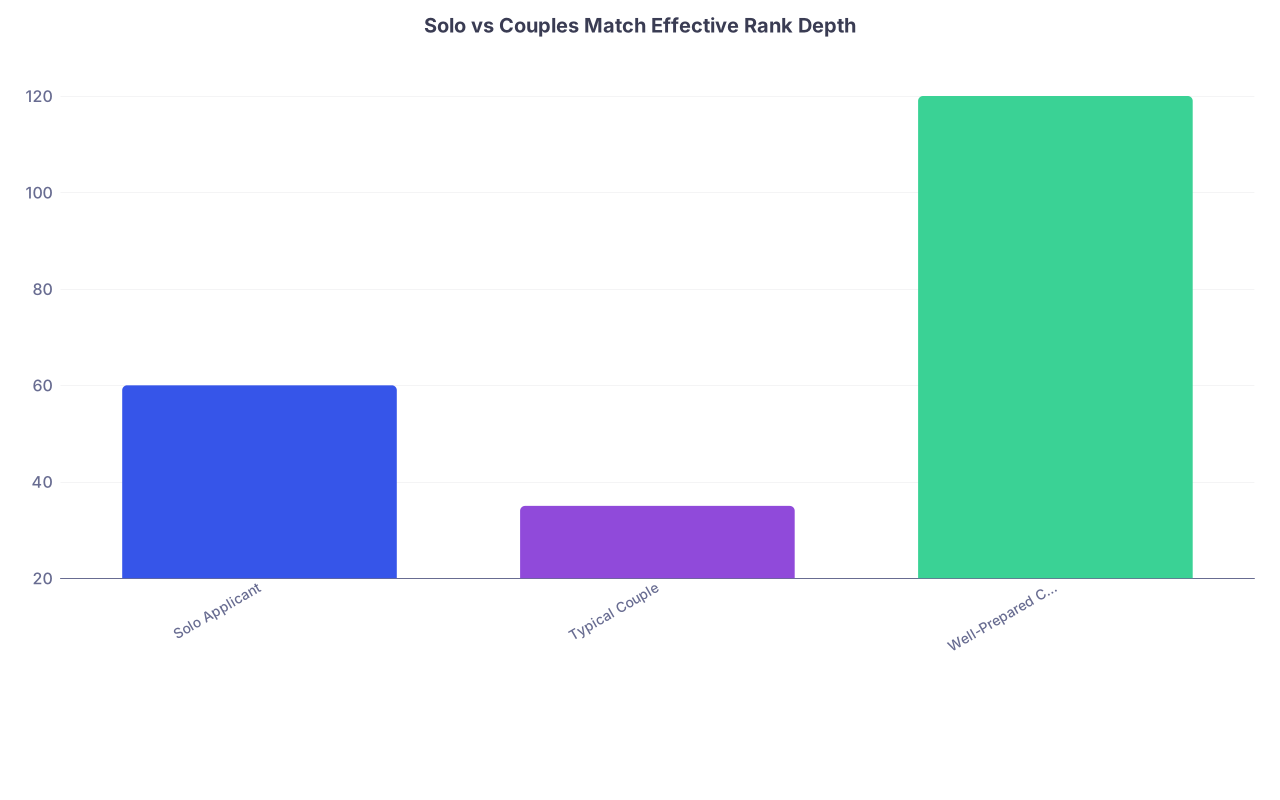
| Category | Value |
|---|---|
| Solo Applicant | 60 |
| Typical Couple | 35 |
| Well-Prepared Couple | 120 |
- Solo applicant might rank 60 programs and be fine.
- Typical couple ends up with ~30–40 pairs and thinks that is “a lot.”
- Smart couples build 100+ pairs when possible.
No, you will not always hit 100. Some specialties are too competitive or too small. But most couples could have significantly longer lists and simply never do the work.
If your joint list is under ~40 combinations and you are not both absolute rockstars, you are taking an avoidable risk.
Mistake #4: Ignoring the “Different City, Same Time Zone” Layer
Here is the part couples do not like to talk about:
Sometimes, the algorithm cannot place you together in the same city, even if you did “everything right.”
The worst mistake is refusing to even consider ranking:
- Different-city combinations
- That are still feasible for your relationship
- For example, 1–2 hour flights or same time zone with good transit
I have watched couples go completely unmatched because they never allowed the algorithm to give them this safety net.
Define this layer explicitly:
- “We are willing to rank:
- Same metro area > neighboring cities within 1 hour drive > same state but 3–4 hours apart > same region with direct flights only > or not at all.”
For example, a realistic couple might create:
- Chicago + Milwaukee pairs
- NYC + New Haven / Philly pairs
- Dallas + Houston / Austin pairs
Not forever. Not ideal. But better than:
- One matched, one unmatched
- Or both unmatched and thrown into SOAP chaos
You do not have to rank these high. You just have to rank them somewhere above “no match.”
Mistake #5: Not Having the “What If One of Us Does Not Match?” Conversation
If you are not willing to have this conversation now, you are emotionally not ready for the couples match.
Scenarios you must plan for before certifying your list:
Partner A matches, Partner B does not.
- Do you:
- Have Partner A withdraw and both reapply next year?
- Have Partner B SOAP wherever and endure a year apart?
- Have Partner B take a research year in the same city?
- Do you:
Partner B matches in a dream city, Partner A matches in a barely tolerable program in the same city.
- Do you accept the asymmetry?
- Do you plan for A to try to transfer later?
Both do not match.
- Are you willing to SOAP into prelims in different cities?
- Or do you agree: no prelims, only try again?
These decisions must inform your rank strategy:
- If you both swear, “We will not do long distance under any circumstance,” then it is irrational to:
- Not rank more local but “less ideal” combos.
- If one of you is clearly more competitive:
- You may choose to lean on that person taking a less ideal program to protect the other from not matching.
Couples who refuse to get concrete about these scenarios end up blindsided on Match Day. And then they are making major life decisions while shocked and sleep-deprived.
Mistake #6: Letting Ego and Prestige Drive the Top Third of Your List
Couples match magnifies ego-driven mistakes.
Classic pattern:
- One partner shoots for highly competitive academic programs in saturated cities.
- The other has a more modest application, but they rank exclusively pairs where the stronger partner gets their dream tier.
- The weaker partner’s realistic programs in those cities either:
- Are not ranked at all, or
- Are buried so low they might as well not exist.
End result:
- The whole couple’s success probability gets tied to the more competitive person’s ambitions.
- The partner with fewer options effectively “disappears” from the strategy.
That is backwards.
If there is an imbalance in competitiveness, the less competitive partner’s options should drive your geographic strategy first. Then you fit the stronger partner’s options into those feasible locations.
How to avoid the prestige trap:
- Build a reality-based expectations table:
| Partner | Specialty | Approx Competitiveness | Application Strength |
|---|---|---|---|
| A | Dermatology | Very High | Above average |
| B | Internal Med | Moderate | Below average |
- Accept that:
- Partner B’s city options will be the limiting factor.
- Partner A may need to:
- Rank solid but not elite programs.
- Pivot to strong but less insane academic centers.
If prestige drives your top third and your bottom third is a cliff to nowhere, the algorithm will happily toss you off that cliff.
Mistake #7: Failing to Use Categorical + Prelim Combinations Intelligently
If even one of you is applying to a field that often requires:
- Prelim medicine
- Prelim surgery
- Transitional year
You can blow up your couples match strategy by not understanding how to rank:
- Categorical + Prelim combos
- Same-city vs. different-city prelims
Common disasters:
- Ranking categorical-only combinations for one partner and forgetting to pair them with prelims for the other.
- Refusing to rank “strong prelim in same city + categorical elsewhere” even when that might save your year.
- Creating a joint list that assumes perfect alignment of categorical and prelim outcomes, which is fantasy.
You need to map out:
- “If Partner A matches this advanced program:
- Which prelims in the region are we willing to accept for B?
- In what order?”
Then build those combinations explicitly into the list. The algorithm does not “infer” logical pairs. You must rank them.
This is where people get lazy and pay dearly.
Mistake #8: Not Using Data to Anchor Your Optimism
Every couple thinks they are the exception. Especially if both have decent scores and good letters.
They say things like:
- “We interviewed well; I just have a feeling.”
- “Programs really liked us as a couple.”
- “My mentor said we should shoot high.”
Feelings do not change match statistics.
Ground yourself with real data:
- Specialty match rates
- Your Step/COMLEX ranges compared with program averages
- How many couples historically match into your chosen combination of specialties
Then decide how aggressive you can afford to be.
You want a top-heavy list. You do not want a top-heavy fantasy list with nothing realistic beneath it.
Mistake #9: Doing the Joint Rank List in a Rush and While Tired
I have watched otherwise bright couples throw together their final list over:
- One late-night session
- In the middle of a busy rotation
- With one or both of them emotionally burned out
They:
- Mis-order pairs
- Omit cities they later realize they preferred
- Fail to include critical safety combinations
- Forget to rank entire hospitals for one partner in cities they liked
Big result from a small error: a completely different match outcome.
Treat your joint rank list like a major exam:
- Schedule at least 2–3 separate sessions:
- One to draft
- One to revise
- One to sanity-check before certifying
- Narrow your environment:
- No phones
- No friends
- Just you, your partner, and the data
Have someone you trust (advisor, mentor) look at the structure. They do not need to see every single pair. They just need to see:
- Are you too top-heavy?
- Is there a realistic middle?
- Is your safety tier real or imaginary?
You cannot outsource the list. But you can absolutely let someone more experienced point out obvious structural problems.
Mistake #10: Confusing “We Would Hate That” with “We Would Rather Not Match”
This is the most subtle and most dangerous mistake.
There is a huge difference between:
- “We would hate to end up there.”
- “We would rather not match than end up there.”
Yet couples routinely build lists as if those are the same statement.
The match algorithm assumes that:
- Every rank above the last one is preferred to not matching. If that is not actually true for you, your list is lying.
You must:
Explicitly define your true floor:
- “We would rather:
- Not match
- Reapply next year
- Or SOAP in a less controlled way
than match into these specific combinations.”
- “We would rather:
Separate:
- “Ugly but acceptable” from
- “Truly unacceptable.”
Do not be brave with your future by leaving out “ugly but acceptable” tiers just because they offend your pride. Match outcomes are very hard to unwind.
Once you are in a program:
- Transfers are rare.
- Re-matching is complicated.
- Visa issues, spouse jobs, kids, housing—everything multiplies.
Rank your true preferences. Not your aspirational ones.

| Step | Description |
|---|---|
| Step 1 | Start: Decide to Couples Match |
| Step 2 | Define Geography Tiers |
| Step 3 | Map Each Partners Programs by City |
| Step 4 | Identify Overlap & Asymmetry |
| Step 5 | Build Top-Tier Equal Outcome Pairs |
| Step 6 | Add Asymmetric but Acceptable Pairs |
| Step 7 | Add Safety & Different-City Pairs |
| Step 8 | Stress Test: Unmatched Scenarios |
| Step 9 | Advisor Review of Structure |
| Step 10 | Revise & Lengthen List |
| Step 11 | Final Sanity Check |
| Step 12 | Certify Rank List |
Use something like that. Not a last-minute “we’ll just figure it out.”
Quick Reality Check Table
Use this to see if you are on track or drifting toward disaster:
| Area | Low Risk Behavior | High Risk Behavior |
|---|---|---|
| Geography | Multiple acceptable regions | 1–2 cities only, no backups |
| List Length (pairs) | 70+ when possible | <40 with no strong reason |
| Asymmetry | Rank unequal but acceptable outcomes | Only rank “great for both” |
| Different-City Options | Ranked low but present | Refused on principle |
| Worst-Case Planning | Clear plan for unmatched scenarios | “We will figure it out if it happens” |
If you are stacking the right column, you are setting yourself up for an avoidable couples match disaster.
FAQs (Exactly 5)
1. Should every couple participate in the couples match, or are there cases where we should match separately?
Not every couple should couples match. It can reduce flexibility when:
- One partner is applying in an ultra-competitive specialty with limited locations (e.g., neurosurgery, derm)
- The other has a weak application and very few interviews
In that scenario, sometimes you are better off: - The weaker partner applying broadly and not being constrained by the other’s geography
- Then trying to relocate or transfer later
You couples match when your interview distributions and geographic preferences are at least somewhat compatible. If they are wildly misaligned, forcing a couples match can drag both of you down.
2. How many program pairs should we aim to rank as a couple?
If it is feasible in your specialties, aim for at least 60–70 pairs, and more if you can. Under ~40, you are flirting with avoidable risk, unless:
- You are both in non-competitive specialties
- You have strong applications and broad geographies
What matters is not just raw length but structure: - Strong top tier
- Realistic middle tier
- Uncomfortable but acceptable safety tier
Most couples underbuild the middle and bottom.
3. Is it a mistake to rank separate-city combinations if we really do not want long distance?
It is only a mistake if you both are genuinely willing to go unmatched rather than be apart. Most couples say they “could never do long distance” but then, on Match Day, are suddenly willing to consider anything to avoid being unmatched.
If you rank separate-city pairs, put them below all together-in-one-city options you prefer. But if you truly would choose “no match and reapply” over “1–2 years apart,” then do not rank them. Just be sure that decision is conscious, mutual, and informed by reality—not made out of pride or fear.
4. How do we handle big competitiveness differences between partners when building the list?
You let the less competitive partner’s options drive the geographic map. Then you fit the stronger partner’s realistic options into those areas. Do not let the more competitive person’s ambitions dominate the cities while the other becomes an afterthought. You should also:
- Be more generous to the weaker partner in asymmetrical pairs (their “reach” programs might sit higher than the stronger partner’s equivalent reach)
- Accept that the stronger partner may need to sacrifice prestige for relationship stability and a successful couples match outcome.
5. Can we change our minds about priorities after we submit the rank list?
No. Once the NRMP certification deadline passes, your rank list is locked. No edits. No “just one more city.” That is why doing it rushed or in a single sitting is such a bad idea. If there is even a 10% chance your priorities might shift (family news, health changes, new data), build that flexibility into the list before certification—usually by:
- Including one or two extra cities you are mildly unsure about but would not hate
- Ranking more safety combinations than your ego wants
The algorithm is unforgiving. Your only leverage is before the deadline, not after.
If you remember nothing else:
- The couples match rewards structure and realism, not romance or ego.
- Your joint rank list is a blunt instrument. Build it wide, layered, and honest.
- The disaster scenarios nearly always trace back to the same cause: a short, top-heavy, pride-driven list that never seriously planned for what happens if things do not go perfectly.


