

What if you both match… but three states apart because you ranked your linked “safety” programs too low?
Let me be blunt: couples do not usually blow their match on wild reach programs. They blow it by underranking their safe linked options. The programs that actually would have taken them. The ones they shoved way down the list “because surely we’ll match higher.”
I’ve watched couples end up:
- One in Florida, one in New York
- One matched, one unmatched
- One at their dream, one scrambling in SOAP for anything
Not because they were weak applicants. But because they were overconfident and under-protective when ranking their linked programs.
If you’re couples matching, this mistake is one of the fastest ways to sabotage both of your careers and your relationship in one shot.
Let’s walk through exactly how people screw this up—and how you’re going to avoid joining them.
1. The Core Problem: Misunderstanding What “Safe” Really Means in Couples Match
You’re not just matching you. You’re trying to match a pair into an actual geographic and program combination that the algorithm can place.
That changes the game.
Why “safe” is different for couples
For an individual:
- A “safe” program = one where your stats and application are comfortably above average
For a couple:
- A “safe linked pair” = a combination where:
- Both of you are realistically competitive
- Both programs rank you decently
- The joint pair is not competing with 50 other couples who want the same city
So no, “we each have 3 safe programs” does not mean you have 3 safe pairs.
You might have:
- 3 safe programs for Partner A
- 3 safe programs for Partner B
- But only 1 or 2 realistic overlapping pairs in the same region
And here’s the dangerous move I see constantly:
- Couples rank their “cool city, moderately realistic” pairs high
- Then they push their truly safe pairs (maybe in less desirable cities) way down
- Because they “don’t want to end up there unless we absolutely have to”
Guess what. The algorithm takes you literally.
If your rank list says you’d rather:
- Have one person unmatched than
- Both at that boring-but-safe city
…it will happily give you that outcome.
2. How the Algorithm Punishes Underranking Safe Linked Pairs
You don’t need to be a mathematician, but you do need to understand the trap.
The false security of “a long list”
I hear this all the time in October:
“We’re fine—we have like 25 ranked pairs. There’s no way we won’t match.”
Then I look at the list. It’s a disaster.
- First 10–12: high‑reach academic pairs in the same three cities
- Next 8–10: medium‑reach, still competitive combos
- Bottom 3–5: the only truly safe linked options… but ranked at the very end
On paper they have 25 pairs. In reality:
- Maybe 5–7 are genuinely viable given their stats and interview vibes
- But their truly high‑probability safety pairs are sitting at #20–25
If the algorithm gets to #20 on your list, you’re already on thin ice. Programs high on their lists have filled. You might have been “safe” in December. By Match processing time, not so much.
The couples twist that destroys you
Here’s what many couples misunderstand:
The algorithm doesn’t care how far apart your safety options are on your joint list. It just follows your preference order.
If you rank:
- Dream city A / Dream city A
2–15. Different mixes of competitive urban pairs - Partner 1 at solid mid-tier community, Partner 2 at solid mid-tier nearby
17–24. More mid-tier distant combos - Both at very safe, stable, geographically acceptable programs
But programs closer to the top:
- Didn’t interview you strongly
- Or liked one of you but not the other
- Or filled with stronger applicants
The algorithm walks down your list and:
- Skips the ones that can’t take you as a couple
- Keeps marching past your “moderate reach” pairs
- Gets to your true safety at #25…
…at which point seats may be gone, or one of you is still okay but the other is squeezed out.
You told the system that matching at #25 was barely better than not matching at all. That’s the message encoded in your list.
Do not be surprised when it grants that wish.
3. Red Flags: How to Tell You’re Underranking Safe Linked Programs
You might already be in the danger zone and not see it. Here’s how to know.
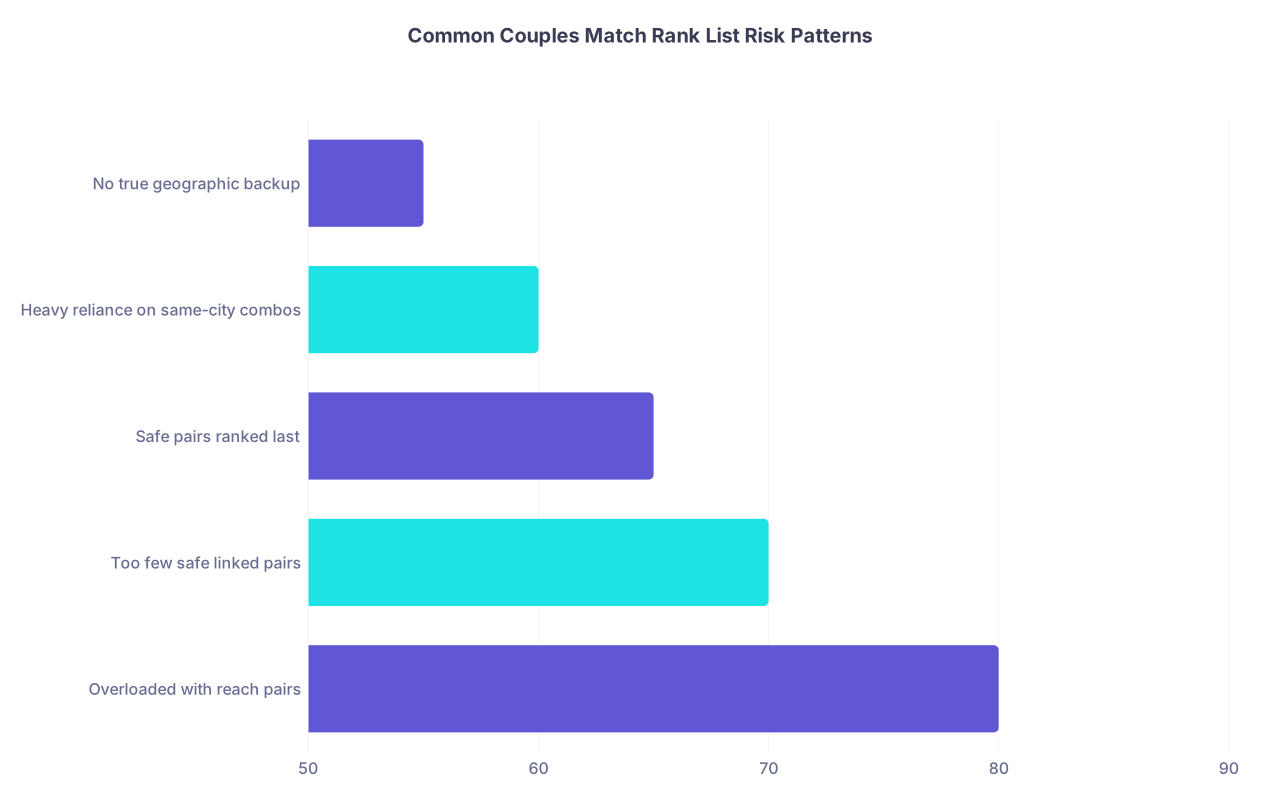
| Category | Value |
|---|---|
| Overloaded with reach pairs | 80 |
| Too few safe linked pairs | 70 |
| Safe pairs ranked last | 65 |
| Heavy reliance on same-city combos | 60 |
| No true geographic backup | 55 |
Red flag #1: You say “worst case” and describe an actually decent situation
Listen to your own language.
If you’re saying:
- “Worst case, we end up in [solid but less exciting city] together.”
- “I’d be miserable if we had to go to that mid-tier community, but at least we’d be together.”
That’s not “worst case.”
Worst case is:
- One unmatched / one in a city you both hate
- Or both unmatched
- Or 1,000 miles apart because you split your lists unpredictably
If a pair is good enough that you’d be okay, even if not thrilled, it should not be sitting at #24 like radioactive waste.
Red flag #2: You’re anchoring to your stronger partner
This is brutal but common.
Partner A:
- 250+ Step 2, strong research, several top‑tier interviews
Partner B:
- 230–235 Step 2, decent but not stellar, mixed interview season
Then I see a list structured as if both are Partner A. Every city is built around A’s top academic programs. B’s true safe options? Way down or not even linked.
This is a recipe for:
- A matching at a big‑name place
- B unmatched or stuck in SOAP
- Your relationship under massive strain before you’ve even started residency
If you’re couples matching, your joint strategy must be built around the more vulnerable application, not the stronger one.
Red flag #3: Your “backup city” is just a worse version of your dream city
I see this with major metros: Boston, NYC, Chicago, SF.
Couple says:
- “We have backups—if we don’t get MGH/BWH, we’ve got BIDMC and Tufts.”
- Or “If not Columbia/Cornell, we’ve got NYU, Sinai, Montefiore, etc.”
Those are not “backups.”
They’re slightly different flavors of the same competitive market.
A real backup:
- Is in a different tier of competitiveness
- Or a different region entirely
- Or includes strong community programs that reliably match couples
If all of your “linked safety pairs” live in the same very competitive ecosystem, you don’t have a safety. You have wishful thinking.
Red flag #4: You can’t name 3 pairs where you’re >80% confident you’d match as a couple
Sit down separately and write this out.
List 3–5 program pairs where you honestly believe:
“If we rank this near the top, there’s a very high chance we’ll both match here.”
If you can’t name at least 3?
- Or your lists don’t overlap?
- Or your “very high chance” are actually still fairly competitive academic places?
You’re likely underranking—or not even including—your true safety pairs.
4. Building a Safer Rank List: What Protected Couples Actually Do
The couples who match well and keep their sanity do not just list the shiniest cities. They’re ruthless about protecting their floor.
Here’s the pattern I see in couples who avoid the underranking trap.
Step 1: Decide your real non‑negotiables
Not your “it’d be nice” list. Your actual:
- Deal‑breakers (distance, cost, family obligations)
- Realistic preferences (urban vs suburban vs rural)
- Minimum acceptable program qualities
Then rank priorities with honesty:
- Both matched, same city, both reasonably happy
- Both matched, same region, commute doable
- Both matched, different cities but major hubs, manageable visits
- One matched at dream, one unmatched (is this really acceptable?)
- Both unmatched
Most couples say #1 > #4.
Then they build lists that functionally treat #4 as better than #1, because their true reliable pairs are ranked below dozens of “dream+probable‑unmatched” combinations.
Your rank list must reflect your actual values, not your ego.
Step 2: Identify true safe programs for each of you
Not:
- “They were nice on interview day.”
- Or “I vibed with the residents.”
True safeties tend to be:
- Community or hybrid programs
- In slightly less saturated markets
- Historically friendly to your school or region
- Places where your stats sit solidly above their typical matched range
Do this separately for each of you first. Then overlap.
Step 3: Build and explicitly prioritize safe linked pairs
Now, and this is where most couples fail:
You have to intentionally create and elevate pairings where:
- Both of you are reasonably competitive
- Both programs have real capacity and history of taking couples
- The city/region is livable for you for 3–7 years, even if not thrilling
Those pairs don’t belong at #22.
They belong somewhere in the top 8–12, interwoven with your reaches.
A typical protected couples list might look like:
1–5: High reach but still plausible pairs in top cities
6–10: Strong, realistic, mid‑tier academic/community combos
11–15: Really safe city/regional pairs where you’d both be okay living
16+: Less ideal geography / split‑city / more complex scenarios
Notice the difference:
- They’re not burying their safety under twenty fantasies
- They’re acknowledging: “We care about ending up together, matched, more than chasing prestige for 20 lines”
| Strategy Type | What It Looks Like | Main Risk |
|---|---|---|
| Dangerous | 15+ reach pairs, safeties buried at bottom | One or both unmatched |
| Moderately Risky | Mix of reaches and realistic pairs, but safeties still low | Geographic separation or match regret |
| Safer | Reaches at top, realistic linked safeties in top 10–12 | Lower prestige sometimes, but both matched together |
Step 4: Be brutally honest about misaligned competitiveness
If Partner A is much stronger:
- You do not build a list where A’s dream program is prioritized over B’s ability to match at all
Realistic couples say things like:
- “Yeah, you could get [Top 10 program], but if that means I’m stuck scrambling, that’s not worth it.”
- “Let’s rank a pair where I’m very safe and you’re still in a solid mid-tier above the place you’d hate.”
This is hard for the more competitive partner’s ego. But if you’re couples matching, you’re signing up to tie your outcomes together. Pretending that isn’t true is how you end up resenting each other post‑Match.
5. Specific Traps by Program Type and Geography
Not all “safe” programs behave the same way for couples.
Trap: “We both ranked big‑name programs in the same city; that’s enough”
New York, Boston, Chicago, SF, LA—every couple thinks:
- “We’ll just both match somewhere in the city. There are so many programs.”
Reality:
- Those markets are packed with couples
- Programs coordinate a bit, but not infinitely
- Your competition isn’t one‑off applicants, it’s other couples with similar plans
If your only safe pairs are “MGH + BIDMC,” “Columbia + Cornell,” “Northwestern + UChicago,” you aren’t safe. Those are still highly selective.
You need:
- At least one smaller‑name but solid program in that region
- Or a secondary city in driving distance that you’d both accept
Trap: The “two‑body problem” in very competitive specialties
If one or both of you are in:
- Derm, Ortho, ENT, Plastics, Neurosurg, Rad Onc, etc.
You cannot treat safety the way an IM or FM applicant can. Your margin is thinner.
You must ask:
- “If I don’t match this cycle, what’s my plan?”
- “Is it actually better for me to reapply while my partner starts residency, than for both of us to be stuck across the country?”
But here’s the key:
Even in competitive fields, couples blow it by:
- Ranking only super‑prestigious linked pairs
- Not including (or underranking) scenarios where one of you does a preliminary or transitional year in the same institution or city
Those “prelim + categorical” linked pairs can be extremely valuable backup options—and yet they’re often banished near the bottom.
Trap: “We’ll just let the algorithm decide”
This one makes me twitch.
You’ll hear people on Reddit say:
- “The algorithm favors applicants, just rank in true preference order.”
For solo applicants? Usually right.
For couples? Dangerous half‑truth.
Your “true preference order” as a couple is not purely:
- City prestige + program reputation
It should be:
- Probability of both matching
- Geographic reality
- Relationship stability
- Career safety
If you just reflexively put “shiniest first” with no risk adjustment, you’re lying to yourself about your actual preferences. The algorithm isn’t smart; it’s literal. It believes you.
6. Concrete Safeguards: What You Should Do Differently This Week
Here’s how to protect yourselves from underranking safe linked programs.
1. Perform a “floor audit” of your current draft list
Sit together with your rank list and go line by line until you reach:
- The first pair where both of you say, “We’d rather this than risk one of us not matching.”
Mark that.
If that line is:
- Below #10? You’re likely under‑protecting.
- Below #15? You’re playing with fire.
2. Force yourselves to move at least 2–3 safe pairs up
Identify:
- 2–3 program pairs where you are both realistically competitive
- In cities you may not love, but can live with
Then move them up—above:
- Some of the fanciest but least likely pairs
- Some same‑city combos that are actually long shots
It’ll feel uncomfortable. That’s the point. You’re trading a bit of prestige fantasy for actual career and relationship safety.
3. Ask each program directly (if time allows)
Late in the season, some PDs or coordinators are surprisingly honest if you phrase it right:
“We’re couples matching with [specialty] at [program types]. If we rank you highly as part of a pair, is this something your program has been able to accommodate previously?”
You’re not begging. You’re gathering data:
- Do they take couples?
- Have they done it before?
- Are they open to coordinating with other local programs?
Use that intel to reorder your safe pairs. Not all safety options are equal.
4. Reality‑check with someone who isn’t emotionally invested
Mentor, advisor, upper‑year who successfully couples matched. Hand them your provisional list and ask:
- “Where do you see us taking unnecessary risk?”
- “Which pairs would you move up if our #1 goal is both matching in the same city?”
If they immediately point to a midwestern community pair sitting at #19 and say, “Why is this so low?”—listen.
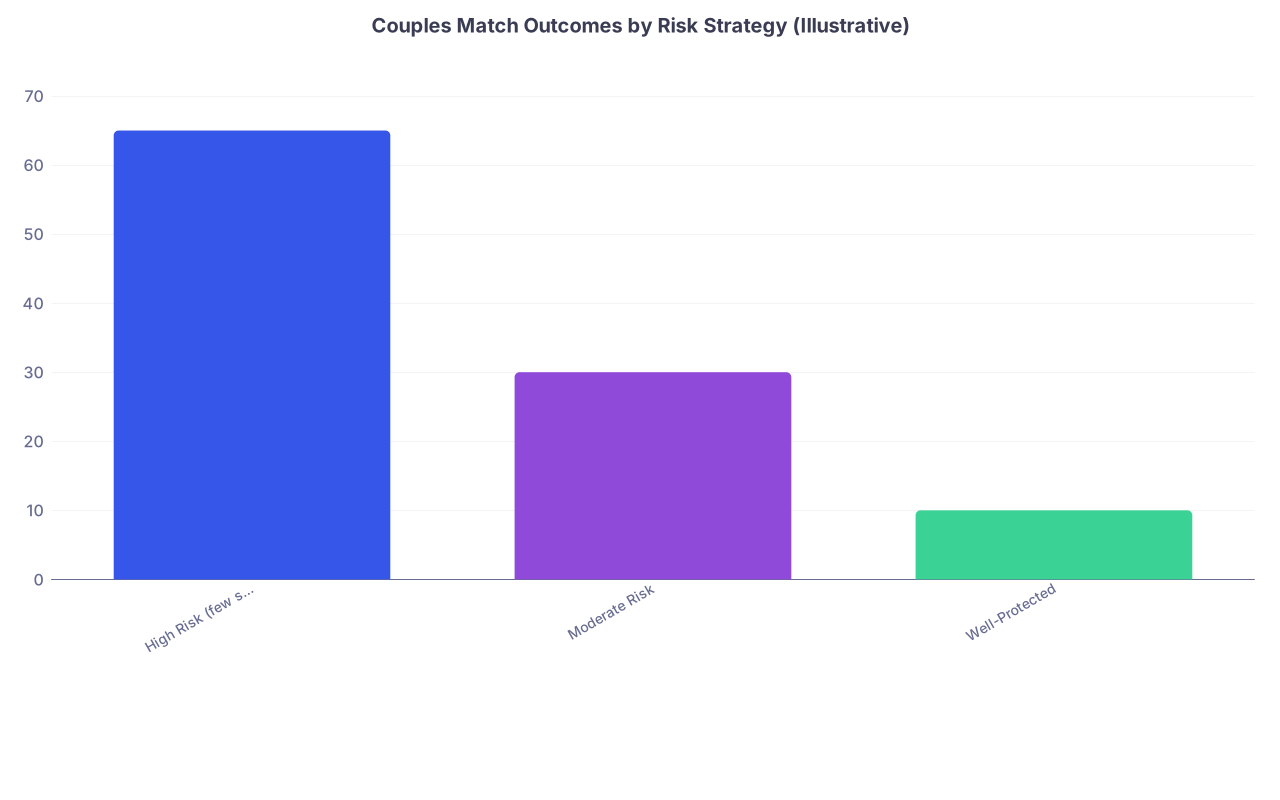
| Category | Value |
|---|---|
| High Risk (few safeties) | 65 |
| Moderate Risk | 30 |
| Well-Protected | 10 |
(Values = approximate % of couples I’ve seen who had at least one partner unmatched or in SOAP in each strategy group. Not official NRMP data—this is what it looks like on the ground.)
FAQ (Exactly 3 Questions)
1. If we rank more pairs, doesn’t that automatically make us safer?
No. A long list of mostly unrealistic or reach pairs just gives the algorithm more ways to not place you. What makes you safer is where your truly realistic linked pairs sit on that list. Ten solid, well‑positioned pairs beat 30 fantasy combos with your safest options buried at the bottom.
2. Should we ever rank a scenario where one of us doesn’t match in order to get the other into a dream program?
Only if you’ve had an honest, sober conversation and both truly agree that’s better than matching together at a less prestigious pair. Most couples, when pushed, admit they’d rather be together at a solid but unsexy program than split between “dream + unmatched.” If your list prioritizes split/dream scenarios above safe-together options, you’re implicitly choosing the dream over the relationship.
3. How do we know if a program pair is “safe enough” to move higher?
Ask yourself:
- Are both of our applications clearly above the typical profile for those programs?
- Did interviews feel neutral‑to‑positive, not awkward or disinterested?
- Is the city somewhere we could tolerate living for several years without resentment?
If the answer is “yes” to those, that pair probably deserves to be in your top 8–12, not rotting at #20+.
Open your joint rank list right now and find the first truly safe, same‑city pair you’d both accept without feeling destroyed. If it’s not in your top 10–12, move it up today—before the algorithm makes a decision you can’t undo.


