

The quiet decision to let one partner handle all the Couples Match planning is one of the most dangerous mistakes you can make.
Not dramatic. Not obvious. But I’ve watched this exact pattern blow up otherwise solid relationships right in the middle of ERAS season. People think they’re being “efficient” or “supportive.” What they’re actually doing is setting up unequal workload, silent resentment, and—very often—worse match outcomes for both of you.
Let me walk you through the landmines so you do not become another “we almost broke up during the Couples Match” story.
The Hidden Problem: Planning ≠ “Just Admin Work”
Here’s the first misconception that hurts couples: they treat planning like clerical work instead of what it really is—high‑stakes strategic decision‑making.
The “planner” partner ends up doing:
- Program list research for two careers
- Geographical strategy (tiers, safety nets, distance)
- Tracking 40–80+ applications each
- Interview date juggling and cancellations
- Communication templates for emails
- Spreadsheet design and maintenance
- Rank list modeling for dozens (sometimes hundreds) of pair combinations
That’s not just “being organized.” That is managing the entire risk profile of both of your futures.
When one person carries that alone:
- They become the default project manager of the relationship.
- They absorb the anxiety for both career outcomes.
- They become the single point of failure when something gets missed.
And then the other partner is surprised when there’s a blowup over a “small thing” like a missed deadline or a program not added. It’s not actually about that one program. It’s about six months of invisible labor and pressure sitting on one person’s shoulders.
You don’t want to be in that fight. Trust me.
How This Actually Plays Out (Real Patterns I Keep Seeing)
Let me make this concrete. Here are the scripts I’ve heard over and over from couples in the match mess:
- “She just cares more about details, so she took over the spreadsheets.”
- “He’s better with numbers, so he did all the rank list scenarios.”
- “I was on a tough ICU rotation, so she said she’d just handle the programs for both of us this month.”
- “He already had a list from his advisor, so we just built off that and I trusted him.”
Looks innocent. Logical, even.
Then later:
- “I had no idea we didn’t apply to more community programs in the Midwest.”
- “Wait, why didn’t we include that program I mentioned back in October?”
- “I thought we were ranking geography higher than prestige—you changed it without really asking me.”
- “I feel like I was just along for the ride in my own match.”
And the big one:
- “I didn’t realize how much work you were doing. I just thought it was… happening.”
Too late.
The pattern is consistent:
- Delegation without clear boundaries
- Planner assumes more and more responsibility
- Non‑planner checks out to avoid anxiety
- Critical decisions happen without real joint discussion
- Resentment and regret show up in January–March when it’s basically locked in
You cannot fix this afterward. Once lists are in, the damage is done.
Why Unequal Planning Wrecks Both the Relationship and the Match
This is not just about feelings. The planning imbalance actually degrades your final match chances and satisfaction.
1. One Brain Can’t Hold All the Variables
Couples Match is combinatorial hell. You’re balancing:
- Two specialties (with very different competitiveness)
- Two sets of advisor opinions
- Visa needs / family needs / geography
- PD emails, away rotations, red flags
- Programs that are secretly malignant (everyone has a list)
- Money, time, and interview fatigue
When one partner is the only one in the weeds, they inevitably simplify decisions:
- “We’ll just drop these X programs; too far.”
- “Let’s not apply there; they don’t usually take IMGs.”
- “This city is probably fine; we can always make it work.”
The non‑planner never really engages with the trade‑offs:
- What if that “too far” program was your only realistic joint safety net?
- What if that IMG‑unfriendly place actually loved your specific profile?
- What if the “make it work” city is actually miserable for one of you?
You get a weaker joint strategy, not a stronger one.
2. Decision Ownership Becomes Lopsided
When things go well, the non‑planner casually says, “We got lucky.”
When things go badly, the planner hears: “You screwed this up.”
I’ve watched planner partners carry intense guilt for years:
- “He could’ve matched better if we hadn’t tied.”
- “I pulled us toward my family and away from his opportunities.”
- “She took those interviews for me, then we didn’t even rank that region high.”
This is what happens when one person “owns” the decisions instead of both of you sharing them. You can’t pretend later that you made decisions together if one of you was checked out for 80% of the process.
3. The “Cognitive Load” Problem
Cognitive load is real. The planner partner doesn’t just track tasks. They mentally juggle:
- Application deadlines
- Letters still missing
- Who replied to which invite
- Travel logistics
- Financial modeling
- All the “what if” simulations at 2 AM
The other partner often sees only:
- “Spreadsheets”
- “Nagging”
- “More questions”
Resentment brews on both sides:
- Planner: “I’m doing everything and you’re just living your life.”
- Non‑planner: “You’re stressed all the time and I can’t do anything right.”
The emotional climate of your relationship during match season matters. Unequal planning poisons it fast.
Common Rationalizations That Are Flat‑Out Dangerous
Let me be very clear about a few lines I hear constantly—and why they’re traps.
“I’m just not a spreadsheet person.”
That’s fine. You don’t have to become Excel‑obsessed. But if you’re using this sentence as an excuse to disengage from:
- Program list decisions
- Ranking strategy
- Geographic compromises
…then you’re outsourcing your future to your partner. That’s not “I’m not a spreadsheet person.” That’s “I’m avoiding adult participation in a life‑defining decision.”
“She cares more about planning, so it makes sense she does it.”
Caring more doesn’t mean they should carry more. It means they’re more likely to burn out when left alone with the entire mental load.
If one person cares more about it, that person actually needs more partnership, not less, or their anxiety will drive the whole process.
“We’ll talk it through once she has a draft.”
Too late. By the time the planner has a “draft,” they’ve already:
- Filtered out programs based on their preferences
- Built geography tiers that feel normal to them
- Internalized a mental map of “good vs bad” options
You’re not really co‑creating then. You’re editing someone else’s world view. That’s not collaboration.
“We trust each other completely.”
Good. You should.
But trust is not a substitute for participation. “I trust you” should never mean “I’m going to be functionally absent from our joint future planning.”
Trust is useful when unpredictable things happen. It’s not an excuse to opt out of foreseeable work.
A Better Model: Shared Planning Without Driving Each Other Nuts
You do not need perfectly equal hours. You do need balanced responsibility and real joint ownership.
Here’s how couples avoid the classic trap.

| Step | Description |
|---|---|
| Step 1 | Agree on Roles |
| Step 2 | Set Shared Priorities |
| Step 3 | Divide Concrete Tasks |
| Step 4 | Weekly Check-in |
| Step 5 | Adjust Strategy Together |
| Step 6 | Build Rank List Jointly |
Step 1: Start With Values, Not Spreadsheets
Before anyone opens Excel:
Sit down and write (separately, then compare):
- Top 3 career priorities (prestige, fellowship chances, lifestyle, location)
- Top 3 personal priorities (family, cost of living, climate, call schedule)
- Absolute deal‑breakers (no rural, no > X hours flight from parents, etc.)
If you skip this and one person builds the program universe based only on their mental map, you’re already in unequal territory.
Step 2: Explicitly Divide Roles
Instead of “You’re just better at this, so you do it,” try:
- One person: builds master program list (from FREIDA, advisors, word of mouth)
- Other person: does first‑pass filtering (commute, geography bands, in‑house fellowships)
- Both: vote/comment on each region/program tier
Concrete example:
- Partner A (planner‑leaning) owns: spreadsheet structure, tracking invites, deadline reminders
- Partner B (non‑planner) owns: outreach emails, PD/PC communications, researching resident culture via alumni/social media
Now the planning isn’t “yours vs mine.” It’s different pieces of a shared project.
Step 3: Non‑Planner Still Has Non‑Negotiable Responsibilities
Even if one partner has more planning talent or tolerance, the other must still:
- Attend scheduled planning talks (no “I’m too tired, can we skip?” 10 times in a row)
- Review program lists and rank list drafts before they’re “final”
- Bring at least some programs to the table (from mentors, residents, online forums)
- Stay engaged with big trade‑offs (prestige vs location, distance vs safety)
If you check out from those, you’re back to unequal ownership.
Step 4: Regular, Short Check‑ins (Not Marathon Fights)
The couples that do this well don’t wait for months then have a 4‑hour meltdown.
They do:
- 30–45 minutes once a week during application season
- Dedicated agenda:
- What’s changed?
- Which new programs?
- Any red/green flags from interviews?
- Are we drifting from our agreed priorities?
The planner doesn’t get stuck holding all the updates. The non‑planner doesn’t feel ambushed.
The Planning Work Itself: Do NOT Let One Person Own All This
Here’s where planning workload silently explodes. If you see one partner doing all of these, stop. You’re in the danger zone.
| Task Area | If One Partner Does 100%… |
|---|---|
| Program List | Their biases define your entire universe |
| Interview Tracking | One point of failure, huge stress load |
| Geography Strategy | Silent assumptions about distance/family |
| Rank List Modeling | One person owns all risk calculations |
| Communication | Other partner loses relationships with PDs |
Let’s break a few of these down.
Program List Construction
Red flag pattern:
- One partner builds a list of 60 internal medicine programs for themselves and “drops in” 40–60 for the other specialty based on quick filters.
What happens?
- They overweight regions they like.
- They under‑include true backup options for the other partner.
- They may unintentionally bias the list toward their academic vs community preference.
This list should never be built solo. At minimum:
- Each of you creates your own “solo” list first.
- Then you merge them, compare, and discuss.
- Then you jointly adjust based on geography and competitiveness.
Interview Management
Another common failure: the planner partner becomes the “interview coordinator” and:
- Accepts/declines for both
- Decides which conflicts to resolve
- Picks which lower‑tier interviews to drop
Non‑planner wakes up in January and realizes:
- “We dropped X? That was my safety in that region.”
- “Why did we keep Y if we hated the vibe there?”
Even if one person does the actual clicking and calendar work, both of you must:
- See the same shared calendar
- Approve major changes
- Talk through which interviews are non‑negotiable keepers
Rank List Modeling
This one is huge and underappreciated.
The planner often ends up building the rank pairs because:
- “It’s so many combinations; it’s too confusing.”
- “I already understand the system—just trust me.”
Then they’re the only one who really understands:
- How often you’re separated
- How often you land in low‑tier programs for one partner to keep the couple together
- How far you actually are from family/friends given common outcomes
You don’t each need to run probability trees. But you both need to sit with:
- Examples of plausible match scenarios
- What those scenarios look like for each person, not just as a pair
If only one partner has seen the downside scenarios in detail, they’re carrying emotional weight you’re not sharing.
Emotional Fallout: What You Don’t See Until It’s Too Late
Even if you “match well on paper,” unequal planning leaves marks.
Here’s what I see in the first residency year from couples who made this mistake:
- Planner partner:
- Burnout from having basically done a second job for 6–9 months
- Lingering resentment: “He still doesn’t realize what I did for us”
- Hyper‑vigilance about all future planning (housing, finances, kids)
- Non‑planner partner:
- Subtle disenfranchisement: “I just landed where the spreadsheet put me”
- Defensive guilt: “I know I should have helped more, but it’s over now”
- Avoids talking about match season because it feels like an accusation
You do not want this dynamic as your starting point for residency, when you’re both sleep‑deprived and maxed out already.
Practical Guardrails: How to Protect Yourselves Right Now
Let’s get to some concrete, actionable protections.
1. Make a “Planning Agreement” Early
Literally write down:
- Who owns what tasks (with both names on the high‑risk ones)
- How often you’ll meet about it
- What decisions must be made jointly
Is it formal? Sure. That’s the point. It stops the slow drift into “one of us is doing everything because it just sort of happened.”
2. Use Tools That Force Shared Visibility
Your tools should make it impossible for one person to hoard information.
Examples:
- Shared Google Sheet with:
- Columns for each partner’s notes on each program
- Color codes for each person’s priority level
- Shared calendar with all interview dates, travel, and deadlines
- Shared document listing:
- Final chosen programs
- Why each region/program stays or goes
If all of this lives in one person’s laptop and head, that’s not a “system.” That’s a liability.
3. Decide in Advance How You’ll Handle Disagreements
You will not agree on everything. Pretending you will is naïve.
Before you’re exhausted and irritated, decide:
- For geography disputes:
- “We’ll strongly prioritize X region, but each of us gets Y number of ‘must‑apply’ cities.”
- For prestige vs location:
- “Top 10% of our joint list can be higher‑prestige stretch as long as the middle 60% is balanced for both.”
- For worst‑case:
- “If couples match makes both outcomes significantly worse, are we willing to decouple? Under what exact conditions?”
If you don’t talk about decoupling early, it becomes a nuclear option rather than a strategic one.
4. Keep Advisors From Talking Only to One Partner
Another subtle problem: mentors, PDs, and advisors often talk mainly to the more engaged/planner partner.
Result:
- Strategy gets skewed toward that person’s interests.
- The other partner never really hears the nuance behind the recommendations.
Fix this:
- Whenever possible, attend advisor meetings together.
- Or at minimum, the person who met with the advisor has to debrief the other in detail (and the other actually has to listen, not just nod through it).
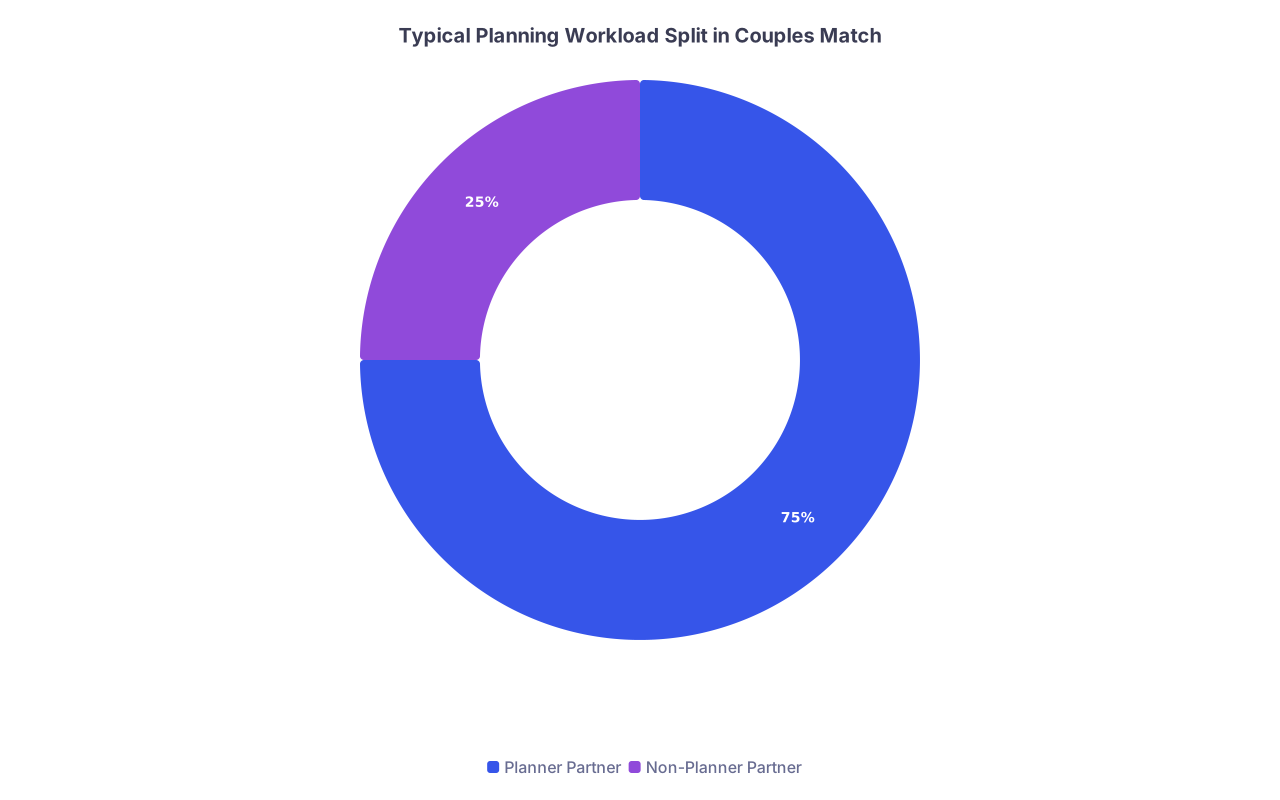
Visual Reality Check: Planning Load Distribution
Take a hard look at how the work is really split. Be honest:
| Category | Value |
|---|---|
| Planner Partner | 75 |
| Non-Planner Partner | 25 |
If that’s even remotely close to your situation, you’re in the danger zone.
Red Flags You’re Repeating This Exact Mistake
If any of this describes you, stop and recalibrate:
- You can’t clearly explain your joint geography strategy without asking your partner.
- You’ve never opened the main spreadsheet yourself.
- One of you says “we” about match planning, the other says “she/he.”
- You’re afraid to ask detailed questions because you “don’t want to make it worse.”
- One partner jokes, “I just do what she tells me; she’s the boss of this stuff.”
That last one? Not cute. Not harmless. That’s how people talk right before they realize they gave away their say in their own future.
FAQs
1. What if one of us is on a brutal rotation and genuinely has no time?
Then you treat it like a temporary and explicitly limited imbalance, not the default.
- Set an end date: “For these 4 weeks on night float, you do more, then we rebalance.”
- The busy partner still:
- Reviews key decisions on a weekly call
- Gets a summarized “short list” to react to
- Has veto power over big moves
It’s fine for the workload to flex short‑term. It’s not fine to let that turn into “you handled everything, I was too busy existing.”
2. Is it ever okay for one partner to fully lead because they’re better at it?
Lead, yes. Own everything, no.
The planner‑strong partner can:
- Design the system
- Drive the timelines
- Propose options
But they should not:
- Decide alone which programs stay or go
- Set geography tiers unilaterally
- Build and finalize the rank list without deep joint review
“Leadership” is not a free pass for unilateral control when both lives are on the line.
3. How do we fix this if we’re already midway through applications and one person has done most of it?
You don’t fix it philosophically. You fix it concretely and right now.
- Schedule a long, intentional session to:
- Review the full program list together
- Recheck against both of your priorities
- Identify missing safety and middle‑tier options
- Shift some ownership today:
- Non‑planner takes over outreach emails or interview tracking
- Both commit to co‑building the rank list from scratch, even if one does the initial draft
You can’t undo past imbalance, but you can stop compounding it.
4. What if we fundamentally disagree on whether to prioritize being together vs best individual program?
Then you have a real decision to make, and planning structure won’t save you from it.
You need to answer, honestly:
- Are we willing to accept worse individual outcomes to stay together?
- If so, how much worse? Slightly lower tier? Different city tier? Different type of program?
- If not, are we willing to consider not couples matching at all?
The worst mistake is trying to dodge the question and letting one partner quietly tilt everything toward their answer while the other “just trusts” them.
Keep this simple:
- Letting one partner carry all the Couples Match planning is not “helpful,” it is hazardous—to your relationship and your match.
- You don’t need equal hours, but you do need equal ownership of the big decisions and transparent, shared systems.
- If you see the imbalance already, stop telling yourselves “it’s fine” and rebalance now—before your future gets locked into a rank list one of you barely helped create.


