
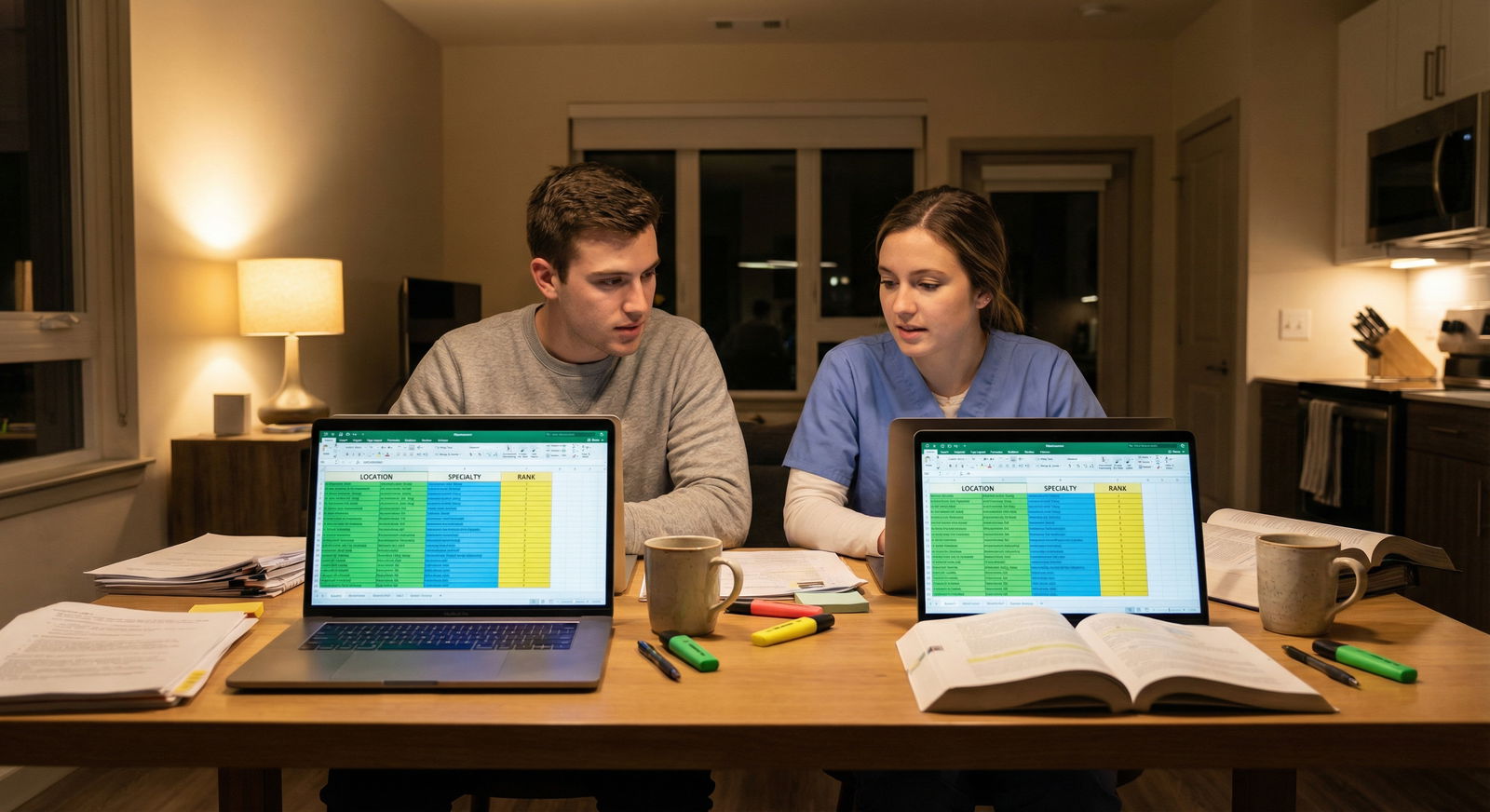
It is early January. You and your partner are sitting on the couch, scrolling through Instagram between virtual interviews. You are technically “off” for the day, but your brain is not. You are checking program hashtags, stalking current residents, and doomscrolling Reddit threads about “which programs hate the couples match.”
Then you notice something awful.
Your partner’s Instagram story from last week: a screenshot of your rank list spreadsheet, blurred poorly. You can still see program initials. A caption: “Trying to make #CouplesMatch work somehow.” And the story mentions a co‑resident who follows an attending at a program you just interviewed with.
This is how people get burned.
Programs are not clueless, and residents talk. Faculty have kids, and those kids are on TikTok. PDs see Reddit. Screenshots travel. You assume no one is looking. That assumption is wrong.
Let me walk you through the specific social media mistakes that quietly expose your couples match strategy to programs—and how to stop handing them ammunition.
Mistake #1: Publicly Announcing You Are Couples Matching (Before You Understand Who Is Watching)
You think: “Everyone already knows we are together. It is not a secret. Who cares if I post that we are couples matching?”
Here is the problem: there is a difference between people knowing you are a couple and people seeing your entire couples match situation as a live unfolding drama.
I have seen this one over and over:
- Instagram posts with “We are couples matching—wish us luck!” tagged with #ERAS, #Match2025, and specific program hashtags.
- TikTok videos about “POV: You are couples matching and your partner only ranked big-name places” with identifiable context.
- LinkedIn posts bragging about “navigating the couples match as a dual-IM couple targeting the Northeast.”
You think you are just sharing your life. What you are actually doing is handing programs context they do not need and did not ask for.
Here is why that matters:
- Some programs become risk‑averse when they realize you are constrained geographically.
- Your stated “target region” online may not match their location.
- Programs may infer where else you are applying and how likely you are to rank them highly—or not at all.
Does every program stalk you? No. Do enough residents and coordinators live online enough that things leak upward? Yes.
How to avoid it:
- Do not publicly post that you are couples matching until after Match Day. Full stop.
- If you must share, do it privately: small group chats, closed friends lists with people you actually trust, not “close friends” that includes 250 acquaintances from undergrad.
- Keep your LinkedIn and other semi‑professional profiles neutral. No “couples match strategy” content. No vague bragging about “coordinated ranking.”
Mistake #2: Dropping Location and Region Clues That Narrow Your Strategy
You might not say, “We will only match in Boston or we will be long-distance,” but you hint at it constantly. Programs are good at reading between the lines.
Classic examples:
- Twitter (X) posts: “No way I survive winter anywhere colder than Texas again” during interview season.
- Instagram captions: “If we do not end up together on the East Coast, I am rioting.”
- TikTok about “choosing love over prestige” accompanied by only West Coast city clips.
- Reddit posts: “Dual couples match, both competitive specialties, trying to stay in the Midwest near family—what are our chances at [city]?”
Now connect the dots. If you are interviewing at a strong program in Minnesota and your public online footprint screams “absolutely not moving north,” do you think that helps? Programs want residents who might actually stay.
Worse, your partner is posting different signals. Maybe they complain publicly about “not wanting to live in the South at all,” while you are clearly targeting Texas and Georgia. You have now telegraphed that your couple is misaligned—and that chaos is coming.
How to avoid it:
- During application and interview season, stop making dramatic geography posts. You can hate winter silently.
- Remove past posts that are too specific about where you “would never live” if they are recent and public.
- Tell your partner, explicitly: “No location jokes online until after Match. We keep our preferences off the internet.”
This is not about being fake. It is about not volunteering unnecessary data that can only hurt you.
Mistake #3: Posting Screenshots of Rank Lists, Spreadsheets, or Interview Calendars (Even “Blurred”)
This one is surprisingly common and surprisingly reckless.
I have seen:
- Blurred Excel rank lists with visible column headers: “Program,” “City,” “Partner rank,” “Combined outcome.”
- Google Calendar screenshots with interview dates, program names, and color‑coding (“green = my favorite, red = backup”).
- Whiteboard photos with initials that any insider could decode: “MGH, BI, BWH, NYP, Penn” or worse, niche community programs that are easily identifiable.
People underestimate how good humans are at reconstructing minimal data from context. A few letters, a logo glimpse, city skylines in the background of a “study” shot—enough.
And no, adding a half‑assed blur or emoji over half the content does not solve it. Residents and med students love puzzles. Someone will figure it out, and someone will send it to the wrong person one day.

How to avoid it:
- Do not post your rank list. At all. Not zoomed. Not blurred. Not as a “funny” meme background.
- Do not post calendars with interview program names showing.
- If you want to vent, crop aggressively or recreate a fake spreadsheet that does not resemble your real one in any meaningful way.
Your rank list is the most sensitive document in this process. Treat it like a password, not like aesthetic content.
Mistake #4: Over‑Sharing Program Impressions Publicly (Especially Negatively)
You vent after a bad interview. Someone annoyed you. They were late. You and your partner are stressed; the stakes feel unfairly high. So you go online.
Classic forms:
- “Just had the most disorganized interview day at a ‘top’ program in [region]. Red flag after red flag.”
- “If this is what [big brand program] is like, hard pass. They totally ignored that we are couples matching.”
- “Programs that say they are ‘couple‑friendly’ then offer like 2 joint interviews… make it make sense.”
You do not tag the program, so you think you are safe.
You are not.
Residents search themselves and their programs. People have alert bots on their hospital names. A single vague tweet can be screenshotted, relocated to a group chat, and within 24 hours it is in front of a chief resident who helps with the rank list.
And here is the part no one tells you: even neutral or mildly negative comments can expose:
- That you ranked them low or dropped them.
- That you have many “better options.”
- That your couple is divided in your enthusiasm.
Programs are already anxious about the couples match because it complicates their rank list. Do not hand them more reasons to see you as unstable or likely to rank them low.
How to avoid it:
- No real‑time program impressions in public spaces. Not Twitter, not TikTok, not Instagram, not public Reddit.
- Keep commentary in small, trusted private chats—ideally encrypted ones where no one is taking screenshots for sport.
- If you feel compelled to contribute to online discourse, anonymize heavily and talk in general principles, not “this city,” “this exact specialty mix,” “this exact scenario we had yesterday.”
Mistake #5: Letting Your Partner’s Account Undermine Your Professionalism
You might be careful. Your partner is not. And programs do not care whose account the red flag lives on; what they see is a package.
I have watched this dynamic blow up:
- Applicant A has a clean, boring online presence.
- Applicant B (their partner) makes “edgy” TikToks about “gaslighting ERAS,” “ranking programs by how hot the residents are,” or mocking patients.
- Residents recognize B’s face from the interview, send videos around. Program now associates both of you with bad judgment.
When you couples match, you are tied together. Programs know they cannot rank you independently in a simple way. If one of you looks like a problem, both of you become high‑risk.
This is especially bad when:
- One partner is more competitive on paper and “carries” the other specialty.
- One of you is going for a small or saturated specialty (Derm, Ortho, ENT), where PDs scrutinize every signal.
| Behavior Type | Risk Level | Impact Scope |
|---|---|---|
| Negative program posts | High | Both partners |
| Rank list screenshots | High | Both + other apps |
| Location rants | Medium | Regional programs |
| Mild venting memes | Low–Medium | Context dependent |
| Private close-friends | Variable | Depends on audience |
How to avoid it (as a couple):
- Have an explicit, honest talk: “What are we each going to stop posting until after Match?”
- Agree on a “no interviews / no programs / no rank strategy” rule across both accounts.
- If one of you has a big online presence, consider a temporary quiet period or content pivot during peak season.
You are not just protecting yourself. You are protecting the person you allegedly care about enough to couples match with.
Mistake #6: Letting Reddit and Anonymous Forums Tie Your Story to Your Real Identity
You think Reddit is anonymous. It often is not.
Here is how people accidentally dox their own couples match situation:
- Posting in r/medicalschool or r/ResidencyMatch with:
- Both of your exact specialties.
- Your Step scores or shelf percentiles.
- Your school type and region.
- Specific research areas or visa status.
- A very unique geographic constraint (“We must be within 1 hour of [mid‑size city] because of kid custody arrangements”).
Individually, none of these are a problem. Combined, they can pinpoint you. Now imagine a resident on a selection committee who spends time on Reddit. They see a post that clearly matches an applicant they interviewed last week. It mentions their “backup” view of that program or that they mainly care about their partner’s dream city.
Once someone makes that mental link, your supposedly “private” opinion is already in an unofficial file labeled “not that interested” or “will rank us low.”
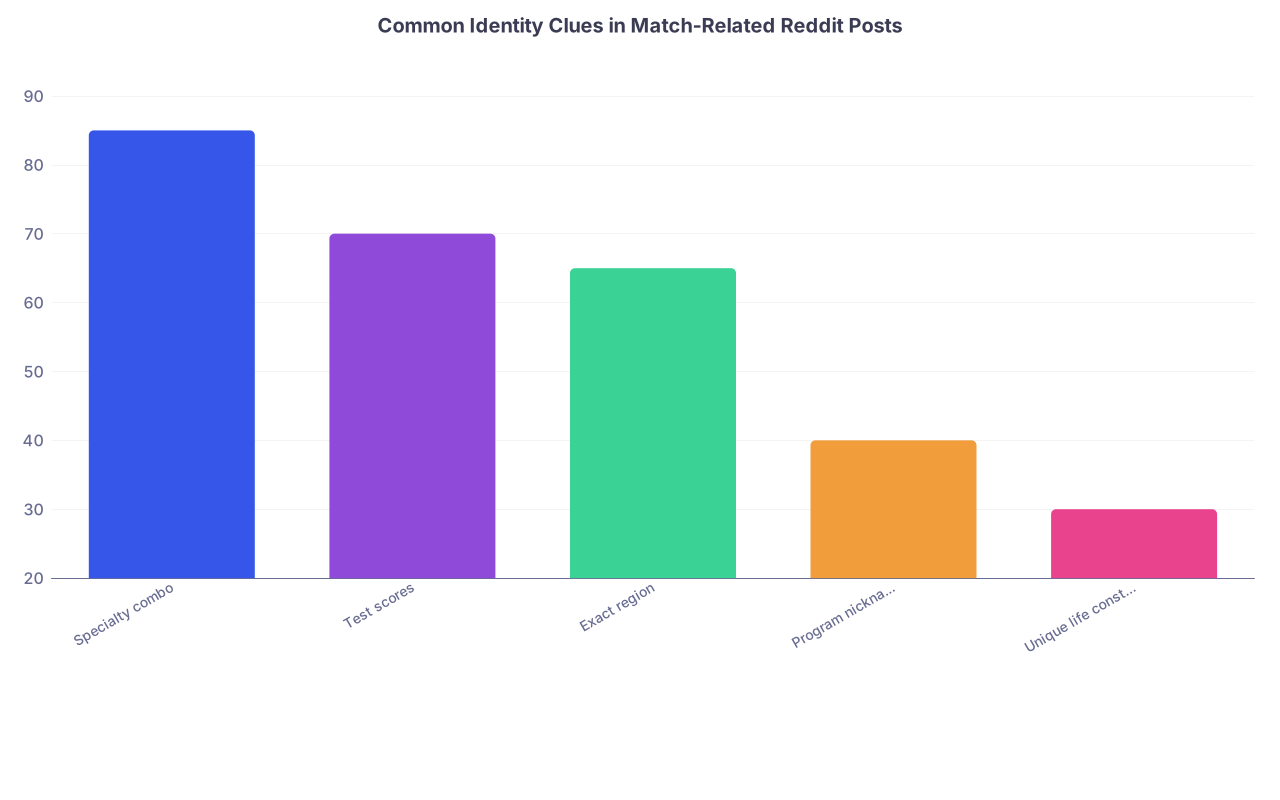
| Category | Value |
|---|---|
| Specialty combo | 85 |
| Test scores | 70 |
| Exact region | 65 |
| Program nicknames | 40 |
| Unique life constraints | 30 |
I have seen residents say things like, “I am 95% sure this is that EM/FM couple from [school] who interviewed last week.” You do not want to be that topic in their group chat.
How to avoid it:
- When posting online for advice, deliberately blur your specifics:
- Use ranges (“mid‑230s” not “236”).
- General regions (“Midwest”) instead of “Chicago area.”
- Omit school type if it is identifiable (“large northeastern MD‑granting school” is already narrow).
- Never mention both of your specialties and your couples match status and your geographic limit in the same post. Choose one, maybe two, but not the full set.
- If you already overshared, do not panic. You can still delete or heavily edit old posts, especially if they were emotionally charged or negative about programs.
Mistake #7: Making “Thirsty” Content That Signals Desperation or Disloyalty
Programs are not just reading what you hate. They watch for what you chase.
Examples:
- Liking or commenting on every single post from one “dream program” account for months, while ignoring others.
- Publicly joking, “If I do not get into [X prestigious program], I will just reapply next year” while you also interviewed at several very solid but less famous programs.
- Posting TikToks ranking regions: “Tier list of East Coast cities we would accept matching in.”
You might think this is harmless. Human. Relatable. But to a program on your list that is not in your A‑tier city or prestige tier, it reads like: “They will never rank us high. Why should we take a risk on this couple, then?”
And for couples specifically, another layer: if one of you posts constant adoration for a “dream” place that did not even interview your partner, programs may worry that your rank list will be chaotic and self‑sabotaging. They do not want to gamble on a couple whose priorities look misaligned even in jokes.
How to avoid it:
- Stop interacting with program social media in an obsessive, lopsided way. A few normal likes are fine. Being their top commenter is not.
- Do not publicly declare any program or city as the only acceptable outcome.
- Save your emotional highs and lows for offline conversations. The more dramatic the feeling, the worse it ages in screenshots.
Mistake #8: Forgetting That “Private” Is Not Really Private
Close Friends. Private story. Locked Twitter. Finsta. You tell yourself: “This is safe. Only my people see this.”
No. This is where people make the worst mistakes.
What actually happens:
- You add classmates, co‑residents, and “internet friends” you have never really tested.
- You post:
- Screenshots of PD emails.
- Rants about specific programs or faculty.
- Complaints that “Program X totally ignored our couples status even though my partner is a much stronger applicant than their residents.”
- One person screenshots.
- One person is dating or friends with someone at that program.
- The image walks right into a resident Slack or GroupMe.

| Step | Description |
|---|---|
| Step 1 | You post to Close Friends |
| Step 2 | Friend takes screenshot |
| Step 3 | Shared in group chat |
| Step 4 | Forwarded to resident at Program |
| Step 5 | Shown to Chief/PD |
You thought you were venting in a safe container. You were basically submitting an unsolicited PS statement to the program’s inner circle—except this one made you look impulsive and unprofessional.
How to avoid it:
- During match season, assume anything you post—even to private or close friends—can be screenshotted and travel.
- Keep your tightest vents off platforms entirely. Use Signal, WhatsApp, or actual phone calls / in‑person.
- If you have a chaotic finsta, either lock it to under 10 people you absolutely trust or go dormant until after Match.
The couples match gives you enough variables and hazards. Do not add “leaked private story” to the list.
Mistake #9: Using Social Media DMs for Negotiation or Hints to Programs
Some of you slide into DMs. I have seen it:
- “Hi Dr. X, loved my interview at your program. My partner and I are couples matching and [insert awkward explanation of why they should rank you together].”
- “Hey [current resident], off the record—do you think your PD would be open to helping couples match applicants a bit more?”
- Or, worse, “We will rank you highly if you can help us match together.”
Programs do not want ranking deals in writing. Residents especially do not want them, in Instagram DMs, of all places.
This is not just tacky. It exposes how you are thinking about strategy. You are telling them: “We are worried we will not match here, but we will try to pressure you anyway.” That is not leverage. That is a red flag.
If you need to communicate couples priorities, that happens:
- In your ERAS application (checkbox + couple ID).
- If appropriate, via very brief, professional emails to coordinators/PDs.
- Potentially during the interview, when asked about your situation.
Not in DMs. Not in a way that will be screenshot, misunderstood, and shared.
How to avoid it:
- Never negotiate rank positions or couples favors through social media DMs.
- If you message residents, keep it to clarifying neutral questions about culture, call, or housing. Not ranking. Not “how can I get you to rank us higher.”
- If a resident opens the door to talking about the couples match, keep it light and non‑committal: “Yes, we are couples matching; we are trying to keep an open mind and build a flexible list.”
Mistake #10: Failing to Audit Your Entire Online Footprint Before Interview Season
You worry about your CV. You obsess over your personal statement. Then you leave 8 years of unfiltered, searchable content hanging out on the internet with your name attached.
When you couples match, the stakes of that laziness double. Because now two footprints get judged together.
Here is what I have seen derail people:
- Old tweets mocking certain patient populations or specialties that your partner is applying to.
- Political or controversial posts that a program finds alienating in their local context.
- Off‑color jokes that make you look like liability material in a lawsuit.
Couples matching amplifies risk:
- If they were on the fence about taking you because of an old post, seeing your partner’s profile also look questionable pushes them to “No.”
- If one of you has a squeaky clean footprint and the other does not, programs might assume misaligned maturity.
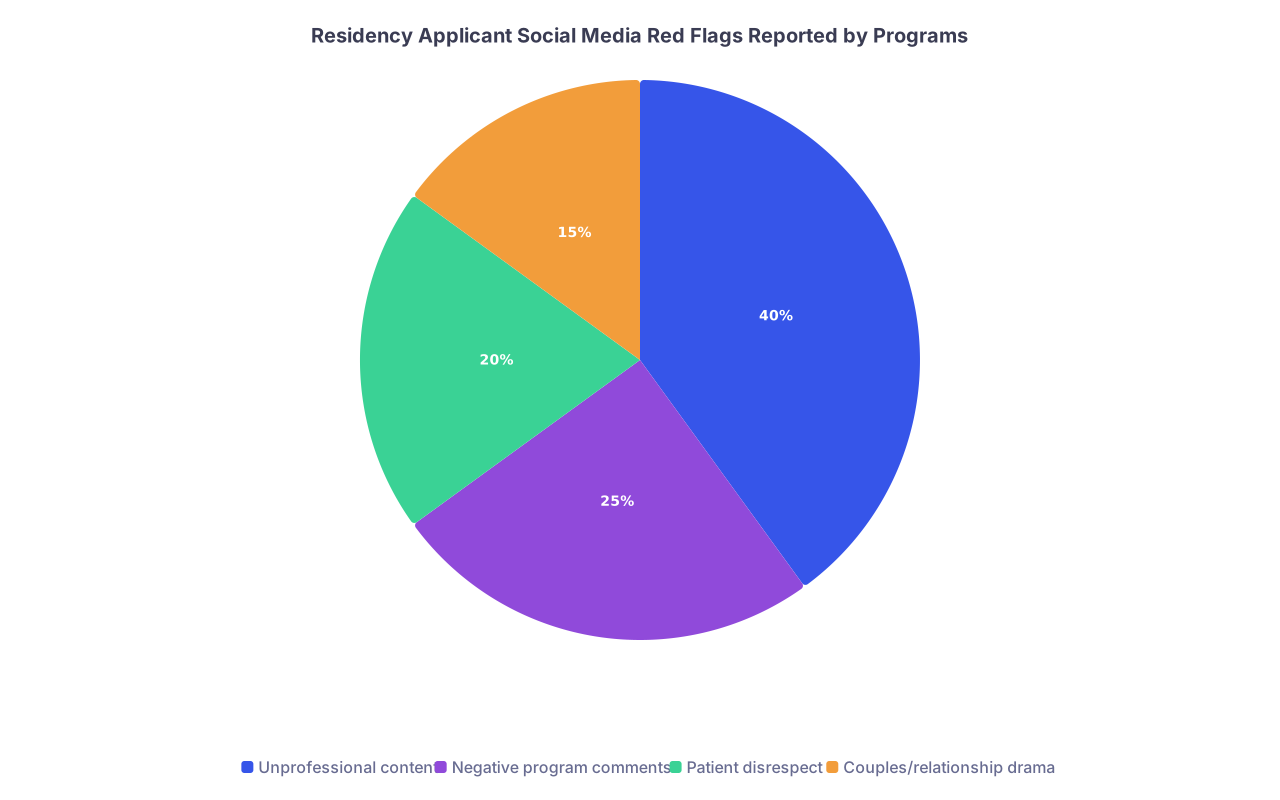
| Category | Value |
|---|---|
| Unprofessional content | 40 |
| Negative program comments | 25 |
| Patient disrespect | 20 |
| Couples/relationship drama | 15 |
How to avoid it:
- Sit down together and do a full audit:
- Google your names and common nicknames.
- Check old Twitter, Facebook, Tumblr, blogs, etc.
- Look at tagged photos from others.
- Delete or hide anything that:
- Bashes specific groups.
- Shows clear impairment in clinical settings.
- Is sexually explicit in a way that clashes with your professional persona.
- Exposes details of your rank strategy or program impressions.
Do this before applications go out, not in February when someone in your class whispers that a PD “follows them on Instagram.”
How to Handle Social Media Well During the Couples Match
To be clear, you do not need to vanish from the internet. You just need to stop broadcasting your strategy like a live sports commentary.
Baseline rules that keep you safe:
No discussion of:
- Where you interviewed.
- How you ranked.
- Which programs your partner got / did not get.
- How “annoying” or “amazing” specific places were.
Keep posts generic and time‑shifted:
- Talk about being grateful for interviews in general, not “this awesome interview at a West Coast academic center today.”
- Share match‑related content after the fact. “Last year this time…” is much safer than “Today…”
Use a “would I be fine if a PD read this out loud in front of me?” test.
And do this as a couple, not as two separate random applicants. You are attached in the algorithm of the match. Start acting like your online decisions affect both of you—because they do.
Final Takeaways
- Your couples match strategy should live in your heads, your spreadsheets, and maybe with one trusted advisor—not on Instagram, TikTok, Reddit, or DMs.
- Anything that reveals your locations, rank list, program impressions, or desperation can only hurt you; it almost never helps.
- You and your partner need a shared, explicit social media plan for match season, because one person’s “harmless” post can become both of your problem.
Protect your privacy. Protect each other. Programs already have enough real data to judge you—do not donate extra.


