

What happens when you open your Match email and realize you and your partner are in different cities… with a 4‑hour drive between you… for three years… after telling yourselves, “We’ll figure it out later”?
You would be shocked how often I see that exact story play out. Smart, hard‑working couples. Terrible planning. Avoidable misery.
If you are couples matching, “we’ll figure it out later” is not a plan. It is a trap.
Let’s walk through the most common planning mistakes couples make in the residency Match and how to avoid ending up in a long‑distance, career‑compromised mess you never actually chose.
Mistake #1: Treating the Couples Match Like Two Individual Matches
The worst assumption I hear:
“We’ll each just apply where we want, then link our lists. It will work out.”
No. It probably will not.
When you couples match, you are not running two parallel individual Matches. You are running one combined, more fragile Match with:
- Fewer realistic geographic options
- Fewer realistic specialty combinations
- A much higher penalty for poor coordination
If you plan like two individuals, you miss how unforgiving the math becomes.
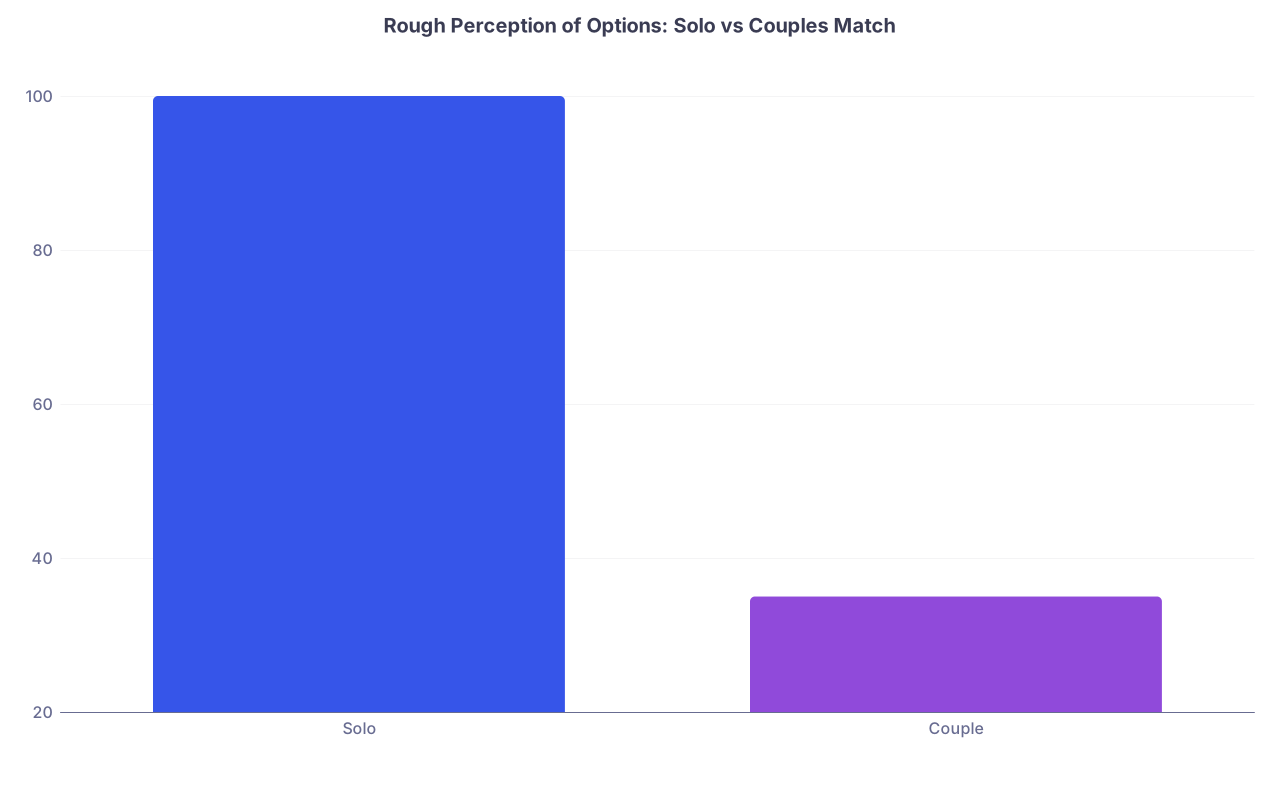
| Category | Value |
|---|---|
| Solo | 100 |
| Couple | 35 |
That “100 vs 35” is not exact math. It is what it feels like. The choice space shrinks fast when you must land together.
Red flags you are making this mistake:
- You each have your own program list spreadsheet, and there is no combined sheet.
- You are still using phrases like “my reach programs” instead of “our reach programs.”
- You have not explicitly mapped which programs are in the same city or commutable region.
How to avoid it:
Create one joint document
One shared spreadsheet. Tabs for:- City/region
- Programs for Partner A
- Programs for Partner B
- Overlap / proximity combinations
Start from geography, not prestige
Wrong approach:- “Where would I go if I was single?”
Correct approach:
- “Which cities/regions can realistically support both of us in our specialties?”
Define “deal‑breaker distance” early
Is 45 minutes acceptable? 90 minutes? Different cities but 60‑minute train?
If you do not define this by October, you will fudge it in February out of panic.
Mistake #2: Being Vague About Priorities Until It Is Too Late
“I mean… obviously we want to be together. But we also want strong training. We’ll see how it shakes out.”
That line has ruined more relationships than you think.
When you wait to clarify what really matters until after interview season, you end up ranking emotionally, not rationally. By then:
- You are flattered by certain programs
- You are biased by interview day hospitality
- You are scared of under‑ranking “name brands”
So you both build rank lists that secretly prioritize ego and fear over the actual goal: staying together with training you can live with.
You need explicit, written priorities. Not vibes.
For example:
- Priority 1: Same city
- Priority 2: Both at programs where we can realistically pass boards and not burn out
- Priority 3: At least one of us in a strong academic center
- Priority 4: Prestige / reputation
And you must decide:
Is it better to be in the same city with one partner at a clearly less competitive program… or to be apart with both at “better” programs?
If you refuse to answer that question now, the Match will answer it for you. You may not like that answer.
Concrete exercise (do this together):
Each of you write down answers separately, then compare:
I would rather:
- A) Be in the same city at a mid‑tier program
- B) Be 3+ hours apart but at top‑tier programs
My worst acceptable outcome is:
- A) Long distance, but both in our preferred specialties
- B) Same city, but one of us in a backup specialty or prelim year
If we do not match together, I would:
- A) Strongly consider SOAP/withdrawing/deferring
- B) Complete my training wherever I match, even if apart
If your answers are not aligned, you do not have a plan. You have a silent conflict waiting to explode.
Mistake #3: Underestimating How Brutal Some Specialty Combinations Are
Some couples match combinations are simply more dangerous than others.
I have seen this go badly with pairs like:
- Dermatology + Orthopedics
- ENT + Ophthalmology
- Neurosurgery + Anything
- IR + Any other very competitive specialty
- Two people both going for the same hyper‑competitive field in the same city
If one of you is going into a competitive specialty and the other is in something more flexible (FM, IM, Peds, Psych), you need to treat that as an asymmetric problem. It is not “we are equal” on the Match math level, even if you are equal in your partnership.
Classic mistake:
The competitive‑specialty partner applies as if they are single: narrow geographic spread, only top‑tier programs, minimal safety net. The more flexible partner says, “I will follow you.” That is not following. That is gambling.
You know you are underestimating the risk if:
- The competitive partner has < 30 programs total
- More than 50% of their list are “dream” or “reach” institutions
- The less competitive partner is willing to “just SOAP if it goes badly”
That last one is especially dangerous. SOAP is not a relationship plan. SOAP is a controlled fire.
What to do instead:
Competitive partner:
- Apply broadly. Obscenely broadly.
- Include mid‑tier and lower‑tier programs in cities that have options for your partner.
- Talk honestly with mentors about realistic ranges for your application strength. Not wishful thinking.
Less competitive partner:
- Be ruthless about flexibility.
- Consider community vs academic, different regions, and backup specialties before ERAS submission.
- Do not agree to “I’ll just scramble if needed.” That is chaos, not strategy.
| Combination Type | Relative Risk |
|---|---|
| Primary care + Primary care | Lower |
| Primary care + Mid-competitive | Moderate |
| Mid-compet + Mid-compet | High |
| Competitive + Primary care | High |
| Competitive + Competitive | Very High |
If you two are in the “High” or “Very High” rows, you do not get to do casual planning. You need redundancy built into your application lists.
Mistake #4: Ignoring Program Culture Around Couples
Not every program actually likes the couples match. Some quietly resent it. Some love it and will openly say so.
It is a planning mistake to treat all programs as neutral. They are not.
Signals a program is couples‑friendly:
- Mentions couples match on their website or at the interview day
- Current residents who couples matched there and are still together (ask directly)
- PDs or chiefs saying things like, “We try to help couples land in the same city”
Signals a program treats couples… poorly:
- “We rank individuals, not couples” spoken with a dismissive tone
- No stories of successful couples in recent memory
- Vague HR answers when you ask about co‑hire or cross‑department coordination
You do not want to discover in February that your top ranked program “does not really do couples match” in practice.
Action steps:
During interviews, ask this specific question:
“In the last 3 years, how many couples matched here or in the same city, and how did the program support them?”Talk to residents privately:
“Did anyone apply here as a couple? How honest can we be about our situation?”
Then actually use that intel. A couples‑friendly mid‑tier program may be a much safer and happier choice than a top‑tier name that does not care whether your partner ends up 4 states away.
Mistake #5: Not Talking About Money and Logistics Until After the Match
This one is painful because it is so predictable.
I have seen couples match “successfully” in the same city and still crash emotionally because they never discussed:
- Cost of living
- Debt differences
- Commuting tradeoffs
- Who sacrifices what when call schedules conflict
I remember a couple in the same city: she at a big academic IM program, he at a solid community FM program 35 minutes away. They were thrilled on Match Day. By September, they were fighting weekly because:
- Her call schedule was brutal
- His salary was slightly lower
- The apartment was closer to her hospital
- He was doing more housework and resented it
- She felt guilty and defensive
All of that was foreseeable. None of it was discussed.
At minimum, before rank lists lock, you two should know:
- What is our realistic housing budget in each city on our list?
- Are we okay with one person having a longer commute permanently? Who and why?
- How will we handle:
- Different call burdens
- Different salary levels
- Different vacation policies
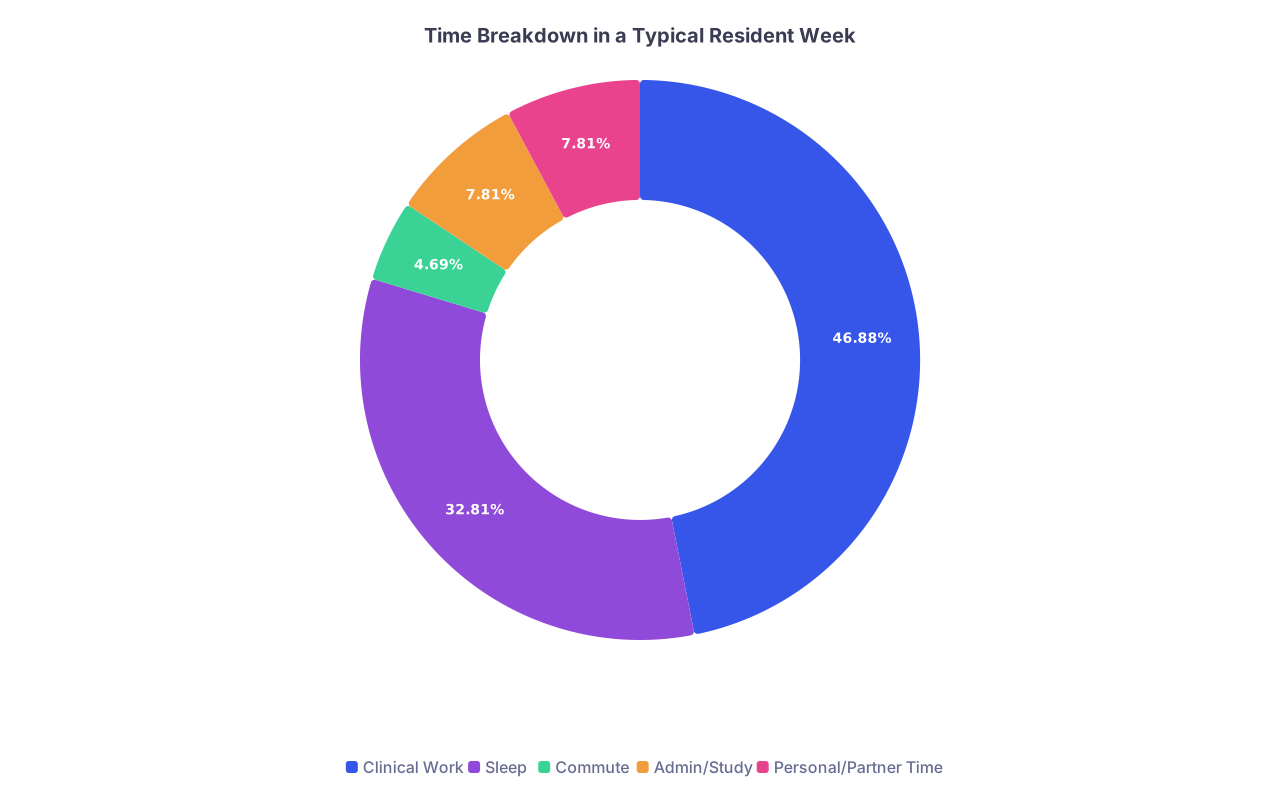
| Category | Value |
|---|---|
| Clinical Work | 60 |
| Sleep | 42 |
| Commute | 6 |
| Admin/Study | 10 |
| Personal/Partner Time | 10 |
You see that last slice? “Personal/Partner Time.” That 10 hours gets very small if one of you commutes 60–90 minutes a day because you never agreed who should live close to which hospital.
Mistake #6: Building a Rank List You Cannot Emotionally Live With
The couples algorithm will try to honor your rank list combinations. But some of the combinations you write down in February will not be things you can emotionally tolerate in March.
You know the pattern:
- “Let us just stick this long‑distance combo at the bottom ‘just in case’.”
- “I mean, I would hate it, but it is better than not matching.”
- “It is fine, we will survive a year apart.”
Sometimes that is true. Often it is not.
The mistake: ranking combinations that feel logically defensible at 1 a.m. on spreadsheet night, but would actually break you when the email hits.
I have sat in living rooms on Match Day where one partner says, “Well, at least we matched,” and the other partner is thinking, “I never really agreed to this life.”
Brutal but necessary question:
Are there ranked outcomes on your list that you would secretly rather not match than accept?
If yes, they do not belong on your list.
How to sanity‑check your ranks:
For each of your bottom 5–10 couples combinations, ask:
- If this is our reality for the next 3 years, would we:
- Both still feel committed to staying together?
- Be able to pay our loans and bills without constant crisis?
- Be okay looking back in 5 years and saying, “We chose this”?
If the answer is “I don’t know” or “probably not” or “only if everything magically goes perfectly,” do not rank it. There is a difference between courage and denial.
Mistake #7: Not Making a Break‑Glass‑in‑Emergency Plan
Everything above assumes things mostly work out. But sometimes they do not:
- One of you matches. The other does not.
- You match in different cities, and it is worse than you imagined.
- Life happens: illness, family crises, pregnancy, burnout.
“We’ll cross that bridge if we come to it” is not resilience. It is avoidance.
You need a basic contingency plan. Not a detailed manual, but a shared understanding:
If one of us does not match, do we:
- SOAP?
- Take a research year in the other’s city?
- Reapply next year strategically together?
If we match in different cities, do we:
- Re‑evaluate in 6 months and consider transferring?
- Prioritize one career for transfer vs the other?
Under what conditions would we consider:
- One partner changing specialties
- One partner resigning and reapplying
- Long‑term long‑distance vs breaking up
Uncomfortable? Yes. Necessary? Absolutely.

| Step | Description |
|---|---|
| Step 1 | Couples Match Result |
| Step 2 | Assess Program Fit & Logistics |
| Step 3 | Plan Commute & Housing |
| Step 4 | Consider Transfers / Future Moves |
| Step 5 | SOAP / Research / Reapply Plan |
| Step 6 | Same City? |
| Step 7 | Acceptable Distance? |
| Step 8 | Both Matched? |
If you cannot talk about these paths now, you will fight about them later when you are sleep‑deprived and cornered.
A Quick Reality Check: What Strong Couples Do Differently
Here is what I see in couples who come out of the Match stronger, even when the outcome is not perfect:
- They start planning early (spring MS3), not after interviews.
- They are brutally honest about competitiveness and risk.
- They use one shared planning document, not parallel fantasy lists.
- They talk openly about money, commute, family plans, and mental load.
- They are willing to sacrifice prestige to protect the relationship and their sanity.
They do not hide their real desires behind “we’ll see” or “it will probably work out.”
They respect the Match enough to treat it like what it is: a high‑stakes, low‑control system that punishes magical thinking.
FAQs
1. Should we always prioritize being in the same city over program quality?
Not always. But you must decide where that line is for you before rank lists are due.
A common mistake is pretending both things are “equally important” when they are not. In practice, most couples are happier in a mid‑tier program together than in separate elite programs far apart. The exceptions tend to be:
- Extremely competitive subspecialty goals that truly require certain institutions
- Couples already accustomed to long‑distance with a clear multi‑year plan
If you are conflicted, rank your scenarios in this order for yourselves:
- Same city, both at solid programs
- Same city, one at a clearly less‑prestigious but safe program
- Long‑distance, both at dream programs
- Long‑distance, only one at a dream program
Your honest emotional ranking of these will tell you more than any advisor’s opinion.
2. How many programs should couples apply to?
More than you want to. Fewer than will destroy your sanity. That is the tension.
Rough guidance (not rigid rules):
- Both in less competitive specialties: 25–40 programs each
- One competitive + one less competitive: 40–60 for the competitive partner, 25–40 for the other
- Both in competitive specialties: very often 60+ each
But raw numbers matter less than geographic and tier diversity. If you have 60 applications all clustered in 5 expensive, hyper‑competitive cities, that is not safer than 40 well‑distributed applications.
3. Is it a bad idea to couples match if our relationship is “not 100% solid”?
If you are already describing your relationship with that phrase, you need to slow down.
Couples matching is essentially tying your early careers together and making both more fragile. If you break up mid‑residency, you have:
- Limited transfer options
- Potential bitterness about career sacrifices
- Two people stuck in locations they might not have chosen individually
I have seen couples use the Match as a test of commitment. That is a mistake. If you would not sign a 3‑year lease and co‑sign a major loan with this person, you should think hard about linking your NRMP futures with them.
4. How open should we be with programs about being a couple?
More open than most people are, but not reckless.
You should:
- Indicate couples participation properly in ERAS/NRMP
- Mention your partner in appropriate contexts during interviews
- Reach out (politely) to PDs or coordinators when you have significant overlap in rank interest
You should not:
- Act entitled to linked positions
- Pressure programs or sound manipulative (“If you rank me higher, my partner will too”)
- Hide the fact you are couples matching until rank time and then expect miracles
Programs cannot help coordinate what they do not know. The couples match exists for a reason; using it openly is not a weakness.
5. What if our advisors disagree on how risky our plan is?
It happens all the time. One mentor says, “You are very strong; shoot high.” Another says, “You should be scared.” Meanwhile, your partner is getting totally different advice from their side.
You do not solve that by averaging the opinions. You solve it by forcing specificity:
- Ask each advisor: “What percentage chance would you assign to me matching in my top 5? Top 10?”
- Ask: “If I were your child in a couples match, what would you tell me to do differently?”
Then compare those answers as a couple. If someone is clearly sugar‑coating things, lean toward caution. The cost of being too aggressive is much higher for couples than for solos.
Open your shared spreadsheet (or create one if you do not have it yet) and add three columns: “Risk level,” “Couples‑friendly,” and “Would we be OK living with this outcome for 3 years?” Fill those in honestly for your current program list. If you cannot answer those questions, you are not planning—you are hoping.


