

The couples match does not fail because your love “wasn’t strong enough.” It fails because you did not sync your interview priorities.
You can be two excellent applicants with solid scores, strong letters, and realistic expectations—and still blow your Couples Match by treating interviews like two separate processes that will magically align at the end. They will not. Programs are not coordinating for you. If you do not consciously align priorities early, you are handing control of your future to chaos and hope.
Let me walk you through the specific mistakes I see couples make over and over, the ones that quietly wreck rank lists and force painful last‑minute compromises.
1. Acting Like Two Solo Applicants Who Happen To Be Dating
The most common—and most destructive—mistake is pretending you can both run “normal” application strategies and then just link rank lists later.
That fantasy dies the moment interview invitations start rolling in.
Here is what I have seen multiple times:
- One partner applies broadly and aggressively.
- The other partner is “picky,” banking on a geographic preference or prestige dream.
- Neither builds a coordinated application map.
- By November, one has 18 interviews spread across 10 cities; the other has 7 interviews in 3 completely different regions.
They sit down to “start thinking about the rank list” and realize they only have two real overlapping cities—and one of them is a place neither actually wants to live.
This is not bad luck. It is bad planning.
You cannot afford to behave like two solo NRMP applicants if you are in the Couples Match. The rules change:
- Geography matters more than prestige.
- Overlap matters more than local “fit.”
- Joint viability matters more than individual fantasy programs.
If one of you is still talking about “dream programs” while you are not even sure you have three viable overlapping cities, your priorities are misaligned.
Fix it now, not in January. Before ERAS submission, sit down and:
- Build a shared Google Sheet with all possible cities and programs for each of you.
- Mark realistic targets, stretch programs, and safety options.
- Decide together: Are we prioritizing city first, program tier first, or back‑up security first?
If you do not explicitly answer that question, you will both be answering it differently in your heads—and making irreconcilable decisions.
2. Never Defining Your “Non‑Negotiables” Up Front
Another classic trap: one partner thinks “I’d really like to be near my family” is a soft preference. The other hears it as a hard rule. Nobody clarifies it.
Fast‑forward to rank list season. One partner wants to rank a great overlapping pair on the West Coast first. The other has mentally committed to being within a two‑hour drive of their parents on the East Coast. Now every discussion turns into a low‑grade fight.
You should not be discovering your non‑negotiables in February.
You need them in writing before interview season, ideally before you pick where to apply.
At minimum you each must answer, explicitly:
- Are there any absolute no‑go regions or cities?
- Is being in the same hospital system essential, or is same city enough?
- Are there specific needs (childcare, visa, medical care for a family member) that trump program prestige?
- Are there programs that are “no” for you no matter what (toxic culture, reputation, call schedule) even if they are the only overlap?
If you do not articulate these, you will default to unspoken assumptions and then accuse each other of “changing the rules” when the rank list does not line up with what was in one person’s head.
Write them down. Three categories:
- Absolute: we will not cross this line.
- Strong preference: we will sacrifice some program quality to get this.
- Nice to have: this is a bonus, not a requirement.
You will thank yourself later when you are forced to choose between a top‑tier but long‑distance pair vs a mid‑tier but co‑located pair.
3. Ignoring How Competitiveness Shapes Strategy
Couples often pretend both partners are equally competitive, even when they are not. That is how mismatched interview portfolios are born.
I will be blunt: if one partner is applying derm or ortho with a 260+ and multiple pubs, and the other is a solid but unremarkable FM or peds applicant, the strategies cannot be symmetric. They should not be.
What goes wrong in misaligned couples:
- The more competitive partner applies narrowly to brand‑name programs in cool cities, assuming their partner will “probably get interviews there too.”
- The less competitive partner mirrors the same cities and prestige level, despite weaker stats.
- December hits: one partner has a wall of interviews; the other has a couple of scattered invites and a rising sense of dread.
You cannot fix that in January. The damage is done at the application and preference‑setting stage.
You have to account for asymmetry from the beginning.
| Pair Type | Risk If Ignored | Strategic Priority |
|---|---|---|
| Both highly competitive | Wasted overlap | City clustering & coordination |
| One highly, one moderately competitive | Few shared interviews | Broader net for weaker partner |
| Both average or below average | Not enough interviews | Volume & safety programs |
If one of you is clearly more competitive:
- That person may need to apply wider geographically to match where the other partner can realistically land interviews.
- The less competitive partner should prioritize volume and spread in cities where the stronger partner can adjust—rather than chasing fantasy overlaps at long‑shot institutions.
The mistake is ego. The stronger partner wants their shiny name. The weaker partner feels pressured to “keep up.” The result: you have prestige on paper and no practical overlaps.
Be ruthless with that. Ask:
“If we do this, will we actually have 8–10 realistic overlapping cities?”
If the answer is no, your priorities are wrong.
4. Failing To Coordinate Interview Acceptances And Declines
You can have perfect geographic planning and still sabotage yourself if you treat interview invitations like a video game—accept everything, decline nothing, hope it works out.
Here is the pattern I have watched sink couples:
- One partner auto‑accepts every interview instantly.
- The other tries to wait a bit, coordinate schedules, and respond thoughtfully.
- By the time they talk, one is locked into multiple cities the other cannot reasonably reach, or on completely different weekends than the best overlap options.
Or worse:
- Partner A turns down interviews in City X because Partner B “is not interested” in that city.
- Two months later, Partner B does not land interviews in their preferred cities, suddenly “reconsidering” City X.
- Those declined invites? Gone.
This is priority misalignment in real time.
You need rules for interview management before the first invitation lands, not as a panicked text thread while you are rounding:
- Which cities are “must pursue” for overlap, even if one of you is lukewarm?
- Are there any cities/programs either of you should never decline unilaterally?
- How flexible are you about second‑look or pre‑interview visits if only one of you is invited to a nearby program?
Make a simple, brutal rule:
No one declines an interview in a potential overlap city without speaking to the other person, even if it is 1 a.m. Even if it is “just” a mid‑tier program.
And do the opposite too: if one of you gets an invite in a high‑priority city, the other should immediately email that city’s programs expressing interest or seeking cancellation‑waitlist spots. That level of coordinated urgency is what gets you extra overlap opportunities.
5. Treating Rank List Creation As An Emotional Negotiation, Not A Structured Process
By far the ugliest conflicts I see come up in late February, when couples finally sit down to build the actual NRMP rank pairs.
They start with “what feels fair.” Or “we’ll take turns picking.” Or “we’ll just put the city we both like first and go from there.”
That is how you get a list that looks emotionally satisfying but strategically weak.
Common screw‑ups at this stage:
- Not understanding that you are ranking pairs of programs, not cities.
- Over‑ranking long‑shot pairs at the top while under‑ranking safer but co‑located options.
- Letting one partner “win” the top ranks entirely and the other get “thrown a bone” at the very bottom—effectively turning the Couples Match into a solo match plus a passenger.
You cannot afford to improvise this.
You need a structured process:
- First, list every possible city you both interviewed in, grouped by region.
- For each city, list all potential program pairs (even imperfect ones—e.g., one in the city, one in the nearest suburb).
- For each pair, assign three scores:
- Joint quality (training + living situation for both of you).
- Co‑location strength (same hospital > same city > nearby city > long commute).
- Realistic probability (based on your competitiveness and interview vibes).
- Only after that do you start ordering them.
This sounds mechanical, but it protects you from the single worst outcome: ranking a pair highly because one person is emotionally attached to a prestige program, even though the other partner is miserable about their side of the pair or unlikely to match there.
If you feel yourself saying, “Well, I know you hate that program, but it is my dream, and we should put it high just in case,” you are already in dangerous territory.
Emotion first, structure second is how couples sabotage the list.
Do structure first. Then argue about the top 3–5 pairs.
6. Blindly Choosing Between “Together Anywhere” And “Apart For Prestige”
You will hear this false dichotomy constantly:
- “We will rank all co‑located options first no matter what.”
- “Or we will prioritize the best individual programs, even if it means doing distance.”
Both can be wrong if they are rigid.
The mistake is not the choice itself. It is failing to make the choice explicit, rational, and shared.
Some couples:
- Claim “we will go anywhere as long as we are together,” but then sabotage safer co‑located options by ranking high‑prestige misaligned pairs above them.
- Or they talk tough about doing long‑distance “if necessary,” yet melt down when faced with a realistic chance of matching apart because their list was built that way.
You must decide—out loud:
- Is “together in the same city” a higher priority than either of you being in a top‑tier program?
- Or are there specific program types (e.g., highly specialized fellowships, visa‑sponsoring institutions) that justify a temporary long‑distance phase?
Then align your rank list with that decision.
If staying together is truly your highest priority, you cannot rank a huge block of risky “prestige but apart” pairs above your solid “together in a decent city” options. That is just lying to yourselves.
On the other hand, if one of you is chasing a once‑in‑a‑lifetime training opportunity (say, a neurosurgery spot in the only program that will realistically take you), you both need to be honest that you may rank a small number of non‑overlapping pairs above some weaker co‑located ones. That is a conscious tradeoff, not an accident.
The sabotage happens when couples claim one value system and build a rank list that reflects another.
7. Not Using Data From Programs And Interviews To Adjust Priorities
Some of you cling to your original wish list like it is sacred, even after interviews clearly tell you the story has changed.
Let me give you a scenario I have actually seen:
- You both love City A and City B on paper. You apply heavily there.
- Interview season comes: City A is lukewarm at best. One of you gets no interviews there. City B, on the other hand, invites both of you to multiple programs and the vibes are strong.
- Yet when it is time to build the rank list, you still treat City A as some sort of “top tier” emotional favorite and build pairs around it that are not realistically going to hit, while under‑utilizing all your solid City B pairs.
This is not just stubborn. It is reckless.
Programs show you their interest by their behavior:
- Interview invite timing
- PD / faculty enthusiasm
- Follow‑up emails
- How they talk about couples during Q&A
If you ignore that and stick to what you dreamed up in June, then yes, you are sabotaging yourselves.
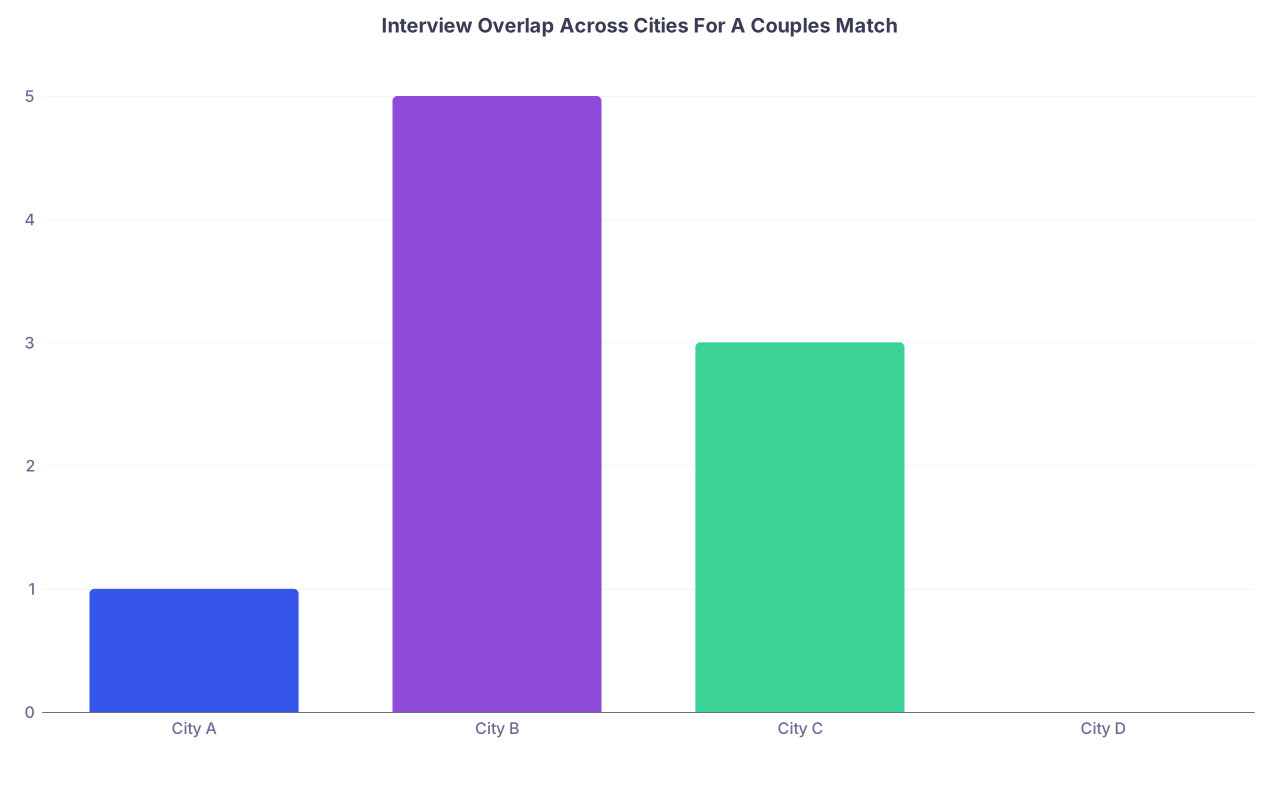
| Category | Value |
|---|---|
| City A | 1 |
| City B | 5 |
| City C | 3 |
| City D | 0 |
In the example above, too many couples still treat City A as equal to City B because “we always wanted to live there.” One shared pair vs five. That is not a tie. That is delusion.
You should be ruthless about this:
- If a city gives you poor overlap, it drops in priority—even if the lifestyle there is great.
- If a less sexy city gives you multiple strong program pairs, it moves up the list.
Interview season is feedback. Use it. Do not cling to your original map when reality has redrawn it.
8. Keeping Program Directors In The Dark About Being A Couple
Another subtle way couples sabotage themselves: hiding the fact that they are in the Couples Match until the very end, or never mentioning it at all.
I know why people do it. Fear of bias. Worry that programs will see them as complicated.
Sometimes that fear is justified. Some programs are clumsy or dismissive about couples. But most large institutions are used to it and will at least try to help where they can—if they have the information early enough to act on it.
Here is the mistake:
- You both interview at different programs in the same city.
- You never mention you are a couple, assuming the NRMP algorithm will handle it.
- Meanwhile, the PD at Program X might have been willing to talk to the PD at Program Y to help align interest—if they knew. They did not. So nothing happens.
You do not need to bring it up awkwardly in the first five minutes of every interview. But if you had a genuinely strong interaction with a program and you know your partner is interviewing (or hoping to) at a nearby program, it is entirely reasonable to send a brief, professional note later:
“Dr. Smith, thank you again for the opportunity to interview at [Program]. I also wanted to mention that I am participating in the Couples Match with my partner, who has applied to [Partner Program(s)] in [City]. We are both very enthusiastic about training in [City] and would be thrilled to match there together.”
That is it. You are not begging. You are giving programs a chance to coordinate if they care to. Some will not. Some quietly will.
The mistake is leaving potential allies uninformed, then complaining that “no one helped us as a couple.”
9. Letting Resentment, Guilt, Or Martyrdom Drive Decisions
This one will not show up in any NRMP guide, but it wrecks matches.
You are both stressed, exhausted, and terrified of destroying each other’s careers. That is fertile ground for emotional bargaining:
- “We should put your programs first; your specialty is harder to match.”
- “No, we should prioritize your happiness; I can do my field anywhere.”
- “If we do not get into [My Dream Program], I will always resent you.”
None of that belongs in a rational ranking conversation.
Here is the ugly pattern:
- One partner sacrifices too much—agreeing to rank several cities or programs they truly dread in order to “support” the other.
- They tell themselves they are fine with it. They are not.
- A year into residency, that builds into resentment, which poisons both the relationship and the training experience.
Or the opposite:
- One partner digs in, insists on their dream city or top‑tier program, refusing to seriously consider realistic overlapping options.
- The other partner swallows it, outwardly agrees, inwardly panics.
- When the couple fails to match together, blame lands like a grenade.
Your priority alignment must be rational, not guilt‑driven. That means:
- No one gets to unilaterally declare their career “more important.”
- No one is forced to rank programs that feel unsafe or deeply misaligned with their values.
- Both of you explicitly agree to the tradeoffs you are making and can explain them without emotional blackmail.
If you hear sentences like “If you loved me, you would…” in your rank discussions, stop. You are no longer talking about strategy. You are negotiating power.
That is how couples sabotage not just their match, but their relationship.
10. Practical Alignment Checklist (Use This Before It Is Too Late)
You do not need a 50‑page workbook. You need a brutally honest, shared framework.
Use this as a sanity check mid‑interview season and again before ranking:

| Step | Description |
|---|---|
| Step 1 | Start |
| Step 2 | Define non-negotiables |
| Step 3 | Map target cities |
| Step 4 | Assess competitiveness asymmetry |
| Step 5 | Set rules for interview accepts/declines |
| Step 6 | Update priorities based on invites |
| Step 7 | Score program pairs by realism & fit |
| Step 8 | Build rank list consistent with core values |
| Step 9 | Final check: both accept tradeoffs |
| Step 10 | Submit Couples Rank List |
If you cannot walk through that flow without serious disagreement at multiple steps, your priorities are not synced. Yet.
Stop adding more interviews. Stop obsessing over small details in personal statements. Fix this first. Because once the NRMP deadline passes, no amount of regret will change the fact that your list reflects misalignment, not reality.
The Bottom Line
Couples do not lose the Match because they were unlucky. They lose it because:
- They acted like two solo applicants and never built shared, explicit priorities.
- They refused to adjust their map to match real‑world interview data and competitiveness.
- They let emotion—not structure—drive interview decisions and rank lists.
Avoid those three mistakes, and you drastically increase your odds of not just matching—but matching in a way both of you can actually live with for the next three to seven years.


