

You are sitting on FaceTime. One of you is in a cramped apartment in Philadelphia, the other in a call room in Houston. ERAS season is here. Everyone keeps asking, “So… are you couples matching?” You both say “yes,” but privately you are thinking: we are not even in the same time zone. How do we turn this into an actual plan that lands us within driving distance, let alone the same city?
This is where most couples in your situation screw up: they talk about feelings, not logistics. They say “we’ll figure it out” instead of “open a spreadsheet.” You do not have that luxury if you want to convert long-distance into near-distance during Match.
Let us build an actual, practical, near-distance couples match strategy from the ground up.
Step 1: Define the Relationship Goal in Match Terms
“Be together” is not specific enough. You need to translate relationship goals into residency match constraints.
You must pick one of these as your primary goal:
- Same program
- Same city
- Same region / drivable distance (1–4 hours)
- Same state (looser, but workable)
Everything else is secondary.
If you are currently long-distance and in different schools/regions, your realistic top primary goals usually look like:
- #2 Same city – ambitious but doable with smart strategy
- #3 Same region – extremely reasonable and often the best balance
- #1 Same program – sometimes possible for IM + IM, FM + FM; much harder for very competitive + very competitive in the same specialty
Be brutally honest about:
- Competitiveness of each specialty
- Competitiveness of each partner (Step scores, clinical grades, letters, research)
- Geography flexibility for each partner (family obligations, visa, medical school region bias)
If one of you is dead set on “only Northeast major academic centers” and the other needs “West Coast only,” you do not have a couples match strategy problem. You have a relationship alignment problem. Solve that first.
Concrete task for this week:
- Each of you separately writes:
- Your absolute top 3 cities
- Your “willing to be happy” 5–10 cities/regions
- Your absolute “no” locations
- Then compare, and categorize overlaps:
- Perfect overlap cities
- One-sided strong preference
- Neutral / acceptable for both
This becomes the skeleton of your geographic strategy.
Step 2: Understand How Couples Match Actually Works (Without Myths)
A lot of long-distance couples operate on bad information. You cannot afford that.
Key reality checks:
- The couples match does not create new positions. It only ties two separate applicant rank lists together.
- You submit a combined rank list: pairs of (Program A for you, Program B for partner).
- You can include:
- Same-program pairs (Program X / Program X)
- Same-city different-program pairs (Program X / Program Y)
- Same-region different-city pairs (Program X / Program Z)
- “One matches / one does not” options if you are willing to take that risk
- The algorithm still tries to maximize both of your preferences jointly, not individually.
If you do not organize your rank list and program list around “near-distance pairs” you will default into chaos.

| Step | Description |
|---|---|
| Step 1 | Build individual program lists |
| Step 2 | Define shared geographic zones |
| Step 3 | Create pairable program combinations |
| Step 4 | Apply strategically as a couple |
| Step 5 | Interview prioritization & scheduling |
| Step 6 | Construct combined rank list by zones |
| Step 7 | Review risk tolerance & finalize list |
That is your roadmap. Everything else is detail.
Step 3: Map Your Realistic Program Universe
This is where most couples under-prepare. They both make their usual “solo” target lists and then try to smash them together in January. That is backwards.
You are going to build a shared map early.
3.1. Build your individual realistic lists
For each partner, create three columns:
- Likely (solid chances)
- Reach
- Safety
Use honestly:
- Class rank / MSPE language
- Step/COMLEX scores or pass outcomes
- Honors in cores and sub-I’s
- Research in field (especially for competitive specialties)
- Visa or IMG status
Now, for each list, add an extra column: Geographic flexibility rating:
- 1 = only this city because of family/visa/etc.
- 2 = prefer this region but open
- 3 = anywhere is fine if program quality is good
3.2. Overlay both lists on a map
Do not keep this conceptual. Actually map it.
You can:
- Use a shared Google Sheet and conditional formatting by city.
- Or literally pin programs on a US map with colors (old-school but effective).
- Or use a free online mapping tool and upload a list of addresses.
Mark:
- Blue pins = Partner A programs
- Red pins = Partner B programs
- Purple pins = cities where both have programs
- Green circle = regions where pairs could be within 1–3 hours driving
Your “near-distance” match strategy lives where these colors overlap.
Step 4: Decide on Your “Near-Distance Zones”
This is how you convert long-distance into structured near-distance priorities instead of vague hopes.
You create zones. Rank the zones, not just the programs.
Example:
Zone 1 – High Priority Same-City / Same-Program
- Cities where:
- Both have at least 2–3 programs each
- One or more same-program possibilities exist
- You would both be happy living there
- Your combined competitiveness realistically fits
Zone 2 – Strong Near-Distance (Under 2 hours apart)
- Metro clusters:
- Example: Philly–NYC–Newark corridor
- Example: Baltimore–DC
- Example: Dallas–Fort Worth
- Or city pairs:
- Example: Rochester–Buffalo
- Example: Durham–Greensboro–Winston-Salem triangle
Zone 3 – Acceptable Region (2–4 hours apart, same state or region)
- Example: Boston vs Springfield / Worcester
- Example: Chicago vs smaller Illinois programs
- Example: Atlanta vs Augusta / Macon
Zone 4 – Remote back-up scenarios
- One in a stronger program, one further away, but still reachable by cheap flights or occasional drives.
- You do not lead with this. You keep it as a “we will not be jobless” tier at the bottom.
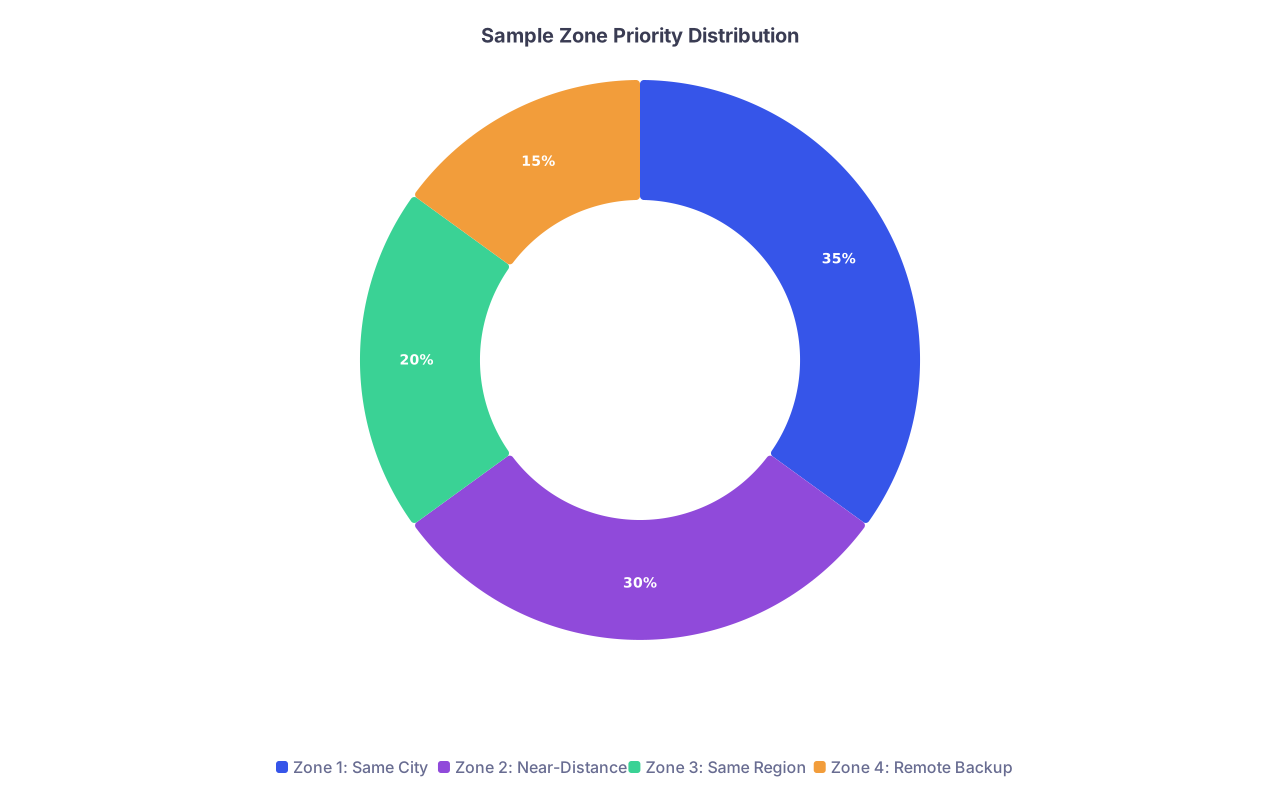
| Category | Value |
|---|---|
| Zone 1: Same City | 35 |
| Zone 2: Near-Distance | 30 |
| Zone 3: Same Region | 20 |
| Zone 4: Remote Backup | 15 |
Your application and interview strategy must reflect this zone system. Otherwise you are just “hoping.”
Step 5: Build a Program Pairing Matrix
Now we move from theory to spreadsheet grind. This is where I have seen long-distance couples either win or collapse.
Create a shared couples spreadsheet with these columns:
- City
- Region
- Program A name
- Program B name
- Distance between programs
- Zone (1–4)
- Competitiveness match (Green/Yellow/Red)
- Applied? (Y/N for each partner)
- Interview invite status
- Relative rank priority (1–5)
Example of what you want to see:
| City/Region | Program A | Program B | Distance | Zone | Priority |
|---|---|---|---|---|---|
| Boston | MGH IM | BIDMC IM | 5 miles | 1 | 1 |
| Baltimore–DC | Johns Hopkins Neuro | Georgetown Neuro | 42 miles | 2 | 2 |
| Philly–NYC | Penn IM | Mount Sinai IM | 95 miles | 2 | 3 |
| Upstate NY | Rochester FM | Buffalo FM | 74 miles | 3 | 4 |
You are going to keep updating:
- When one of you gets an interview, look for possible pair programs in that same city/region for the other partner.
- If one of you does not apply where the other has multiple good options, that is usually a mistake. Fix it early while apps are still open.
Step 6: Application Strategy for Long-Distance Couples
Your long-distance status changes two main things:
- You likely have fewer natural overlapping “home” program advantages.
- You must be more intentional about where you both apply heavily.
6.1. Where to apply more broadly
You should over-apply in:
- Cities with many programs in both specialties
- Regions with robust near-distance clusters
For example, if one is EM and the other is IM:
- Boston, NYC, Philly, Chicago, Houston, Dallas, Atlanta, LA, SF Bay, Seattle, DC–Baltimore all become high-yield clusters.
- Smaller cities with only one EM and one IM program are fine but higher risk if someone does not get an interview.
6.2. Where to apply more conservatively
You can under-apply (or even skip) in:
- Solo cities with only one program for one of you and zero for the other.
- Geographic outliers that do not create any pair or near-distance options unless they are dream programs.
Many couples get stuck because each partner has 10 solo “dream” cities that do not overlap at all. You can have a few of these, but if your entire list is like this, your near-distance goal is fantasy.
Step 7: How to Talk to Programs Without Shooting Yourself in the Foot
Long-distance couples often mishandle communication. They either:
- Hide the relationship entirely (bad for couples planning)
- Overshare and sound entitled (“We must be together, please accommodate us”)
You want a middle path: strategic transparency.
7.1. When to disclose couples matching
Reasonable to mention:
- In ERAS application: Check “couples match” and list partner.
- In personal statement: One short line if relevant to geography, not a whole narrative.
- In interviews:
- If they ask about geography preference
- If they seem open to couples considerations
Example language:
“My partner and I are couples matching. She is applying in pediatrics and is very interested in this area as well, especially [Neighboring Program / Hospital System]. We are prioritizing being in the same city or within a reasonable driving distance.”
Do not:
- Demand linked ranking or special treatment.
- Threaten “we will not rank you unless…”
Programs hate that.
7.2. Email strategy for near-distance support
You can send targeted, concise emails to PDs or coordinators when appropriate:
- When one of you has an interview at a program and the other is waiting to hear from a nearby program (same city/region).
- When you already have interviews at two programs in the same city and want to emphasize your couples status.
Example:
Subject: Couples Match – Strong Interest in [City]
Dear Dr. [Name],
I am writing to express my strong interest in [Program]. My partner and I are participating in the couples match; she has been invited to interview at [Nearby Program] in [Same City/Region].
We are both highly committed to training in [City/Region] and hope to build our careers here. I would be grateful if you might keep our couples status in mind as you review applications.
Sincerely,
[Your Name], [Med School]
This is reasonable. Not pushy. You are simply giving them information they can use.
Step 8: Scheduling Interviews to Maximize Pairing
You are long-distance now. So you will have more flight and logistics headaches than a same-school couple. Plan aggressively.
Rules:
- Try to cluster interviews by geographic zone, not just by date convenience.
- If one of you gets an interview in a key Zone 1 or 2 city, the other should:
- Immediately check status at nearby programs.
- Consider a polite update email to those programs noting “I will be in town on [date] interviewing at [X]; I remain very interested in your program.”
- Use any interview day visits wisely:
- Talk to residents about other local programs. They usually know which ones are friendly to couples, which hospital systems share call rooms, etc.
A practical trick I have seen work:
- If Partner A has 3 interviews in Chicago, Partner B should:
- Apply broadly to Chicago-area programs even if they seem slightly reachy or slightly beneath their usual bar.
- You are buying geographic probability, not just “prestige.”
Step 9: Constructing a Near-Distance Combined Rank List
This is where everything either comes together or falls apart. Most couples massively underestimate the time and conflict this takes.
You are going to rank pairs, not programs. That is the mental shift.
9.1. Start with zones, not emotions
Do this in stages:
- List all possible same-program pairs. Rank those internally.
- List all same-city, different-program pairs. Rank those.
- List all near-distance, under 2 hours pairs.
- Then broader same-region, 2–4 hours pairs.
- Only after that, decide:
- Are you willing to rank “one matches / one does not” pairs at the bottom?
Now, merge these groups respecting your Zone priority:
- Top chunk: Zone 1 pairs (same program + same city)
- Next chunk: Zone 2 pairs
- Then Zone 3
- Lastly: Safety + remote backup plans
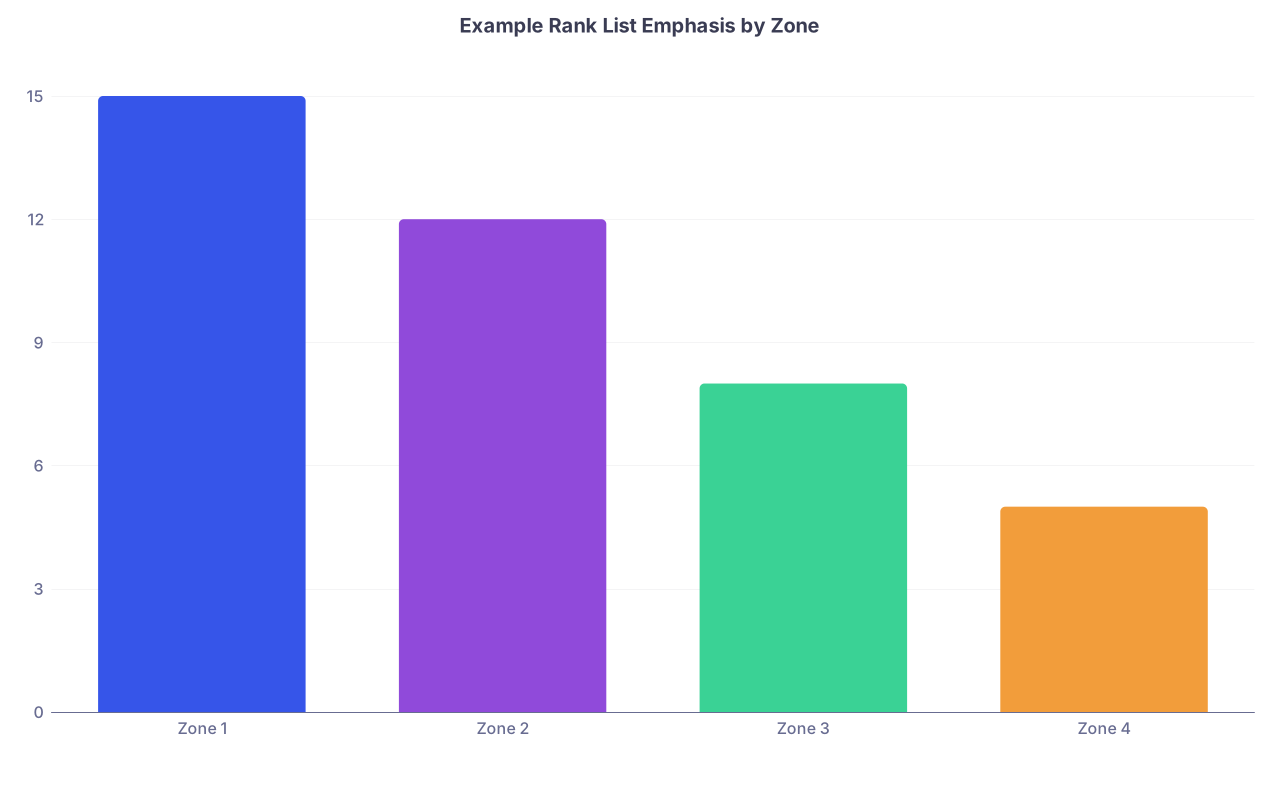
| Category | Value |
|---|---|
| Zone 1 | 15 |
| Zone 2 | 12 |
| Zone 3 | 8 |
| Zone 4 | 5 |
You want the algorithm seeing a long, dense sequence of “we will be near each other” options before it ever touches scenarios where you are far apart.
9.2. Decide your tolerance for mismatch
Long-distance couples need one especially hard conversation:
Are we willing to have one of us unmatched if it avoids us being very far apart?
You have three basic stances:
No “one matches / one does not” pairs at all
- Safer for both matching somewhere
- Higher risk of being far apart
Include a few “one matches / one does not” at the very bottom
- Mostly protects togetherness
- Preserves some individual match safety if everything above fails
Many “one matches / one does not” pairs
- Maximizes each individual matching
- High risk of ending up far apart again
There is no universally correct answer. People who pretend there is are lying.
My general position:
- For most long-distance couples serious about ending the distance, option 2 is usually the best compromise.
- Option 1 is reasonable only if both of you are moderately competitive and have robust couples-compatible lists.
- Option 3 is what I see in couples who say they prioritize being together but secretly prioritize prestige. That is fine if you are both honest about it. But do not pretend it is a “near-distance strategy.”
Step 10: Protecting the Relationship During This Process
Long-distance is already hard. Add couples matching and you are effectively running a joint logistics company with someone in another city.
A few concrete guardrails:
Weekly “Match Meeting”
45–60 minutes, same time every week, video call. Agenda:- Updates on interviews
- New pair possibilities
- Adjustments to zones or priorities
- Emotional check-in after logistics
No rank-list arguments after 10 PM or post-call.
People make dumb, emotional decisions when exhausted. Set that boundary explicitly.Write down agreements.
If you agree “we will not rank us more than 4 hours apart above togetherness,” write it in the header of your rank list Google Doc. When stress hits in February, you will both “remember” different things if it is not written.One spreadsheet owner.
Let one of you be the primary keeper of the shared sheet. Not because you are unequal, but because version chaos kills couples. The other person reviews and suggests edits.
Common Pitfalls I See (That You Can Avoid)
Pretending both partners are equally competitive when they are not.
You must acknowledge if one partner needs more geographic flexibility because their specialty or application is weaker. That is not a moral judgment. It is probability management.Too many solo “dream” programs and almost no overlap.
Cap these. For example:- Each partner gets 3–5 solo dream programs that are allowed on the individual mental list, but the couples combined rank list still prioritizes overlap and near-distance.
Waiting until January to seriously talk about geography.
By then, invites are mostly out. You are stuck with what you have, not what you want.Ranking prestige over proximity while telling each other you are prioritizing proximity.
Be honest with each other. If prestige really matters more to one of you, own that. Then construct your list accordingly. Hypocrisy does more damage to the relationship than a 2-hour drive ever will.
Quick Scenario Walkthrough
To make this concrete, here is a common pattern:
- Partner A: Applying Internal Medicine, strong application.
- Partner B: Applying Psychiatry, average application.
- Currently: Long-distance (Midwest vs East Coast).
- Shared goal: Same city ideally, near-distance acceptable; want to end up in Northeast or Midwest.
What they should do:
Build target zones:
- Zone 1: Chicago, Boston, NYC, Philly
- Zone 2: DC–Baltimore, Cleveland–Columbus, Rochester–Buffalo
- Zone 3: Other Midwest regional clusters
Apply heavily:
- Chicago: A applies to 7–8 IM programs, B applies to all psych programs.
- Boston: Same pattern.
- NYC/Philly: Broad application by both.
Use interview season:
- If A gets multiple Chicago IM invites, B emails Chicago psych programs highlighting couples match and Chicago visits.
- Any city where both get invites moves up in zone priority.
Rank list:
- Top: Same-program pairs where possible (e.g., both at Rush, both at UH Cleveland).
- Next: Same-city different-program pairs (e.g., A at Northwestern, B at UChicago psych).
- Then: 1–2 hour near-distance pairs (e.g., A in Cleveland, B in Columbus).
- Bottom: A few “one matches / one does not” as last-ditch if they choose that route.
End result: They massively increase their chances of converting long-distance into near-distance. Not by magic. By system.
FAQs
1. What if our specialties are very different in competitiveness (e.g., Derm + FM)?
You design the system around the more constrained partner. Dermatology, neurosurgery, plastics, ENT, ortho – these specialties limit your city choices. The other partner (FM, IM, peds, psych) needs to be more geographically flexible and often must apply broadly around the derm-friendly cities. You still use zones, but the “anchor” programs are from the more competitive specialty.
2. Should we both apply to places where we would not be happy alone, just to be near each other?
To a point. You will both have a small subset of “I would never be happy there no matter what” locations. Those are valid hard stops. Everything else is negotiable. Rank more highly the places where you would each at least be “content individually” and potentially near each other. Do not fill your list with mutual misery just to share a zip code. That is a fast track to resentment.
3. Is it ever smart to not couples match if we are long-distance?
Yes. If one of you is in an ultra-competitive specialty with a fragile application, couples matching can reduce their odds of matching at all. In that case, you can:
- Both apply and interview normally.
- Coordinate geography informally (target same regions).
- Skip the formal couples tie in NRMP. This preserves maximum odds that each of you matches somewhere, with a softer, less reliable attempt to be close. It is a tradeoff: higher individual security, lower geographic control. You choose based on your risk tolerance and how resilient your relationship is to another 3–4 years of some degree of distance.
Key Takeaways
- Long-distance couples do not “hope” into a near-distance match. They build zones, maps, and pairing matrices early.
- Your goal is not just “good programs.” It is a long, dense rank list of realistic near-distance pairs, ordered by what you both can actually tolerate and thrive in.
- Honest conversations about competitiveness, geography, and risk – backed by a shared spreadsheet, not just feelings – are what turn a long-distance relationship into an actual near-distance match strategy.


