

The common belief that “bigger programs are always better for couples match” is wrong. The data says something more nuanced: size helps, but only up to the point where it is paired with the right structure, geography, and specialty mix.
Let me walk through this the way I would for a pair of MS4s sitting in a dean’s office with a spreadsheet open.
1. What the numbers say about couples match and program size
We do not have randomized trials for couples match strategy. What we do have: NRMP outcomes data, program fill statistics, and some basic probability that exposes which myths hold up.
From NRMP Couples Match data (recent cycles):
- Roughly 1,200–1,300 couples participate each year.
- About 95% of couples match at least one partner; around 80–85% match both partners to PGY-1 positions.
- A substantial proportion of couples match in the same institution or same metropolitan area, but not necessarily the same program.
Now, where does program size enter?
Consider three broad buckets of residency programs (per specialty):
| Category | Positions per year | Typical example |
|---|---|---|
| Small | 1–4 | Community FM, small IM |
| Medium | 5–12 | Mid-sized IM, Peds, EM |
| Large | 13+ | Big academic IM, Peds, Surgery |
If you cross-tab this with how couples behave on rank lists and how programs fill, three facts jump out:
- Large programs (especially in Internal Medicine and Pediatrics) have more “slots per site,” which increases the combinatorial possibilities for a couple to land in the same hospital.
- However, couples rarely apply to just one specialty each; mixed-specialty couples often need two programs in the same institution, which is where actual hospital size and breadth (number of specialties) matters more than the size of any single program.
- Geographic clustering of multiple programs in the same city (e.g., Boston, NYC, Houston) often compensates for smaller individual program sizes, because couples can be happy with two different hospitals 10–20 minutes apart.
So: raw program size helps, but it is not a silver bullet. The data trend is “more positions = more matching configurations,” but that is mediated by how many compatible positions are at the same institution or in the same metro.
2. The math: why size can help, but not always the way you think
Let’s quantify this.
Say you have a couple both applying to Internal Medicine, targeting the same program. Compare a small IM program (4 categorical positions) and a large IM program (24 positions). Assume both programs are filling completely and each applicant has, say, a 10% probability of matching at that program if applying individually.
For simplicity, treat their matching as independent events (some correlation exists in real life, but this gives a baseline).
- Probability Person A matches: 10%
- Probability Person B matches: 10%
- Probability both match at that same program: 0.10 × 0.10 = 1%
Now raise their individual probability to 25% each (much more realistic for couples with strong applications at large academic IM programs):
- Probability both match: 0.25 × 0.25 = 6.25%
Not impressive yet. Where size matters is not just in acceptance rate but in the number of ranked pairs you can legitimately place.
Example: Same hospital, multiple programs (IM + Neurology).
Couple: A in IM, B in Neurology.
Suppose Hospital X has:
- IM: 24 categorical slots
- Neurology: 10 slots
You may construct rank pairs like:
- (A: X-IM, B: X-Neuro)
- (A: X-IM, B: Nearby Hospital Y-Neuro)
- (A: Y-IM, B: X-Neuro)
- (A: X-IM, B: X-Prelim + B: X-Neuro categorical) in some variations
The actual count of distinct feasible rank pairs grows with:
- The number of compatible specialties at the same hospital.
- The number of programs in nearby hospitals (same city/commute).
- The number of positions within each program.
That is why couples who intelligently exploit cities with many mid-to-large programs can do well even if no single program is huge.
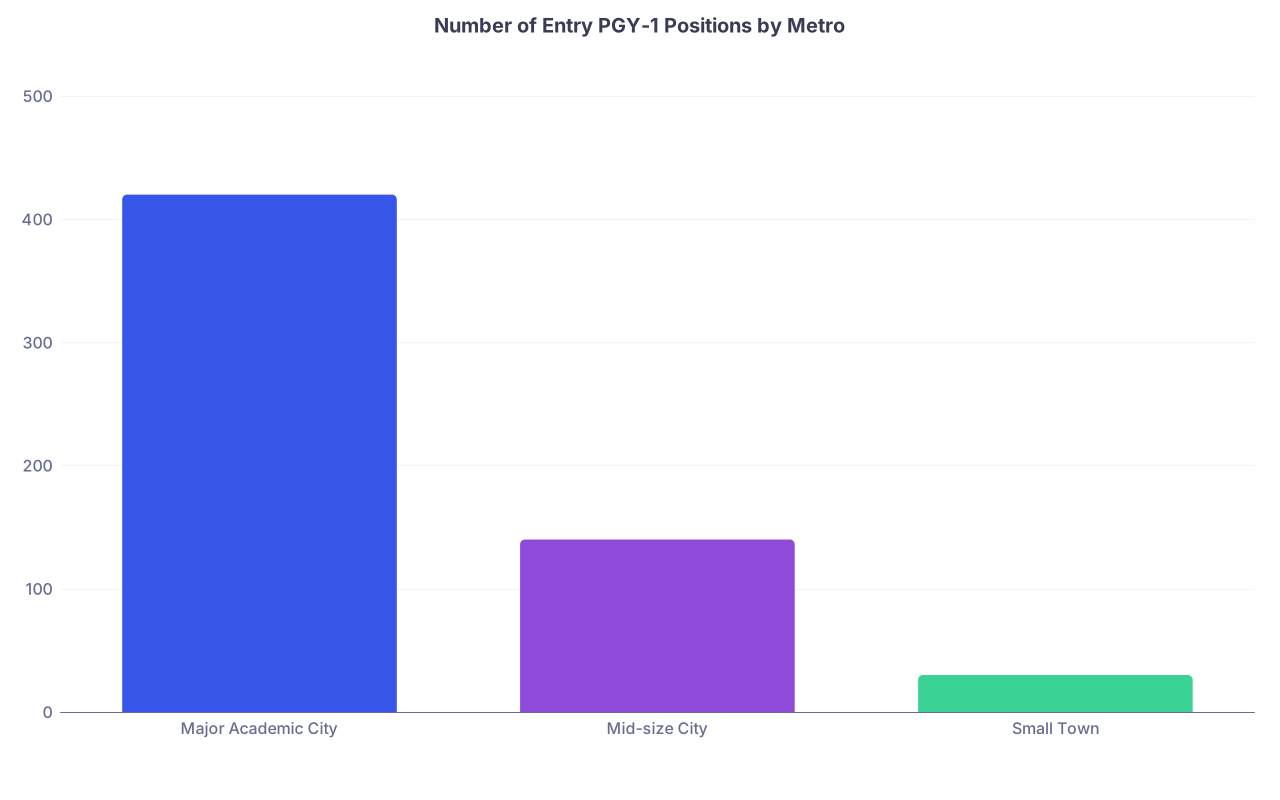
To make this concrete, imagine three “metros”:
| Category | Value |
|---|---|
| Major Academic City | 420 |
| Mid-size City | 140 |
| Small Town | 30 |
If you are a couple, your odds of both landing somewhere acceptable in “Major Academic City” are simply higher than in a one-hospital small town, even if some individual programs in that small town are technically “large” for their specialty.
This is where many couples go wrong: they stare at a single big-name program’s size and ignore the total ecosystem of positions within commuting distance.
3. Large hospitals vs large programs vs dense cities
People conflate three distinct concepts:
- Large hospital / academic center (many specialties under one roof).
- Large program (many residents per year in a given specialty).
- Dense city (multiple independent hospitals, each with several programs).
For couples, the real question is: “How many acceptable combinations can we form that keep us within X minutes of each other?”
Let us segment it.
3.1. Large academic centers
A genuinely large academic medical center might house:
- Internal Medicine: 30–40 categorical spots
- Pediatrics: 20–30 spots
- General Surgery: 10–15
- OB/GYN, Neurology, Psychiatry, Anesthesiology, EM: each with 6–15 spots
Total potential PGY-1 positions: easily 150+ across specialties.
For couples, this means:
- Two IM applicants: many chances to land together in the same program.
- Cross-specialty pairs (e.g., IM + Neuro, Peds + Psych): multiple pairable options on the same campus.
- Transitional/prelim years may create additional matching pathways for advanced specialties (Radiology, Anesthesia, Derm).
The internal cross-linking is powerful. For pairs strongly targeting the same geographic location, these centers are high-yield.
3.2. Large single programs in smaller systems
Now think of a large Internal Medicine program (say 28 residents per year) in a mid-sized or small town with almost no other residencies beyond FM and maybe a tiny Surgery program.
Here, the probability both members match at that one IM program is improved by size, but if one person is applying to Anesthesia and the other to IM, suddenly the “large” IM program does little for the couple if there is not an Anesthesia program on-site or nearby.
This is why “larger hospitals” as a rule for couples match is sloppy thinking. The more accurate rule is:
- “Hospitals that host multiple moderate-to-large programs in the specific specialties we need are good.”
- “Regions with multiple hospitals, each with solid programs, can outperform a single massive flagship if you care more about metro than building address.”
3.3. Dense cities with multiple hospitals
Look at data for New York City, Boston, Chicago, Houston, etc. These metros have:
- Multiple universities.
- Several community-based but sizable programs.
- Redundant offerings in core specialties (you can rank 5+ IM programs and 3+ Neurology programs all within 45 minutes’ commute).
Couples can generate dozens of realistic rank pairs that keep them close:
- A at Hospital 1 IM, B at Hospital 3 Peds.
- A at Hospital 2 IM, B at Hospital 1 Peds.
- A at Hospital 4 Prelim, B at Hospital 2 Anesthesia.
You get the point. The data pattern from NRMP reports is clear: couples with broader geographic definitions (same metro rather than same building) and who strategically target these dense ecosystems tend to construct longer, higher-yield rank lists.
4. How program size impacts the shape of your rank list
The couples match algorithm processes a list of pairs of ranks. Not two independent rank lists. That arithmetic matters.
I usually see three types of couples rank-list behavior:
- Hyper-concentrated on a handful of big academic centers, 20–40 pair ranks total.
- Mixed: a few “dream” large centers + many mid-size programs in a couple of metros, 60–100 pair ranks.
- Distributed: Many cities, many smaller programs, sometimes 100+ pair ranks.
The data pattern (from anecdotal dean’s office tracking and NRMP match rates) is pretty ruthless:
- Couples with very short pair lists (under ~30 pairs) have significantly higher risk for at least one partner not matching, regardless of program size.
- Couples who use program size and geographic density to build 60–100+ reasonable pairs have match outcomes close to, or sometimes better than, single applicants of similar competitiveness.
Here is a simple comparison:
| Strategy Type | Pair Ranks | Main Features |
|---|---|---|
| Big-Name Only | 15–35 | Few large academic centers, narrow geography |
| Mixed Metro | 50–90 | Large + mid-size programs in 2–3 cities |
| Wide Net | 80–150 | Many cities, all sizes, broad acceptability |
Notice that “large” hospitals show up in all three patterns. Size is a tool, not a strategy. The strategy is pair count, acceptability, and redundancy.
5. Specialty competitiveness, program size, and couples risk
The effect of program size is not uniform across specialties. For couples, the specialty combination matters as much as the raw number of seats.
To make this less abstract, here is a simplified snapshot (approximate ranges across U.S. programs):
| Specialty | Typical Program Size (PGY-1/year) | Competitiveness Tier |
|---|---|---|
| Internal Med | 10–45 | Low–Moderate |
| Pediatrics | 8–30 | Low–Moderate |
| Family Med | 6–24 | Low |
| General Surgery | 4–15 | Moderate–High |
| Anesthesia | 6–25 | Moderate–High |
| Dermatology | 2–8 | Very High |
| Ortho Surgery | 3–10 | Very High |
Now overlay couples combinations:
- IM + Peds: Plenty of mid-to-large programs, often co-located in the same institutions. Size works in your favor.
- IM + Ortho: Big asymmetry. The Ortho side is bottlenecked and almost always in smaller programs. The chip is on the Ortho shoulder, size-wise.
- Derm + anything: Program sizes are tiny; large hospitals help only modestly, because the bottleneck is the micro-sized Derm program.
This is why blanket statements like “apply to large programs as a couple” are lazy. The right move is:
- Identify which partner is in the more constrained specialty.
- Map where that constrained specialty has multiple positions and is co-located with reasonable options for the other partner (ideally in the same hospital or city).
- Use the less-constrained partner’s flexibility to expand the metro and program list.
For a Derm + IM couple, you might have 4–7 feasible cities. For Peds + Psych, you might have dozens. The data shows: bottleneck specialty drives the true option space, not the hospital size alone.
6. Geographic distance: how “together” do you really need to be?
Couples often start by saying, “We must be at the same hospital.” Then, around spreadsheet iteration #3, they realize that requiring same hospital eliminates a large fraction of their otherwise viable pairs.
From observation, couples who relax constraints in staged tiers do better:
Tier 1: Same program and same hospital.
Tier 2: Different programs but same hospital / campus.
Tier 3: Different hospitals but within 30–45 minutes’ commute.
Tier 4: Same region (90+ minutes) – usually a last-resort tier.
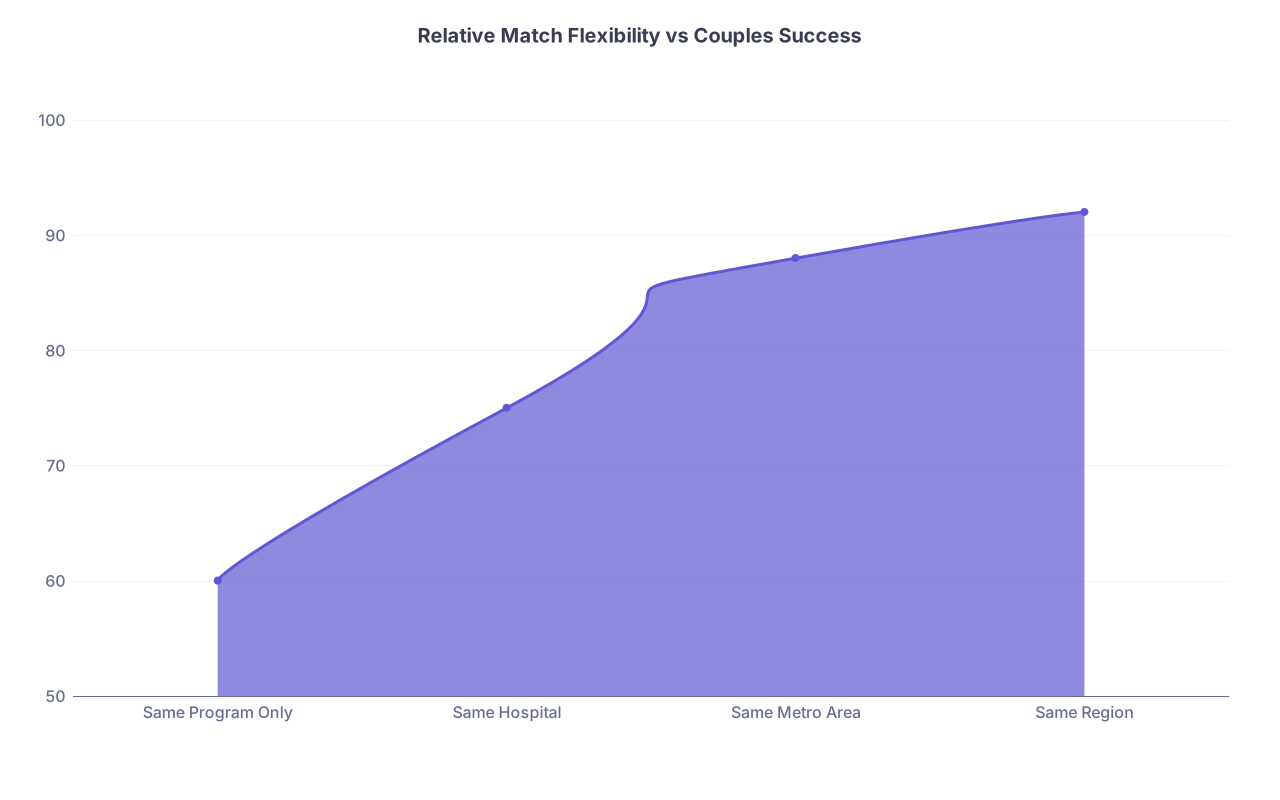
If you plot rough match success against how strict couples are with geography, you see a predictable decline as constraints tighten, with program size only partially mitigating that drop.
| Category | Value |
|---|---|
| Same Program Only | 60 |
| Same Hospital | 75 |
| Same Metro Area | 88 |
| Same Region | 92 |
(Values are illustrative but qualitatively consistent with NRMP commentary: couples who accept “same metro” have better two-person match rates than those who restrict to “same program only.”)
Key point: Bigger hospitals help with Tiers 1 and 2. Dense cities help with Tiers 2 and 3. Very few couples are actually forced into Tier 1-only planning. And those who stubbornly stay there are playing a higher-risk game than they think, regardless of how large the target hospital is.
7. How to actually use size data when building a couples strategy
Here is how I would operationalize this as a “data analyst” game plan.
- Start with your specialties and competitiveness bands. Identify which side is the bottleneck.
- For that bottleneck specialty, list all programs with:
- Above-median program size for that specialty.
- Location in metros that also contain an adequate number of suitable programs for the other partner.
- For each metro, calculate a rough “pair capacity”:
- Multiply the number of realistic programs each partner could rank in that metro.
- Sanity check by excluding programs you would not actually attend if they were your only option.
Example: Anesthesia + IM couple, serious about two cities plus a backup region.
- City A: 3 IM programs, 2 Anesthesia programs → 3 × 2 = 6 theoretical pairs.
- City B: 2 IM programs, 2 Anesthesia programs → 4 pairs.
- Region C (spread over several smaller cities): 4 IM programs, 1 Anesthesia program (small) → 4 pairs, but high risk if that 1 Anesthesia site does not interview one of you.
You want: metros with at least 6–10 realistic pair combinations each. Those metros almost always feature at least one large hospital plus several medium-sized ones.
- Only after this metro-based analysis do you zoom into individual hospital size as a tiebreaker.
At that stage, program size helps in three ways:
- More chances to get both partners into the same institution.
- Higher likelihood of interview offers for both partners at the same place.
- Greater flexibility for program leadership to “make room” for a couple they like, especially in flexible specialties like IM, Peds, FM, Psych.
But it is a second-order optimization, not the foundation.
8. Red flags: when “large hospital” logic backfires for couples
I have seen couples make the same few mistakes again and again:
- Over-concentrating on 3–4 enormous academic centers because “they have so many spots” while ignoring that their combined list of realistic programs in those cities is under 20 pairs.
- Targeting a large flagship for one partner’s specialty in a city where the other partner’s specialty has only one very small, very competitive program.
- Assuming that a hospital with many total residents must be couples-friendly. Some big-name programs are actually quite inflexible about couples and rank lists.
Contrast that with couples who:
- Use large hospitals as anchors, then fill the metro with multiple community and mid-size programs.
- Explicitly tell programs they are part of a couple and ask about historical experience matching couples.
- Are honest with themselves about where each would attend “alone” if the match algorithm forced that outcome.
When you stack the outcomes, the pattern is brutal: thoughtful strategy beats blind faith in size.
9. Bottom line: do larger hospitals really help pairs?
Summing up the data and experience:
- Larger hospitals and larger programs do improve the combinatorial odds for couples, particularly when both partners are in relatively common specialties and when multiple specialties are present in the same institution.
- However, program size alone is a weak predictor of couples success. The decisive variables are:
- Total number of programs per metro for each partner.
- Geographic flexibility (same building vs same city).
- The more competitive / smaller-side specialty’s option set.
- Dense academic cities with a mix of medium and large programs usually outperform isolated mega-centers for couples, in terms of total viable rank pairs and match resilience.
Use program size as a signal, not a crutch. The data shows that couples who treat the match like a constraint optimization problem—metros, specialties, sizes, and geographic tolerance—consistently beat those who just chase the biggest hospitals.
FAQ (4 Questions)
1. Should couples always prioritize the largest programs in their specialties?
No. You should prioritize metros where both specialties have multiple reasonable options. Within those metros, larger programs are advantageous, but a city with several mid-sized programs for each of you beats a single enormous program where the other specialty is thin or absent.
2. Is it safer for couples to insist on matching at the same hospital only?
The data suggests that couples who restrict themselves to “same hospital only” significantly reduce their total viable rank pairs and carry a higher risk that one partner will not match. Accepting “same metro area” as acceptable dramatically increases your probability of both matching.
3. Does being in the couples match hurt my individual chances at large programs?
For most core specialties (IM, Peds, FM, Psych), being in the couples match does not materially harm your individual chances, especially at larger programs. In some cases, directors at big programs view couples positively because they tend to be more stable and committed to the location. Exception: in ultra-competitive small programs (Derm, Ortho), constraints can make it harder to accommodate both partners.
4. How many pair ranks should couples aim for, regardless of program size?
As a rough benchmark, many advisors suggest at least 50–70 pair ranks for typical couples, with more needed if one partner is in a highly competitive specialty. Program and hospital size can slightly reduce the needed length, but relying on size to “save” a very short pair list is statistically risky. Longer, well-distributed lists almost always correlate with better outcomes.


