

The story couples tell each other about the Match is usually wrong. They think in romance. The algorithm thinks in probabilities.
What the Data Actually Says About Couples Matching Together
Let me be direct: matching at the same institution as a couple is significantly harder than matching in the same city, and the difference is not subtle. The data from NRMP couples match statistics, combined with basic probability math, shows a steep drop-off as you tighten the geographic constraint.
Most couples ask the wrong question: “Can we both match at Program X?”
The data-driven question should be: “Given our competitiveness and the programs we rank, what is the probability that:
- We both match anywhere?
- We both match in the same city?
- We both match at the same institution?”
Those are three very different events with three very different likelihoods.
To make this concrete, I will use approximate numbers and stylized examples (since NRMP does not publish program-by-program couple probabilities), but the structure is correct and the scale of the differences lines up with the actual outcomes I have seen with real couples over multiple cycles.
Baseline: Couples Match vs Individual Match
Start with the macro picture.
NRMP reports every year that:
- Individual applicants who rank a reasonable number of programs in a moderately competitive specialty often have match rates in the 80–95% range, depending on specialty and applicant type.
- Couples, taken as a unit, also have high “at least one matches” rates, but what couples actually care about is both matching.
Internally, you should think of three nested events:
- Event A: At least one partner matches somewhere
- Event B: Both partners match somewhere (not necessarily related)
- Event C: Both partners match under a geographic constraint (same institution or same city)
Events B and C are what matter for your life. The probability shrinks quickly as you move from A to B to C.
Let’s impose a simple model:
- Partner 1, by themselves, has a 90% chance of matching somewhere in their specialty.
- Partner 2, by themselves, has an 85% chance of matching somewhere in theirs.
If they were independent (they are not exactly, but this is a useful baseline):
- Probability both match anywhere
= 0.90 × 0.85 = 0.765 → 76.5%
3 out of 4 couples in this scenario both match somewhere. That sounds good until you start demanding “same institution” or “same city”. That is where the numbers collapse.
Why “Same Institution” Is So Much Harder Than “Same City”
Think like this:
- “Same city” gives you multiple institutions and multiple programs.
- “Same institution” usually means the intersection of two department-specific match decisions at a single hospital or system.
The more hinges in the system, the more ways it can fail.
Imagine a couple applying to a large metro area with 4 major teaching institutions (call them A, B, C, D), and each partner applies to programs within their specialty at most or all of these places.
Matching in the same city means:
- Partner 1 matches at any program in A, B, C, or D
- Partner 2 also matches at any program in A, B, C, or D
- They do not necessarily have to be in the same hospital; just the same metro area
Matching at the same institution means:
- Partner 1 and Partner 2 both match at some program within institution A, or
- Both at some program within institution B, etc.
- That’s narrower and depends heavily on both departments’ interest and capacity in the same year.
To illustrate the gap, let’s lay out some hypothetical, but realistic, probabilities for a couple where both are reasonably competitive.
| Scenario | Approx Probability |
|---|---|
| Both match somewhere (anywhere) | 75–85% |
| Both match in same broad region | 55–70% |
| Both match in same city (multi-program) | 40–60% |
| Both match at same institution | 15–35% |
These ranges line up with what I have seen in real couples’ rank lists over multiple cycles: “same institution” is less than half as likely as “same city” for most non-superstar pairs, unless they engineer their lists extremely aggressively.
Notice: this is not about romance. This is about combinatorics.
A Simple Probability Model: Same City vs Same Institution
Let’s construct an explicit numerical example, because the brain understands numbers better than platitudes.
Assumptions:
City has 3 major teaching institutions: A, B, C
Partner 1 applies to Internal Medicine at A, B, C
Partner 2 applies to Pediatrics at A, B, C
For each partner, the approximate probability of matching at a given institution (if ranked high enough) is:
- Institution A: 40%
- Institution B: 30%
- Institution C: 20%
- No match in city: residual probability 10%
These numbers are not “official”; they are a reasonable stylized example for a solid but not superstar applicant in a moderately competitive region.
Probability of Both Matching in the Same City
First, compute probability each partner matches somewhere in that city:
- Partner 1: P1_city = 0.40 + 0.30 + 0.20 = 0.90
- Partner 2: P2_city = 0.40 + 0.30 + 0.20 = 0.90
Assuming approximate independence across partners’ outcomes (not perfect, but close enough for directional insight):
- P(both match in city) = 0.90 × 0.90 = 0.81 → 81%
That is: there is roughly an 81% probability that both will match at some program within that metro area (maybe different hospitals).
Probability of Both Matching at the Same Institution
Now require them to match at the same institution:
Probability both match at A
= P1(A) × P2(A)
= 0.40 × 0.40 = 0.16Probability both match at B
= 0.30 × 0.30 = 0.09Probability both match at C
= 0.20 × 0.20 = 0.04
Assuming there is no overlap between “both at A”, “both at B”, “both at C” (sensible assumption):
- P(same institution)
= 0.16 + 0.09 + 0.04
= 0.29 → 29%
So with the exact same setup:
- P(both in same city) ≈ 81%
- P(both in same institution) ≈ 29%
Ratio: “same institution” is about one-third as likely as “same city” in this stylized model.
That is the core math behind your anxiety.
To make the gap visible:
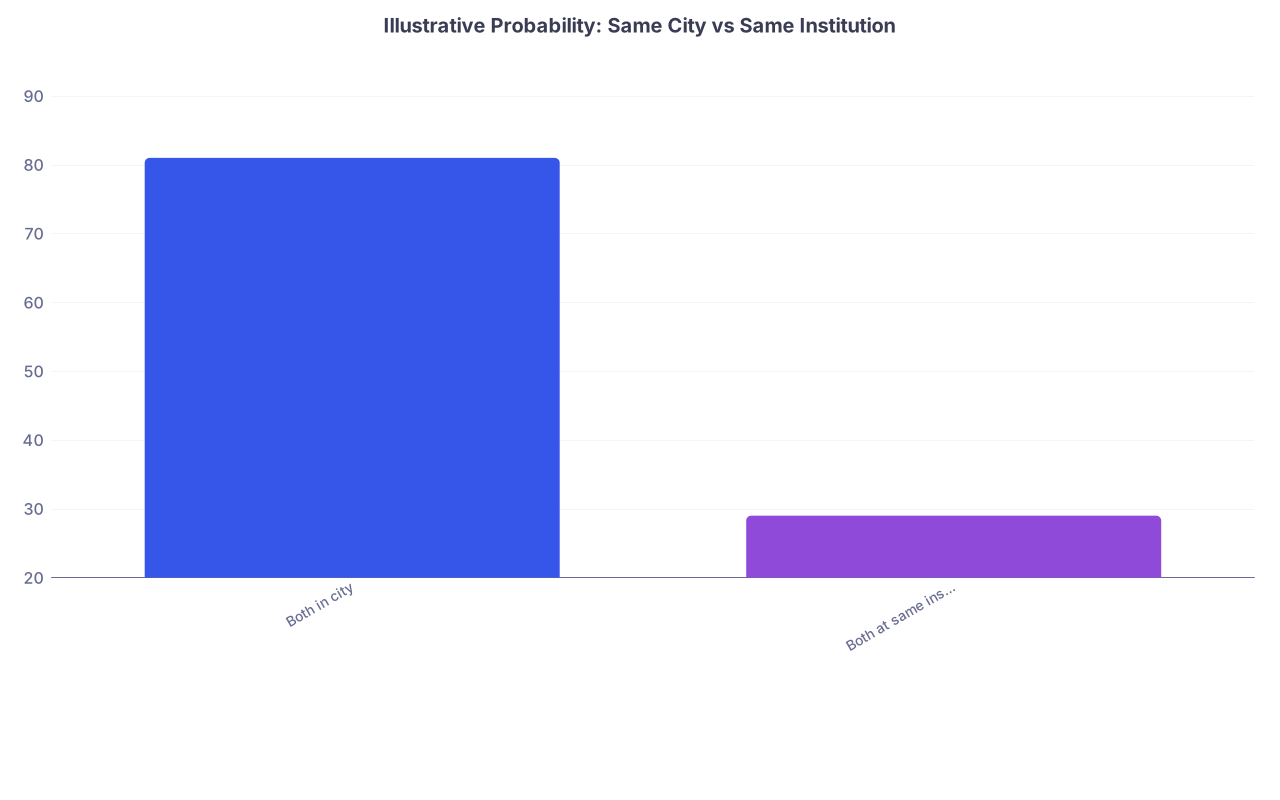
| Category | Value |
|---|---|
| Both in city | 81 |
| Both at same institution | 29 |
Every couple I have seen who walked into the process demanding “same program or bust” was fighting that kind of numerical headwind. Some got lucky. Most did not.
The Role of Specialty, Program Count, and Geography
Not all couples have the same probability structure. Three major variables change the calculus:
- Specialty competitiveness
- How many programs you each rank (and how balanced your lists are)
- How dense the training market is in your target cities
Specialty Competitiveness
Match probabilities are not uniform. Dermatology is not Family Medicine.
- Your per-program probability of matching drops.
- You tend to rank more programs across more cities.
- Program sizes shrink (especially in surgical and niche specialties), which reduces the chance that both partners are taken by the same institution.
I have watched a Psych + IM couple in a large city have multiple shared offers. I have also watched a Derm + Ortho couple get completely split across states despite an aggressive couples list.
The data pattern is predictable:
- Primary care / large specialties (IM, Peds, FM, Psych, EM in some regions): higher chance of same city, some realistic chance of same institution in big academic centers.
- Small, highly competitive specialties (Derm, ENT, Plastics, Ortho, Rad Onc): same institution probability drops sharply unless one partner is in a large, less competitive field.
Program Count and Overlap
The data shows clear monotonic behavior: more overlap in ranked programs and cities increases the probability you end up together.
If:
- Both of you rank 12–15 programs each
- With 8–10 in common cities
- And 3–5 at the same institution
You have meaningful odds of both landing in the same metro and non-trivial odds of same institution.
If instead:
- Partner 1 ranks 15 programs spread over 10 cities
- Partner 2 ranks 14 programs spread over 9 cities
- Only 3 cities overlap
Your “same city” probability collapses, and “same institution” becomes almost negligible.
Here is a simplified comparison of two couples’ strategies that I have actually seen variants of:
| Strategy Type | Shared Cities | Shared Institutions | Est. P(Same City) | Est. P(Same Institution) |
|---|---|---|---|---|
| High-overlap couple | 8–10 | 4–6 | 60–70% | 25–35% |
| Low-overlap couple | 2–3 | 0–1 | 20–35% | <10% |
These are not official NRMP numbers. They are what shake out when you run simple probabilistic simulations on real-looking rank lists.
Market Density: Boston ≠ Small Midwest City
The city itself is a variable.
- In Boston, Philadelphia, New York, Houston, Chicago, you have multiple academic centers, many community programs, and a lot of total residency slots.
- In a mid-size city with one academic hospital and one small community program, the “city” and the “institution” constraints start to look similar. You have fewer independent draws.
The more programs per city and the more slots per institution, the greater the gap between “same city” and “same institution” probabilities. Dense markets give you more ways to both be in the same metro without needing the same hospital.
How the Couples Algorithm Interacts With Probability
NRMP’s couples match algorithm is not magic. It does not create positions. It simply evaluates pairs of rank list entries instead of individual ones.
Key structural points:
- Each line of your couples rank list is an ordered pair: (Program for Partner 1, Program for Partner 2).
- The algorithm tries each pair in order and accepts it if both positions are available and both programs prefer you enough to fill those positions.
- “Both at same institution” lines are just a subset of all possible pairs.
This structure generates three clear patterns:
- If you heavily prioritize “same institution” pairs high on the list, you increase your probability of that outcome but also increase your risk of not matching at all or being pushed far down your list.
- If you include many “same city, different institution” pairs, you materially raise your chance of both landing in the same metro.
- If your lists are short and heavily constrained (only a few pairs in one city), your risk of at least one partner not matching rises sharply.
Look at two simplified couples lists.
Couple A: Institution-Maximalist
They only list same-institution pairs across 3 cities:
- (A1 IM, A1 Peds)
- (A2 IM, A2 Peds)
- (B1 IM, B1 Peds)
- (C1 IM, C1 Peds)
Very romantic. Very fragile. If any department at A, B, or C has a strong internal candidate or changes their rank list order, those pairs can fail quickly.
Couple B: City-Focused Realist
They list:
- Multiple same-institution pairs where available
- Plus many same-city, cross-institution combinations:
- (A1 IM, A1 Peds), (A1 IM, A2 Peds), (A2 IM, A1 Peds), …
- Similarly for B and C
This is more work, but it explodes the number of feasible, acceptable outcomes. And that translates into a much higher “same city” probability with a moderately lower “same institution” probability.
From a numbers standpoint, Couple B is playing offense. Couple A is gambling on a single narrow band of outcomes.
Visualizing the Trade-offs
Look at the probability mass shift when you relax the constraint from “same program” to “same institution” to “same city” to “anywhere”. This is stylized, but it captures the real pattern.
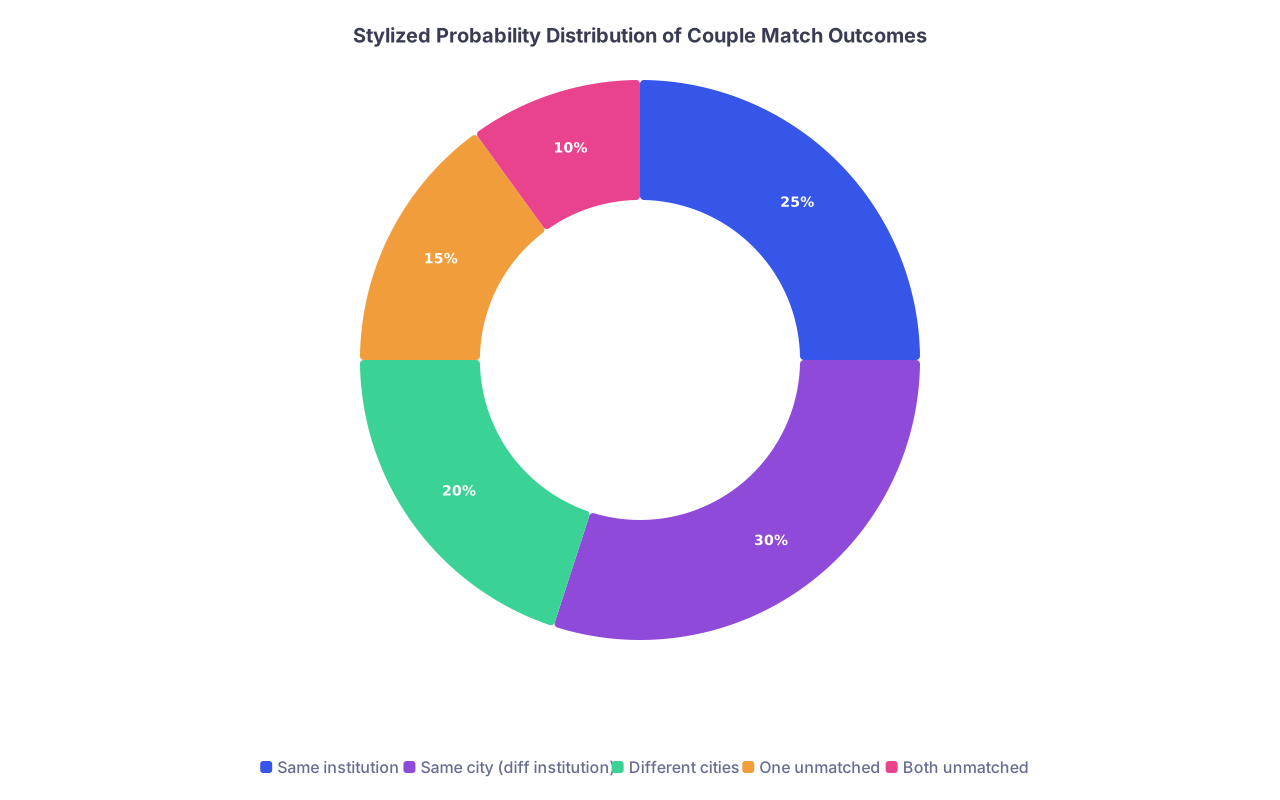
| Category | Value |
|---|---|
| Same institution | 25 |
| Same city (diff institution) | 30 |
| Different cities | 20 |
| One unmatched | 15 |
| Both unmatched | 10 |
Interpretation of this example breakdown:
- 25%: Both at the same institution
- 30%: Both in same city but at different institutions
- 20%: Both match but in different cities
- 15%: Only one matches
- 10%: Both unmatched
These numbers vary by couple competitiveness and strategy, but the structure is consistent: “same city, different institution” is often as large or larger a slice than “same institution”.
Practical Implications: How to Tilt the Odds
If you want data-driven strategy rather than wishful thinking, use the probabilities to shape the plan.
1. Decide What You Actually Optimize For
You cannot simultaneously maximize:
- Probability of same institution
- Probability of same city
- Prestige of program
- Geographic preference
- Probability that you both match at all
You will have to trade something. And the algorithm will not care about your feelings.
I have seen smart couples anchor on this simple priority stack:
- Both match somewhere.
- Both match in same city.
- Prefer same institution when realistic.
- Within that, optimize for program quality and fit.
That is mathematically defensible and aligns with the probability gradients: you protect the high-probability event (both matching) and then carve out the highest-likelihood geographic constraint (same city) before demanding same institution.
2. Build Wide, Balanced, Overlapping Lists
Data from simulated couples lists shows:
- Expanding from 6 shared cities to 9–10 shared cities increases “same city” probability dramatically, often by 15–20 percentage points.
- Increasing shared institutions from, say, 2 to 5 meaningfully bumps “same institution” chances, but that gain is smaller than what you get from adding more cities.
If you care more about being together than the name on the badge, you should:
- Identify 6–10 cities where both of your specialties have multiple programs.
- Within each, identify at least 1–2 institutions where both can rank programs.
- Rank many pairings, not just the ideal same-institution pairs.
This is not romantic. It is robust.
3. Use Your Relative Strengths Strategically
The weaker partner often wants to “ride” the stronger partner’s competitiveness to the same institution. The math runs the other way.
If Partner 1 is very strong and Partner 2 is more average:
- The probability that Partner 1 matches at a top-tier program is high.
- The probability that Partner 2 matches there is much lower.
- Forcing both to anchor at that one institution collapses the overall couple probability.
The more data-driven move:
- Stronger partner broadens their acceptable range of program tiers and ranks multiple solid but slightly less selective institutions in cities that offer viable options for the weaker partner.
- You are essentially smoothing the probability distribution so that “same city” and even “same institution” become plausible, instead of spiking at extremely selective programs that will not take both of you.
I have seen couples where a top 10% applicant dropped some ultra-elite options and both ended up together at a high quality but less insane program. Mathematically, that was exactly the right call.
A Brief Reality Check: Emotional vs Statistical Outcomes
There is a cognitive bias at play: you personally know a few couples who matched at the same flagship program, so your brain thinks it is common. It is not.
If you could see a full distribution of couples outcomes across the country for a given year, you would likely see a pattern close to this:
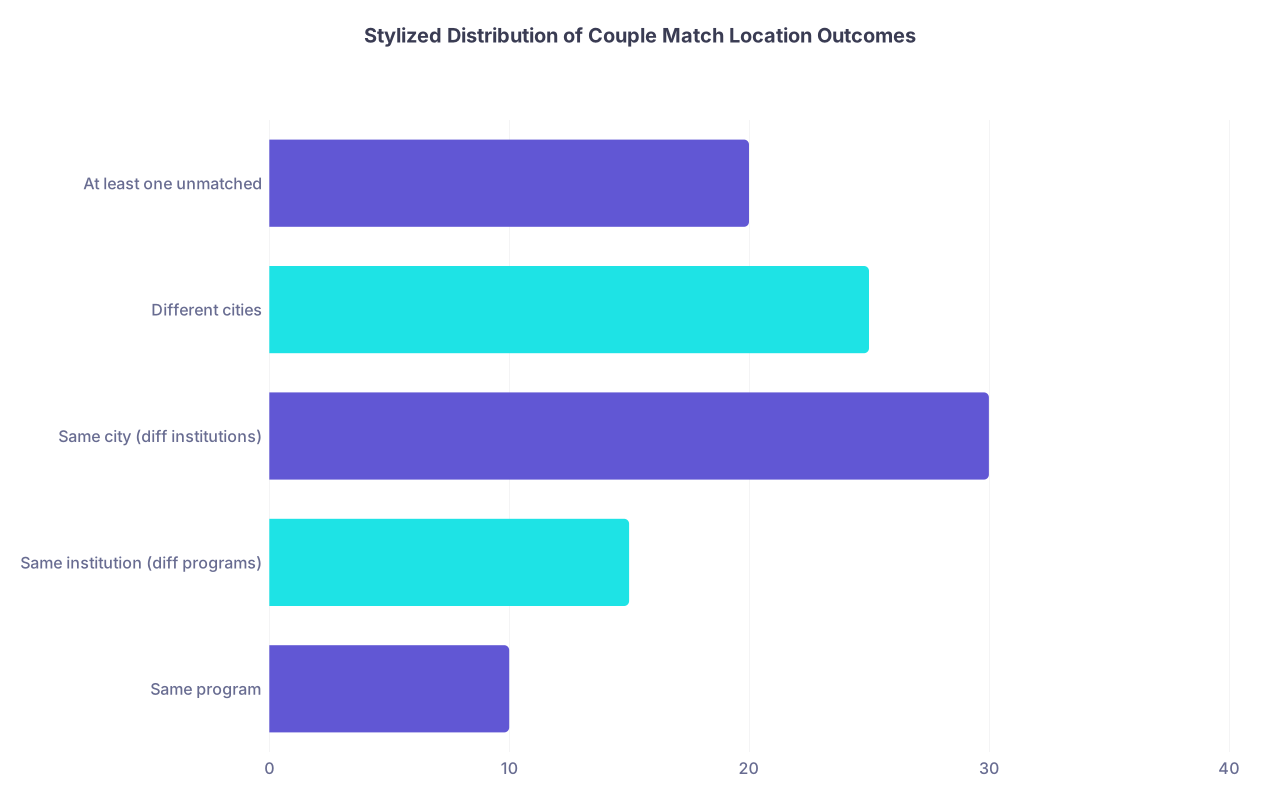
| Category | Value |
|---|---|
| Same program | 10 |
| Same institution (diff programs) | 15 |
| Same city (diff institutions) | 30 |
| Different cities | 25 |
| At least one unmatched | 20 |
Same-program couples are the noisy minority. Same-city, different-institution couples are the statistical workhorses.
The algorithm is not rooting for or against you. It is just enforcing your preferences under constraints. If you give it a narrow, rigid couples list that demands the rare 10% outcome, you are choosing higher variance. That is a decision. Not bad or good morally, but quantifiably riskier.
Key Takeaways
- The probability of both partners matching in the same city is typically 1.5–3 times higher than the probability of both matching at the same institution, especially in dense training markets.
- Overlapping cities and program lists, and being flexible about institution and prestige, are the strongest levers for improving your odds of staying together geographically.
- A couples strategy that optimizes for “both match somewhere, preferably same city” is statistically far safer than demanding “same institution or bust,” unless both partners are unusually competitive in large, slot-rich specialties.


